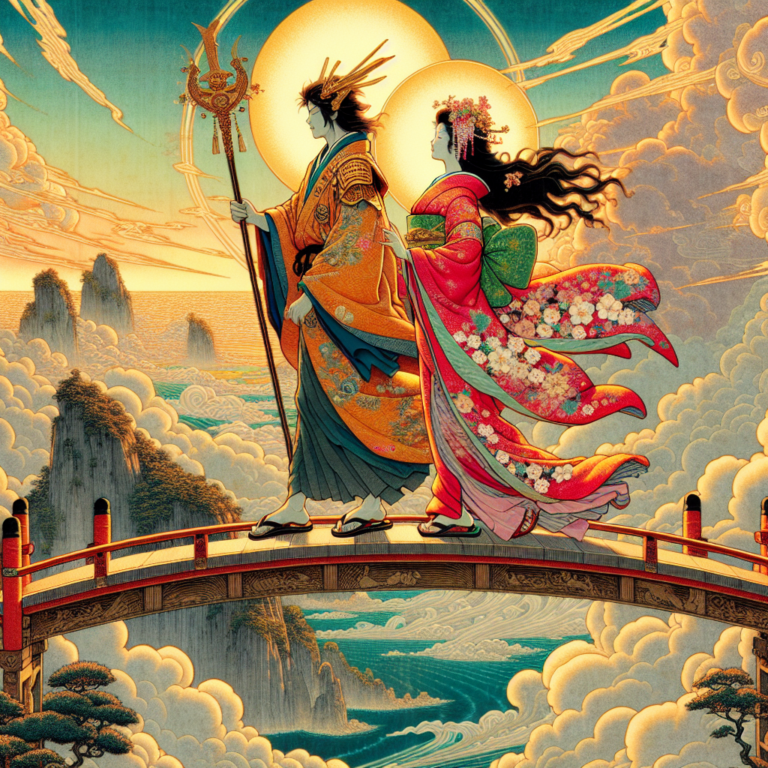
‘The Courtship of Izanagi and Izanami: A Shinto Creation Story’ is an educational moral story perfect for bedtime reading with children ages 6-12.
In the beginning, before the islands of Japan existed, before mountains rose or rivers flowed, there was only the void—a swirling chaos where heaven and earth were not yet separated. From this chaos, the first gods came into being, and they set about creating order from disorder.
Among these primordial deities were Izanagi-no-Mikoto (The Male Who Invites) and Izanami-no-Mikoto (The Female Who Invites). These two kami stood together on the Floating Bridge of Heaven, looking down at the churning ocean of chaos below.
“We must give form to this shapeless world,” said Izanagi, his voice deep as thunder.
“Yes,” agreed Izanami, her voice clear as mountain water. “Let us create land where beings can dwell.”
The elder gods gave them a jeweled spear called Ame-no-nuboko, the Heavenly Jeweled Spear. Together, Izanagi and Izanami thrust this spear down into the swirling waters below and stirred the brine with a divine churning motion.
Round and round they stirred, and when they lifted the spear, drops of salty water fell from its tip back into the sea. These drops piled up and solidified, forming the first island—Onogoro-shima, the Self-Curdling Island.
“Let us descend to this island,” Izanagi said. “We will make it our dwelling place and continue the work of creation.”
And so the two kami descended from the Floating Bridge of Heaven to stand upon the new-made land. It was a small island, but it was firm and real—the first solid ground in all of existence.
Upon Onogoro Island, Izanagi and Izanami erected a great pillar called the Heavenly August Pillar, and around it they built a palace with eight arms stretching outward. This would be the sacred center of creation.
Izanagi looked at Izanami and noticed how different they were—and yet how perfect for completing the work of creation together. “How is your body formed?” he asked.
“My body is completely formed,” Izanami replied, “except for one part that is not fully grown.”
“My body is completely formed,” said Izanagi, “and there is one part that has grown in excess. I think it would be good if we joined the part of my body that has grown in excess with the part of your body that is not fully grown, and thereby create more lands.”
“That is a good idea,” Izanami agreed.
Then Izanagi said, “Let us walk around this Heavenly Pillar and meet on the other side. When we meet, we will become united and create new lands together.”
They agreed to this ritual. “You walk around from the right,” Izanagi said to Izanami, “and I will walk around from the left.”
So they began to walk in opposite directions around the great pillar. When they met on the far side, Izanami spoke first: “Oh, what a beautiful and excellent young man you are!”
After her, Izanagi spoke: “Oh, what a beautiful and excellent young maiden you are!”
Then they joined together in divine union. From this union, Izanami gave birth to their first child. But something was wrong. The child that was born was soft and malformed—a boneless, leech-like being. They named this unfortunate child Hiruko (the Leech Child). Despite their love for it, they knew it could not remain on the sacred island. With heavy hearts, they placed Hiruko in a boat made of reeds and set it adrift upon the sea.
Their second child was born next—the island of Awa, the Foam Island. But this too was not properly formed and was not counted among their successful offspring.
Troubled by these failures, Izanagi and Izanami ascended back to heaven to consult with the elder gods. They asked, “Why were our children not properly formed?”
The elder gods performed a divination, examining the cracks in the shell of a sacred tortoise. When they read the patterns, they understood the problem.


“The failure occurred because the female spoke first,” the gods declared. “In the ritual of creation, it is the male who must speak first. Return and perform the ritual again, this time in the proper order.”
Izanagi and Izanami descended once more to Onogoro Island. They stood before the Heavenly Pillar and prepared to walk around it again.
“This time I will speak first,” Izanagi said.
Again they walked in opposite directions around the pillar. When they met on the far side, this time Izanagi spoke first: “Oh, what a beautiful and excellent young maiden you are!”
Then Izanami responded: “Oh, what a beautiful and excellent young man you are!”
They joined together again, and this time their union was blessed. Izanami gave birth to the islands of Japan, one after another—each island coming into being through their sacred creativity.
First came Awaji Island, which means “the Road to Awa.” Then came Shikoku, the four provinces. Next was Oki Island, followed by Kyushu, the nine provinces. Then Iki Island appeared, and Tsushima Island. Then came Sado Island, and finally the great island of Honshu, called Oyamato-Toyo-aki-tsu-shima—the Great-Yamato-Abundant-Autumn-Dragon-fly Island.
These eight islands formed Oyashima-Kuni, the Land of Eight Great Islands—what we now call Japan.
But Izanagi and Izanami did not stop there. After creating the islands, they went on to create the kami who would govern the natural world. Izanami gave birth to gods of the sea and rivers, gods of mountains and valleys, gods of plains and vegetation. She gave birth to the kami of wind and trees, of mist and valleys.
Each birth brought new beauty to the world. The god of the wind filled the air with gentle breezes. The god of trees covered the mountains with forests. The god of mountains raised peaks that touched the clouds. The goddess of rivers carved channels through the land and filled them with pure water.
Last of all, Izanami gave birth to the fire god, Kagutsuchi. But this birth was different—terrible and tragic. The fire god burned so hot that his birth burned Izanami terribly. She fell ill from her injuries, suffering in great pain.
Even in her suffering, she continued to create. From her vomit came the gods of metal and mountains. From her other effluents came the goddess of clay and the goddess of water. But despite all this creative power, she could not heal herself.
Finally, after days of agony, the goddess Izanami died—the first death in all of creation. Izanagi was heartbroken. He wept over her body, and his tears became kami too. He took his beloved wife and buried her on Mount Hiba, on the border between the lands of Izumo and Hoki.
In his grief and rage, Izanagi drew his sword and struck off the head of Kagutsuchi, the fire god whose birth had killed his beloved Izanami. From the blood and body of the fire god, eight more kami of volcanoes and mountains came into being. But no amount of new creation could fill the emptiness in Izanagi’s heart.
The world had been made beautiful—Japan’s islands stretched across the sea, mountains and rivers adorned the land, forests and fields teemed with life. But the joy had gone out of creation, for Izanami, who had helped bring it all into being, would not walk in this beautiful world again.
Or so it seemed. But Izanagi could not accept this loss. What happened next—his journey to the underworld to find Izanami and the terrible consequences of that journey—that is another story, one that explains why life and death are forever separated in our world.
But the story of Izanagi and Izanami’s creation of Japan is remembered and honored still. The sacred places where they worked their creation—the Heavenly Pillar, Onogoro Island—remain holy sites in Shinto tradition. When Japanese people see the beauty of their islands—the mountains rising majestically, the rivers flowing pure and clear, the forests clothing the hills—they remember the two kami who brought all this into being through their divine partnership.
The tale teaches us about the sacredness of creation, the importance of proper ritual and order, and the truth that even the gods experience love and loss. It reminds us that the land itself is divine, born from the union of male and female divine principles, and that we who walk upon these islands are walking on ground that was made sacred by the first creators.
To this day, Shinto shrines across Japan honor Izanagi and Izanami as the progenitors of the islands and the ancestors of the Japanese people. Their story is not just mythology—it is the sacred history of how the land of Japan came to be.
Moral Lessons
- Creation requires partnership, proper order, and sacred attention to ritual. The land itself is sacred, born from divine love and sacrifice. From the cooperation of complementary forces, great beauty and life can emerge.
Test Your Understanding
1. What magical tool did the elder gods give Izanagi and Izanami to create the first land?
Frequently Asked Questions
What is the moral lesson of The Courtship of Izanagi and Izanami: A Shinto Creation Story?
What age is this story appropriate for?
How long does it take to read The Courtship of Izanagi and Izanami: A Shinto Creation Story?
What culture does this story come from?
Can I use this story for teaching?
Frequently Asked Questions
What is the Shinto creation story of Izanagi and Izanami about?
The Shinto creation story of Izanagi and Izanami tells how two divine gods, standing on the Floating Bridge of Heaven, used a magical jeweled spear to stir the ocean of chaos and create the islands of Japan. It explores themes of partnership, balance, and bringing order to a formless world.
Who are Izanagi and Izanami in Japanese mythology?
Izanagi and Izanami are primordial creator deities in Shinto mythology. Their names mean ‘The Male Who Invites’ and ‘The Female Who Invites.’ Together, they are considered the gods responsible for creating the Japanese islands and giving birth to many other important kami, or divine spirits.
Is the Izanagi and Izanami story appropriate for young children?
Yes, this retelling of the Izanagi and Izanami Shinto creation story is written for children ages 6 to 12 and works well as a bedtime story. It uses clear, engaging language to introduce kids to Japanese mythology while teaching moral lessons about cooperation and responsibility.
📚 Recommended Books
Handpicked for readers like you
As an Amazon Associate, we earn from qualifying purchases. These recommendations are personalized based on this story's themes and your reading history.
What is the Floating Bridge of Heaven in Japanese mythology?
The Floating Bridge of Heaven, known as Ame-no-ukihashi, is a mythical bridge in Shinto belief from which the gods Izanagi and Izanami looked down upon the primordial ocean. It represents the boundary between the heavens and the unformed earth before creation began.
What moral lessons does the Izanagi and Izanami creation story teach kids?
The story teaches children the value of teamwork, balance between opposites, and taking responsibility for the world around them. By working together with purpose and respect, Izanagi and Izanami transform chaos into something beautiful, encouraging young readers to approach challenges collaboratively.