

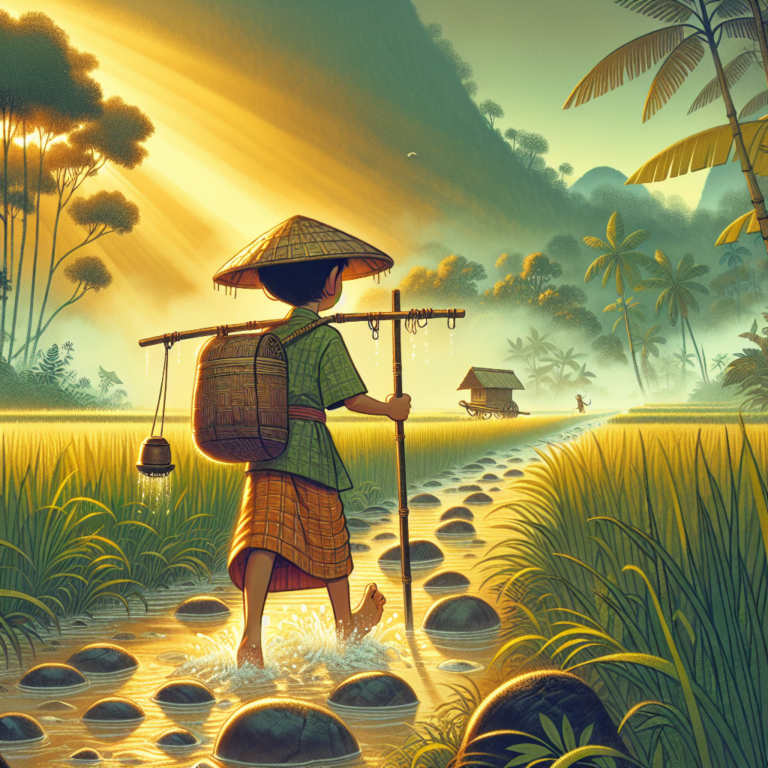
‘Kip’s Journey to the Whispering Temple of Wisdom’ is an educational moral story perfect for bedtime reading with children ages 6-12.
Chapter 1: The Boy Who Collected Questions
In a small village where emerald rice paddies stretched to the horizon and water buffalo moved slowly through morning mist, there lived a boy named Kip. He was twelve years old, with curious eyes and a notebook that he carried everywhere – filled not with answers, but with questions.
“Why do the fireflies light up at night?”
“Where does the wind go when it stops blowing?”
“How do the monks know things that nobody taught them?”
Kip’s father, a rice farmer with hands calloused from honest work, would laugh gently at his son’s endless curiosity. “Some questions have answers that can be explained. Some questions have answers that must be experienced. And some questions are doorways – they don’t lead to answers, but to bigger questions still.”
“How do I know which is which?” Kip asked.
His father smiled mysteriously. “That is perhaps the best question of all.”
Kip’s mother, who wore flowers in her hair and knew the names of every plant in their garden, had a different response. “There is a temple beyond the seven hills,” she said softly one evening. “They say a spirit lives there – a wise being who can answer any question asked with a sincere heart. Perhaps one day, when you are ready, you will make that journey.”
From that moment, Kip thought of little else.
Chapter 2: The Path Through the Fields
On the morning of his thirteenth birthday, Kip told his parents he was ready.
His father gave him a walking stick carved from bamboo. His mother gave him rice cakes wrapped in banana leaves. His grandmother, who had said nothing about his quest until now, pressed something into his palm – a single lotus seed.
“Plant this at the temple,” she said, her ancient eyes twinkling. “And listen to what it teaches you.”
The journey began easily enough. Kip walked through the familiar fields of his village, waving to neighbors who called out blessings for his travels. The path wound past the old stupa where villagers made offerings, past the banyan tree where spirits were said to rest during the heat of the day.
But as the village disappeared behind him and the first hill rose before him, Kip felt suddenly small. The world was vast. His questions seemed to shrink to insignificance against the enormity of the sky.
“I am one small boy,” he whispered to himself. “Why would a wise spirit bother to speak with me?”
As if in answer, a butterfly landed on his shoulder – bright orange and black, its wings like painted silk. It stayed there as Kip climbed, keeping him company until he reached the top of the first hill. Then it flew away toward the distant temple, as if showing him the way.
Chapter 3: The Three Teachers
By the third day, Kip had climbed four hills and his rice cakes were running low. He sat by a stream to rest, dangling his tired feet in the cool water.
“Where are you going, young traveler?” a voice asked.
Kip looked up to see an old woman gathering herbs by the riverbank. Her back was bent, her hands gnarled, but her eyes were bright as morning stars.
“To the Whispering Temple, grandmother,” Kip replied respectfully.
“Ah, to seek the spirit’s wisdom. Tell me, what is the most important question you hope to ask?”
Kip thought carefully. “I want to ask how to be wise.”
The old woman cackled. “A good question! But I will save you some time. I am not as wise as the temple spirit, but I have learned one thing in my many years. Would you like to hear it?”
“Yes, please, grandmother.”
“Wisdom does not come from knowing the right answers. It comes from asking the right questions. A foolish person thinks they already know. A wise person knows they are always learning.” She pressed a small bundle of herbs into his hands. “Tea, for your journey. Remember what I told you.”
On the fifth hill, Kip met a young monk walking in the opposite direction, his orange robes bright against the green forest.
“Brother monk,” Kip asked after they had exchanged greetings, “what is the secret to finding peace?”
The monk smiled. “You ask large questions, little one. But here is something I have discovered. Peace is not found by avoiding difficulty. Peace is found by meeting each moment fully, whether it brings joy or sorrow. The present moment is the only place we ever truly are. If we can be at peace here, now, we can be at peace anywhere, always.”
He bowed and continued on his way, leaving Kip to ponder his words.
On the sixth hill, Kip encountered a farmer trying to free his ox from a muddy ditch. Without being asked, Kip set down his things and helped push, straining until both boy and farmer were covered in mud but the ox was free.
“You didn’t have to help,” the farmer said, wiping his face. “You have your own journey to make.”
“Helping you was part of my journey,” Kip replied, surprising himself with his own words.
The farmer nodded slowly. “You are learning already, young traveler. Let me tell you something my grandfather told me. The wisdom you seek is not at the end of your journey – it is the journey itself. Every step, every person you meet, every choice you make – these are all your teachers. The temple is important, yes. But do not think that wisdom waits only there.”
Chapter 4: The Whispering Temple
On the seventh day, Kip climbed the seventh hill and finally saw his destination. The temple rose from a sea of rice paddies, its white marble walls gleaming in the afternoon sun, its spires reaching toward heaven like prayers made solid. Lotus flowers bloomed in the pools surrounding it, their pink and white petals reflected in still water.
As Kip approached, he heard it – a sound like wind through bamboo, like water over stones, like leaves rustling and insects humming and all the quiet sounds of nature woven together into something almost like speech.
The whispering.
He climbed the temple steps slowly, reverently. At the top, in a courtyard open to the sky, he found… no one. The temple seemed empty.
“Hello?” Kip called, his voice echoing off ancient walls. “I have traveled far to ask my questions. Is anyone here?”
The whispering intensified. And then, from everywhere and nowhere at once, a voice spoke – or rather, many voices speaking as one, gentle as a breeze and vast as the sky.
“We are here, young seeker. We have always been here. We will always be here. Ask your questions.”
Chapter 5: The Questions and the Answers
Kip’s mind raced. He had collected so many questions over the years. Where should he begin?
“Honored spirit,” he said, remembering his grandmother’s lotus seed, “first, may I plant this? My grandmother asked me to.”
“You may.”
Kip found a patch of soft earth near one of the lotus pools. He dug a small hole with his fingers and placed the seed inside, covering it gently.
“Now,” he said, straightening up, “I would like to ask… how can I become wise?”
The whispering seemed to laugh – not mockingly, but with genuine delight.
“You have already begun to answer that question yourself. On your journey, what did you learn?”
Kip thought back. “The old woman told me that wisdom comes from asking questions, not knowing answers. The monk told me that peace comes from being present in each moment. The farmer told me that the journey itself is the teacher.”
“And do you believe these things?”
“I… I’m starting to. But I’m not sure I understand them completely.”
“That is perfect,” the voice whispered. “Understanding grows slowly, like a lotus seed becomes a flower. The moment you think you understand completely is the moment you have stopped learning.”
Kip had more questions. “What is the purpose of life?”
“To grow. To learn. To love. To help others grow and learn and love. Beyond that, each person must discover their own specific purpose through living.”
“How do I know if I’m making the right choices?”
“Ask yourself: Does this choice cause harm? Does this choice help me grow? Does this choice move me toward who I want to become? If you answer honestly, the right path usually becomes clear.”
“Is there life after death?”
“There is continuity beyond what the eye can see. Whether you call it rebirth, or energy transformation, or returning to the source – life does not end, it changes. But do not spend so much time wondering about death that you forget to live.”
Chapter 6: The Deepest Question
The questions flowed, and with each one, Kip felt something shifting inside him. It was as if windows were opening in a room that had been too dark, letting in light.
Finally, he asked the question that had been hiding beneath all the others.
“Honored spirit… why do bad things happen to good people? My grandmother’s husband – my grandfather – he was the kindest man in our village, and he died young. My friend’s family lost everything in a flood, and they had never harmed anyone. It doesn’t seem fair.”
The whispering grew softer, gentler.
“This is perhaps the oldest and hardest question of all. We will not pretend to answer it completely – that would be a lie. But we will tell you what we know.”
The voice seemed to gather itself.
“The world is not designed to reward goodness with ease, or punish badness with suffering. It is more complex than that. Rain falls on the just and the unjust alike. Sometimes kind people suffer. Sometimes cruel people prosper. This is simply the nature of an interconnected world where countless causes lead to countless effects.
But this is also true: good actions, even when they do not prevent suffering, create ripples of goodness that spread in ways we cannot always see. Your grandfather’s kindness still lives in the people he touched. Your friend’s family, in their suffering, may have received help that showed them the compassion of others.
The question is not why bad things happen – the question is what we do with them when they happen. Do we become bitter, or do we become wiser? Do we close ourselves off, or do we open ourselves wider? Suffering can destroy us, or it can teach us. The choice, young seeker, is always ours.”
Chapter 7: The Return Home
Kip stayed at the temple for three days and three nights, asking questions, listening to answers, and sitting in silence when there were no more words. On the morning of the fourth day, he rose to leave.
“Thank you, honored spirit,” he said. “I came seeking answers, and you have given me something better – you have given me better questions.”
“Before you go,” the whispering said, “look at what you planted.”
Kip walked to where he had buried the lotus seed. To his amazement, a green shoot had pushed through the soil – impossibly fast, impossibly bright. As he watched, it grew before his eyes, unfurling leaves, rising toward the light.
“How is this possible?” he breathed.
“Time moves differently when we are truly present. You have been here longer than you think, young seeker – not in days, but in growth. This lotus is you. It will bloom when you are ready, no sooner and no later. Return to visit it when you can.”
The journey home seemed shorter than the journey out. Kip walked with lighter steps, seeing the hills and fields with new eyes. Everything seemed more vivid, more alive, more worthy of attention.
When he reached his village, his parents were waiting at the edge of the rice paddies.
“Our son has returned!” his mother cried, embracing him.
“And he looks different,” his father observed, studying Kip’s face. “Tell us – did you find your answers?”
Kip smiled, and the smile held depths it had not held before.
“I found something better than answers,” he said. “I found the courage to keep asking. I found that wisdom isn’t a destination but a direction. And I found that every person I meet, every moment I experience, is a teacher – if I have the humility to learn.”
His grandmother nodded from the doorway, her ancient eyes understanding.
“And the lotus seed?” she asked.
“It’s growing, grandmother. Just like me.”
Chapter 8: The Continuing Journey
Years passed. Kip grew into a man who was known throughout the region for his gentle wisdom and his willingness to listen. People came to him with their troubles and their questions, and he would sit with them, never pretending to have all the answers, but always helping them find their own way forward.
Sometimes, visitors would ask him about the Whispering Temple.
“Is it real?” they would ask. “Does a spirit truly live there?”
And Kip would smile, the same mysterious smile his father had once smiled at him.
“The temple is real,” he would say. “I have seen the lotus I planted there, now blooming beautifully. Whether the voice belongs to a spirit or to the wisdom of countless seekers accumulated over centuries or to something within ourselves that we can only hear when we are truly ready – that, I cannot say for certain.”
“Did the spirit give you the secrets of life?”
“The spirit reminded me of what I already knew but had forgotten: that asking is more important than knowing, that the journey is more important than the destination, that helping others is part of helping ourselves, and that peace is found not in escaping life but in embracing it fully, moment by moment.”
And then, if the visitor seemed ready, Kip would say: “Perhaps one day you should make the journey yourself. The path begins right outside this door. It winds through seven hills, but the real distance is not measured in steps. It is measured in how open your heart becomes along the way.”
And with that, another seeker would set off, notebook in hand, full of questions – which is exactly as it should be.
Moral Lessons
- Wisdom is not a destination to reach but a journey of continuous learning and growth. The answers we seek are often discovered along the path itself, through the people we help and the experiences we embrace. True understanding comes not from having all the answers but from maintaining the humility and curiosity to keep asking meaningful questions.
Test Your Understanding
1Who is Kip in the story?
Frequently Asked Questions
What is the moral lesson of Kip’s Journey to the Whispering Temple of Wisdom?
What age is this story appropriate for?
How long does it take to read Kip’s Journey to the Whispering Temple of Wisdom?
What culture does this story come from?
Can I use this story for teaching?
Frequently Asked Questions
What is Kip’s Journey to the Whispering Temple of Wisdom about?
Kip’s Journey to the Whispering Temple of Wisdom is a children’s moral story about a curious 12-year-old boy named Kip who lives in a small village and embarks on a quest for knowledge. It explores themes of curiosity, wisdom, and self-discovery, making it an ideal bedtime story for children ages 6-12.
What age group is this story suitable for?
This story is perfectly suited for children ages 6 to 12. It works wonderfully as a bedtime read-aloud for younger kids or an independent read for older ones. The gentle moral lessons and adventure elements keep children engaged while encouraging thoughtful questions about the world around them.
What moral lessons does Kip’s Journey to the Whispering Temple of Wisdom teach?
The story teaches children the value of curiosity, the courage to seek knowledge, and the understanding that some questions lead to bigger, more meaningful questions rather than simple answers. It encourages kids to embrace wonder and see questioning as a strength rather than a weakness.
📚 Recommended Books
Handpicked for readers like you
As an Amazon Associate, we earn from qualifying purchases. These recommendations are personalized based on this story's themes and your reading history.
Is this story good for bedtime reading with kids?
Yes, it’s an excellent bedtime story! The calm, descriptive setting of a village with rice paddies and morning mist creates a soothing atmosphere. The relatable main character and gentle life lessons make it a meaningful read that sparks great conversations between parents and children before sleep.
Who are the main characters in this children’s story?
The main character is Kip, a 12-year-old boy with boundless curiosity who carries a notebook full of questions. His supportive father, a hardworking rice farmer, and his mother also play key roles. Together they help set Kip on his journey toward wisdom and deeper understanding.
