

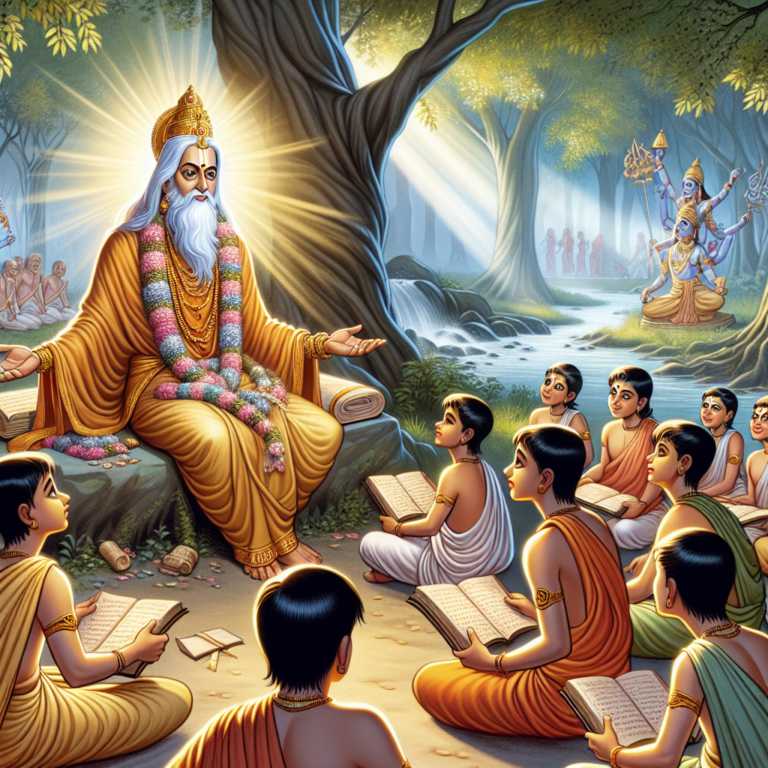
This moral story for children ages 6-12 combines entertainment with important values.
Chapter 1: The Boy Who Could Not Be Still
In the ancient city of Varanasi, where the sacred Ganges River flowed like a ribbon of silver through temples and ghats, there lived a boy who could not sit still. His name was Arun, and his mind was like a monkey swinging from thought to thought, never resting, never quiet.
While other students at the gurukula sat peacefully in meditation, Arun fidgeted. While others listened calmly to their teachers, Arun’s eyes wandered to the birds outside, to the clouds drifting past, to the ants marching in their endless lines.
“You have a brilliant mind,” his teacher, a patient old brahmin named Guru Vishwas, told him. “But a brilliant mind that cannot be controlled is like a powerful horse with no rider – it will run wild and take you nowhere useful.”
“I try, Guruji,” Arun said miserably. “I try to be still. But my thoughts won’t stop. They’re like a river that never stops flowing.”
Guru Vishwas smiled gently. “There is a sage who lives in the hills beyond the city. His name is Patanjali, and he has devoted his life to understanding the mind. Perhaps he can help you where I cannot.”
Chapter 2: The Sage of the Serpents
The next morning, Arun set off into the hills. The path wound through forests of sandalwood and teak, past waterfalls that sang ancient songs, up slopes where wild peacocks displayed their feathers like living jewels.
After three days of walking, Arun came to a simple ashram nestled in a valley so peaceful that even the wind seemed to whisper rather than blow. There, seated beneath a spreading banyan tree, he found Patanjali.
The sage was unlike anyone Arun had ever seen. He sat absolutely still, his legs folded beneath him, his back straight as a temple pillar. But most remarkable was this: he seemed to radiate peace the way a lamp radiates light. Being near him, Arun felt his own racing thoughts begin to slow.
“So,” Patanjali said without opening his eyes, “you are the boy whose mind is like a wild monkey.”
Arun startled. “How did you know, Master?”
Now Patanjali’s eyes opened, dark and deep as still pools. “I was once like you. My mind would not rest. I was tormented by endless thoughts, endless desires, endless fears. That is why I have devoted my life to finding the path to peace.”
“Did you find it?”
“I found many paths. All of them lead to the same destination, if followed with dedication. Come, sit. Let me teach you what I have learned.”
Chapter 3: The Eight Limbs
Over the following weeks, Patanjali instructed Arun in what he called the Ashtanga – the eight limbs of yoga.
“Most people think yoga means bending and twisting the body,” Patanjali explained. “But that is only a small part of it. Yoga means union – bringing the wild mind into harmony with its true nature. To do this, we must grow eight limbs, like a tree grows branches.”
He held up a finger. “The first limb is Yama – restraints. Before we can control the mind, we must control our behavior. We must practice truthfulness, non-violence, non-stealing, self-discipline, and non-grasping. A person who lies and steals and harms others cannot find inner peace, for their own actions will torment them.”
“The second limb is Niyama – observances. These are positive practices: cleanliness of body and mind, contentment with what we have, self-discipline in our habits, study of wisdom, and dedication to something greater than ourselves.”
Arun nodded slowly. “So before we even begin to practice yoga, we must live good lives.”
“Exactly,” Patanjali smiled. “The outer life and the inner life are connected. You cannot have a peaceful mind while living in chaos and conflict.”
Chapter 4: The Body as Vehicle
“The third limb is Asana – posture. This is what most people mean when they say ‘yoga’ today. We train the body to be strong, flexible, and comfortable in stillness.”
Patanjali stood and demonstrated several postures – his body moving with a grace that seemed almost magical for a man of his years.
“But remember, asana is not about showing off or achieving perfect poses. It is about preparing the body to sit in meditation without distraction. A body that is stiff or weak will cry out for attention. A body that is trained and healthy becomes silent, allowing the mind to focus.”
Over the following days, Arun learned to stretch and strengthen his young body. At first, his legs cramped when he sat. His back ached. His neck stiffened. But gradually, with patient practice, his body learned to be comfortable in stillness.
“The fourth limb is Pranayama – breath control,” Patanjali continued. “The breath and the mind are connected like two sides of a coin. When you are anxious, your breath becomes quick and shallow. When you are calm, your breath becomes slow and deep. But here is the secret: it works both ways. If you control your breath, you can control your mind.”
He taught Arun to breathe slowly and deeply, to pause between breaths, to feel the life force – the prana – flowing through his body with each inhalation.
And Arun discovered something amazing. When he focused on his breath, his wild thoughts actually began to settle. The monkey mind, which had tormented him all his life, finally started to rest.
Chapter 5: The Inner Limbs
“The first four limbs deal with the outer world,” Patanjali explained. “How we behave, how we observe, how we position the body, how we breathe. But the last four limbs are internal. They deal with the mind itself.”
“The fifth limb is Pratyahara – withdrawal of the senses. Normally, our attention is pulled outward by everything we see, hear, smell, taste, and touch. The mind becomes a slave to whatever catches its attention. In pratyahara, we learn to draw the senses inward, like a turtle pulling its limbs into its shell.”
Arun practiced sitting with his eyes closed, letting go of sounds, letting go of sensations, becoming a quiet center in the middle of a busy world.
“The sixth limb is Dharana – concentration. Once the senses are withdrawn, we focus the mind on a single point. This could be the breath, or a word, or an image, or a candle flame. The scattered mind becomes focused, like sunlight through a magnifying glass.”
“The seventh limb is Dhyana – meditation. When concentration becomes effortless and continuous, it transforms into meditation. The mind is no longer struggling to focus; it flows naturally toward its object, like a river flowing to the sea.”
“And the eighth limb?” Arun asked eagerly.
Patanjali’s eyes grew distant, as if looking at something far beyond the world. “The eighth limb is Samadhi – union. In samadhi, the separation between the one who meditates, the act of meditation, and the object of meditation dissolves. The individual mind merges with universal consciousness. This is the goal of yoga – to realize that we are not separate from the infinite, that our true nature is peace itself.”
Chapter 6: The Battle Within
Despite all he was learning, Arun still struggled. Some days, he could sit peacefully for hours. Other days, his mind was wilder than ever, filled with frustration at his own failures.
“I am terrible at this,” he complained one evening. “I have been here for months, and still my mind wanders. Still my thoughts torment me.”
Patanjali laughed gently. “My dear boy, I have practiced for fifty years, and still my mind sometimes wanders. The goal is not to defeat the mind, as if it were an enemy. The goal is to make friends with it.”
He picked up a stone from the ground. “This stone does not think. It does not wander. It does not struggle. Is that what you want to be? A stone?”
“No,” Arun admitted.
“The mind thinks. That is its nature, just as the river flows and the fire burns. We do not try to stop the mind from thinking. We simply learn not to be dragged along by every thought. We learn to observe our thoughts like clouds drifting across the sky – present, but not controlling.”
“But how? How do you observe without getting involved?”
Patanjali pointed to a bird flying overhead. “When that bird flies across your vision, do you immediately jump up and chase it? No. You notice it, perhaps admire it, and let it pass. Thoughts are the same. Notice them. Let them pass. Do not judge yourself for having them. Do not fight them. Simply return, again and again, to your breath, to your focus, to the present moment.”
Chapter 7: The Greatest Teacher
One morning, after years of study and practice, Arun sat in meditation beneath the same banyan tree where he had first met Patanjali. The sun rose slowly, painting the sky in shades of gold and rose. Birds began their morning songs. The world awoke around him.
But Arun did not stir. He sat perfectly still, his breath soft and even, his mind clear as a mountain lake. Thoughts came and went like fish beneath the surface, but they did not disturb his peace.
Patanjali, watching from nearby, smiled.
When Arun finally opened his eyes, hours had passed like minutes.
“Master,” Arun said, his voice filled with wonder, “I think I understand now. For so many years, I thought peace was something I had to find, somewhere outside myself. But it was always here, wasn’t it? Hidden beneath all the noise of my thoughts?”
“Yes,” Patanjali said. “The peace you have found was never created by yoga. It was always your true nature. The practices simply removed the obstacles that prevented you from seeing it.”
“Like cleaning a mirror,” Arun suggested.
“Exactly like that. The mirror was always capable of reflecting perfectly. It just needed to be cleaned of dust.”
Chapter 8: The Sutras
As Arun prepared to leave the ashram and share what he had learned, Patanjali called him aside.
“I have spent my life organizing these teachings into a series of sutras – threads of wisdom that can be memorized and contemplated. Take them with you. Teach them to others.”
He handed Arun a collection of palm leaves covered in careful writing.
“Remember,” Patanjali said, “yoga is not about escaping the world. It is about being fully present in the world without being controlled by it. It is about finding the calm center within yourself that remains steady no matter what storms rage outside.”
Arun bowed deeply. “I will carry your teachings with me always, Master. And I will pass them on to others, as you have passed them to me.”
Patanjali placed his hands together in blessing. “Yoga citta vritti nirodha – yoga is the stilling of the fluctuations of the mind. When you have learned this, truly learned it in your heart and not just your head, you will have understood everything I have to teach.”
Years later, Arun became a teacher himself, and his students would often ask him about his legendary calmness, his unshakeable peace.
“I was once the most restless child in Varanasi,” he would tell them. “My mind was like a wild monkey, swinging from thought to thought. But I met a sage named Patanjali, who taught me that peace is not something we create – it is something we uncover. The eight limbs of yoga are the tools for that uncovering. With patience and practice, anyone can find the stillness that lies beneath the surface of the mind.”
And then he would smile, just as Patanjali had once smiled at him, and say: “Now, sit. Breathe. Let us begin.”
Moral Lessons
- True peace is not found by escaping the world or stopping our thoughts, but by learning to observe our minds without being controlled by them. Through consistent practice of ethical behavior, physical discipline, breath awareness, and meditation, we can uncover the calm that already exists within us. The goal is not perfection but patient, persistent effort toward self-mastery.
Test Your Understanding
1Who was Patanjali?
Frequently Asked Questions
What is the moral lesson of Patanjali’s Quest for the Enlightened Path?
What age is this story appropriate for?
How long does it take to read Patanjali’s Quest for the Enlightened Path?
What culture does this story come from?
Can I use this story for teaching?
Frequently Asked Questions
What is Patanjali’s Quest for the Enlightened Path about?
It’s a moral story for children ages 6-12 set in ancient Varanasi. It follows a restless boy named Arun who struggles to control his wandering mind. Guided by his teacher, he seeks the wisdom of the sage Patanjali to learn focus, inner stillness, and the enlightened path toward self-mastery.
Who was Patanjali and why is he important in this story?
Patanjali was a legendary ancient sage known for his teachings on yoga and mental discipline. In this story, he serves as a wise guide who helps the restless boy Arun learn to calm his mind. His teachings on the enlightened path make him a central figure in the story’s moral lessons.
What values does this children’s moral story teach?
The story teaches patience, focus, self-discipline, and the importance of controlling your thoughts. Through Arun’s journey, young readers learn that a brilliant but uncontrolled mind can hold you back, and that stillness and practice are keys to personal growth and wisdom.
📚 Recommended Books
Handpicked for readers like you
As an Amazon Associate, we earn from qualifying purchases. These recommendations are personalized based on this story's themes and your reading history.
Is this story suitable for young children to read on their own?
It’s written for children ages 6-12, so younger kids around 6-8 may enjoy it best with a parent reading along. Children 9-12 can likely read it independently. The language is accessible and engaging, with relatable characters and simple life lessons woven naturally into the adventure.
What age group is Patanjali’s Quest for the Enlightened Path written for?
This moral story is specifically designed for children ages 6-12. It blends entertainment with important values like mindfulness and self-control, using vivid settings like ancient Varanasi and the sacred Ganges River to bring the story to life in a way that resonates with young readers.
