‘The Unseen Trouble and the Forgotten Mallet’ is an educational moral story perfect for bedtime reading with children ages 6-12.
In the sun-drenched outback of Australia, where the red earth stretched to meet a sky so blue it hurt your eyes, there lived a farming family on a modest sheep station called Willowbrook.
Tom McAllister was the farmer—a hardworking man with calloused hands and a weathered face. His wife, Martha, was a kind soul who ran the homestead with quiet efficiency. And their daughter, Rosie, was a pleasant young woman of twenty years, with auburn hair that gleamed like burnished copper and a smile that could light up a room.
Now, Rosie had attracted the attention of a young gentleman from the city named Jack Palmer. Jack was an accountant’s apprentice—steady, sensible, and hoping to make his fortune in the growing colonies. He’d met Rosie at the country fair, been charmed by her laugh and her dancing, and had been coming out to Willowbrook every Sunday evening for supper ever since.
This particular Sunday was no different from the others. Jack arrived at the homestead just as the afternoon shadows were growing long, his horse dusty from the ride but his heart light with anticipation. He tied his horse to the post, dusted off his good jacket, and knocked on the door.
“Jack! Come in, come in!” Tom McAllister ushered him inside with a warm handshake. “Martha’s just finishing the roast, and Rosie’s been talking about nothing else all week.”
The family gathered in the cozy kitchen, where the smell of lamb and rosemary filled the air. They talked and laughed about the week’s events—the new lambs born, the fence that needed mending, the letter that had arrived from Martha’s sister in Sydney.
As they settled in for supper, Tom turned to Rosie. “Love, would you mind going down to the cellar and fetching the cider? We’ve got a fresh barrel, and I think our guest might appreciate something cool to drink.”
“Of course, Papa,” Rosie said, rising from her chair. She took the jug from the shelf and headed down the narrow wooden stairs to the cellar.
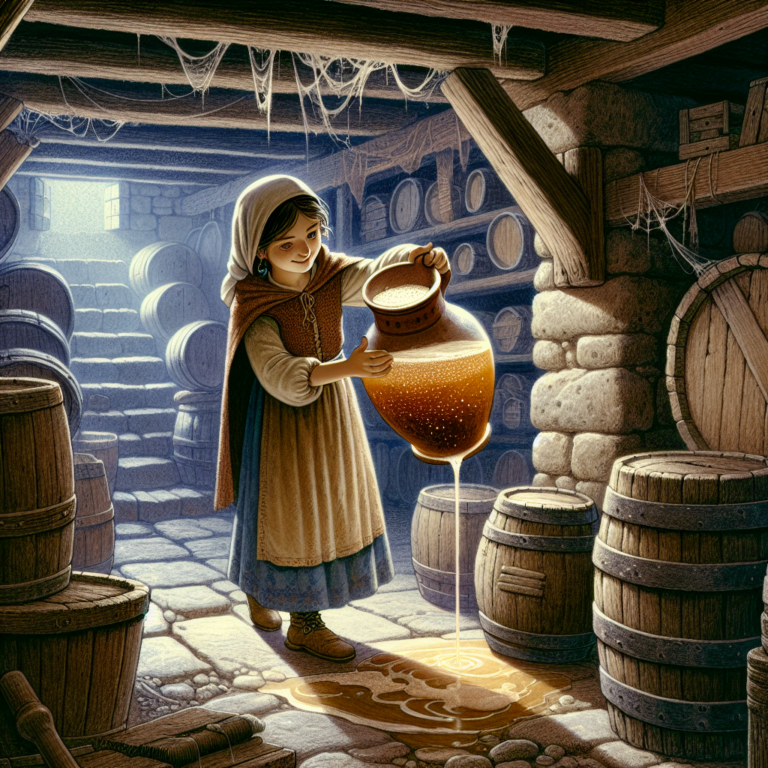
The cellar was cool and dim, smelling of apples and earth and the mustiness of preserved goods. Rosie made her way carefully down the steps, past shelves lined with jars of preserves and pickles, to where the cider barrel sat in the corner.
She placed her jug beneath the tap and turned it, watching the amber liquid begin to flow. As she waited for the jug to fill, she looked around the cellar—and her eye fell upon something she had never noticed before.
There, lodged in one of the wooden ceiling beams, was an old axe.
It must have been there for years, perhaps left behind by whoever had built the cellar. The blade was rusty, the handle dark with age, and it was wedged firmly in the beam at an angle, as if someone had swung it up there long ago and then simply… forgotten about it.
Rosie stared at the axe, and a thought began to form in her mind.
“What if,” she murmured to herself, “I were to marry Jack someday. And what if we had a child—a beautiful baby boy. And what if that boy grew up strong and handsome. And what if, one day, I sent him down to the cellar to fetch some cider, just as Papa sent me today. And what if…” her voice dropped to a horrified whisper, “what if he were standing RIGHT HERE, in this VERY spot, and that axe fell from the beam and struck him on the head and KILLED him!”
The more Rosie thought about this imaginary future catastrophe, the more real it became in her mind. She could picture it all: the wedding, the baby, the growing boy, the terrible accident, the grief that would follow. Tears began to stream down her cheeks.
“Oh, my poor, poor baby!” she wailed. “My beautiful boy! Killed by a falling axe before he even had a chance to live!”
She sat down on an empty crate, overcome by sorrow, the jug of cider forgotten beside her as it overflowed and spilled across the earthen floor.
Up in the kitchen, the adults waited patiently for Rosie to return. But as the minutes stretched on, Martha began to worry.
“She’s been down there an awfully long time,” Martha said, rising from her chair. “I’d better go check on her.”
Martha descended the cellar stairs, only to find her daughter sitting on a crate, weeping as if her heart would break, while cider ran in rivers across the floor.
“Rosie! Good heavens, what’s wrong?” Martha rushed to her daughter’s side. “Are you hurt? Did you fall?”
“Oh, Mum!” Rosie sobbed. “Look up there—do you see that axe?”
Martha looked up and saw the rusty old axe lodged in the beam. “Yes, I see it. What about it?”
“Don’t you understand? What if I marry Jack, and we have a son, and he grows up, and someday I send him down here to fetch cider, and that axe falls and KILLS him? Oh, Mum, my poor little boy!”
Martha’s eyes widened. She looked from her daughter to the axe to the imaginary future that Rosie had conjured, and suddenly she saw it all too—the wedding, the baby, the growing boy, the terrible accident.
“Oh, my GRANDSON!” Martha wailed, sinking down onto another crate. “My beautiful grandson, killed by a falling axe! How terrible! How AWFUL!”
Now there were TWO women weeping in the cellar, the cider completely forgotten.
Back in the kitchen, Tom and Jack sat in increasingly uncomfortable silence. The lamb was getting cold, the bread was going stale, and neither woman had returned.
“What in blazes is going on down there?” Tom muttered, rising from his seat. “I’d better go see what the trouble is.”
He descended the cellar stairs, his boots heavy on the wooden steps, and found his wife and daughter huddled together on crates, sobbing uncontrollably, while the cellar floor had become a small lake of spilled cider.
“Martha! Rosie! What on EARTH is happening?”
“Oh, Tom!” Martha cried. “Look at that axe in the beam!”
Tom looked up. “I see it. I reckon I put it there myself, twenty years ago, meaning to fix the handle. Never got around to it.”
“But don’t you SEE?” Rosie wailed. “What if I marry Jack and have a son, and he grows up, and someday he comes down here for cider, and the axe falls and KILLS him?”
Tom stared at his daughter. He looked at the axe. He thought about this hypothetical grandson—his own flesh and blood, growing up strong and handsome, only to be struck down by a falling axe in the prime of his life.
“Oh, my GRANDSON!” Tom bellowed, tears springing to his eyes. “My boy! My beautiful boy!” He sat down heavily on a barrel, overcome with grief for a child who did not exist and an accident that had not happened.
Now there were THREE people weeping in the cellar.
Up in the kitchen, Jack Palmer sat alone, thoroughly confused. His supper was stone cold, there was no cider to drink, and the entire family he hoped to marry into had disappeared into the cellar and was apparently weeping.
“This is ridiculous,” Jack said to himself. He rose from his chair and descended the cellar stairs.
What he found defied all reason. Tom, Martha, and Rosie sat amid crates and barrels, weeping as if they had lost everything dear to them, while cider pooled around their feet. The tap was still running, the jug forgotten.
“What in heaven’s name is going on?” Jack demanded.
“Oh, Jack!” Rosie cried. “Look at that axe!”
Jack looked up at the rusty old axe lodged in the beam. “Yes, I see it. What about it?”
“Don’t you UNDERSTAND? If we get married and have a son, and he grows up, and someday he comes down here to fetch cider, that axe might fall and KILL him!”
Jack was silent for a moment, processing this extraordinary statement.
Then he walked to the corner of the cellar, found an old stepladder, set it beneath the beam, climbed up, and pulled the axe free. He tucked it under his arm, climbed back down, and turned to face the weeping family.
“There,” he said. “Problem solved. Now there’s no danger of anyone being killed by a falling axe.”
The McAllisters stared at him.
“What… what do you mean?” Tom asked, his tears drying on his cheeks.
“I mean,” Jack said patiently, “that you were all crying about something that HADN’T HAPPENED and MIGHT NEVER HAPPEN. You invented a child who doesn’t exist, imagined an accident that was entirely preventable, and worked yourselves into a state of grief over a tragedy that was completely imaginary. Meanwhile, the ACTUAL problem—the axe in the beam—was right there, waiting to be fixed. All anyone had to do was pull it out.”
He shook his head slowly. “With all respect, this is the silliest thing I have ever seen in my life.”
The McAllisters slowly emerged from their grief, looking rather sheepish. The reality of the situation—the spilled cider, the cold supper, the tears shed over nothing—began to sink in.
“I suppose,” Tom said slowly, wiping his face with his sleeve, “that does seem a bit… foolish, when you put it that way.”
“A BIT foolish?” Jack tucked the axe under his arm. “Mr. McAllister, I came here today hoping to ask for your daughter’s hand in marriage. But I have to be honest—I’m not sure I want to join a family that weeps over imaginary tragedies.”
Rosie’s eyes went wide. “Oh, Jack! Please don’t say that!”
“Let me finish,” Jack said, holding up his hand. “I’ve decided to make a journey. I’m going to travel across this country, and I’m going to see if I can find THREE people who are SILLIER than you three were today. If I can find three people who worry about imaginary problems as much as you do—who ignore practical solutions while inventing unlikely disasters—then I’ll know that your behavior, while foolish, is at least common. And I’ll come back and marry Rosie.”
He paused. “But if I CANNOT find three sillier people, then I’m afraid the engagement is off.”
Tom, Martha, and Rosie exchanged anxious glances. Had they really been THAT silly?
“That seems fair,” Tom said finally. “Travel safe, Jack. And… we hope you find what you’re looking for.”
Jack nodded, took the axe with him as a reminder of the absurdity he had witnessed, and rode off into the sunset.
Jack traveled for many days, sleeping under the stars and eating bread and cheese from his saddlebags. He began to wonder if perhaps he had been too harsh on the McAllisters. Surely ordinary people didn’t work themselves into states of grief over purely imaginary problems?
Then he came to a small farmhouse, where a woman was struggling with an unusual problem.
She was standing outside her house, trying to push her cow up a ladder. The ladder was propped against the roof, and the cow was mooing in distress, clearly not designed for ladder-climbing.
“Excuse me,” Jack called out. “What on earth are you doing?”
“Can’t you see?” the woman huffed, still pushing the cow. “There’s lovely grass growing on my roof—nice and green from the rain we had last week. I’m trying to get my cow up there to graze!”
Jack stared at her. “Wouldn’t it be easier to cut the grass and bring it DOWN to the cow?”
The woman stopped pushing. Her face went through several expressions—confusion, consideration, and finally embarrassment.
“I… I suppose that WOULD be easier,” she admitted. “I never thought of that.”
Jack shook his head. “That’s one,” he said to himself, and continued on his journey.
A few days later, Jack came to a village where a crowd had gathered around a man who was jumping up and down in his trousers, his face red with frustration.
“What’s the matter here?” Jack asked a bystander.
“It’s Old Pete,” the bystander explained. “He’s been trying to put his trousers on for an hour now. Says they won’t go on properly.”
Jack watched Old Pete leap into the air, trying to land with both legs inside the trouser legs at once. He failed spectacularly, ending up tangled on the ground.
“Friend,” Jack said, helping the man up, “have you tried sitting down and putting them on one leg at a time?”
Old Pete’s eyes widened. “One leg at a time? What a CLEVER idea! Why didn’t I think of that?”
He sat down, carefully inserted one leg, then the other, and stood up triumphantly, properly dressed at last.
“That’s two,” Jack said to himself.
Jack was beginning to feel hopeful. Surely there must be one more silly person somewhere in this wide country.
He found her in a cottage by a lake, where an old woman was trying to scoop the moonlight out of a bucket of water with a ladle.
“What are you doing?” Jack asked, completely baffled.
“The moon fell into my bucket!” the old woman wailed. “I went to fetch water from the lake, and when I came back, there it was—the moon, right there in my bucket! I’ve been trying to scoop it out for hours, but every time I think I’ve got it, it slips away!”
Jack looked into the bucket. Sure enough, the reflection of the moon shimmered on the water’s surface.
“Ma’am,” he said gently, “that’s not the moon. That’s the moon’s REFLECTION. Look up.”
The old woman looked up at the sky, where the moon hung full and bright, exactly where it had always been.
“Oh!” she exclaimed. “There it is! It must have climbed back up while I wasn’t looking!”
“That’s three,” Jack said with a smile.
Jack rode back to Willowbrook Station with a light heart. He had found three people who were just as silly as the McAllisters—perhaps even sillier. The woman pushing a cow up a ladder instead of bringing the grass down. The man jumping into his trousers instead of putting them on sensibly. The old woman trying to scoop the moon out of a bucket.
When he arrived at the farmhouse, the family came rushing out to meet him.
“Jack! You’ve returned!” Rosie cried.
“Did you find what you were looking for?” Tom asked anxiously.
Jack dismounted and tied his horse to the post. “I did indeed. I found three people who worry about the wrong things, ignore simple solutions, and make their own lives difficult for no reason at all.”
He turned to Rosie and took her hands in his. “It seems that silliness is more common than I thought. And if the whole world is full of people who focus on the wrong problems, then I suppose your family is no worse than average.”
Martha beamed. Tom let out a sigh of relief.
“But,” Jack added, “let me suggest one thing. From now on, when you find yourselves worrying about something that MIGHT happen in the future, ask yourselves this: Is there something I can DO about it right now? If the answer is yes—like pulling an axe out of a beam—then do THAT instead of worrying. And if the answer is no, then what good does worrying do?”
Rosie nodded slowly. “That… that makes a lot of sense.”
“Worrying about tomorrow’s problems while ignoring today’s solutions is the silliest thing a person can do,” Jack said. “But taking action to prevent trouble? That’s just good sense.”
He got down on one knee right there in the dusty yard. “Rosie McAllister, will you marry me?”
And Rosie, who had learned a valuable lesson about focusing on the present rather than imaginary future disasters, said yes.
Tom, Martha, and Rosie McAllister were forever after known in the district as the “Three Sillies,” but they wore the title with good humor. They had learned something important that day in the cellar, something they passed on to their children and grandchildren.
“Don’t borrow trouble,” they would say. “If you see a problem, fix it. If you can’t fix it, don’t waste your tears on it. And for goodness’ sake, if there’s an axe stuck in your ceiling, TAKE IT DOWN instead of crying about what it might do someday.”
Rosie and Jack had a long and happy marriage, and they DID have a son—a beautiful boy named Thomas, after his grandfather. And when young Thomas was old enough to fetch cider from the cellar, there was no axe in the beam to worry about, no danger lurking overhead, no imaginary tragedy waiting to unfold.
Because Jack had fixed the problem with ten seconds of practical action, all those years ago, while everyone else was too busy worrying to notice there was an easy solution right in front of them.
And that, as Jack often said, is the difference between silly and sensible.
This humorous folk tale teaches us that *worrying about imaginary future problems is foolish when there are practical solutions available right now. The McAllister family invented an elaborate tragedy involving a grandson who didn’t exist, while the actual danger—the axe in the beam—could have been fixed in moments.
The story also shows us that silliness is surprisingly common. Jack found three other people making their lives difficult in absurd ways: pushing a cow up a ladder, jumping into trousers, trying to scoop the moon from a bucket. This reminds us not to judge others too harshly for their foolishness, since we all have moments of irrationality.
Most importantly, the tale encourages us to take action rather than merely worry. When we face a problem, we should ask: “Is there something I can DO about this?” If yes, we should do it. If no, then worrying accomplishes nothing. Either way, sitting and crying over imaginary catastrophes is the silliest response of all.
“The Three Sillies” is a traditional English folk tale, most famously recorded by Joseph Jacobs in his collection English Fairy Tales (1890). However, similar stories exist throughout European and Asian folklore, suggesting the theme is universal.
This story belongs to a genre called “noodlehead tales” or “fool tales”—stories about people who behave illogically. These tales appear in almost every culture and serve to:
– Provide humor and entertainment
– Allow audiences to feel clever by recognizing the foolishness
– Teach critical thinking by example (what NOT to do)
– Offer comfort that everyone makes silly mistakes sometimes
Similar stories appear in:
– Germany: “Die drei Dummköpfe” (The Three Blockheads)
– Italy: “I tre sciocchi” (The Three Fools)
– Jewish Folklore: Wise Men of Chelm stories
– Arabia: Mulla Nasruddin tales
While preserving the essential plot and moral, this retelling places the story in the Australian outback, replacing English cottages with sheep stations and adapting language and setting for a different cultural context. The wisdom of the tale remains unchanged.
Primary Source:
Joseph Jacobs, English Fairy Tales (1890), “The Three Sillies”
Story Elements from Original:
1. A daughter sent to fetch something from the cellar – Traditional setup
2. Discovery of a dangerous object (axe/mallet) overhead – Original detail
3. Imagining a future child killed by the object – Core of the foolishness
4. Mother joining in the worry – Progressive silliness
5. Father joining in the worry – Completing the trio
6. Practical suitor who solves the problem simply – Voice of reason
7. Suitor’s challenge to find three sillier people – Traditional test
8. Three examples of foolish behavior found on journey – Original structure
9. Return and marriage after finding the sillies – Happy resolution
Common Variations:
– The object varies (axe, mallet, pickaxe, hammer)
– The liquid varies (cider, beer, ale, wine)
– The three sillies found vary widely by version
– Some versions include more than three found sillies
Historical Context: Folk tales like this one were passed down orally for generations before being written down. They served as entertainment, education, and social commentary all at once.
The Psychology of Worry: Modern psychology confirms what this folk tale understood intuitively: excessive worry about unlikely future events (catastrophizing) is counterproductive and can prevent us from taking helpful action in the present.
Discussion Starters:
1. Have you ever worried about something that never happened?
2. What’s the difference between useful planning and useless worrying?
3. Why do you think the mother and father joined Rosie in her worry instead of offering a solution?
4. What would YOU have done if you were Jack and saw the family crying in the cellar?
1. Why do you think Rosie’s imaginary worry about a future grandson felt so real to her? (Explores how our minds can make fictional scenarios feel emotional)
2. Why did Martha and Tom join in the crying instead of pointing out that the problem was imaginary? (Discusses how emotions can be contagious and how we sometimes reinforce each other’s irrational fears)
3. Jack solved the problem in seconds by simply removing the axe. Why didn’t anyone else think of this? (Explores how worry can blind us to obvious solutions)
4. The three silly people Jack found were doing absurd things: pushing a cow up a ladder, jumping into trousers, scooping moonlight. What do these have in common with the McAllisters’ behavior? (All ignored simple, obvious solutions)
5. The story says “worrying about tomorrow’s problems while ignoring today’s solutions is the silliest thing a person can do.” Do you agree? Can you think of times when worrying IS useful? (Nuanced discussion about productive vs. unproductive worry)
6. Would you have come back to marry Rosie if you were Jack? Why or why not? (Explores judgment, forgiveness, and second chances)
– Folk Tale: A traditional story passed down through generations, often with a moral lesson
– Noodlehead Tale: A humorous story about foolish people who act illogically
– Catastrophizing: Imagining the worst possible outcome and treating it as if it’s certain to happen
– Practical: Focused on useful action rather than abstract worry
– Hypothetical: Something imagined or supposed, not real or actual
– Preventable: Something that can be stopped from happening through action
– [Joseph Jacobs – English Fairy Tales (1890)](https://www.gutenberg.org/ebooks/7439) – Original collection
– [The Three Sillies – SurLaLune Fairy Tales](https://www.surlalunefairytales.com/threesillies/) – Analysis and variations
– [Noodlehead Tales – Encyclopedia of World Folklore](https://www.worldoftales.com/European_folktales/English_folktale_28.html) – Genre context
– [ATU Classification System](https://en.wikipedia.org/wiki/Aarne%E2%80%93Thompson%E2%80%93Uther_Index) – Tale type 1450
This story is faithfully adapted from “The Three Sillies,” a traditional English folk tale recorded by Joseph Jacobs in 1890. While the setting has been relocated to the Australian outback, the essential plot, characters, and moral lesson remain true to the original. This timeless tale continues to entertain and instruct, reminding us that practical action is always more valuable than anxious imagination, and that worrying about tomorrow’s hypothetical problems is no substitute for solving today’s real ones.*
Moral Lessons
- – **Noodlehead Tale**: A humorous story about foolish people who act illogically
– **Catastrophizing**: Imagining the worst possible outcome and treating it as if it’s certain to happen
– **Practical**: Focused on useful action rather than abstract worry
– **Hypothetical**: Something imagined or supposed, not real or actual
– **Preventable**: Something that can be stopped from happening through action
Test Your Understanding
1Who is the ‘bloke from the city’ in the story?
Frequently Asked Questions
What is the moral lesson of The Unseen Trouble and the Forgotten Mallet?
What age is this story appropriate for?
How long does it take to read The Unseen Trouble and the Forgotten Mallet?
What culture does this story come from?
Can I use this story for teaching?
Frequently Asked Questions
What is ‘The Unseen Trouble and the Forgotten Mallet’ about?
It’s an educational moral story set in the Australian outback, following a farming family called the McAllisters at their sheep station, Willowbrook. The story explores themes of honesty, foresight, and responsibility through the characters of farmer Tom, his wife Martha, their daughter Rosie, and her suitor Jack Palmer.
What age group is ‘The Unseen Trouble and the Forgotten Mallet’ suitable for?
The story is ideal for children aged 6 to 12 and works especially well as a bedtime read. The language is accessible and engaging for younger readers, while the moral themes give older children something meaningful to think about and discuss.
What moral lesson does this bedtime story teach children?
While the full lesson unfolds through the story, the title hints at themes of overlooked problems and neglected responsibilities. Children are encouraged to think about the consequences of ignoring small issues and the importance of taking care of the tools and tasks in front of them.
📚 Recommended Books
Handpicked for readers like you
As an Amazon Associate, we earn from qualifying purchases. These recommendations are personalized based on this story's themes and your reading history.
Where is the story set and why does the setting matter?
The story is set in the Australian outback on a sheep station called Willowbrook. The vivid rural setting — red earth, wide blue skies, and Sunday suppers — creates a warm, grounded world that makes the moral lessons feel natural and relatable rather than preachy.
Is this a good story to read aloud to kids at bedtime?
Yes, absolutely. The story features cosy, descriptive scenes like Sunday evening suppers and family gatherings that are calming and engaging. Its gentle pacing and moral focus make it a great choice for parents who want bedtime reading that’s both enjoyable and quietly educational.