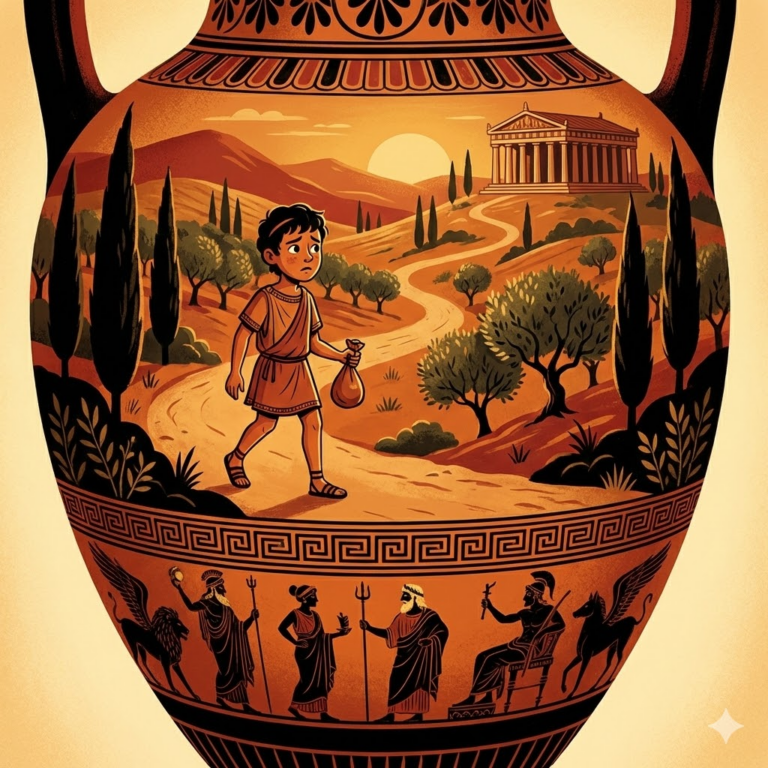
This moral story for children ages 6-12 combines entertainment with important values.
At the foot of Mount Hymettus, where wild bees made honey sweeter than any other in Greece and the rocky soil yielded olives only to those who worked it with patience, there lay a small village called Kyparissia.
The people of Kyparissia were neither rich nor poor, neither famous nor forgotten. They farmed their terraced fields, tended their goats, and gathered each evening in the village square to share news and stories. It was a simple life, but a good one—most of the time.
Young Theodoros was born into this village during a hard winter, when snow—rare in these southern lands—had dusted the olive groves and made the roads treacherous. His father, a shepherd named Nikolas, died that same winter from a fever that swept through the village, leaving Theodoros’s mother, Helena, to raise her son alone.
From his earliest memories, Theodoros understood that life was difficult.
Their small stone house leaked when it rained. Their olive trees produced barely enough oil to trade for bread. Helena’s hands were rough and cracked from washing clothes for wealthier families, and there were nights when the pot over the fire held more water than food.
But Helena never complained—at least, not in front of her son.
“Every burden we carry,” she would tell him, smoothing his dark hair as he lay in his narrow bed, “makes us stronger for the next one. That is the way the gods have ordered the world. We do not grow by resting—we grow by struggling.”
Theodoros believed her, though he did not always understand.
As Theodoros grew older, the burdens grew with him.
At seven, he began helping his mother with the washing, carrying heavy baskets of wet clothes up the hillside to dry in the sun. His arms ached and his back bent, but he did not complain.
At ten, he took over the care of their small flock of goats—only five animals, but they were everything. When a wolf came down from the mountain one winter night, Theodoros fought it off with nothing but a shepherd’s crook and a desperate courage. He saved the goats, but gained a long scar across his forearm that he would carry for the rest of his life.
At thirteen, his mother fell ill.
The sickness came on slowly at first—a cough that wouldn’t go away, a weariness that kept her in bed longer each morning. By spring, Helena could barely rise at all. Theodoros did everything: the washing, the goat-tending, the olive harvesting, the cooking, the cleaning. He nursed his mother through long nights of fever, bathing her forehead with cool water and spooning broth between her cracked lips.
The villagers helped when they could, but everyone had their own troubles. There were no rich patrons to offer assistance, no family members to share the load. Theodoros was alone.
One evening, as he sat by his mother’s bedside in the flickering lamplight, Helena reached out and took his hand.
“My son,” she whispered, her voice thin as a thread, “I fear I am leaving you soon.”
Theodoros shook his head fiercely, tears spilling down his cheeks. “No, Mother. You’ll get better. You have to.”
“Listen to me.” Her grip tightened with surprising strength. “I have watched you carry burdens that would break a grown man, and I have seen you stand each time you fell. I could not be prouder of the person you have become.” She paused, gathering her breath. “But there is something I have never told you—something you need to know.”
“What is it, Mother?”
“The Oracle at Delphi… before you were born, I made a pilgrimage there. I asked the Pythia what my son’s life would hold.” Helena’s eyes glistened in the lamplight. “She told me that you would face great sorrows, but that those sorrows would forge you into something remarkable. She said: ‘The steel that is never placed in the fire is never strong enough to become a sword.’”
Theodoros was silent, turning these words over in his mind.
“I have often wondered,” Helena continued, “whether I should have told you sooner. But I wanted you to discover your own strength, not just believe in a prophecy.” She smiled weakly. “And you have, my son. You have become the sword.”
Helena passed away that night, slipping peacefully from this world to the next as the stars wheeled overhead. Theodoros buried her beneath the old olive tree on their land—the tree his grandfather had planted, the tree that had sustained their family through good times and bad.
For many days after, Theodoros did not know what to do. He went through the motions of life—feeding the goats, maintaining the house—but inside, he felt hollow. The burdens that had once given him purpose now seemed meaningless. What was the point of struggling if everyone you loved was taken away?
Then, one morning, he remembered the Oracle.
The steel that is never placed in the fire is never strong enough to become a sword.
His mother had received a prophecy about him—about HIS life, HIS struggles, HIS purpose. Perhaps if he went to Delphi himself, the Oracle could help him understand what he was meant to become.
Theodoros sold three of his five goats to pay for the journey. He packed bread and cheese and olives in a leather satchel, said goodbye to the neighbors who had been kind to him, and set out on the road to Delphi.
The journey took many days. He slept under olive trees and drank from mountain springs. He walked until his feet blistered and then walked on. He climbed higher and higher into the sacred mountains where the gods were said to dwell.
And finally, footsore and weary but determined, he arrived at Delphi.
Delphi was unlike anything Theodoros had ever seen.
The sanctuary clung to the slopes of Mount Parnassus, a collection of temples and treasuries and statues that seemed to grow from the very rock itself. The Sacred Way wound upward through monuments dedicated by grateful cities and individuals—offerings of thanks for prophecies received, battles won, fortunes made.
At the center of it all stood the Temple of Apollo, where the Pythia delivered the god’s messages to those who came seeking answers.
Theodoros presented himself at the temple gate with the small purse of coins he had saved—barely enough for the required offering. A priest in white robes looked him over skeptically.
“You are young to seek the Oracle’s wisdom,” the priest said. “What question burns in your heart?”
“I want to understand my life,” Theodoros said. “My mother told me that the Pythia prophesied great sorrow for me, but also that my suffering would make me strong. I have lost everything—my father, my mother, my hopes for a normal life. I need to know: what is it all FOR? Why must I suffer? What am I supposed to become?”
The priest studied him for a long moment. Then, slowly, he nodded.
“The Pythia will see you. But remember: the Oracle’s answers are not always what we expect. You must be prepared to hear the truth, even if it is not the truth you hoped for.”
Theodoros was led down into the inner sanctuary, where strange vapors rose from a chasm in the earth and the air was thick with the smell of burning laurel. On her three-legged stool above the sacred fissure, the Pythia sat swaying, her eyes rolled back, her voice emerging as if from a great distance.
Theodoros knelt before her, his heart pounding.
“Great Oracle,” he said, his voice trembling, “I am Theodoros of Kyparissia. My mother came to you before I was born and received a prophecy about my life. I have suffered greatly, as was foretold. I ask you now: what is the PURPOSE of my suffering? What am I meant to do with the strength it has given me?”
For a long moment, there was only the hiss of the sacred vapors and the distant sound of wind on the mountain. Then the Pythia spoke, her voice echoing strangely in the chamber:
“Young bearer of burdens, listener to the wind,
You ask why the gods have placed weight on your shoulders.
Know this: the purpose is not in the CARRYING—
The purpose is in what the carrying CREATES.
The tree that grows on the windswept cliff
Sends its roots deeper than the tree in the sheltered valley.
The river that flows through rocky ground
Carves canyons that endure for ages.
You have been shaped by hardship into something rare:
A heart that understands suffering,
Hands that know how to help,
A spirit that does not break.
Go out into the world, son of sorrow.
Find those who struggle as you have struggled.
Be for them what you wished someone could be for you.
Your purpose is not to be saved—
Your purpose is to become a SAVIOR.”
The Pythia fell silent, slumping on her stool. The priests hurried forward to attend to her, and Theodoros was guided back into the light of day.
He stood outside the temple, blinking in the sunshine, turning the Oracle’s words over in his mind.
Your purpose is not to be saved. Your purpose is to become a savior.
Theodoros returned to Kyparissia changed.
Not in any visible way—he was still the same lean, scarred young man with calloused hands and serious eyes. But inside, something had shifted. He understood now that his suffering had not been a punishment or a curse. It had been a preparation.
He sold his remaining goats and used the money to apprentice himself to a healer in the nearby town of Lavrio. He learned which herbs brought down fevers, which poultices drew out infections, which words brought comfort to the dying and hope to the despairing. He learned to set broken bones and stitch wounds and ease the pains of childbirth.
And he learned something else, too: that his years of hardship had given him a gift no training could provide. He understood suffering from the inside. When a mother wept over a sick child, Theodoros knew that grief. When a farmer despaired over a failed crop, Theodoros remembered hungry nights. When orphans huddled alone and afraid, Theodoros saw his own childhood reflected in their eyes.
He could not take away their pain, but he could stand beside them in it. He could say, “I understand,” and mean it. He could show them, by his own example, that burdens did not have to crush you—they could forge you instead.
Word spread about the young healer from Kyparissia who seemed to know, without being told, exactly what his patients were feeling. People began to seek him out from villages throughout the region. Rich and poor alike came to his door, and he treated them all with the same steady compassion.
Ten years after his pilgrimage to Delphi, Theodoros faced his greatest test.
A plague swept through the region, more terrible than any in living memory. It struck without warning, killing some within days and leaving others to linger in agony. The wealthy fled to their country estates; the poor huddled in their homes, praying to gods who seemed not to hear.
Many healers refused to treat the sick, terrified of catching the disease themselves. But Theodoros went where he was needed.
Day after day, he moved through the infected villages, tending to the dying, comforting the bereaved, doing what could be done and accepting what could not be changed. He worked until he collapsed from exhaustion, slept a few hours, and then rose to work again.
People marveled at his courage.
“Are you not afraid of death?” a young priest asked him one night, as they stood together in a village square littered with the sick and dying.
Theodoros considered the question carefully. “I have known fear,” he said at last. “I have known grief and loneliness and despair. But I have also learned that these things do not destroy us unless we let them. The Oracle told me that my purpose was to become a savior—not to save everyone, for that is beyond any mortal’s power, but to be present in suffering, to offer what help I can, and to show others that darkness does not have to be faced alone.”
He paused, looking out over the square. “If I die from this plague, I will die doing what I was meant to do. And that is not a tragedy—it is a completion.”
The priest was silent for a long moment. Then he said, quietly, “I think you are the bravest person I have ever met.”
Theodoros shook his head. “Courage is not the absence of fear. Courage is carrying on despite the fear. That is something anyone can learn—I know, because I learned it myself, one burden at a time.”
Theodoros survived the plague, though it left him weakened for many months afterward. He lived to old age, continuing his work as a healer and teacher until his hands grew too unsteady to mix medicines and his eyes too dim to read scrolls.
But his legacy was not in the patients he healed or the herbs he prescribed. His legacy was in the lesson he taught through his life: that adversity is not our enemy.
He trained dozens of apprentices over the years, and to each of them he passed on the Oracle’s wisdom:
“You will face hardship,” he would tell them, as they sat in his simple house on the slopes of Mount Hymettus. “Everyone does. The question is not whether you will suffer, but what you will DO with your suffering. Will you let it break you? Or will you let it forge you into something stronger?”
“But how?” the apprentices would ask. “How do we keep going when everything seems hopeless?”
“One burden at a time,” Theodoros would answer. “One foot in front of the other. One day and then the next. You do not have to carry all your troubles at once—only the one in front of you right now. And when you have carried that one, you will find that you are stronger than you were before. Strong enough to carry the next.”
He would hold up his scarred forearm, the mark of the wolf he had fought as a boy. “I was terrified that night. I wanted to run. But I thought of my mother, depending on those goats, and I found courage I didn’t know I had. That courage did not come from nowhere—it came from all the smaller fears I had faced before. Each one prepared me for the next.”
When Theodoros finally passed from this world, the people of the region mourned him as a hero. They built a small shrine in his honor, and for generations afterward, those who faced great troubles would come to leave offerings and pray for his guidance.
The inscription on the shrine read:
Here rests Theodoros, the Burden Bearer,
Who learned that suffering is the forge where heroes are made,
And taught that courage is not given but built,
One hardship at a time.
This tale from ancient Greece teaches us that *adversity, while painful, can be a source of strength rather than merely a source of suffering. Theodoros faced loss, poverty, and hardship from his earliest days, but these experiences shaped him into a person of extraordinary compassion and resilience.
The Oracle’s wisdom—”the steel that is never placed in the fire is never strong enough to become a sword”—reminds us that easy lives do not produce strong characters. It is precisely BECAUSE Theodoros struggled that he became capable of helping others in their struggles.
The story also teaches that our suffering can have purpose beyond ourselves. Theodoros’s pain was not wasted—it gave him understanding that allowed him to comfort the afflicted and strengthen the weak. What seemed like meaningless hardship became the foundation for a life of meaning.
Finally, the tale shows us that courage is built gradually through facing smaller fears. Theodoros did not wake up one day with the ability to walk fearlessly among plague victims. He built that courage through years of smaller challenges, each one preparing him for the next.
The philosophical foundation of this story draws heavily on Stoic thought, which emerged in Greece around 300 BCE. The Stoics taught that:
– External circumstances are less important than our response to them
– Adversity provides opportunities for growth and virtue
– True freedom comes from accepting what we cannot change
– Our purpose is to use our reason and abilities in service of others
The Delphic Oracle was the most important religious institution in ancient Greece. The Pythia (priestess of Apollo) delivered prophecies in response to questions from petitioners who came from throughout the Greek world. Famous maxims inscribed at Delphi included “Know Thyself” and “Nothing in Excess.”
Unlike some traditions that view suffering as purely negative, Greek thought often emphasized that hardship builds character. This is reflected in:
– Hesiod’s Works and Days (8th century BCE): “Before the gates of excellence the high gods have placed sweat”
– Greek tragedy, where heroes are tested and refined through suffering
– Athletic and military training, where pain was understood as necessary for excellence
Healing was a sacred calling in ancient Greece, associated with the god Asclepius. Healers were expected to treat all patients regardless of ability to pay and to face danger (such as plagues) with courage.
Philosophical Sources:
This story draws on authentic Greek philosophical and wisdom traditions:
– Hesiod’s Works and Days (8th century BCE) – On the value of hard work and struggle
– Stoic Philosophy (3rd century BCE onward) – On finding meaning in adversity
– Hippocratic Tradition – Medical ethics and the healer’s duty
– Delphic Wisdom Literature – The Oracle’s role in Greek religious life
Story Elements from Greek Tradition:
1. The Oracle’s prophecy shaping a life – Common motif in Greek literature
2. Early loss of parents – Many Greek heroes were orphans (Oedipus, Perseus)
3. Journey to Delphi as a turning point – Countless Greeks made such pilgrimages
4. Service to others as life purpose – Greek civic virtue
5. Plague as a test of character – Athens famously suffered a terrible plague
6. The wise mentor who teaches by example – Greek paideia (education) tradition
Geographic and Cultural Details:
– Mount Hymettus: famous for its honey in antiquity
– Olive cultivation: central to Greek agriculture
– The Sacred Way at Delphi: authentic description
– Greek medical traditions: herbs, poultices, bedside manner
Historical Context: The ancient Greeks were deeply interested in questions of suffering and meaning. Their tragedies often explored how mortals could maintain dignity and purpose in the face of terrible circumstances.
Modern Relevance: Research in psychology confirms the Greek intuition about “post-traumatic growth”—the phenomenon where people who face and overcome adversity often develop greater wisdom, compassion, and resilience than those who have lived easier lives.
Discussion Starters:
1. Can you think of a time when something difficult turned out to be good for you in the end?
2. Why do you think facing small fears helps us face bigger ones later?
3. The Oracle said Theodoros’s purpose was to “become a savior.” What do you think that means?
4. Do you agree that “courage is not the absence of fear, but carrying on despite the fear”?
1. Theodoros’s mother told him “every burden we carry makes us stronger for the next one.” Do you think this is always true? Are there burdens that DON’T make us stronger? (Explores nuance in the moral lesson)
2. The Oracle said “the purpose is not in the CARRYING—the purpose is in what the carrying CREATES.” What did Theodoros’s suffering create in him? (Compassion, understanding, resilience, courage)
3. Many healers fled during the plague, but Theodoros stayed. Was he being brave or foolish? Is there a difference? (Explores the line between courage and recklessness)
4. Theodoros said his suffering gave him the ability to say “I understand” to others and mean it. Why is being understood so important when we’re suffering? (Explores the value of empathy)
5. The story suggests that easy lives don’t produce strong characters. Is this fair? Should everyone have to suffer to become a good person? (Challenges the moral with ethical questions)
6. At the end, Theodoros tells his apprentices to face hardship “one burden at a time.” Why is this advice helpful? (Discusses the psychology of coping with difficulty)
– Stoicism: Greek philosophy teaching that virtue and wisdom come from accepting what we cannot change
– Oracle: A person or place through whom divine messages are communicated
– Pythia: The priestess of Apollo at Delphi who delivered prophecies
– Adversity: Difficulties, hardships, and challenges in life
– Resilience: The ability to recover from setbacks and continue forward
– Compassion: Deep understanding of others’ suffering and desire to help
– [Stoic Philosophy – Stanford Encyclopedia](https://plato.stanford.edu/entries/stoicism/) – Philosophical context
– [The Oracle at Delphi](https://www.britannica.com/topic/Delphic-oracle) – Religious institution
– [Hesiod’s Works and Days](https://www.perseus.tufts.edu/hopper/text?doc=Perseus%3Atext%3A1999.01.0132) – Wisdom literature
– [Greek Medicine and Healing](https://www.nlm.nih.gov/hmd/greek/greek_medicine.html) – Medical traditions
This story draws on authentic Greek philosophical traditions, particularly Stoic thought and the wisdom literature of Hesiod, to explore the profound truth that adversity can be transformative rather than merely destructive. The setting, characters, and themes are faithful to ancient Greek culture, allowing young readers to encounter the timeless wisdom that what does not break us can indeed make us stronger—if we choose to let it.*
Test Your Understanding
1What was Theodoros’ family situation like?
Frequently Asked Questions
What is the moral lesson of A young person discovers courage in adversity?
What age is this story appropriate for?
How long does it take to read A young person discovers courage in adversity?
What culture does this story come from?
Can I use this story for teaching?
Frequently Asked Questions
What is the moral story about a young person discovering courage in adversity?
It’s a children’s moral story set in ancient Greece, following Theodoros, a boy raised in poverty by his widowed mother in the village of Kyparissia. The story explores how he develops courage and resilience despite hardship, making it a meaningful read for kids aged 6 to 12.
What age group is this courage in adversity story suitable for?
This moral story is designed for children aged 6 to 12. It blends engaging storytelling with important life values like perseverance, bravery, and resilience, making it ideal for parents, teachers, or caregivers looking for meaningful stories to share with young readers.
What life lessons does this story teach children?
The story teaches children that hardship can build character. Through Theodoros’s difficult upbringing — poverty, loss of his father, and daily struggle — young readers learn about courage, resilience, and the importance of a positive attitude even when life is tough.
📚 Recommended Books
Handpicked for readers like you
As an Amazon Associate, we earn from qualifying purchases. These recommendations are personalized based on this story's themes and your reading history.
Where is the story of Theodoros set?
The story is set in a small Greek village called Kyparissia, at the foot of Mount Hymettus. The setting draws on ancient Greek rural life, featuring olive groves, goat herders, and tight-knit village communities, giving the story a rich, culturally immersive backdrop.
Why is discovering courage in adversity an important theme for kids?
Teaching children about courage in adversity helps them develop emotional resilience and problem-solving skills. Stories like this one show kids that facing difficulties is a normal part of life, and that inner strength — like that shown by Theodoros and his mother Helena — can help overcome even the hardest challenges.