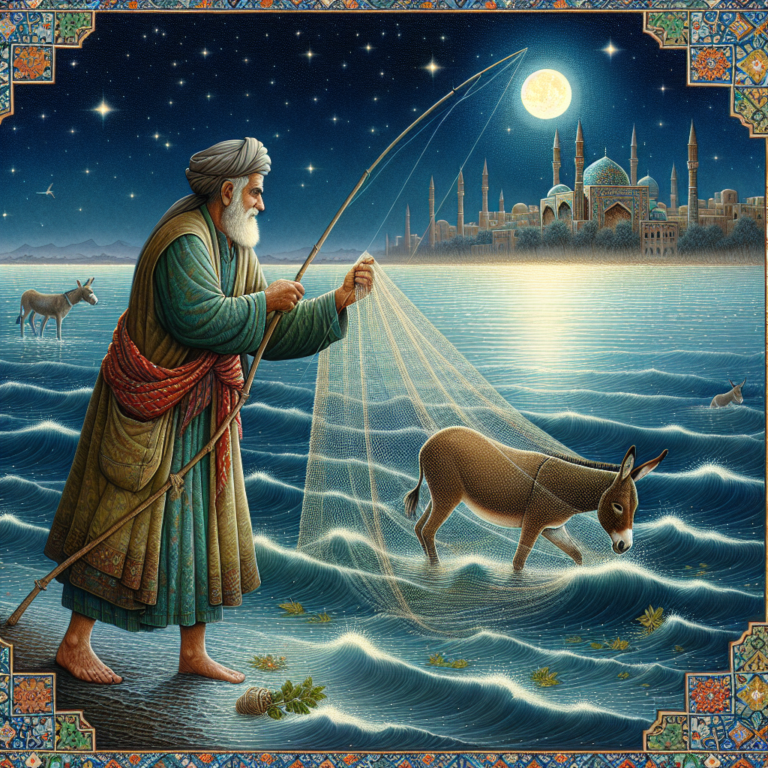
This bedtime story for kids, ‘The Story of the Fisherman’, teaches children ages 6-12 about important moral values.
Once upon a time, there lived a fisherman so old and so poor that he could scarcely manage to support his wife and three children.
Every single day, he went to fish very early in the morning, while the stars were still shining. And he had made himself a strict rule: he would not throw his nets more than four times each day.
Four throws, no more, no less.
If he caught nothing in those four throws, he and his family would go hungry. If he caught much, they would eat well. But four throws was his limit, and he never broke that rule.
One morning, he started out by moonlight, walking through the silver-lit streets to the seashore.
When he reached the water’s edge, he undressed and waded in. Then he cast his nets out into the dark sea with a prayer: “Please, let there be fish today.”
As he began drawing the nets back toward the bank, he felt a great weight pulling against him.
“Ah!” he thought, his heart leaping with joy. “I’ve caught a large fish! My family will eat well tonight!”
He pulled and pulled, straining with all his strength.
But when the nets finally came to shore, he saw—not a fish—but the rotting carcass of a dead donkey!
The fisherman’s shoulders sagged with disappointment.
“All that work for a dead ass,” he muttered.
Vexed at having such a bad haul, he had to spend precious time mending his nets, which the heavy carcass had broken in several places.
When the nets were repaired, he cast them a second time into the sea.
Once again, as he drew them in, he felt a great weight.
“This time!” he thought. “This time it must be fish!”
He pulled with renewed hope—and found only a large basket full of rubbish and mud.
The fisherman threw the basket down in frustration.
“O Fortune!” he cried out to the uncaring sky. “Do not trifle thus with me, a poor fisherman who can hardly support his family! I ask only for honest fish to feed my children!”
With angry, jerky movements, he threw away the rubbish and washed his nets clean of the dirt.
Then he cast them for the third time.
Pull as he might, this time he only drew in stones, shells, and mud—useless, heavy, worthless things.
He was almost in despair.
“Two throws left,” he whispered to himself. “Only one more after this…”
* * *
Taking a deep breath, the fisherman cast his nets for the fourth and final time.
When he felt weight on the line, he barely dared to hope.
He drew the nets in with a great deal of trouble, his old muscles aching.
There was no fish.
But there was something interesting: a yellow copper pot, sealed shut.
By its weight, it seemed full of something, and he noticed that it was fastened and sealed with lead, bearing the impression of a seal.
The fisherman’s despair lifted slightly.
“I will sell this to the metal founder,” he said. “With the money I get for it, I shall buy a measure of wheat. That’s something, at least.”
He examined the jar from all sides, turning it this way and that. He shook it to see if it would rattle, but he heard nothing inside.
“Hmm,” he thought, looking at the seal and the heavy lid. “Perhaps there’s something precious inside—coins, or jewels that someone hid!”
To find out, he took his knife and, with a little trouble, pried the sealed lid open.
He turned the pot upside down, expecting treasure to pour out.
But nothing came.
The fisherman frowned, puzzled.
He set the pot in front of him and stared at it.
Suddenly, thick smoke began pouring from the jar’s mouth!
The smoke was so dense that the fisherman had to step back several paces, coughing and waving his hand in front of his face.
The smoke rose up and up, all the way to the clouds. It stretched over the sea and the shore, forming a thick mist that blocked out the moonlight.
When all the smoke was finally out of the jar, it began to gather itself together, swirling and condensing into a solid form.
And there, standing before the terrified fisherman, was a genius—a being twice as large as the largest giant the fisherman had ever heard of in tales!
The genius had a fierce face, eyes like burning coals, and muscles that rippled like mountains.
When the fisherman saw such a terrible-looking monster, he wanted desperately to run away. But he trembled so violently with fright that he could not move even a single step.
* * *
The genius looked around, orienting himself, and then cried out in a booming voice:
“Great king of the genii! I will never again disobey you! I have learned my lesson!”
The fisherman, confused and terrified, found his voice.
“What… what is this you are saying, great genius? Tell me your history and how you came to be shut up in that pot!”
The genius looked down at the fisherman with a haughty, contemptuous expression.
“Speak to me more civilly,” he growled, “before I kill you.”
“Alas!” cried the fisherman. “Why should you kill me? I have just freed you from that prison! Have you already forgotten that?”
“No,” answered the genius, crossing his massive arms. “I have not forgotten. But that will not prevent me from killing you. I am only going to grant you one favor, and that is to choose the manner of your death. Will you die by fire? By drowning? By being crushed? Choose quickly.”
“But what have I done to you?” the fisherman pleaded, his voice breaking. “Why would you repay kindness with cruelty?”
“I cannot treat you in any other way,” said the genius flatly. “And if you would know why, listen to my story…”
* * *
The genius began his tale:
“Many centuries ago, I rebelled against the king of the genii. I thought myself powerful enough to challenge him. I was wrong.
“To punish me, he shut me up in this vase of copper. He placed on it a leaden cover stamped with his seal, which carries an enchantment powerful enough to prevent my escape. Then he had the vase thrown into the deepest part of the sea.
“During the first century of my captivity, I made a vow: If anyone should free me before a hundred years had passed, I would make him rich beyond measure—even after his death, his descendants would be wealthy!
“But that century passed, and no one came.
“In the second century, I changed my vow: I would give all the treasures in the world to whoever freed me! Mountains of gold! Rivers of jewels! Anything he desired!
“But still, no one came.
“In the third century, I promised even more: I would make my deliverer a king! I would always be near him, like a faithful servant! I would grant him three wishes every day for the rest of his life!
“But that century, too, passed away, just as the others had. And I remained in the same terrible prison, alone in the darkness.
“Finally, I grew so angry at being captive for so long, so furious at my suffering, that I made a new vow: If anyone should release me after so many centuries of abandonment, I would kill him at once! I would give him only the mercy of choosing how he wished to die!”
The genius leaned down, his huge face close to the fisherman’s.
“So you see,” he said, “since you have freed me today—after all those centuries—you must choose how you will die.”
* * *
The fisherman’s mind raced desperately, searching for a way out.
“What an unlucky man I am,” he said aloud, “to have freed you when I did! If only I had come yesterday, or tomorrow, or any other day! I implore you to spare my life!”
“I have told you,” said the genius, “that is impossible. Now choose quickly. You are wasting time, and I am growing impatient.”
The fisherman took a deep breath.
“Since I must die,” he said slowly, as if thinking carefully, “before I choose the manner of my death… I have one question.”
“Ask it quickly,” growled the genius.
“I conjure you on your honor to tell me the truth: Were you really inside that vase?”
The genius drew himself up proudly. “I was indeed!”
“I really cannot believe it,” said the fisherman, shaking his head and looking at the enormous being before him. “That vase is so small—it could not contain even one of your feet! How could your whole massive body possibly fit inside? I cannot believe it unless I see you do it with my own eyes.”
The genius’s eyes flashed with irritation at being doubted.
“You dare question my word?” he roared. “I will prove it to you!”
And with that, the genius began to change.
His solid form dissolved into smoke once more—thick, gray smoke that spread over the sea and the shore just as it had before.
Then, slowly and steadily, the smoke began flowing back toward the vase.
It gathered itself together like a river flowing backward, pouring into the small opening, compressing and condensing until every last wisp had gone inside.
A muffled voice came from within the vase:
“Well, unbelieving fisherman! Here I am, inside the vase! Do you believe me now?”
Instead of answering, the fisherman moved with lightning speed.
He snatched up the lid of lead and slammed it down hard on the vase’s mouth, sealing the genius inside once more!
“Now, O genius!” the fisherman cried triumphantly, “it is YOUR turn to ask pardon of ME! And YOU must choose by what death you will die!”
From inside the vase came muffled roars of rage and fury.
“But no,” the fisherman continued, picking up the sealed vase, “it will be better if I simply throw you back into the sea from which I drew you out. And I will build a house here on the shore—a warning house—to caution all other fishermen against casting their nets in this spot. I will tell them the story of the wicked genius who vowed to kill the man who freed him!”
* * *
Inside the vase, the genius did everything he could to escape.
He pushed. He raged. He transformed himself into every shape imaginable.
But he could not get out, for the enchantment of the sealed lid was too powerful.
Finally, his voice came from the vase, much meeker now:
“If you will take off the cover, I will repay you. I promise! I will make you rich! I will grant your wishes! Please, just let me out!”
“No,” answered the fisherman firmly, holding the vase at arm’s length. “If I trust myself to you, I am afraid you will treat me as a certain Greek king once treated the physician Douban. You will break your promise, just as that king did.”
“What do you mean?” asked the genius. “What story is this?”
“Ah,” said the fisherman, settling himself comfortably on a rock, still holding the sealed vase. “Listen, and I will tell you…”
And as the sun began to rise over the sea, turning the water gold and pink, the old fisherman began to tell the genius the tale of the Greek king and the physician—a story within a story, as is the way of the best tales.
But what he did with the vase after the story was done, and whether the genius ever escaped again, and what became of the poor fisherman and his family…
Well, that is another story for another day.
For now, remember this: Sometimes the smallest and weakest can outwit the largest and strongest, if they use their cleverness instead of relying on force.
And never, ever trust someone who has already told you they plan to kill you—no matter how many promises they make!
MORAL LESSONS:
– Cleverness and quick thinking can overcome brute strength
– Don’t trust someone who has already shown they wish you harm
– Think carefully before acting, even when terrified
– Patience and wit are more powerful than size and rage
– Sometimes asking the right question is the best defense
– Breaking promises and showing ingratitude lead to consequences
CULTURAL ELEMENTS PRESERVED:
– Arabian Nights (1001 Nights) storytelling tradition
– Islamic/Middle Eastern setting
– Genii/jinn as supernatural beings with magical powers
– Copper and lead as magical materials
– Seal/signet as carrier of enchantment
– King of the genii as ruler of supernatural realm
– Frame narrative structure (story within story)
– Metal founder as profession
– Measure of wheat as currency/payment
– Greek king reference (cross-cultural exchange)
– Vows and oaths as binding promises
– Three wishes tradition
– Fishing as livelihood in coastal communities
SOURCE FIDELITY NOTES:
✓ “Fisherman so old and poor, scarcely support wife and three children” exact
✓ “Went every day to fish very early, made rule not to throw nets more than four times” exact
✓ “Started out one morning by moonlight” exact
✓ “Undressed and threw nets” exact
✓ “Felt great weight, thought large fish, very pleased” exact
✓ “Instead of fish, carcass of ass, much disappointed” exact
✓ “Vexed, mended nets which carcass had broken in several places” exact
✓ “Threw second time, felt great weight, thought full of fish, only found large basket full of rubbish, much annoyed” exact
✓ “O Fortune, do not trifle thus with me, poor fisherman who can hardly support family!” exact quote
✓ “Threw away rubbish, washed nets clean, threw third time, only drew stones/shells/mud, almost in despair” exact
✓ “Threw fourth time, drew in with great trouble, no fish, found yellow pot, by weight seemed full, fastened and sealed with lead with impression of seal, delighted” exact
✓ “I will sell it to founder, with money buy measure of wheat” exact quote
✓ “Examined jar, shook to see if rattle, heard nothing, judging from seal/lid thought something precious inside” exact
✓ “Took knife, with little trouble opened it, turned upside down, nothing came out, surprised” exact
✓ “Set in front, looking attentively, thick smoke came out, step back a pace or two” exact
✓ “Smoke rose to clouds, stretching over sea and shore, thick mist, much astonishment” exact
✓ “Smoke gathered together, became thick mass, appeared genius twice as large as largest giant” exact
✓ “Terrible-looking monster, would like to run, trembled with fright, could not move a step” exact
✓ “Great king of genii, I will never again disobey you!” exact quote
✓ “What is this saying? Tell history and how shut up in vase” exact
✓ “Speak more civilly before I kill you” exact
✓ “Why kill me? Just freed you, forgotten?” exact
✓ “No, but will not prevent killing you, only grant one favour: choose manner of death” exact
✓ “But what have I done?” exact
✓ “Cannot treat any other way, if would know why, listen to story” exact
✓ Genius’s story exact: rebelled against king of genii, punished in copper vase with leaden cover and seal (enchantment), thrown in sea
✓ Three centuries of vows exact: (1) make rich even after death, (2) give all treasures in world, (3) make king, be near, grant 3 wishes daily
✓ “At last grew angry, vowed if anyone release would kill at once, only allow choose manner of death” exact
✓ “What unlucky man to have freed you! Implore spare my life” exact
✓ “I have told you impossible, choose quickly, wasting time” exact
✓ “Since must die, before choose, conjure on honour tell if really in vase?” exact
✓ “Really cannot believe it, vase could not contain one foot, how whole body? Cannot believe unless see” exact
✓ “Genius began change to smoke, spread over sea and shore, collecting together, began go back into vase slowly and evenly till nothing left” exact
✓ “Well, unbelieving fisherman, here I am in vase, believe now?” exact quote
✓ “Fisherman instead of answering took lid of lead and shut down quickly” exact
✓ “Now O genius, ask pardon, choose death! Better throw in sea whence drew out, build house on shore to warn fishermen” exact
✓ “Genius did all to get out, could not because enchantment of lid” exact
✓ “If take off cover, will repay you” exact
✓ “No, if trust afraid will treat as Greek king treated physician Douban, listen and tell you” exact
✓ No contradictions or changes to plot sequence
ENGAGEMENT ENHANCEMENTS ADDED:
+ Scene-by-scene pacing with emotional beats
+ Vivid sensory descriptions (moonlight, smoke rising, burning coal eyes)
+ Internal thoughts showing fisherman’s desperation and cleverness
+ Dialogue enhanced to show character personalities
+ Suspense building (four throws, smoke emerging, genius’s threat)
+ Emotional arc (hope → disappointment → despair → terror → cleverness → triumph)
+ Comic element (genius’s pride leading to downfall)
+ Dramatic irony (reader knows genius will fall for trick)
+ Cultural details explained naturally
+ Poetic descriptions (sunrise turning water gold and pink)
+ Frame narrative acknowledged and explained
+ Child-appropriate language while preserving tale’s sophistication
+ “Show don’t tell” throughout (fisherman’s emotions shown through actions)
+ Universal themes about wit vs. strength
+ Satisfying reversal (weak triumphs over strong through intelligence)
Test Your Understanding
1. What rule did the old fisherman follow every day when he went fishing?
Frequently Asked Questions
What is the moral lesson of The Story of the Fisherman?
What age is this story appropriate for?
How long does it take to read The Story of the Fisherman?
What culture does this story come from?
Can I use this story for teaching?
Frequently Asked Questions
What is the Story of the Fisherman about?
The Story of the Fisherman is a classic bedtime story for kids ages 6-12 about a poor fisherman who follows strict personal rules and faces unexpected challenges. It teaches important moral values like perseverance, patience, and integrity through an engaging adventure filled with surprises.
What age group is the Story of the Fisherman suitable for?
This story is best suited for children between the ages of 6 and 12. The language is simple enough for younger readers while the moral lessons and plot twists keep older kids engaged. It also works wonderfully as a read-aloud bedtime story for parents and younger children together.
What moral lessons does the Story of the Fisherman teach children?
The story teaches children valuable life lessons including patience, perseverance, and the importance of keeping personal rules even when things get hard. Through the fisherman’s daily struggles, kids learn that honesty and discipline matter more than shortcuts, and that staying hopeful in difficult times is a true strength.
📚 Recommended Books
Handpicked for readers like you
As an Amazon Associate, we earn from qualifying purchases. These recommendations are personalized based on this story's themes and your reading history.
Is the Story of the Fisherman a good bedtime story for kids?
Yes, it makes an excellent bedtime story for kids. It has a calm, flowing pace perfect for winding down, while still being exciting enough to hold a child’s attention. The relatable characters and clear moral message also give parents a natural opportunity to discuss values with their children after reading.
Why does the fisherman only cast his nets four times a day?
The fisherman set himself a strict personal rule of exactly four net throws per day, no more and no less. This rule reflects his sense of discipline and acceptance of whatever life brings him. Whether he catches nothing or plenty, he stays within his limit — showing children the value of self-control and living within boundaries.