Share this engaging bedtime story with kids ages 6-12 to teach valuable life lessons.
In the golden halls of Mount Olympus, where the gods feasted on ambrosia and nectar and the air itself seemed to shimmer with divine power, there lived a young god named Apollo.
Apollo was the son of mighty Zeus, king of the gods, and the Titaness Leto. He was breathtakingly handsome, with hair like spun gold and eyes as bright as the sun he drove across the sky each day. He was the god of many things: music, poetry, archery, healing, plague, and prophecy. His silver lyre produced melodies so beautiful that even the other gods fell silent to listen. His golden arrows never missed their mark.
In short, Apollo had every reason to be proud. And proud he was—perhaps too proud.
“I am the god of prophecy,” he would say, strumming his lyre as he lounged on a marble couch. “I see the future as clearly as mortals see the past. I know the paths of fate before they are walked. What counsel could anyone offer ME that I do not already possess?”
the other Olympians would exchange glances when Apollo spoke this way. Even Zeus, his father, would frown slightly, though he said nothing. Apollo was young, as gods reckon such things, and the young often believe they know everything.
But there was one who worried more than the others: the Oracle herself.
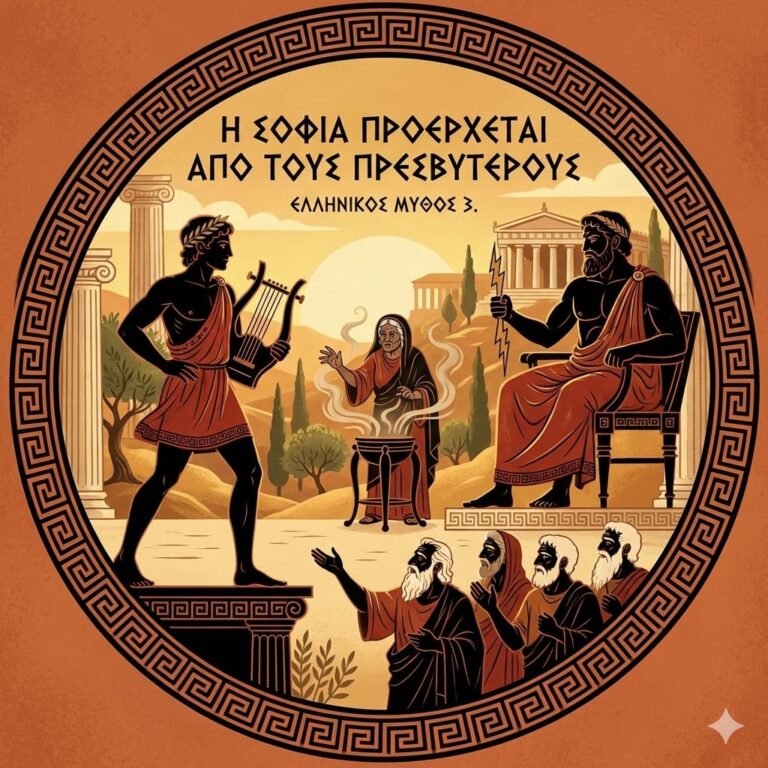
The Oracle of Delphi was not a goddess but a mortal woman—the Pythia, priestess of Apollo’s own temple. She sat above the sacred chasm from which prophetic vapors rose, and through her, Apollo’s prophecies were delivered to the world of mortals.
But the Pythia also received visions of her own, granted by forces older even than the Olympian gods. And one day, she summoned Apollo to his temple.
The god descended from Olympus in a shower of golden light, appearing before his priestess with a confident smile.
“You called for me, Pythia? What mortal matters need my attention?”
The old woman did not smile in return. Her eyes, filmed with the mists of prophecy, gazed at something Apollo could not see.
“Lord Apollo,” she said, her voice rough as wind through ancient trees, “I have seen a vision. You stand at a crossroads, and the path you choose will determine much—not just for yourself, but for gods and mortals alike.”
Apollo raised a golden eyebrow. “A vision about ME? How interesting. Tell me what you saw.”
“I saw you falling,” the Pythia said simply. “I saw your light dimmed, your confidence shattered, your divine power turned against you. I saw a future where your pride leads to disaster—unless you learn a lesson that your youth has not yet taught you.”
For a moment, something flickered in Apollo’s bright eyes—uncertainty, perhaps, or even fear. But it was gone in an instant, replaced by his usual confident smile.
“Falling? My light dimmed?” He laughed, a sound like bells chiming. “Pythia, I appreciate your concern, but I think you may have misread the vision. I am Apollo, son of Zeus, master of prophecy. If there were danger in my future, would I not see it myself?”
The Oracle shook her head slowly. “That is precisely the problem, my lord. The gods can see the futures of mortals, but they are often blind to their own. And you are so certain of your wisdom that you do not think to look.”
“What would you have me do?”
“Listen,” the Pythia said. “Listen to those who have walked longer paths than you—the ancient ones, the Titans, the beings who existed before Olympus rose. They know things you do not, have seen things you have not. Let their wisdom guide you, before your confidence becomes your downfall.”
Apollo was silent for a moment. Then he shrugged his perfect shoulders.
“I will consider your words, Pythia. But I must say, I think you worry too much. I have faced challenges before and triumphed. Why should this be any different?”
And with that, he returned to Olympus in another shower of light, leaving the Oracle to shake her head in sorrow.
Apollo walked the marble halls of Olympus, his mind churning. He would not admit it aloud, but the Oracle’s words had disturbed him. What if she was right? What if there was some danger he could not see?
No, that was impossible. He was the god of prophecy. If there was a threat, he would know.
Still, perhaps it would not hurt to speak with some of the older beings—not to seek advice, of course, but simply to demonstrate that his own knowledge was sufficient.
He found Atlas in the courtyard of the divine palace, seated on a stone bench with his massive shoulders hunched. Atlas was a Titan—one of the elder gods who had ruled before Zeus and the Olympians rose to power. After the great war between gods and Titans, Atlas had been punished to hold up the sky for eternity. But occasionally he was permitted to visit Olympus, his burden temporarily transferred to others.
“Atlas,” Apollo called, approaching with his confident stride. “I wonder if I might have a word with you.”
The Titan looked up. His face was ancient beyond description, carved by eons of strain and suffering, but his eyes held a depth of knowledge that even Apollo had to acknowledge.
“Young Apollo,” Atlas rumbled. “It is rare that the gods of Olympus seek out the company of conquered Titans. What brings you to me?”
“The Oracle spoke to me of dangers ahead,” Apollo said, settling onto the bench—far enough from Atlas that the Titan’s massive frame did not dwarf him. “She suggested I might learn something from those older than myself. I thought I would see if there was any truth to her words.”
Atlas was silent for a long moment, studying the young god. “And what do you hope to learn?”
“That is just it—I do not know. I am already the god of prophecy. I have knowledge of healing and plague, music and poetry, light and truth. What could you possibly teach me that I do not already know?”
A rumbling sound emerged from Atlas’s chest—it might have been a laugh. “Ah, young one. You remind me of myself, in the age before the war.”
“Oh?”
“I too believed that my power and knowledge were sufficient. I was a Titan, after all—we had ruled since the beginning of time. What could we not handle? What challenge could we not overcome?” His voice grew heavy. “And then your father’s generation rose against us, and we learned that the world was larger and more complex than we had imagined.”
Apollo frowned. “You suggest that I am making the same mistake?”
“I suggest nothing. I merely observe.” Atlas turned his ancient gaze to the horizon. “Let me ask you this, young god: have you ever been wrong about something important?”
“I—” Apollo started to say no, but something stopped him. He thought of the times his prophecies had been misunderstood, the times mortals had interpreted his words wrongly and suffered for it. He thought of his own mistakes, though he rarely liked to dwell on them.
“Perhaps,” he admitted reluctantly. “On occasion.”
“And when you were wrong, did you see the error beforehand, or only after?”
“After,” Apollo said slowly. “Usually after.”
Atlas nodded. “That is the nature of wisdom, young one. We often cannot see our own blind spots. That is why we need others—those whose eyes are different from our own, whose experience has taught them lessons we have not yet learned.” He paused. “The Oracle was right to warn you. And if you are wise, you will heed her words.”
Apollo returned to his quarters troubled. Atlas’s words echoed in his mind, joining the Oracle’s warning. Perhaps—just perhaps—there was something to what they said.
But before he could think further, a messenger arrived from Zeus.
“Your father summons you to the throne room,” the messenger said. “A dispute has arisen between two kingdoms of mortals, and they have both appealed to Olympus for judgment. Zeus wishes you to hear the case and deliver the verdict, using your prophetic sight to determine the truth.”
Apollo straightened his shoulders. This was exactly the sort of task he excelled at. He would show everyone—the Oracle, Atlas, all the doubters—that his judgment was sound and his wisdom sufficient.
The throne room was crowded with lesser gods and divine servants. At the far end, two groups of mortals knelt before Zeus’s great throne. On one side were the representatives of Thessaly, a northern kingdom; on the other, envoys from Boeotia, their neighbor to the south.
Zeus sat on his throne, lightning crackling quietly around his head. “Apollo, my son. These mortals come seeking divine judgment. Both claim ownership of a valley on their shared border—a valley rich with silver and timber. Each says the land has belonged to their people since ancient times. Use your gifts to determine the truth and render judgment.”
Apollo stepped forward confidently. He closed his eyes and reached out with his prophetic powers, seeking the threads of the past that would reveal the truth.
What he saw confused him.
The visions were contradictory. He saw Thessalian shepherds grazing their flocks in the valley generations ago—but he also saw Boeotian farmers tilling the same soil in the same era. He saw boundary stones that had been moved, documents that had been forged, memories that had been altered by time and wishful thinking.
The truth was not simple. The truth was not clear.
Apollo opened his eyes, a flicker of uncertainty crossing his face. But all the assembled gods were watching, and the mortals were waiting for his judgment. He could not admit that he did not know the answer.
“The valley,” he declared, his voice ringing with authority, “rightfully belongs to Thessaly. Their claim is older and more legitimate.”
The Thessalian envoys cheered. The Boeotians fell silent, their faces pale with despair.
But as Apollo spoke, he saw something in his peripheral vision: Atlas, standing in the shadows at the edge of the room, slowly shaking his head.
The Boeotians, convinced that the gods had judged against them unfairly, did not accept the verdict. They raised an army and marched on the disputed valley, determined to take by force what they believed was rightfully theirs.
The Thessalians, emboldened by divine support, met them with their own forces.
The battle was terrible. Hundreds died on both sides. Families were torn apart, villages were burned, and the valley itself—the rich land both sides had wanted—was scorched and ruined by the fighting.
When news of the disaster reached Olympus, Apollo felt it like a physical blow.
He had been wrong.
His judgment, delivered with such confidence, had been based on incomplete understanding. He had not taken the time to truly examine the complexity of the situation, had not sought counsel from others who might have seen what he missed. He had trusted his own perception over everything else.
And now people were dead because of it.
Apollo returned to Delphi, to the temple where the Oracle waited. He did not descend in a shower of golden light this time. He walked, slowly, like a mortal burdened by shame.
The Pythia was sitting by a small fire, her face calm and unsurprised when he appeared.
“You have come to tell me I was right,” she said. It was not a question.
“Yes.” Apollo’s voice was quiet, stripped of its usual confidence. “I did not listen. I thought my judgment was sufficient. And now…” He could not finish the sentence.
“And now you understand why the wise counsel of elders is not weakness, but strength.” The Oracle rose and placed a weathered hand on Apollo’s arm. “Even the gods can be wrong, Lord Apollo. Even those with prophetic sight have blind spots. The difference between wisdom and folly is not in never making mistakes—it is in learning from them.”
“How do I learn?” Apollo asked. “How do I become wise, when I have been so foolish?”
“You have already begun. You are here. You are listening. You are admitting that you do not know everything.” The Pythia smiled gently. “That is the first step—and the hardest.”
From that day forward, Apollo was changed.
He did not stop being the god of prophecy, of music, of light and healing. His arrows still flew true, and his lyre still produced melodies of heartbreaking beauty. But there was a new depth to him, a humility that had been absent before.
When mortals came to his Oracle seeking answers, he took greater care with the prophecies he delivered. He consulted with other gods, with the ancient Titans, with wise mortals who had accumulated knowledge he lacked. He learned to say, “I do not know,” when that was the truth, rather than offering false certainty.
And when the young gods of Olympus—the children of Zeus’s children—grew arrogant in their turn, Apollo would seek them out and share his story.
“I once thought I knew everything,” he would tell them. “I was the god of prophecy, after all. Who could tell ME anything I did not already see? But I learned—through failure and through sorrow—that wisdom is not the same as knowledge. Knowledge is seeing the facts before you. Wisdom is knowing how much you do not see.”
“But how can we trust the counsel of others?” the young gods would ask. “How do we know their advice is good?”
“You cannot always know,” Apollo would answer. “But that is precisely the point. When you think you know everything, you close yourself off from learning. When you admit your limitations, you open yourself to growth. The wisest beings in the cosmos are those who have lived longest and learned most—and they will tell you that the more they learn, the more they realize they do not know.”
He would often seek out Atlas after that, sitting with the ancient Titan in quiet conversation. Atlas had lived through the rise and fall of dynasties, the birth and death of gods, the transformation of the world itself. His experience dwarfed Apollo’s, and his perspective illuminated truths that younger eyes could not perceive.
“Why do you spend so much time with him?” Hermes asked once, puzzled. “He is a defeated Titan. What can he offer the god of prophecy?”
Apollo smiled—a wiser, gentler smile than the confident grin of his youth. “He can offer me his eyes. He sees the world from angles I have never considered. He remembers things I have never experienced. Through his wisdom, I become wiser myself.”
“But you are still a god,” Hermes protested. “You are still more powerful than he is.”
“Power and wisdom are not the same thing,” Apollo said. “In fact, sometimes power makes wisdom harder to achieve. When you can do anything, you are tempted to believe you know everything. It is only when we humble ourselves—when we admit that others may know things we do not—that true learning becomes possible.”
Centuries passed. Empires rose and fell. Mortals came and went like leaves in an eternal forest. But the lesson Apollo learned that day at Delphi echoed through all the ages that followed.
The Oracle continued to speak his prophecies, but she also spoke her own wisdom: “Even the god of prophecy listens to the counsel of elders. Should you, mortal, be too proud to do the same?”
The temples of Apollo became places where the young sought guidance from the old, where the confident were taught humility, and where the words “Know Thyself” were carved in stone as an eternal reminder.
And when, in later ages, philosophers arose among the mortals who began to ask deep questions about wisdom and knowledge and the nature of truth, they looked to Apollo as a model.
“The god of prophecy himself admitted he did not know everything,” they would say. “He learned from his elders, corrected his mistakes, and became wiser through humility. Shall we not follow his example?”
This was the true gift Apollo gave to the world—not his music, beautiful as it was; not his prophecies, valuable as they were; but the lesson that wisdom begins with acknowledging our limitations.
The young think they know everything. The wise know they do not.
And the wisest of all are those who seek counsel from those who have walked longer paths, learned harder lessons, and earned their understanding through the patient accumulation of experience.
This tale from Greek mythology teaches us that *wisdom comes from listening to those who have more experience than we do. Apollo was a god of prophecy, yet he failed to see the truth in a situation that more experienced beings might have perceived clearly.
The story shows us that confidence is not the same as wisdom. Apollo was supremely confident, but his confidence led him to ignore warnings and make a disastrous judgment. True wisdom includes knowing the limits of our own knowledge.
Most importantly, the tale reminds us that humility is the beginning of learning. As long as Apollo believed he knew everything, he could not learn. Only when he admitted his limitations did growth become possible. This is true for mortals as much as for gods.
The ancient Greeks inscribed “Know Thyself” at the temple of Delphi for a reason: self-knowledge, including knowledge of what we do NOT know, is the foundation of all wisdom.
Apollo was one of the most important gods in the Greek pantheon, associated with:
– Music and Poetry: His lyre was said to produce the most beautiful music in existence
– Prophecy: The Oracle at Delphi was his primary prophetic seat
– Light and the Sun: Later traditions identified him with the sun god Helios
– Healing and Plague: He could both cause and cure disease
– Truth: He was considered a god who could not lie
The Delphic Oracle was the most authoritative source of divine wisdom in ancient Greece. The Pythia, priestess of Apollo, delivered prophecies that influenced decisions from personal matters to affairs of state. The famous inscriptions at Delphi included:
– “Know Thyself” (gnothi seauton)
– “Nothing in Excess” (meden agan)
The Titans were the generation of gods who ruled before Zeus and the Olympians. After their defeat in the Titanomachy (war between Titans and Olympians), most were imprisoned in Tartarus, but Atlas was given the special punishment of holding up the sky.
Greek philosophy distinguished between different types of knowledge:
– Sophia: Wisdom, particularly moral and practical wisdom
– Episteme: Scientific or technical knowledge
– Phronesis: Practical judgment, knowing what to do in specific situations
The Greeks valued especially the wisdom that comes from experience and age, believing that elders possessed perspectives that youth could not yet understand.
Mythological Sources:
While this specific story is a modern retelling, it draws on authentic elements from Greek mythology:
– Apollo’s character: From the Homeric Hymn to Apollo and other sources
– The Delphic Oracle: Well-documented in Greek historical sources
– Atlas the Titan: From Hesiod’s Theogony and other sources
– Divine pride leading to downfall: Central theme in Greek tragedy
Thematic Sources:
– Sophocles’ Oedipus Rex: On the limits of prophecy and self-knowledge
– Plato’s Dialogues: On wisdom, humility, and the importance of questioning
– Greek Wisdom Literature: The tradition of seeking counsel from elders
Story Elements from Greek Tradition:
1. A god acting with hubris – Common motif (cf. Zeus’s own early arrogance)
2. The Oracle’s warning ignored – Countless examples in Greek tragedy
3. Consultation with ancient beings – Heroes often sought Titan or divine counsel
4. Tragic consequences of rash judgment – Core of Greek tragic drama
5. Transformation through suffering – Essential Greek understanding of growth
Historical Context: The ancient Greeks placed enormous value on the wisdom of elders. Young people were expected to learn from those who had more experience, and respect for age was a fundamental social value. This story reflects that cultural emphasis.
Modern Applications: Research in psychology and education confirms that expertise typically requires years of accumulated experience. While young people often have fresh perspectives and energy, older individuals frequently possess practical wisdom that comes only from having lived through many situations.
Discussion Starters:
1. Can you think of a time when you didn’t listen to good advice from someone older?
2. Why do you think it’s so hard to admit when we don’t know something?
3. What’s the difference between knowledge and wisdom?
4. Who are the “elders” in your life whose counsel you should seek more often?
1. Apollo was the god of prophecy, yet he failed to see the truth. How is this possible? (Explores how even experts have blind spots)
2. Atlas told Apollo that “the gods can see the futures of mortals, but they are often blind to their own.” Why might this be true? (Discusses how we are often least objective about ourselves)
3. When Apollo faced the judgment between the two kingdoms, he felt he couldn’t admit he didn’t know the answer. Why not? What would have happened if he had said “I need more time to investigate”? (Explores the pressure of expectations and the courage to admit uncertainty)
4. The Oracle said “wisdom is not the same as knowledge.” What’s the difference? (Knowledge is information; wisdom is knowing how to use it and knowing its limits)
5. After learning his lesson, Apollo began seeking counsel from Atlas and other ancient beings. Why is it important to seek advice from people who have more experience? (Explores the value of learning from others’ experiences)
6. “Know Thyself” was inscribed at Apollo’s temple. How does self-knowledge relate to wisdom? (Understanding our own limitations is essential to true wisdom)
– Oracle: A priest or priestess through whom a god speaks; also the place where prophecies are given
– Pythia: The specific priestess of Apollo at Delphi who delivered prophecies
– Hubris: Excessive pride or arrogance, especially pride that challenges the gods
– Titans: The generation of gods that ruled before the Olympians
– Prophecy: A prediction of future events, often understood as divinely inspired
– Sophia: Greek word for wisdom
– [Apollo – Theoi Greek Mythology](https://www.theoi.com/Olympios/Apollon.html) – Comprehensive mythology
– [The Oracle at Delphi](https://www.britannica.com/topic/Delphic-oracle) – Historical context
– [Know Thyself – Ancient Greek Philosophy](https://plato.stanford.edu/entries/ancient-soul/) – Philosophical background
– [Atlas the Titan](https://www.greekmythology.com/Titans/Atlas/atlas.html) – Titan mythology
This story draws on authentic Greek mythological traditions to explore the timeless truth that wisdom comes from acknowledging our limitations and learning from those who have more experience. Apollo’s transformation from confident arrogance to humble wisdom reflects the Greek understanding that growth requires the courage to admit what we do not know and the humility to seek counsel from those who have walked the path before us.*
Moral Lessons
- From that day forward, Apollo was changed.
He did not stop being the god of prophecy, of music, of light and healing. His arrows still flew true, and his lyre still produced melodies of heartbreaking beauty. But there was a new depth to him, a humility that had been absent before.
When mortals came to his Oracle seeking answers, he took greater care with the prophecies he delivered. He consulted with other gods, with the ancient Titans, with wise mortals who had accumulated knowledge he lacked. He learned to say, “I do not know,” when that was the truth, rather than offering false certainty.
And when the young gods of Olympus—the children of Zeus’s children—grew arrogant in their turn, Apollo would seek them out and share his story.
“I once thought I knew everything,” he would tell them. “I was the god of prophecy, after all. Who could tell ME anything I did not already see? But I learned—through failure and through sorrow—that wisdom is not the same as knowledge. Knowledge is seeing the facts before you. Wisdom is knowing how much you do not see.”
“But how can we trust the counsel of others?” the young gods would ask. “How do we know their advice is good?”
“You cannot always know,” Apollo would answer. “But that is precisely the point. When you think you know everything, you close yourself off from learning. When you admit your limitations, you open yourself to growth. The wisest beings in the cosmos are those who have lived longest and learned most—and they will tell you that the more they learn, the more they realize they do not know.”
He would often seek out Atlas after that, sitting with the ancient Titan in quiet conversation. Atlas had lived through the rise and fall of dynasties, the birth and death of gods, the transformation of the world itself. His experience dwarfed Apollo’s, and his perspective illuminated truths that younger eyes could not perceive.
“Why do you spend so much time with him?” Hermes asked once, puzzled. “He is a defeated Titan. What can he offer the god of prophecy?”
Apollo smiled—a wiser, gentler smile than the confident grin of his youth. “He can offer me his eyes. He sees the world from angles I have never considered. He remembers things I have never experienced. Through his wisdom, I become wiser myself.”
“But you are still a god,” Hermes protested. “You are still more powerful than he is.”
“Power and wisdom are not the same thing,” Apollo said. “In fact, sometimes power makes wisdom harder to achieve. When you can do anything, you are tempted to believe you know everything. It is only when we humble ourselves—when we admit that others may know things we do not—that true learning becomes possible.”
Test Your Understanding
1Who was the old Titan that Apollo met in the marble halls of Olympus?
Frequently Asked Questions
What is the moral lesson of Wisdom comes from listening to elders?
What age is this story appropriate for?
How long does it take to read Wisdom comes from listening to elders?
What culture does this story come from?
Can I use this story for teaching?
Frequently Asked Questions
What is the moral lesson in the story about wisdom coming from listening to elders?
The story teaches children that no matter how talented or gifted you are, wisdom comes from listening to elders and those with more experience. Even Apollo, god of prophecy, had to learn that pride and overconfidence can blind you to valuable guidance that others offer.
What age group is this bedtime story about listening to elders suitable for?
This bedtime story is designed for children ages 6 to 12. It uses engaging Greek mythology characters like Apollo to capture young imaginations while delivering meaningful life lessons about humility, respect, and the importance of listening to those who are wiser and more experienced.
Why is listening to elders considered important for kids?
Listening to elders helps children avoid mistakes by learning from others’ experiences. Elders carry years of hard-earned wisdom that books and talent alone cannot provide. Stories like this one show kids that even the most gifted individuals can benefit from guidance, making humility and openness essential life skills.
📚 Recommended Books
Handpicked for readers like you
As an Amazon Associate, we earn from qualifying purchases. These recommendations are personalized based on this story's themes and your reading history.
How does the story of Apollo teach children about pride and wisdom?
Apollo believes his gift of prophecy means he needs no one’s advice. The story uses his character to show children that excessive pride prevents growth and learning. Wisdom comes from listening to elders and remaining open to counsel, regardless of how capable or knowledgeable you think you already are.
What Greek mythology characters are featured in this kids’ bedtime story?
The story features Apollo, the son of Zeus and the Titaness Leto, as the main character. It also includes Zeus and other Olympian gods. Using familiar Greek mythology figures makes the lesson about wisdom and listening to elders both entertaining and memorable for young readers.