

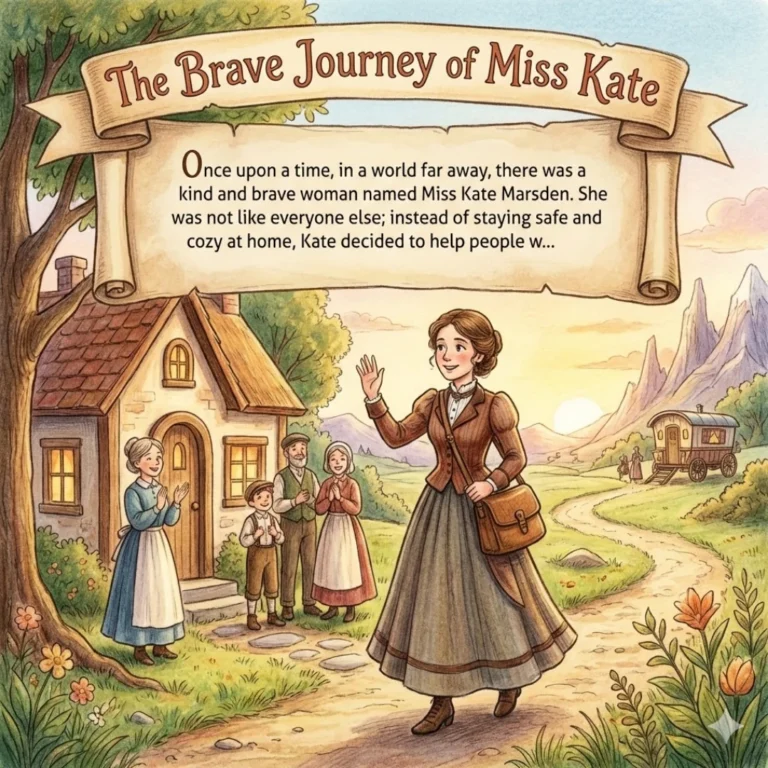
Share this engaging bedtime story with kids ages 6-12 to teach valuable life lessons.
Chapter One: The Nurse with a Dream
In the gray, fog-wrapped city of London in the year 1890, a young nurse named Kate Marsden sat in her small room, reading letters by candlelight. The letters came from faraway places with names that sounded like winter itself: Yakutsk, Irkutsk, Omsk.
They told of people suffering alone in the frozen wilderness of Siberia, people cast out from their villages because they had a terrible disease called leprosy. These letters made Kate’s heart ache with sadness and determination.
“Someone must help them,” she said aloud to herself. “Someone must show them they are not forgotten.”
Kate was not like most young women of her time. While others dreamed of comfortable homes and safe lives, Kate dreamed of adventure with a purpose. She had already served as a nurse in a war zone, caring for wounded soldiers. She had seen suffering up close and discovered she had a gift: she was not afraid.
Chapter Two: An Impossible Plan
When Kate announced her plan, everyone thought she had gone mad.
“You want to travel across Siberia? In winter?” her brother Thomas exclaimed. “Kate, that is the coldest place on Earth! The journey could kill you!”
“People die there every day from loneliness and neglect,” Kate replied calmly. “If I can survive the journey, perhaps I can bring them hope.”
“But you are a woman!” spluttered Lord Humphrey, a wealthy nobleman who sometimes supported charitable causes. “No woman could survive such hardship!”
Kate’s eyes flashed with determination. “I have survived things that would make most men faint, Lord Humphrey. I have held dying soldiers in my arms and not looked away. I have cleaned wounds so terrible that trained doctors fled the room. Do not tell me what a woman can or cannot do.”
Her conviction was so powerful that, one by one, people began to believe in her. Queen Victoria herself granted Kate an audience and gave her blessing to the mission. The Empress of Russia, touched by Kate’s courage, promised assistance when she reached Russian soil.
With letters of introduction, a medical kit, and a heart full of hope, Kate Marsden began her impossible journey.
Chapter Three: Into the Frozen Unknown
Kate’s journey began with steamships and trains, but those modern conveniences soon gave way to more primitive transport. In the deep Russian interior, she traded trains for horse-drawn sleighs called troikas.
The cold was unlike anything Kate had ever experienced. It bit through her fur coats and wool blankets. Her breath froze on her scarf, creating a mask of ice. At night, the temperature dropped so low that water turned to ice before it could reach the ground.
“Miss Kate, we must stop,” pleaded Pyotr, her Russian guide. “The horses cannot continue in this cold.”
“How much further to the next village?”
“Perhaps twenty miles.”
Kate looked at the endless white landscape, the snow glittering like diamonds under a pale sun. Twenty miles might as well be twenty thousand.
“Then we will walk the horses and rest them in shifts,” she decided. “But we will not stop.”
The small group pressed on through the frozen wilderness. Kate’s feet grew numb, then painful, then numb again. Her lips cracked and bled. But every time she wanted to give up, she thought of the people waiting in isolated villages ahead, people who had no hope of rescue, no expectation that anyone in the world cared whether they lived or died.
“I am coming,” she whispered to them across the miles of ice and snow. “Hold on. I am coming.”
Chapter Four: The Village of the Forgotten
After weeks of travel, Kate reached her first destination: a tiny village hidden deep in the Siberian taiga. What she found there broke her heart and strengthened her resolve.
The lepers lived in rough wooden huts far from the main village. They were not allowed to approach healthy people. Food was left for them at a safe distance, and they had to crawl through the snow to collect it. Many had lost fingers and toes to the disease, making even this simple task an ordeal.
“Why have you come?” asked an old woman named Maria, her voice rough from disuse. It had been years since anyone had spoken to her directly.
Kate knelt in the snow beside Maria, looking into her tired eyes. “I have come because you matter. Because every person on this Earth deserves kindness and care. I am a nurse, and I want to help.”
Maria began to cry, tears freezing on her weathered cheeks. “We thought the world had forgotten us.”
“The world can be forgetful,” Kate said gently. “But there are also those who remember. And now that I know you are here, I will make sure others know too.”
Chapter Five: The Herb of Hope
Kate had heard rumors of a special plant that grew in the deepest Siberian forests, an herb that some said could cure leprosy. Though she doubted such a miracle cure existed, she knew she had to investigate. Any hope, however small, was worth pursuing.
With two native guides who knew the forest, Kate ventured into the taiga. The forest was ancient and dense, trees so tall they seemed to touch the sky, their branches heavy with snow.
“The plant grows near the marshes,” explained one guide, an elderly Yakut man named Semyon. “My grandmother used it to treat wounds. But the marsh is dangerous. The ice is thin.”
“Then we will be careful,” Kate said.
They found the plant after three days of searching: a tough little herb with dark green leaves that somehow survived beneath the snow. Kate collected samples carefully, pressing them between pages of her journal.
She could not know then whether this herb would prove useful. But the search itself taught her something important: even in the harshest, most unforgiving landscape, life found a way to endure. The people she had come to help were like this little plant, surviving against all odds in a world that had given up on them.
Chapter Six: The Gift of Witness
Over the following months, Kate visited dozens of isolated communities. She could not cure the sick, not yet, but she could do something almost as important: she could witness their suffering and carry their stories back to the world.
She wrote everything down. The names of the sick. The conditions they lived in. The small kindnesses they showed each other despite their own hardships. The dignity they maintained even when the world treated them as less than human.
“Why do you write so much?” asked a young boy named Ivan, who had been sent to the leper colony when he was only six years old. He watched Kate’s pen move across the page with fascination.
“Because stories have power,” Kate explained. “When I return to England and Russia, I will share these stories with people who have power to help. When they read about you, Ivan, they will want to make your life better.”
“Do you really think anyone will care about us?”
Kate touched the boy’s thin shoulder gently. “I care. And once people know, many more will care too. You are not invisible, Ivan. You are not forgotten. And I promise, I will fight for you.”
Chapter Seven: The Triumphant Return
After nearly a year of travel, Kate Marsden returned to civilization. She was thin, exhausted, and her health had suffered greatly from the journey. But her eyes burned with purpose, and her journals were full of stories that demanded to be told.
She wrote a book about her journey and spoke to anyone who would listen. She addressed scientific societies, charitable organizations, and government officials. She met with the Empress of Russia and the Queen of England, showing them her pressed herb samples and sharing the stories of the forgotten people of Siberia.
“These people need hospitals,” she argued passionately. “They need medicine and doctors and nurses. They need to know the world has not abandoned them.”
Her words moved hearts and opened purses. Donations poured in. Plans were made for proper medical facilities in Siberia. The people Kate had visited, who had thought themselves forgotten forever, learned that a brave woman had traveled across the world to speak for them.
Chapter Eight: The True Meaning of Courage
Years later, when Kate was old and her traveling days were behind her, a young girl came to visit her. The girl wanted to become a nurse, and she had heard of Kate’s famous journey.
“Miss Marsden,” the girl asked, “were you not afraid? How did you find such courage?”
Kate smiled, her eyes distant with memories of frozen landscapes and suffering faces.
“Courage is not the absence of fear,” she said. “I was terrified many times. The cold could have killed me. The journey could have broken me. But courage is choosing to act despite your fear because something matters more than your comfort or safety.”
“What mattered more to you?”
“The people,” Kate said simply. “Every person who suffers alone, thinking nobody cares, every person cast out by society, every child like Ivan who just wants to know they matter. They mattered more than my fear. And do you know what I discovered?”
The girl shook her head.
“I discovered that when you live for others, your own strength grows beyond what you thought possible. The people I went to help ended up helping me. Their dignity in the face of suffering, their kindness to each other, their hope against all hope, they taught me what true strength looks like.”
The young girl left that day with a new understanding. Courage was not about being fearless. It was about caring so much that you could not stay silent, could not stay comfortable, could not stay safe while others suffered.
And that, perhaps, was Kate Marsden’s greatest gift to the world: not just the hospitals she helped build or the suffering she helped ease, but the example she set. One person, armed with nothing but compassion and determination, could travel across the frozen edge of the world and warm it with the fire of human kindness.
Moral Lessons
- True courage means caring so deeply about others that you act despite your fears. One person with compassion and determination can make a difference in the lives of many, even in the most challenging circumstances.
Test Your Understanding
1. Who was Kate Marsden and what did she decide to do?
2. How were the people with leprosy being treated in the villages Kate visited?
3. What did Kate search for in the Siberian forests?
4. Why did Kate write down everything she saw during her journey?
5. What did Kate say about courage when a young girl asked her about it?
6. What is the main moral lesson of this story?
Frequently Asked Questions
What is the moral lesson of The Brave Journey of Miss Kate?
What age is this story appropriate for?
How long does it take to read The Brave Journey of Miss Kate?
What culture does this story come from?
Can I use this story for teaching?
Frequently Asked Questions
Who was Kate Marsden and what made her so brave?
Kate Marsden was a courageous English nurse in 1890s London who dreamed of helping leprosy sufferers abandoned in Siberian wilderness. Unlike most women of her time, she wasn’t afraid of danger and had already served as a war nurse, making her uniquely brave and determined.
Why did Kate Marsden want to travel to the dangerous Siberian wilderness?
Kate received heartbreaking letters about people with leprosy who were cast out from their villages and left to suffer alone in Siberia’s frozen wilderness. Her compassionate heart couldn’t ignore their plight, and she felt called to show them they weren’t forgotten.
Is this bedtime story appropriate for kids ages 6-12?
Yes, this engaging bedtime story is specifically designed for kids ages 6-12. It teaches valuable life lessons about courage, compassion, and determination through Kate Marsden’s inspiring real-life adventure, making it both educational and age-appropriate.
📚 Recommended Books
Handpicked for readers like you
As an Amazon Associate, we earn from qualifying purchases. These recommendations are personalized based on this story's themes and your reading history.
What important lesson does Kate Marsden’s brave journey teach children?
Kate’s story teaches kids that one person with courage and determination can make a huge difference. It shows children the importance of helping others, standing up for what’s right, and not being afraid to follow your dreams, even when others think it’s impossible.
When and where did Kate Marsden’s story take place?
Kate Marsden’s brave journey began in foggy London in 1890, during Victorian times. Her mission took her from the comfortable city life to the harsh, frozen wilderness of Siberia in Russia, making it an epic adventure across continents.
