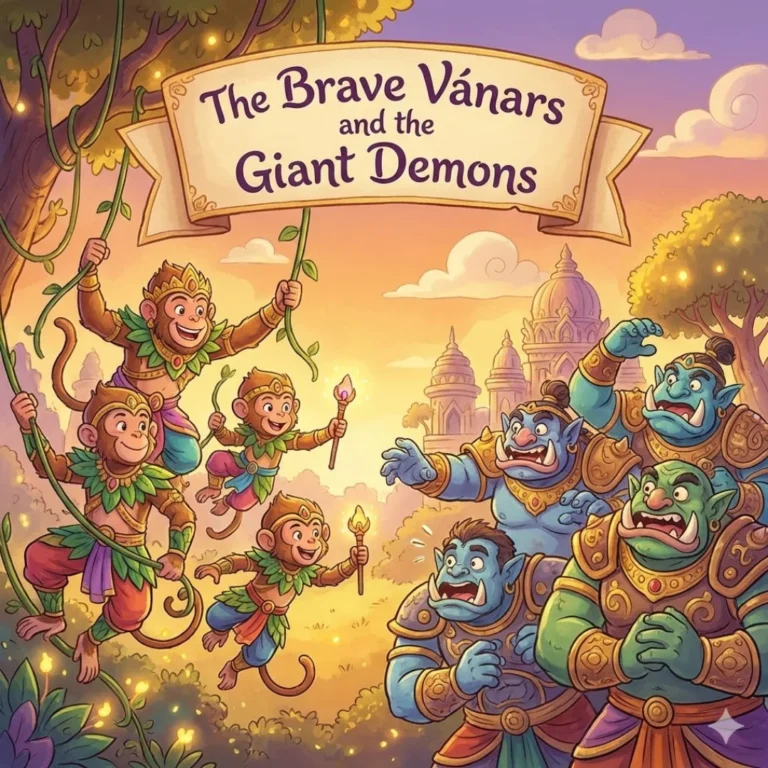
This bedtime story for kids, ‘The Brave Vánars and the Giant Demons’, teaches children ages 6-12 about important moral values.
Long ago, in the age when gods still walked among mortals and the boundaries between heaven and earth were thin, there lived a prince named Rama. He was the prince of Ayodhya, renowned throughout the three worlds for his adherence to dharma – the sacred law of righteousness. Rama was no ordinary prince; he was an avatar, a divine incarnation of Lord Vishnu himself, come to Earth to restore the balance between good and evil.
Rama had been exiled from his kingdom for fourteen years, wandering the forests with his devoted wife Sita and his loyal brother Lakshmana. During their exile, tragedy struck. The ten-headed demon king Ravana, ruler of the golden island of Lanka, kidnapped Sita through trickery and deception, carrying her away in his flying chariot across the ocean.
Rama’s heart was shattered, but his resolve was unbreakable. He vowed to rescue Sita and defeat Ravana, no matter what obstacles lay before him. But how could a single prince, even one blessed by the gods, wage war against the mightiest demon empire the world had ever known?
The answer came in the form of unexpected allies.
**The Alliance with the Vanaras**
In his search for Sita, Rama came to the kingdom of Kishkindha, ruled by the vanara king Sugriva. The vanaras were remarkable beings – possessing the forms of monkeys but blessed with human speech, divine powers, and noble hearts. They lived in a society with kings, ministers, and warriors, following dharma as faithfully as any human kingdom.
Sugriva had been wrongfully exiled by his brother Vali, and Rama helped him reclaim his throne. In gratitude, Sugriva pledged his entire vanara army to Rama’s cause. This was no small promise, for the vanaras numbered in the millions, and among them were warriors of extraordinary power.
The greatest of these was Hanuman, son of Vayu the wind god. Hanuman was blessed with immeasurable strength, the ability to change his size at will, and a devotion to Rama that would become legendary. It was Hanuman who leaped across the vast ocean to Lanka, found Sita imprisoned in Ravana’s garden, and brought back word of her location and her unwavering faithfulness.
When Hanuman returned with news of Sita, Rama knew the time for war had come.
**The March to the Sea**
Sugriva assembled the greatest vanara army ever gathered. Warriors came from every corner of the earth – from the mountains and forests, from the banks of sacred rivers and the depths of hidden valleys. Among the generals were mighty heroes whose names would echo through eternity.
There was Angada, the young prince and son of the fallen Vali, whose strength rivaled that of the mightiest demons. There was Nala, the divine architect, son of Vishwakarma the celestial builder. There was Nila, son of Agni the fire god, whose very touch could burn his enemies. There was Jambavan, the ancient king of bears, who had witnessed the churning of the cosmic ocean and carried wisdom of countless ages.
And leading them all was Hanuman, whose devotion to Rama burned brighter than a thousand suns.
The army marched southward like a living flood, shaking the earth with their footsteps. Mountains trembled at their passing. Rivers parted to let them through. Even the gods watched from heaven, marveling at this alliance between a human prince and the children of the wind and forest.
But when they reached the southern shore, the vanaras faced their greatest obstacle yet – the vast ocean that separated the mainland from Lanka.
**The Bridge of Devotion**
The ocean stretched before them, seemingly infinite, its waves crashing against the shore with the sound of a thousand drums. How could even an army of divine warriors cross such an expanse?
Rama knelt at the water’s edge and prayed to Varuna, the god of the ocean. For three days he meditated without food or water, but the ocean god did not respond. Finally, Rama rose, his eyes blazing with divine fire.
“If you will not help us,” Rama declared, raising his celestial bow, “then I shall dry you up with my arrows and my army shall walk across your empty bed!”
At this, the ocean trembled. Varuna rose from the depths, magnificent and terrible, and bowed before Rama.
“Forgive me, O prince,” the ocean god said. “I cannot part my waters, for it is against my nature. But among your warriors is Nala, son of the divine architect. He possesses the power to build a bridge across my waters. Whatever stones and boulders your vanaras throw into me, I shall support them and they shall not sink.”
With this blessing, the greatest engineering feat in history began.
The vanaras worked like beings possessed by divine purpose. They uprooted mountains and carried them to the shore. They gathered boulders the size of palaces. They tore trees from the earth, roots and all. Under Nala’s guidance, they hurled these materials into the ocean, and miraculously, everything floated.
Stone rested upon stone. Mountain pressed against mountain. The bridge grew at an impossible pace – fourteen leagues on the first day, twenty on the second, twenty-one on the third, twenty-two on the fourth, and twenty-three on the fifth day. In just five days, the vanaras had built a bridge one hundred leagues long, stretching all the way to Lanka.
The army crossed to the island of demons.
**The Giants of Lanka**
Ravana’s demons were not ordinary enemies. They were rakshasas – beings of terrible power who could change their shapes at will, grow to mountainous sizes, wield dark magic, and fight with a ferocity that had conquered even the gods.
Ravana himself was the mightiest of all. His ten heads represented his mastery of the ten directions and the four Vedas. He had performed such severe austerities that Brahma himself had granted him near-immortality – he could not be killed by gods, demons, or celestial beings. In his arrogance, he had not asked for protection from humans or animals, considering them beneath his notice.
Among his warriors were giants whose names struck fear into the hearts of the bravest. Kumbhakarna, Ravana’s brother, was a titan who slept for six months at a time but, when awakened, could devour entire armies. Indrajit, Ravana’s son, had conquered Indra himself and could become invisible in battle. Prahasta, Ravana’s commander, had never known defeat.
When the demons looked out from Lanka’s golden walls and saw the vanara army approaching, many laughed. What could monkeys do against the masters of the three worlds?
They would soon learn.
**The First Clashes**
The war began with terrible fury. Demons poured out of Lanka like a black flood, their weapons gleaming, their war cries shaking the sky. The vanaras met them without fear, wielding mountains as clubs and trees as spears.
The battlefield became a chaos of dust and blood, of roaring vanaras and shrieking demons. The combat was unlike anything the world had seen – warriors growing to giant sizes, hurling boulders that could crush cities, fighting with such force that the earth itself cracked beneath them.
Angada proved himself worthy of his legendary father Vali. He challenged Ravana’s mightiest generals one by one and defeated them all. When the demon Vajradamstra attacked him with a mace, Angada caught the weapon in mid-air and used it to crush his attacker. When Kampana came at him with a sword, Angada tore a tree from the ground and swept him away like a leaf in a hurricane.
Nila, son of the fire god, burned through demon ranks with his blazing touch. Wherever he walked, enemies fell back in terror, for no weapon could harm the child of flame. He faced the demon Prahasta, Ravana’s own commander, and after a fierce battle that shook the walls of Lanka, Nila struck him down with a mountain peak.
Hanuman fought with a fury born of pure devotion. He grew to enormous size, towering over the battlefield, and swept demons aside by the hundreds. When arrows struck him, he simply laughed and continued fighting. When magic was used against him, his faith in Rama dispelled every spell. Nothing could stand against the son of the wind.
**The Terror of Indrajit**
But the demons had their own champions.
Indrajit, called “Conqueror of Indra,” was perhaps the most dangerous of all. He possessed a boon that allowed him to become invisible in battle, and his weapons were blessed by the gods themselves. Worse still, he commanded the Nagapasha – the serpent weapon that could bind even celestial beings.
When Indrajit joined the battle, the tide turned terribly. Invisible to vanara eyes, he rained arrows down upon them like deadly rain. Warriors fell by the thousands, unable to see or strike their attacker. Even the mightiest vanara generals could not find him.
Then Indrajit unleashed the Nagapasha upon Rama and Lakshmana themselves. Millions of magical serpents descended upon the princes, binding them in coils of darkness. The venom entered their bodies, and both fell unconscious, their divine light dimming.
A great wail of despair rose from the vanara army. Their princes were fallen! All seemed lost.
But Hanuman would not surrender to despair. Remembering the ancient wisdom of Jambavan, he flew northward faster than thought itself to fetch the Sanjeevani herb from the Himalayan mountains – a medicine that could cure any wound and revive the dying.
When he could not identify the specific herb, Hanuman simply lifted the entire mountain and carried it back to Lanka. The fragrance of the healing plants revived Rama, Lakshmana, and all the fallen vanaras.
The battle was renewed with even greater fury.
**Kumbhakarna Awakens**
Seeing his armies failing, Ravana made a desperate decision. He ordered his servants to wake Kumbhakarna.
This was no simple task. Kumbhakarna had been cursed by Brahma to sleep for six months at a time, and waking him required the effort of an entire army. Thousands of demons beat drums near his ears. Elephants walked over his body. Mountains of food were piled before his nose.
Finally, the giant stirred.
Kumbhakarna was as tall as a mountain, as wide as a valley. His appetite was legendary – when he awoke, he devoured thousands of animals just to break his fast. His strength was such that he had once made the gods themselves tremble.
When Kumbhakarna strode onto the battlefield, the vanaras scattered like leaves before a storm. He scooped them up by the dozens and devoured them. He crushed thousands with single blows. Even the greatest vanara warriors could not wound him.
The army fell back in terror – all except Hanuman.
The son of the wind faced the son of chaos. They fought like two storms colliding, shaking the earth and sky. Hanuman struck Kumbhakarna with boulders, with trees, with mountains themselves. Kumbhakarna fought back with equal fury.
But Kumbhakarna’s true enemy was Rama himself.
The prince of Ayodhya stood calm amid the chaos, his divine bow Kodanda in his hands. As Kumbhakarna charged toward him, Rama loosed his arrows. Not ordinary arrows, but celestial weapons blessed by the gods.
One arrow severed Kumbhakarna’s arm. The giant fought on.
Another took his other arm. Still he came.
Arrow after arrow struck him, cutting away his terrible power.
Finally, Rama unleashed the Indra-astra, the weapon of the king of gods.
The arrow blazed across the battlefield like a second sun and struck Kumbhakarna’s head from his shoulders. The giant fell like a collapsing mountain, and the earth shook for miles around.
**The Final Battles**
With Kumbhakarna fallen, Ravana’s hope dimmed, but the demon king refused to surrender. He sent wave after wave of his remaining warriors against the vanara army.
Indrajit returned to the battlefield again and again, using every dark magic at his command. But this time, Lakshmana was ready. Guided by the divine sage Agastya, Lakshmana engaged Indrajit in single combat. Though the demon turned invisible, Lakshmana fired arrows that sought their target by sound and vibration. Finally, wielding the Indra-astra, Lakshmana struck down the Conqueror of Indra.
When news of his son’s death reached Ravana, even the ten-headed demon wept. But grief turned to rage, and rage to determination. If his warriors had failed, he would fight himself.
Ravana mounted his great chariot and rode out to face Rama.
The final battle between the prince of dharma and the king of demons was the greatest single combat in the history of the world. Gods gathered in the heavens to watch. The very elements held their breath.
Ravana was a warrior of immense skill, having practiced combat for thousands of years. His ten heads and twenty arms wielded weapons simultaneously, attacking from every direction at once. Dark magic crackled around him. His chariot, pulled by demonic steeds, moved faster than mortal eyes could follow.
But Rama was the embodiment of righteousness itself. He fought with perfect calm, his arrows flying with divine precision. When Ravana cut down Rama’s chariot, the god Indra sent his own celestial vehicle. When Ravana used the darkest magic, Rama countered with the light of dharma.
The battle raged for days. Rama cut off Ravana’s heads, but they grew back. He severed his arms, but they regenerated. How could the demon be defeated?
Then the sage Agastya appeared before Rama and taught him the Aditya Hridayam – the Hymn of the Sun God, the most powerful mantra of righteousness. Empowered by this sacred knowledge, Rama invoked the Brahmastra, the weapon of creation itself.
This divine arrow, blessed by Brahma, blazed with the combined power of the wind, fire, and sun. It struck Ravana in the heart – the one vulnerable point, the seat of his pride and evil – and the demon king fell.
**Victory and Return**
With Ravana’s fall, the war was over. The surviving demons surrendered, and Vibhishana, Ravana’s righteous brother who had joined Rama’s side, was crowned king of Lanka.
Sita was freed from her imprisonment, and after proving her purity through the ordeal of fire, she was reunited with Rama. The long exile was over.
But the celebration belonged equally to the vanaras. These brave warriors, born of divine parentage and blessed with noble hearts, had fought and died for a cause not their own. They had built an impossible bridge, faced demons of terrible power, and never wavered in their loyalty.
When Rama returned to Ayodhya to claim his throne, he honored the vanaras above all others. Hanuman was given the supreme boon – to live as long as Rama’s story was told, eternally devoted to his lord. Sugriva, Angada, and all the vanara chiefs were celebrated as the truest of friends and the bravest of warriors.
The story of their courage spread throughout the three worlds. In heaven, the gods praised them. On earth, humans honored them. Even in the underworld, the tale was told.
For the vanaras had proven that true strength comes not from size or magic, but from devotion, courage, and righteousness. They had shown that when dharma calls, even the humblest beings can become heroes.
And so their story lives on – in temples where Hanuman is worshipped, in the Ramayana that is recited in countless homes, in the hearts of all who believe that good must triumph over evil.
The bridge they built still exists, some say – a line of shoals stretching between India and Sri Lanka, a reminder of the day when an army of devoted warriors made the impossible possible.
Moral Lessons
- True courage comes from devotion to righteousness, not from size or power. When beings of pure heart unite for a just cause, they can overcome even the mightiest evil. Loyalty, selfless service, and unwavering faith in dharma are the greatest weapons of all.
Test Your Understanding
1. Why did Ravana kidnap Sita in the Ramayana?
Frequently Asked Questions
What is the moral lesson of The Brave Vánars and the Giant Demons?
What age is this story appropriate for?
How long does it take to read The Brave Vánars and the Giant Demons?
What culture does this story come from?
Can I use this story for teaching?
Frequently Asked Questions
What are Vanaras in this bedtime story for kids?
Vanaras are monkey-like beings from Hindu mythology who become Rama’s loyal allies. In this bedtime story, they represent courage, friendship, and teamwork. These magical creatures help Prince Rama rescue his wife Sita from the demon king Ravana, showing children how even the smallest helpers can make a big difference in fighting evil.
Is this moral story appropriate for my child?
Yes, this moral story is specifically designed for children ages 6-12. It focuses on positive values like courage, loyalty, and righteousness while presenting the classic Ramayana tale in an age-appropriate way. The story avoids frightening details and emphasizes how good triumphs over evil through teamwork and determination.
What lesson does this story teach children?
This story teaches children about dharma (righteousness), loyalty, courage, and the power of friendship. Kids learn that doing the right thing isn’t always easy, but with good friends and strong values, you can overcome any challenge. The Vanaras show how helping others and working together makes everyone stronger.
📚 Recommended Books
Handpicked for readers like you
As an Amazon Associate, we earn from qualifying purchases. These recommendations are personalized based on this story's themes and your reading history.
What happens in The Brave Vanaras and the Giant Demons story?
Prince Rama teams up with brave monkey warriors called Vanaras to rescue his wife Sita from the ten-headed demon king Ravana. Together, they face incredible challenges, build bridges across oceans, and battle giant demons. The story shows how Rama’s righteousness and his allies’ courage ultimately defeat evil and restore peace.
How long does this bedtime story take to read?
This engaging bedtime story takes about 10-15 minutes to read aloud, making it perfect for nighttime reading. The story is long enough to be captivating but not so lengthy that it keeps children awake. Parents can read it in one sitting or break it into smaller sections for younger listeners.