

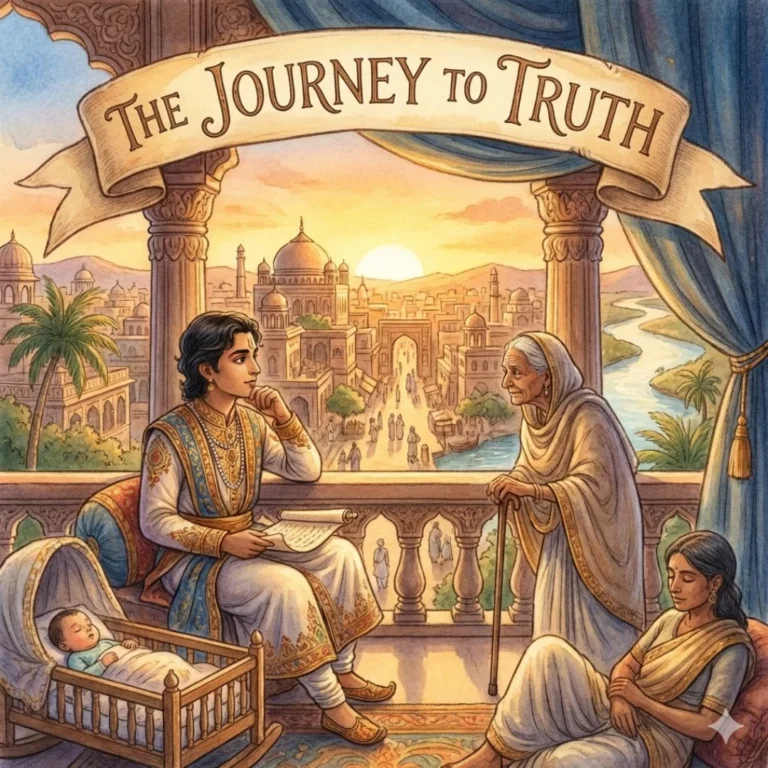
This moral story for children ages 6-12 combines entertainment with important values.
Chapter One: The Prince Who Had Everything
In a magnificent palace surrounded by gardens of jasmine and lotus, there lived a young prince named Siddhartha. His father, King Suddhodana, ruled the Shakya kingdom with wisdom and care, and he loved his son more than all the treasures in his vast kingdom.
Siddhartha had everything a child could wish for. Servants brought him the finest foods on golden plates. Musicians played sweet melodies to help him sleep. His clothes were made of silk softer than clouds, and his toys were crafted by the most skilled artisans in the land.
Yet despite all these riches, young Siddhartha often sat alone in the palace gardens, watching the butterflies drift from flower to flower, a thoughtful expression on his face.
“What troubles you, my prince?” asked his faithful friend Channa one afternoon. Channa was the son of the royal horse keeper and had grown up alongside Siddhartha.
“I watch the butterfly,” Siddhartha replied quietly. “This morning it was a caterpillar. Tomorrow its wings will fade. Everything changes, Channa. Everything passes. Why must it be so?”
Channa had no answer, for the prince asked questions that even wise scholars struggled to understand.
Chapter Two: The Four Sights
King Suddhodana noticed his son’s contemplative nature and grew worried. Long ago, a sage had prophesied that young Siddhartha would either become a great king or a great spiritual teacher. Wanting his son to inherit the throne, the king kept Siddhartha within the palace walls, shielding him from anything that might lead his mind toward spiritual matters.
But even the highest walls cannot hold back truth forever.
On the day Siddhartha turned twenty-nine, he convinced his father to let him ride through the city. The king agreed, but secretly ordered the streets cleared of anyone who was old, sick, or suffering.
Despite these precautions, the young prince saw something his father had tried to hide.
In a quiet alley, hunched against a wall, sat an elderly man. His back was bent, his hair white as winter snow, and his face was carved with countless wrinkles.
“What has happened to him?” Siddhartha asked Channa, who was driving the chariot.
“Nothing has happened, my prince,” Channa replied gently. “He is simply old. This is what time does to all living beings.”
Siddhartha felt a strange sadness settle in his heart. “Will I become like that? Will everyone I love grow old and frail?”
“Yes, my prince. This is the nature of life.”
On later journeys, despite his father’s efforts, Siddhartha encountered a man twisted with fever and illness, and another time, a funeral procession carrying someone who had died. Each sight deepened the questions burning in his mind.
Finally, he saw a wandering holy man in simple orange robes, walking with a peaceful smile despite owning nothing but a wooden bowl.
“Who is that?” Siddhartha asked, amazed by the man’s serene expression.
“He is a seeker of truth,” Channa answered. “He has given up worldly pleasures to find answers about the nature of life and suffering.”
Something stirred deep within Siddhartha’s heart.
Chapter Three: The Great Departure
That night, Siddhartha could not sleep. He walked through the palace, looking at the luxuries surrounding him as if seeing them for the first time. The golden ornaments, the silk tapestries, the jeweled furniture, none of it could answer his questions. None of it could stop old age, sickness, or death.
He paused at the door to his chambers where his wife Yasodhara slept with their newborn son, Rahula. His heart ached with love for them. How could he leave?
But another question burned brighter: If he stayed, could he ever find the answers that might one day free them, and all beings, from suffering?
With tears in his eyes, Siddhartha made the hardest decision of his life.
He asked Channa to saddle his faithful horse, Kanthaka. In the deep darkness before dawn, the prince removed his jewels, cut off his long hair with his sword, and exchanged his silk robes for the simple clothes of a wanderer.
“Tell my father,” he said to Channa, “that I am not abandoning anyone. I am setting out to find something that will help everyone.”
Chapter Four: The Years of Searching
For six years, Siddhartha wandered through forests and mountains, seeking wisdom. He studied with the greatest teachers of his time, learning to quiet his mind through meditation and to control his breath through yoga.
He found many truths, but not The Truth.
Then he tried a different path. He joined five other seekers who believed that denying the body’s needs would free the spirit. For months, they ate almost nothing, sitting motionless in burning sun and freezing rain.
Siddhartha became so thin that his bones showed through his skin. His eyes sank into his skull. He could wrap his fingers around his own backbone. But still, he had not found the answers he sought.
One day, as he sat by a river barely able to move, a young girl named Sujata passed by. She was bringing rice pudding to offer at a nearby temple, and when she saw the starving seeker, compassion filled her heart.
“Please,” she said, kneeling beside him, “you must eat. The body is not your enemy. It is the vessel that carries you toward wisdom.”
Siddhartha accepted her gift and realized an important truth: extreme pleasure and extreme denial were both paths that led nowhere. The answer lay in balance, in what he called the Middle Way.
His five companions saw him eat and left in disappointment, thinking he had given up. But Siddhartha knew his journey was just reaching its most important moment.
Chapter Five: Under the Bodhi Tree
In the village of Bodh Gaya, Siddhartha found a great fig tree with heart-shaped leaves. Something about this tree called to him. He gathered soft grass, made a cushion, and sat beneath its spreading branches.
“I will not rise from this spot,” he declared, “until I have found the truth about life and suffering.”
The moon rose and set. Stars wheeled overhead. Siddhartha sat in deep meditation, going deeper into his own mind than he had ever gone before.
Then came his greatest test.
Mara, the lord of desire and fear, appeared before him. Mara did not want Siddhartha to find enlightenment, for wisdom is the enemy of confusion and selfishness.
First, Mara sent his most beautiful daughters to distract Siddhartha with dreams of pleasure. But the seeker remained still, for he knew that pleasure without meaning was like a flower without roots.
Then Mara sent terrifying demons with weapons of fire and shadow, hoping fear would make Siddhartha run. But the seeker remained calm, for he knew that fear was just another thought, and thoughts were like clouds passing through the sky.
Finally, Mara tried doubt.
“Who do you think you are?” Mara demanded. “What gives you the right to seek the truth? Who witnesses your worthiness?”
Siddhartha simply reached down and touched the earth with his fingertips.
“The earth itself is my witness,” he said. “Every being who suffers, every creature who yearns for peace, they are my witnesses. I seek the truth not for myself alone, but for all beings.”
And with that, Mara vanished like mist before the morning sun.
Chapter Six: The Dawn of Understanding
As the morning star appeared in the sky, Siddhartha’s mind broke through the final veil of confusion. He saw the true nature of existence: how all things are connected, how suffering arises from clinging to things that cannot last, and how freedom comes from understanding and letting go.
He saw that kindness, compassion, and wisdom were the treasures that never faded. He saw that every living being had the same potential for awakening within them, like seeds waiting for water and sunlight.
In that moment, Siddhartha became the Buddha, “the Awakened One.”
He sat beneath the Bodhi tree for days, absorbing the profound peace of his realization. Part of him wanted to stay there forever, dwelling in perfect understanding. But then he thought of all the people in the world who suffered as he once had suffered, who asked the questions he once asked, who searched for answers they could not find.
“I will teach,” the Buddha decided. “I will share what I have learned with anyone willing to listen.”
Chapter Seven: The First Teaching
The Buddha found his five former companions in a deer park near the city of Varanasi. At first, they planned to ignore him, angry that he had abandoned their path of self-denial.
But as he approached, they noticed something had changed. The Buddha seemed to glow with an inner light. Peace radiated from him like warmth from the sun. Despite themselves, the five seekers rose and bowed.
“Friends,” the Buddha said gently, sitting among them as an equal, “I have found the Middle Way, the path between luxury and poverty, between pleasure and pain. Let me share what I have discovered.”
He spoke of Four Noble Truths: that suffering exists, that suffering has a cause, that suffering can end, and that there is a path to that ending. He described the Eightfold Path of right understanding, right intention, right speech, right action, right livelihood, right effort, right mindfulness, and right concentration.
The five seekers listened with open hearts, and understanding dawned in their minds like the rising sun.
This was the beginning of the Buddha’s teaching journey. For forty-five years, he walked across India, sharing his wisdom with kings and peasants, scholars and children. He taught that everyone, no matter their birth or circumstances, could find awakening through wisdom, kindness, and understanding.
Chapter Eight: The Legacy of Awakening
Even after the Buddha passed from this world, his teachings continued to spread. They traveled east to China and Japan, south to Sri Lanka and Thailand, north to Tibet, and eventually across the whole world.
Today, millions of people still follow the path he discovered. They meditate under trees, in temples, and in their homes. They practice kindness to all living beings. They seek to understand their own minds and free themselves from the confusion that causes suffering.
But perhaps the Buddha’s greatest teaching was this: you do not need to be a prince, or sit under a special tree, or travel to distant lands to find truth. The potential for wisdom lives within every heart. Every moment offers the chance to wake up, to see clearly, to choose kindness over anger, generosity over greed, and understanding over ignorance.
The journey to truth is not something that happened long ago to a prince in India. It is happening right now, with every kind word you speak, every compassionate action you take, every moment you choose to truly see the world around you.
Moral Lessons
- True happiness comes not from external treasures but from inner wisdom, kindness, and understanding. By following a balanced path and treating all beings with compassion, we can discover the peace that exists within every heart.
Test Your Understanding
1. What did Prince Siddhartha see that troubled him deeply?
2. What important lesson did the girl Sujata teach Siddhartha?
3. What happened to Siddhartha under the Bodhi Tree?
4. What are the Four Noble Truths that the Buddha taught?
5. What did the Buddha do after achieving enlightenment?
6. What is the main moral lesson of this story?
Frequently Asked Questions
What is the moral lesson of The Journey to Truth?
What age is this story appropriate for?
How long does it take to read The Journey to Truth?
What culture does this story come from?
Can I use this story for teaching?
Frequently Asked Questions
What age group is The Journey to Truth story suitable for?
This moral story is designed for children ages 6-12. It combines age-appropriate storytelling with deeper philosophical questions about life and change, making complex concepts accessible for young minds while maintaining their interest through engaging characters and palace adventures.
Who is Prince Siddhartha in this children’s story?
Prince Siddhartha is the main character who lived in a magnificent palace with every luxury imaginable. Despite having everything, he asks thoughtful questions about why things change and pass away. The story follows his journey from a privileged childhood toward seeking deeper truths about life.
What life lesson does this moral story teach kids?
The story teaches children about curiosity, deep thinking, and questioning the world around them. Through Prince Siddhartha’s observations of butterflies and changes in nature, kids learn it’s okay to ask big questions about life and that seeking truth and understanding is valuable.
📚 Recommended Books
Handpicked for readers like you
As an Amazon Associate, we earn from qualifying purchases. These recommendations are personalized based on this story's themes and your reading history.
Is this story based on a real person from history?
Yes, Prince Siddhartha is based on the historical figure who later became known as Buddha. However, this version is adapted as a children’s story, focusing on his early life and natural curiosity rather than complex religious teachings, making it accessible for young readers.
How does The Journey to Truth help with bedtime reading?
This story works perfectly as a bedtime story because it combines gentle adventure with thoughtful moments that can spark meaningful conversations between parents and children. The palace setting and philosophical questions create a calming yet intellectually stimulating bedtime experience for kids ages 6-12.
