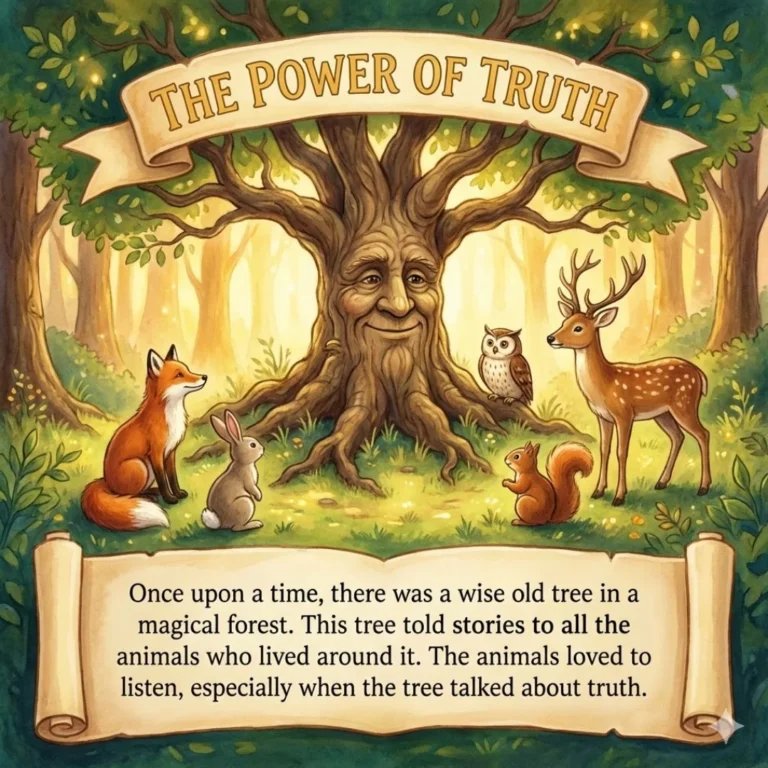
This bedtime story for kids, ‘The Power of Truth’, teaches children ages 6-12 about important moral values.
In the ancient city of Ayodhya, there once lived a king whose name would become synonymous with truth itself – Harishchandra. He was a descendant of the great Ikshvaku dynasty, a lineage blessed by the gods and bound by sacred duty. Among all the kings who ever ruled, Harishchandra was renowned throughout the three worlds for one supreme quality: he had never spoken a lie.
Not once in his entire life had an untruth passed his lips. Not even the smallest exaggeration, not the gentlest softening of difficult facts, not the most innocent white lie. His word was as unbreakable as the mountains, as pure as the waters of the Ganga.
This dedication to truth was not merely a personal preference but a sacred vow. Harishchandra believed that satya – truth – was the very foundation of dharma, the cosmic order that held the universe together. To break one’s word was to tear at the fabric of existence itself.
The gods in heaven watched Harishchandra with admiration. Among them, Lord Vishnu himself praised the king’s virtue. But one being questioned whether any mortal could truly be so perfectly truthful.
That being was the sage Vishwamitra.
**The Sage’s Challenge**
Vishwamitra was one of the most powerful sages who had ever lived. Born a kshatriya warrior, he had transformed himself into a brahmarishi – a sage of the highest order – through thousands of years of severe austerities. His tapas (spiritual heat) was so powerful that even the gods feared to cross him.
“Surely,” Vishwamitra mused, “no human being can be perfectly truthful. Given enough pressure, anyone will break. Let me test this king and reveal the limits of mortal virtue.”
Some say Vishwamitra was motivated by jealousy of Harishchandra’s fame. Others say he wished to prove that the path of perfect truth was impossible for mere mortals. Still others believe the sage was actually helping Harishchandra achieve spiritual liberation through the fire of trials. Perhaps all three were true.
Whatever his motivation, Vishwamitra descended to the mortal realm with a plan that would test Harishchandra to the uttermost limits of human endurance.
**The Dream and the Promise**
One night, King Harishchandra had a dream. In this dream, he saw the great sage Vishwamitra performing a massive yajna – a sacred fire sacrifice for the benefit of all beings. The king, moved by devotion, approached the sage in the dream.
“Great rishi,” Harishchandra said, “I wish to support your noble yajna. Please accept a donation from me – I offer you everything I possess.”
Vishwamitra smiled and accepted the gift.
When Harishchandra awoke, he thought little of the dream. But a few days later, the sage Vishwamitra arrived at his palace in person.
“O King,” Vishwamitra said, “do you remember what you promised me in your dream?”
Harishchandra paled. He did remember. And a promise, whether made waking or dreaming, was sacred.
“I remember, O sage. I offered you everything I possess.”
“Then I have come to collect,” Vishwamitra replied. “I require dakshina – the ritual gift that accompanies a sacred promise. Give me your entire kingdom.”
Without hesitation, Harishchandra signed over his kingdom – every palace, every treasury, every piece of land, every subject. In a single moment, the great king became a pauper.
But Vishwamitra was not finished.
“The dakshina for such a great gift must be equally great,” the sage continued. “You owe me an additional payment – let us say, one thousand gold coins.”
Harishchandra looked around at the kingdom that was no longer his. “I have nothing left, O sage. You have taken everything.”
“Then you must find a way to pay,” Vishwamitra said coldly. “A promise is a promise. You have one month.”
**The Road of Sorrow**
Harishchandra left his own palace with only his wife Shaivya (also called Taramati) and their young son Rohitashva. The former rulers of a great empire now walked barefoot on dusty roads, with no food, no shelter, and no idea how they would survive.
Queen Shaivya did not complain. She had married Harishchandra knowing his commitment to truth, and she shared his values completely. If poverty and hardship were the price of keeping one’s word, she would pay it gladly.
Young Rohitashva, though only a child, seemed to understand that something important was happening. He walked beside his parents without crying, trusting them completely.
They traveled south, toward the holy city of Kashi (Varanasi), hoping to find work. But Vishwamitra followed them, demanding his payment. The month was almost up, and Harishchandra had no money at all.
In desperation, the king made a decision that broke his heart but preserved his word.
“I have only one thing of value left,” he told the sage. “Myself. I will sell myself into slavery, and the payment will go to you.”
“And what of your wife and child?” Vishwamitra asked.
Harishchandra’s voice broke. “They… they must be sold as well. It is the only way.”
The marketplace of Kashi was crowded that day. The former king stood on the slave block, his wife and son beside him. The noble queen, who had once worn silks and diamonds, now stood in rags, yet her dignity was undimmed.
A wealthy brahmin bought Shaivya to serve as a maid in his household. She was separated from her husband and child without even being allowed to say goodbye properly. Her last glimpse of them was through her tears.
Young Rohitashva clung to his father, weeping.
Then a chandala approached – a keeper of cremation grounds, considered the lowest of the low in the social order of that time. This man bought Harishchandra.
The former king of Ayodhya, descendant of the sun god, ancestor of the great Rama yet to come, was now a slave of the cremation grounds.
But he had kept his word.
**The Keeper of the Burning Ghat**
Harishchandra’s duties in the cremation ground were grim. He had to collect fees from families bringing their dead for cremation, gather wood for the funeral pyres, and ensure that the proper rites were performed. He worked among the ashes of the dead, surrounded by smoke and grief.
Day after day, night after night, the former king labored. His hands, once soft from holding scepters, grew calloused from carrying wood. His robes, once magnificent, were replaced by rough cloth stained with soot.
Other workers mocked him. “Look at this one,” they laughed. “He speaks like a king but carries corpses like the rest of us!”
Harishchandra said nothing. What was there to say? He had given his word, and his word was his bond.
Meanwhile, Shaivya worked as a servant in the brahmin’s house, washing clothes, cleaning floors, serving food. She never spoke of her former life as a queen. When other servants treated her poorly, she responded with kindness. Her inner nobility could not be hidden by her outer circumstances.
Young Rohitashva helped in the household as well, running errands and tending to small tasks. Though he sometimes cried for his father, he tried to be brave.
Months passed. The family was separated, suffering, reduced to the lowest circumstances. Yet not one of them considered lying or breaking their word to escape their fate.
**The Ultimate Test**
One terrible day, Rohitashva was gathering flowers in a garden when he was bitten by a venomous snake. The poison worked quickly. Despite the efforts of the household, the boy died before sunset.
Shaivya’s grief was beyond description. She had lost her kingdom, her husband, her freedom – and now her only child. Yet even in this extremity, she did not curse the gods or abandon her dharma.
She wrapped her son’s body and carried him through the dark streets of Kashi to the cremation ground, as custom required. She had no money for the cremation fee – she owned nothing at all – but she hoped the workers would show mercy to a grieving mother.
At the cremation ground, a figure emerged from the smoke and darkness. It was Harishchandra, covered in ash, barely recognizable.
For a moment, husband and wife stared at each other. Then Shaivya’s eyes fell on the small bundle she carried.
“Our son is dead,” she whispered.
Harishchandra’s world collapsed around him. His beloved child, the hope of his dynasty, was gone. The grief that struck him was like a physical blow, driving him to his knees.
But even then, even in the darkest moment of his life, a terrible duty remained.
“I… I must collect the cremation fee,” Harishchandra said, his voice hollow. “That is my duty to my master.”
“I have nothing,” Shaivya replied. “I am a slave. I own nothing in this world.”
Harishchandra knew this was true. He also knew what he had to do.
“Then… then I cannot permit the cremation,” he said, each word like a knife in his heart. “My master has ordered me to collect fees from everyone. I cannot make exceptions, even for… even for my own son.”
Some versions of the story say that Shaivya tore strips from her own garment – the only thing she possessed – to offer as payment. Others say she simply stood there, holding her dead child, while her husband wept but did not waver from his duty.
At this moment, when a man’s commitment to truth was tested against the deepest love a father can feel, the heavens themselves held their breath.
**The Gods Bear Witness**
Suddenly, the sky split open. Divine light poured down upon the cremation ground. The gods themselves descended – Indra, king of heaven; Dharma, the god of righteousness; Vishnu, the preserver; and many others.
Vishwamitra was there too, but transformed. The harsh sage now smiled with infinite kindness.
“Harishchandra,” Vishwamitra said, “your trials are over. I have tested you in every possible way. I took your kingdom, your wealth, your freedom, your family. I placed you in circumstances where any ordinary person would have broken. Yet through it all, you never once abandoned truth.”
“Not when you lost your throne did you lie to reclaim it. Not when you were sold as a slave did you deny your identity. Not when your own son lay dead did you abandon your duty. You are the true king of dharma.”
Dharma, the god of righteousness himself, stepped forward. “Harishchandra, I have watched mortals for countless ages, but never have I seen such perfect adherence to truth. Your satya has created a merit that illuminates all three worlds.”
Then something miraculous happened. Young Rohitashva stirred in his mother’s arms. The boy’s eyes opened. Life returned to his body – a blessing from the gods themselves.
“Father? Mother?” the boy said, confused but alive.
The family embraced, tears of joy mixing with tears of sorrow-transformed. The long nightmare was ending.
**Restoration and Immortal Fame**
Indra, king of the gods, made Harishchandra an offer. “Come to heaven with me now. You and your family have earned eternal residence in Swarga, the celestial realm. You need never suffer again.”
But Harishchandra, even after all he had endured, thought first of others.
“O king of gods, what of my former subjects in Ayodhya? What of the people who depended on me? I cannot accept heaven while they remain without a king.”
This final act of selflessness moved the gods beyond measure. Through divine intervention, Harishchandra was restored to his throne. But he returned not as an ordinary king – he returned as a king who had proven his worth through the ultimate tests, whose name would be remembered forever as the embodiment of truth.
Vishwamitra, his role as tester completed, became one of Harishchandra’s greatest supporters. The sage had not acted from malice but from a divine purpose – to prove to all the worlds that perfect truth was possible for mortals to achieve.
Harishchandra ruled wisely for many more years, his fame spreading throughout the universe. When at last his time on earth ended, he ascended to heaven with his wife and son, taking his entire kingdom with him – a reward unprecedented in the history of the world.
To this day, his name is invoked whenever people speak of truthfulness. “Be like Harishchandra” is the highest praise for someone’s honesty in Indian culture.
**The Teaching of the Story**
The story of Harishchandra teaches us that truth is not merely a policy or a preference – it is the very foundation of dharma, the cosmic order that holds reality together. When we commit to truth absolutely, we align ourselves with the deepest principles of the universe.
This does not mean that the path of truth is easy. Harishchandra suffered terribly for his commitment. He lost everything that the world considers valuable – power, wealth, family, status. Yet he gained something far greater: he became one with dharma itself.
The story also teaches that tests come to those who strive for virtue. The greater our commitment to righteousness, the greater the trials we may face. But these trials are not punishments – they are opportunities for our virtue to shine forth and inspire others.
Finally, the story shows that truth and love are not opposed. Harishchandra loved his wife and son desperately. His commitment to truth did not diminish that love – it proved that love, when combined with righteousness, can endure anything.
In a world where lies seem convenient and truth seems costly, the tale of Harishchandra stands as an eternal reminder that satya – truth – is the highest dharma, and those who uphold it, though they may suffer for a time, will ultimately triumph.
Moral Lessons
- Truth is the highest dharma and the foundation of all virtue. A word once given must be kept, regardless of the cost. Those who commit absolutely to truth, though they may face terrible trials, will ultimately be vindicated and honored. Integrity is more valuable than any worldly possession.
Test Your Understanding
1. What sacred quality made King Harishchandra famous throughout the three worlds?
Frequently Asked Questions
What is the moral lesson of The Power of Truth?
What age is this story appropriate for?
How long does it take to read The Power of Truth?
What culture does this story come from?
Can I use this story for teaching?
Frequently Asked Questions
Who was King Harishchandra and why was he famous for truth?
King Harishchandra was an ancient ruler from Ayodhya in the Ikshvaku dynasty who never spoke a single lie in his entire life. He believed truth (satya) was the foundation of dharma and cosmic order. Even the gods admired his perfect dedication to honesty, making him legendary throughout Hindu mythology.
What happens in The Power of Truth story?
This bedtime story follows King Harishchandra, whose unwavering commitment to truth gets tested by the gods. The tale explores how his sacred vow to never lie becomes both his greatest strength and his ultimate challenge, teaching children about the importance of honesty.
Is this bedtime story appropriate for children ages 6-12?
Yes, this moral story is specifically designed for kids ages 6-12. It presents complex themes like truth and integrity through an engaging ancient tale that’s easy for children to understand, making it perfect for bedtime reading and character development.
📚 Recommended Books
Handpicked for readers like you
As an Amazon Associate, we earn from qualifying purchases. These recommendations are personalized based on this story's themes and your reading history.
What moral lesson does this Hindu story teach kids?
The story teaches children that truthfulness is one of the most important virtues. Through King Harishchandra’s example, kids learn that being honest, even when it’s difficult, builds character and earns respect. It shows how truth forms the foundation of good behavior.
What does dharma mean in this ancient Indian tale?
Dharma refers to righteous duty and the cosmic order that keeps the universe balanced. In the story, King Harishchandra sees truth as the foundation of dharma, meaning that being honest helps maintain harmony in the world around us.