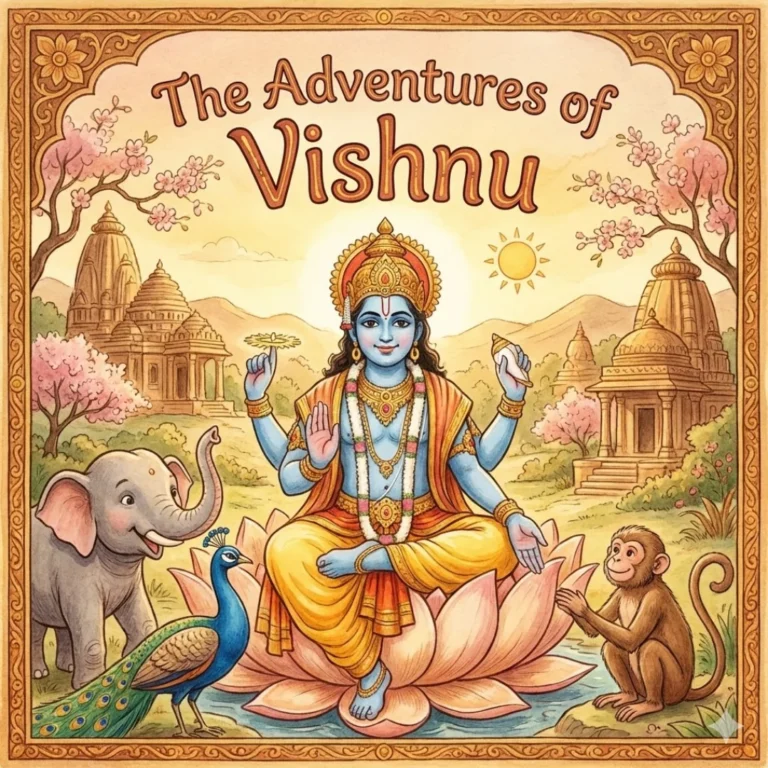
This bedtime story for kids, ‘The Adventures of Vishnu’, teaches children ages 6-12 about important moral values.
In the vast cosmos described by Hindu tradition, there exists a divine trinity—the Trimurti—three aspects of the supreme reality. Brahma creates the universe, Shiva transforms and destroys, and Vishnu preserves and protects. Of these three, Vishnu is known as the Preserver, the compassionate protector who watches over the world and all living beings.
Vishnu dwells in Vaikuntha, a celestial realm beyond the material universe. He reclines on the great serpent Shesha, floating on the cosmic ocean, while his consort Lakshmi, goddess of fortune, sits at his feet. From this divine abode, Vishnu observes the world. Whenever dharma—the sacred law of righteousness—declines and adharma—chaos and evil—rises, Vishnu descends to Earth in a physical form to restore the balance.
These divine descents are called avatars, and tradition speaks of ten principal avatars—the Dashavatara. Each appeared in a different age, when the world faced a unique crisis. This is the story of Vishnu’s ten great interventions.
**Matsya: The Fish**
In the beginning of the current cosmic cycle, there lived a righteous king named Manu Satyavrata. One day, while performing his ablutions in a river, a tiny fish swam into his hands and spoke with a human voice: “Save me from the larger fish who wish to devour me, and I will save you in return.”
Manu, compassionate by nature, placed the fish in a jar. But overnight, the fish grew so large it could no longer fit. Manu transferred it to a tank, then to a lake, then to the ocean—but still the fish kept growing!
“Who are you truly?” Manu asked in wonder.
“I am Vishnu,” the great fish replied. “In seven days, a cosmic flood will destroy all life. Build a great ship and gather the seven great sages, seeds of all plants, and pairs of all animals. When the waters rise, tie your ship to my horn, and I will guide you to safety.”
Manu did as instructed. When the flood came, sweeping away mountains and kingdoms, Vishnu as Matsya pulled the ship through the tumultuous waters. The demon Hayagriva had stolen the Vedas—the sacred scriptures—but Matsya defeated him and recovered the holy texts, preserving divine knowledge for the new age.
**Kurma: The Tortoise**
After the great flood, many precious things had been lost in the cosmic ocean, including amrita—the nectar of immortality. Both the devas (gods) and asuras (demons) desired it, and they agreed to work together to churn the ocean and retrieve it.
They used Mount Mandara as a churning rod and the great serpent Vasuki as the rope. But when they began churning, the mountain started to sink into the ocean floor.
Vishnu then took the form of Kurma, a gigantic tortoise. He dove beneath the mountain and supported it on his back, providing a stable base. For a thousand years they churned, and many wondrous things emerged: the wish-fulfilling cow, the celestial tree, the goddess Lakshmi herself. Finally, the physician of the gods appeared with the nectar of immortality.
The demons tried to steal the nectar, but Vishnu assumed the form of Mohini, an enchanting maiden, and distracted them while the gods drank the nectar, gaining immortality.
**Varaha: The Boar**
A demon named Hiranyaksha had performed terrible austerities and gained great power. Drunk with pride, he attacked the devas and then dragged the very Earth herself down to the bottom of the cosmic ocean, plunging the world into darkness.
Vishnu took the form of Varaha, a mighty boar with tusks that could pierce the heavens. He dove into the dark waters, his divine snout sniffing out the demon’s hiding place. For a thousand years, Varaha and Hiranyaksha battled in the ocean depths. Finally, Varaha gored the demon with his tusks and lifted the Earth on his snout, bringing her back to her proper place in the cosmos.
The Earth, grateful, praised Vishnu: “You have saved me yet again, O Lord. You are the support of all existence.”
**Narasimha: The Man-Lion**
Hiranyaksha had a brother, Hiranyakashipu, who was even more terrible. Seeking revenge and power, he performed such fierce austerities that Brahma himself appeared to grant him a boon.
“Grant me immortality!” Hiranyakashipu demanded.
“That I cannot do,” Brahma replied. “All things must eventually pass.”
So the clever demon asked: “Then let me not be killed by man or beast, by day or night, indoors or outdoors, on earth or in sky, by any weapon.”
Brahma granted this, and Hiranyakashipu became virtually invincible. He terrorized the three worlds and declared himself god, forcing everyone to worship him alone.
But the demon had a son named Prahlada, who was devoted to Vishnu despite his father’s rage. “Father, God is everywhere,” Prahlada would say. “In you, in me, in this very pillar.”
“In this pillar?” Hiranyakashipu mocked, and struck a palace column with his mace. “Then let him save you!”
The pillar split open with a tremendous sound, and from it emerged Narasimha—half man, half lion, a form that was neither man nor beast. At twilight (neither day nor night), on the palace threshold (neither indoors nor outdoors), Narasimha placed the demon on his lap (neither earth nor sky) and tore him apart with his claws (not a weapon).
Thus did Vishnu protect his devotee and destroy evil through divine cleverness.
**Vamana: The Dwarf**
In another age, there ruled a generous demon king named Bali, who through his virtue and sacrifices had conquered the three worlds. Though he ruled justly, his growing power threatened the cosmic balance.
During one of Bali’s grand sacrifices, a small brahmin boy appeared—Vamana, a dwarf, barely reaching up to a man’s knee. He approached the king with great humility.
“Great king,” Vamana said, “I am but a poor student. Will you grant me a small gift—three paces of land measured by my feet?”
Bali’s guru, the wise Shukracharya, recognized this was Vishnu in disguise. “Do not grant this boon!” he warned. “This is no ordinary dwarf!”
But Bali prided himself on his generosity. “I have given my word,” he said, and poured water on Vamana’s hands to seal the gift.
Immediately, Vamana began to grow. He grew and grew until his form filled the entire universe. With his first step, he covered all the Earth. With his second step, he covered all the heavens. “Where shall I place my third step?” the cosmic Vishnu asked.
Bali, recognizing the Lord, bowed his head. “Place it here, upon my head.”
Vishnu’s third step pushed Bali down to the underworld—but not as punishment. Impressed by Bali’s integrity and devotion, Vishnu granted him sovereignty over the netherworld and promised to serve as the guardian of his door, honoring the righteous demon-king forever.
**Parashurama: Rama with the Axe**
When the warrior class (kshatriyas) became corrupt and tyrannical, oppressing the priests and common people, Vishnu was born as Parashurama, son of the sage Jamadaghi.
Parashurama’s father was murdered by an arrogant king named Kartavirya Arjuna, who stole the sage’s sacred cow. In his righteous rage, Parashurama took up his axe and vowed to cleanse the Earth of tyranny. Twenty-one times he circled the Earth, destroying wicked rulers and establishing righteousness.
After accomplishing his mission, Parashurama retired to the mountains to practice meditation, having taught the world that even the powerful must respect dharma or face divine justice.
**Rama: The Perfect King**
In the age of Treta Yuga, the demon king Ravana of Lanka had become invincible through boons. He could not be killed by gods or demons, but in his arrogance, he had not sought protection from humans.
Vishnu was born as Rama, prince of Ayodhya—the embodiment of dharma, the perfect son, brother, husband, and king. Though he was heir to the throne, he accepted fourteen years of exile to honor his father’s promise, showing perfect obedience.
During his exile, Ravana kidnapped Rama’s wife Sita. To rescue her, Rama formed an alliance with the vanaras (forest-dwelling people), built a bridge across the ocean to Lanka, and after a great war, defeated Ravana with his divine arrows.
Rama’s story, told in the great epic Ramayana, teaches the importance of dharma, loyalty, courage, and righteousness even in the face of terrible adversity.
**Krishna: The Divine Cowherd**
In the age of Dwapara Yuga, when the Earth was burdened by evil kings and demons, Vishnu took birth as Krishna, the eighth child of Devaki and Vasudeva, who was raised by foster parents among cowherds.
Krishna’s childhood was filled with miracles—he defeated demons sent to kill him, lifted Mount Govardhana on his finger to protect villagers from torrential rain, and enchanted everyone with his flute playing and divine charm.
As a young man, Krishna became the charioteer and guide of the warrior Arjuna, speaking to him the Bhagavad Gita—one of Hinduism’s most sacred texts—on the battlefield of Kurukshetra. Krishna’s teachings about duty, devotion, and the nature of reality continue to guide millions.
Krishna helped establish righteousness by supporting the Pandavas in the Mahabharata war, teaching that when dharma is threatened, even war may be necessary to restore it.
**Buddha: The Enlightened One**
In some traditions, the Buddha is considered Vishnu’s ninth avatar, though this is debated. According to this interpretation, Vishnu took birth as Siddhartha Gautama to teach compassion, non-violence, and the path to enlightenment.
As Buddha, he showed that attachment causes suffering and taught the middle way between extreme asceticism and indulgence. His message of peace and mindfulness spread across Asia, bringing wisdom and compassion to countless beings.
**Kalki: The Future Warrior**
The tenth avatar has not yet appeared. According to prophecy, at the end of the current age (Kali Yuga), when righteousness has nearly vanished and the world is ruled by chaos and corruption, Vishnu will appear as Kalki.
He will come riding a white horse, wielding a blazing sword, to destroy evil and inaugurate a new golden age. After Kalki’s intervention, the cycle will begin anew, and the world will once again be filled with righteousness and truth.
**The Eternal Protector**
The ten avatars show us that the divine is not distant but actively engaged in the world’s struggles. Each avatar appears in the form most suited to the crisis of that age—sometimes as an animal, sometimes as a fierce warrior, sometimes as a wise teacher.
Together, these avatars teach us that righteousness must be actively defended, that duty must be performed even at great cost, and that the divine compassion extends to all beings. Vishnu descends again and again because the world, though it falls into darkness, is always worthy of saving.
The cycle continues—creation, preservation, destruction, and renewal. And through it all, Vishnu watches, ready to descend once more whenever dharma needs a defender.
Moral Lessons
- Divine protection is always available when righteousness falters. Each crisis requires a different approach—sometimes strength, sometimes wisdom, sometimes compassion. Good will ultimately triumph, and those who uphold dharma will be protected.
Test Your Understanding
1. Why was Krishna sent away from his birth parents as a baby?
Frequently Asked Questions
What is the moral lesson of The Adventures of Vishnu?
What age is this story appropriate for?
How long does it take to read The Adventures of Vishnu?
What culture does this story come from?
Can I use this story for teaching?
Frequently Asked Questions
What is the Adventures of Vishnu bedtime story about?
This bedtime story for kids teaches children about Vishnu, the Hindu god known as the Preserver who protects the world. It tells of his ten avatars—different forms he takes to restore balance when evil rises. The story begins with Matsya the Fish and explores how Vishnu saves the world through his various incarnations.
Who is Vishnu in Hindu mythology?
Vishnu is one of three main Hindu gods in the Trimurti (divine trinity). While Brahma creates and Shiva destroys, Vishnu preserves and protects the universe. He lives in Vaikuntha, a heavenly realm, reclining on the serpent Shesha with goddess Lakshmi. When righteousness declines, he descends to Earth to restore order.
What are Vishnu’s ten avatars in these moral stories for children?
Vishnu’s ten avatars are called the Dashavatara—divine forms he takes to save the world during different crises. The story starts with Matsya, the Fish avatar. Each avatar appeared when the world faced unique challenges, showing children how good always triumphs over evil through divine intervention and righteous action.
📚 Recommended Books
Handpicked for readers like you
As an Amazon Associate, we earn from qualifying purchases. These recommendations are personalized based on this story's themes and your reading history.
Is this Vishnu story appropriate for children ages 6-12?
Yes, this story is specifically designed for children ages 6-12 as a bedtime story that teaches moral values. It presents Hindu mythology in an age-appropriate way, focusing on themes of protection, righteousness, and good versus evil. The content is engaging yet gentle enough for young minds to understand and enjoy.
What moral lessons does the Adventures of Vishnu teach kids?
This story teaches children about dharma (righteousness), the importance of protecting others, and how good ultimately conquers evil. Through Vishnu’s avatars, kids learn about courage, compassion, and divine intervention. It shows that when faced with challenges, staying true to moral values leads to positive outcomes and restoration of balance.