

An elephant king, caught by a crocodile for a thousand years, learns that the most powerful force in the universe is a call from a sincere heart.
In a sacred lake at the foot of a great mountain, there lived a herd of elephants led by their king, Gajendra. He was enormous and proud—the most powerful creature for a hundred miles in any direction.
One afternoon, Gajendra waded into the lake to bathe and drink. He was surrounded by his herd, trumpeting and splashing with joy.
Then something seized his leg.
Deep in the lake lurked a mighty crocodile. Its jaws clamped around Gajendra’s ankle and pulled. The elephant king thrashed and roared, pulling with all his legendary strength.
But the crocodile held.
For a thousand years—or what felt like a thousand—they struggled. Gajendra’s great strength slowly began to fail. His herd watched in anguish but could not help. One by one they retreated, frightened and helpless.
Gajendra felt, for the first time in his life, that no strength he possessed would be enough.
He did not know the exact words of prayer. He had no sacred learning. He was simply an elephant, exhausted, sinking.
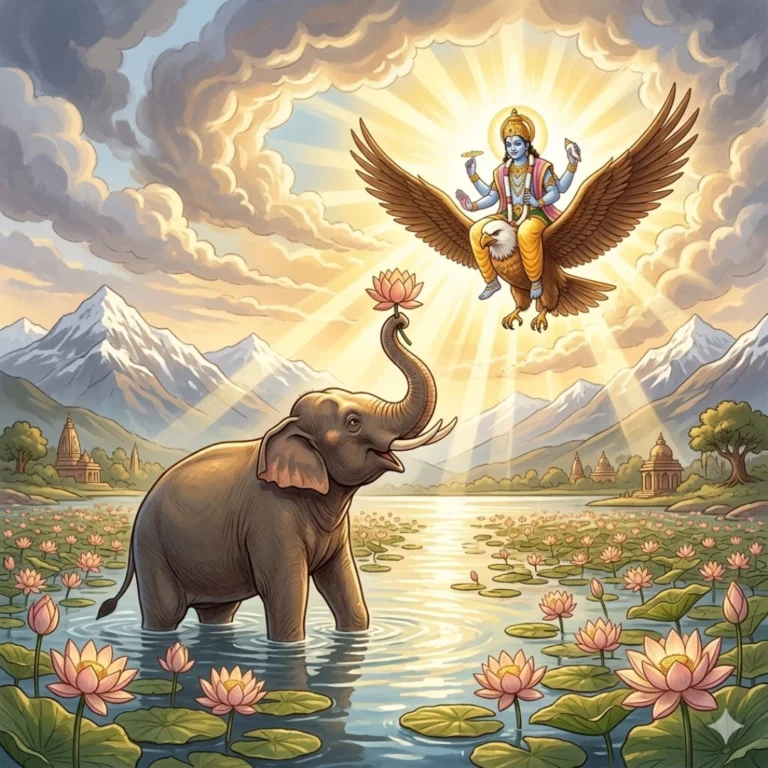
And in that moment of complete helplessness, something opened inside him. He raised his trunk, lifted a lotus flower from the water, and called out from the depths of his heart—not with pride, not with clever words—only with complete, honest surrender.
“O Supreme One,” he cried. “I am not able. Help me.”
On the other side of the universe, Vishnu heard.
He arrived instantly—riding his eagle Garuda, his discus spinning in his hand. With one throw, the crocodile was slain and Gajendra was free.
The elephant king bowed, trembling, in the shallows.
The gods said later that it was not Gajendra’s power that had called Vishnu—it was Gajendra’s complete truthfulness. He had given up pretending to be enough on his own.
That was the purest kind of prayer.
Moral of the Story
Faith is not about perfect words or great knowledge. It is the honest cry from a heart that has stopped pretending to need nothing.
Learn These Words
- anguish
- severe mental or physical pain
- surrender
- giving up resistance; accepting you cannot do something alone
- sacred
- connected to God or considered holy
- discus
- a circular weapon or sports disc
- sincere
- genuinely meaning what you say or feel
Test Your Understanding
1What caught Gajendra’s leg?
2What did Gajendra’s herd do when they could not help?
3What did Gajendra do when his strength failed?
4What did Gajendra lift when he called for help?
5What lesson does this story teach?
Frequently Asked Questions
What is the story of Gajendra’s Cry about?
Gajendra’s Cry is an ancient Hindu mythological tale about an elephant king named Gajendra who is seized by a powerful crocodile while bathing in a sacred lake. After struggling for what feels like a thousand years and exhausting all his strength, Gajendra offers a sincere, heartfelt prayer for divine help—teaching that genuine surrender is more powerful than physical might.
Where does the story of Gajendra’s Cry come from?
The story originates from the Bhagavata Purana, one of the most important sacred texts in Hindu tradition. Known as ‘Gajendra Moksha,’ it is widely retold across Indian culture as a lesson about devotion, humility, and the power of sincere prayer. It remains a beloved moral story shared with children and adults alike.
Why couldn’t Gajendra’s herd of elephants save him from the crocodile?
Despite their numbers and strength, Gajendra’s herd was powerless against the crocodile because it held the advantage in water. The story uses this detail to illustrate a deeper lesson: there are moments in life when no amount of worldly power or outside support can rescue us, and only sincere inner surrender brings true help.
📚 Recommended Books
Handpicked for readers like you
As an Amazon Associate, we earn from qualifying purchases. These recommendations are personalized based on this story's themes and your reading history.
What is the moral lesson behind Gajendra’s Cry?
The central moral is that a sincere cry from the heart is the most powerful force in the universe. Pride, physical strength, and status all have limits. When Gajendra finally let go of his ego and called out with genuine humility and helplessness, divine grace answered. The story teaches that true strength begins where pride ends.
Why did Gajendra lift a lotus flower when he prayed?
Gajendra raising a lotus from the water is a deeply symbolic gesture. The lotus represents purity, devotion, and spiritual offering. Even though Gajendra had no formal prayers or sacred learning, his act of offering the lotus with complete sincerity showed that genuine devotion doesn’t require perfect words—it only requires a pure and humble heart.
