

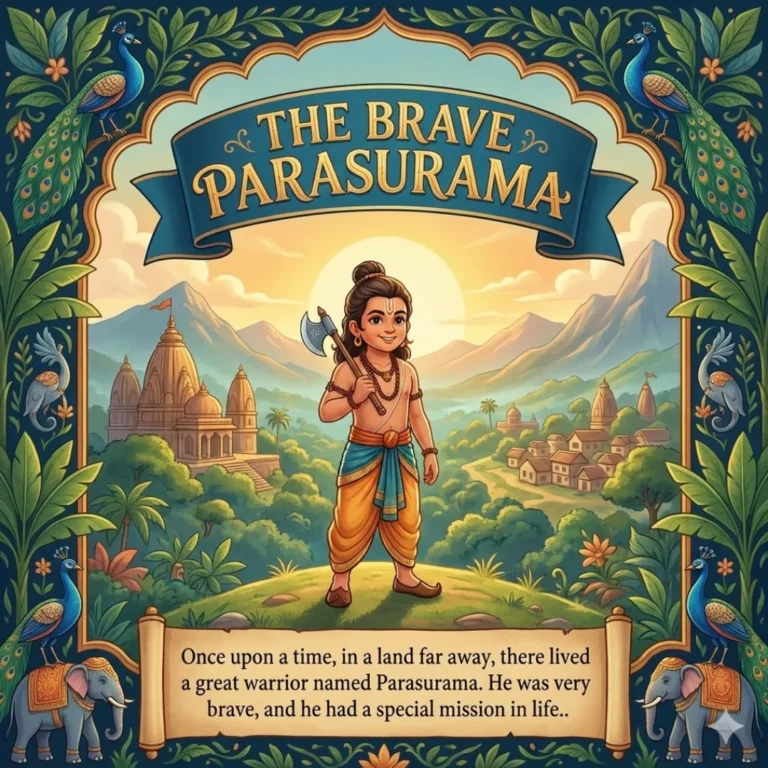
This moral story for children ages 6-12 combines entertainment with important values.
THE BIRTH OF AN EXTRAORDINARY CHILD
In ancient times, during an age when the earth groaned under the weight of injustice and tyranny, the great sage Jamadagni lived with his wife Renuka in a peaceful hermitage nestled in the forests. Jamadagni belonged to the illustrious lineage of Bhrigu, one of the great mind-born sons of Brahma, and was renowned for his spiritual powers, austerities, and mastery of the Vedas.
Renuka was a Kshatriya princess by birth, daughter of King Renu of the Ikshvaku dynasty. She had chosen to leave the comforts of royal life to marry the sage Jamadagni and live a simple life of devotion and service. Together, they had been blessed with five sons: Rumanvat, Sushena, Vasu, Vishwavasu, and the youngest, who would become known to the world as Parashurama.
The birth of this fifth son was marked by extraordinary signs. The gods and celestial beings knew that Lord Vishnu had taken incarnation once again, this time to correct a great imbalance in the cosmic order. The child was born with an innate understanding of both the spiritual knowledge of the Brahmins and the martial valor of the Kshatriyas—a rare combination that would make him unique among all avatars.
The baby was initially named Rama, but he would later earn the name Parashurama, which means “Rama with the axe” (parashu = axe). This name would become synonymous with divine justice and the restoration of dharma through righteous force.
THE EDUCATION OF A WARRIOR-SAGE
Unlike typical Brahmin children who studied only the Vedas and spiritual sciences, young Rama received a dual education. His father Jamadagni taught him the sacred scriptures, the performance of yajnas (fire sacrifices), the science of mantra, and the deep philosophy of the Vedas. From these teachings, Rama developed unparalleled spiritual power and wisdom/” title=”More stories about wisdom”>wisdom.
But the young Rama’s education did not stop there. Recognizing his son’s divine purpose, Jamadagni allowed him to also train in the martial arts and the science of warfare. When Rama came of age, he undertook severe austerities, meditating in the mountains and forests for years, subsisting on minimal food, standing in cold rivers, and demonstrating extraordinary dedication.
Lord Shiva, pleased with Rama’s devotion and recognizing the divine plan for which he had incarnated, appeared before him in resplendent glory.
“Rama, son of Jamadagni,” Shiva spoke with a voice that resonated through creation, “I am pleased with your devotion. You have been born to restore balance to a world tilting toward injustice. For this mission, you will need a weapon worthy of your purpose.”
Shiva then gifted Rama with a celestial axe—the Parashu—a weapon of incredible power that could cut through any armor, any shield, and any obstacle. It was no ordinary axe, but a divine instrument that responded to the wielder’s righteous intent.
“This Parashu will never fail you when your cause is just,” Shiva declared. “I will also teach you the celestial arts of warfare, the Dhanur Veda, so that you may fulfill your divine mission.”
For years, Rama trained under Lord Shiva himself, learning every aspect of combat, strategy, and the wielding of divine weapons. When his training was complete, he returned to his father’s ashram, now a complete Brahma-Kshatriya—a sage with the power of a warrior, a warrior with the wisdom of a sage.
THE DIVINE COW AND THE GROWING TYRANNY
Jamadagni’s hermitage possessed a divine cow named Kamadhenu, also known as Surabhi, who could fulfill any wish and provide unlimited sustenance. This was no ordinary animal but a celestial being who willingly served the sage’s household and the performance of sacred rituals. With Kamadhenu’s help, Jamadagni could feed thousands of visitors, conduct elaborate yajnas, and maintain his hermitage.
During this time, the kingdoms of the world were ruled by Kshatriyas—the warrior class whose dharma (righteous duty) was to protect the people, uphold justice, and use their power for the welfare of all. In the ideal order, the Kshatriyas would rule with strength but be guided by the wisdom of Brahmins, creating a perfect balance between power and wisdom.
However, over many generations, this balance had been lost. The Kshatriyas had become drunk on their own power. They stopped listening to the counsel of wise sages. They used their military might not to protect but to oppress. They taxed the people cruelly, seized lands unjustly, and disturbed the peaceful hermitages of sages. Those who should have been protectors had become tyrants.
The most powerful among these corrupt kings was Kartavirya Arjuna, ruler of the Haihaya kingdom. Through years of austerities, he had received tremendous boons from the god Dattatreya. He possessed a thousand arms and could wield a thousand weapons simultaneously. He could fly through the air without a vehicle. He had strength equal to ten thousand elephants. His power was so great that he had once stopped the mighty river Narmada with his arms, dammed it with his body just to please his wives who wished to play in the still waters.
Such immense power might have been used for good, but in Kartavirya Arjuna’s case, it fed his arrogance and sense of entitlement. The entire world trembled before him, and he believed there was nothing and no one that could deny him anything he desired.
THE FATEFUL VISIT
One day, King Kartavirya Arjuna was hunting in the forest with his army of thousands of warriors. Tired and hungry from the chase, he came upon the peaceful hermitage of sage Jamadagni.
Jamadagni, following the sacred tradition of hospitality, welcomed the king and his vast retinue. “Your Majesty, you honor our humble ashram with your presence. Please rest here and allow me to offer you hospitality.”
Kartavirya Arjuna, looking at the simple hermitage, laughed mockingly. “Old man, how can you possibly feed me and my entire army? We number in the thousands!”
“Your Majesty, in this ashram, we may be simple, but we are rich in what truly matters. Please, allow me to serve you,” Jamadagni replied with gentle dignity.
The sage invoked Kamadhenu, and what happened next amazed even the jaded king. The divine cow manifested a feast fit for gods—not just for the king, but for his entire vast army. The food was exquisite, abundant, and never-ending. Every soldier ate his fill, and still there was more.
Kartavirya Arjuna, instead of feeling gratitude, felt only envy and desire. “This cow is wasted on a mere sage! Such a treasure should belong to a king, who could use it to feed armies and expand his empire!”
After the feast, the king approached Jamadagni. “Sage, I desire this cow. I offer you one thousand ordinary cows in exchange.”
Jamadagni’s face grew serious. “Your Majesty, Kamadhenu is not mine to give. She is here to serve dharma, to enable the performance of yajnas, and to feed holy men and visitors. She cannot be bought or sold.”
The king’s face darkened with anger. “You dare refuse me? I am Kartavirya Arjuna! I have a thousand arms! I have conquered the entire world! No one refuses me!”
“Nevertheless, I must,” Jamadagni replied calmly. “Some things are beyond the reach of worldly power.”
Enraged, Kartavirya Arjuna ordered his soldiers to seize the cow by force. Kamadhenu ran to Jamadagni, “Master, will you not protect me?”
But Jamadagni, being a Brahmin sage committed to non-violence, could only watch in anguish as the soldiers forcibly took Kamadhenu away. Parashurama and his brothers were not present at the hermitage at the time, having gone to the forest to collect materials for the sacred fire.
As the king’s forces prepared to leave with the cow, they destroyed parts of the hermitage in their arrogance, trampling the sacred gardens and breaking the implements of worship. Jamadagni stood amid the destruction, tears flowing down his face—not for himself, but for the dharma that had been so grievously violated.
THE RETURN AND THE OATH
When Parashurama returned to the hermitage and saw the destruction, he found his mother Renuka weeping and his father sitting in deep sorrow. He learned what had transpired, and a righteous fury ignited within him—not the blind rage of personal vengeance, but the controlled anger of one who sees dharma violated and innocent beings harmed.
“Father,” Parashurama said, his voice calm but carrying the weight of divine purpose, “I know you have taken a vow of non-violence. But I am also a Kshatriya by blood through my mother. It is my dharma to protect the innocent and punish wrongdoers. Give me your blessings, for I must correct this injustice.”
Jamadagni looked at his youngest son and saw the divine light surrounding him. He understood that this was no ordinary anger, but the avatar fulfilling his cosmic purpose. “Go, my son. May dharma guide your hand.”
Parashurama took up his axe—the divine Parashu given by Lord Shiva—and set off alone to confront the most powerful king in the world. Those who saw him walking toward Kartavirya Arjuna’s kingdom thought him mad. One young Brahmin with an axe against an army of thousands led by a king with a thousand arms?
But Parashurama was no ordinary Brahmin, and this was no ordinary axe.
When he reached the capital, Parashurama challenged Kartavirya Arjuna to single combat. The king, amused by the audacity of this young sage, accepted. “Come then, little Brahmin. I will crush you with one of my thousand hands!”
The battle that followed became legendary. Kartavirya Arjuna unleashed his full power, fighting with a hundred weapons at once, creating illusions, attacking from all directions simultaneously. His thousand arms moved like a blur, wielding swords, maces, spears, and divine missiles.
But Parashurama moved with divine grace, his axe dancing in his hands. Every strike of Kartavirya Arjuna’s thousand weapons was parried. Every attack was countered. And slowly, methodically, Parashurama began cutting down those thousand arms—ten at a time, then twenty, then fifty. The battlefield echoed with the whistle of the divine axe as it carved through the air.
Kartavirya Arjuna, who had never known defeat, felt fear for the first time in his life. This was no mere Brahmin—this was divine justice incarnate. With his last remaining arms, he begged for mercy, but it was too late. The dharma he had violated for so long had come to claim its due.
Parashurama’s final strike sent Kartavirya Arjuna’s head rolling to the ground. The greatest king in the world had been felled by a single young sage with an axe. The divine cow Kamadhenu was freed and returned to Jamadagni’s hermitage, where she belonged.
THE ULTIMATE TRAGEDY
One might think the story would end here, with justice served and balance restored. But the karmic wheel continued to turn.
Kartavirya Arjuna had sons, and these sons were consumed with rage at their father’s death. They cared nothing for the fact that their father had acted unjustly—they cared only for revenge. They plotted and waited for their opportunity.
One day, when Parashurama and his brothers were again away from the hermitage, the sons of Kartavirya Arjuna attacked. They found Jamadagni performing his daily oblations, sitting in meditation, completely defenseless and absorbed in communion with the divine.
In an act of unspeakable cowardice and cruelty, they murdered the defenseless sage. They cut off his head and took it with them, leaving his body in the sacred space where he had performed yajnas for decades.
When Renuka saw what had happened, her scream of anguish echoed across the three worlds. When Parashurama and his brothers returned and saw their father’s body, the youngest son’s grief was immeasurable. Here was his beloved father, his teacher, his guide—murdered not in fair combat but in cold blood, killed precisely because he had been a man of peace who would never raise his hand in violence.
Parashurama made an oath that would shake the world: “I vow before the sacred fire, before my father’s body, before the gods and all beings, that I will not rest until I have cleansed the earth of the corrupt Kshatriya tyranny that led to this crime! Twenty-one times I will sweep the earth clean of Kshatriya rulers who have abandoned dharma! Let no innocent be harmed, but let every ruler who has abused their power know that divine justice has come!”
THE TWENTY-ONE CAMPAIGNS
What followed was unprecedented in cosmic history. Parashurama embarked on a campaign that would last for years and span the entire earth. Twenty-one times he circled the world, confronting every Kshatriya king and dynasty that had oppressed their people, abused their power, or violated dharma.
This was not mindless slaughter or genocide. Parashurama was selective and just in his mission:
He spared Kshatriyas who ruled justly and served their people well. He protected innocent civilians and families. He specifically targeted only those warriors and rulers who had actively participated in tyranny and oppression. And he ensured that the knowledge and traditions of worthy Kshatriya lineages were preserved even as he removed corrupt individuals from power.
Many corrupt kings, upon hearing that Parashurama was coming, tried to ambush him with their armies. Every such attempt failed. The divine axe moved through their ranks like wind through grass. Some kings repented upon seeing his power and were spared, changing their ways and ruling justly thereafter.
After twenty-one complete campaigns across all the earth’s kingdoms, the cosmic balance was restored. The survivors among the Kshatriyas were either just rulers or had learned humility. No longer did kings believe themselves above dharma. No longer did those with power think they could act without accountability.
Parashurama created five large lakes (some texts say he filled them with the blood of tyrants, symbolically showing the extent of corruption that had existed) and performed elaborate rituals to cleanse himself and the earth of the violence that had been necessary to restore balance.
THE GIFT OF THE EARTH
Having completed his mission, Parashurama performed a great ceremony. He invited all the wise sages and Brahmins of the world, including the great rishi Kashyapa, one of the Saptarishis (seven great sages) and progenitor of many living beings.
“I have cleansed the earth of corrupt rulers,” Parashurama declared, “but it is not fitting that I, who have taken so many lives even in the service of dharma, should rule this earth. Therefore, I give the earth as a gift to the Brahmins, particularly to Sage Kashyapa, that it may be governed by wisdom rather than merely by power.”
Sage Kashyapa accepted the gift and then, understanding Parashurama’s true nature and purpose, relieved him of further worldly responsibilities. “Your work is complete, Rama Bhargava. Now go and do penance, meditate, and continue to serve dharma in your own way.”
Parashurama then went to Mount Mahendra in the Western Ghats, where he established his ashram and devoted himself to meditation and tapas (austerity). But unlike other avatars of Vishnu who returned to the absolute when their mission was complete, Parashurama did not die. He became one of the Chiranjivi—the immortal beings who continue to live through the ages.
THE ETERNAL WITNESS
According to Hindu texts, Parashurama continues to live in his hermitage on Mount Mahendra, engaged in deep meditation. He appears at crucial moments in subsequent ages. He trained Bhishma and Drona in the art of warfare during the Mahabharata era. He tested Rama’s worthiness when that avatar appeared. And it is said that he will be the martial guru of Kalki, the tenth and final avatar of Vishnu who will appear at the end of the current age.
His story became a powerful teaching that echoes through time: Power without dharma leads to destruction. Those who abuse their authority will face divine justice. The combination of spiritual wisdom and righteous strength is necessary to maintain cosmic balance. And sometimes, compassion requires the courage to confront evil, even when confrontation means conflict.
Parashurama showed that a Brahmin need not be weak, that knowledge and power can coexist, that sometimes protecting the innocent requires forceful action, and that true justice considers not just the letter of the law but the spirit of dharma.
His unique position as a Brahmin who wielded weapons challenged rigid social categories and showed that dharma transcends birth-based classifications. His immortal presence serves as an eternal reminder that divine justice watches over the world, and those who abuse power will ultimately be held accountable.
Moral Lessons
- Power must always be balanced by wisdom and used for the protection of the innocent. When authority is abused and dharma is violated, righteous force may be necessary to restore balance. True strength combines both spiritual wisdom and the courage to act when justice demands it.
Test Your Understanding
1. What gift did Lord Shiva give to Parashurama?
Frequently Asked Questions
What is the moral lesson of The Brave Parasurama?
What age is this story appropriate for?
How long does it take to read The Brave Parasurama?
What culture does this story come from?
Can I use this story for teaching?
Frequently Asked Questions
Who is Parasurama in Hindu mythology?
Parasurama is one of the ten avatars of Lord Vishnu in Hindu mythology. He was born as the fifth son of sage Jamadagni and Princess Renuka. Known as the ‘Rama with the axe,’ he possessed both spiritual wisdom of Brahmins and warrior skills of Kshatriyas, making him unique among divine incarnations.
What makes Parasurama different from other Hindu heroes?
Unlike other heroes, Parasurama was born with a rare combination of spiritual knowledge and martial prowess. As the son of a sage and a Kshatriya princess, he bridged the gap between the priestly and warrior classes. He incarnated specifically to restore cosmic balance and fight against tyranny and injustice.
Is The Brave Parasurama story appropriate for children?
Yes, this story is specifically written for children ages 6-12. It combines entertainment with important moral values, teaching kids about courage, justice, and standing up against wrongdoing. The narrative is age-appropriate while introducing children to rich Hindu mythology and cultural heritage.
📚 Recommended Books
Handpicked for readers like you
As an Amazon Associate, we earn from qualifying purchases. These recommendations are personalized based on this story's themes and your reading history.
Who were Parasurama’s parents in the story?
Parasurama’s father was Jamadagni, a revered sage from the illustrious Bhrigu lineage, known for his spiritual powers and mastery of the Vedas. His mother was Renuka, a Kshatriya princess who chose to leave royal luxuries to marry the sage and embrace a simple life of devotion in the forest hermitage.
What moral lessons does this Parasurama story teach kids?
This story teaches children about courage, justice, and fighting against oppression. It shows how combining wisdom with strength can create positive change. The tale emphasizes the importance of standing up for what’s right, respecting both knowledge and action, and understanding one’s purpose in life.
