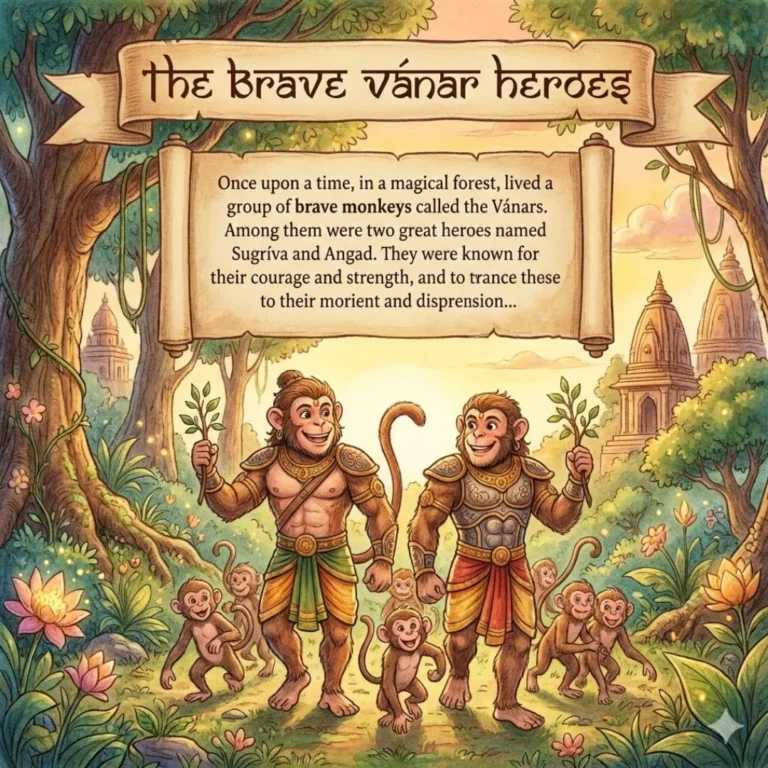
This moral story for children ages 6-12 combines entertainment with important values.
In the golden age of the Treta Yuga, when righteousness still guided most hearts, a great war was about to begin. The demon king Ravana of Lanka had committed an unforgivable crime: he had kidnapped Sita, the beloved wife of Prince Rama of Ayodhya. Now, on the shores of the southern ocean, stood an extraordinary army unlike any the world had ever seen.
They were the vanaras – the forest-dwellers of Kishkindha. They were not ordinary beings, but warriors created by the gods themselves to aid Rama in his righteous battle. Among them stood some of the greatest heroes of their age: Sugriva, their king; Angada, the brave prince; Hanuman, the devoted son of the wind god; and Jambavan, the wise bear-king whose wisdom stretched back to the beginning of time itself.
THE GATHERING OF THE VANARA HOST
After Hanuman had discovered Sita’s location in Lanka and returned with the news, Rama knew the time had come for war. But Lanka was across the vast southern ocean, protected by the mighty rakshasa armies of Ravana. To reach it, Rama would need a miracle.
Under Rama’s direction and with the blessings of the ocean god, the vanaras performed an incredible feat: they built a bridge across the sea itself. For five days, millions of vanaras worked tirelessly, carrying boulders and massive rocks, placing them in the ocean with engineering skill that amazed even the celestial beings watching from above. The bridge, called Rama Setu, stretched across the waters like a path of righteousness connecting the mainland to Lanka.
Once the bridge was complete, the vanara army crossed into Lanka. Sugriva organized his forces with military precision. He had one hundred akshauhinis of warriors – an astronomical number representing millions of brave vanaras. Following their king’s orders, they surrounded Lanka on all four sides, bringing the entire golden city under siege.
The golden ramparts of Lanka, which had once seemed invincible, were now encircled by determined warriors ready to lay down their lives for dharma.
ANGADA’S MISSION OF PEACE
Before the war began, Prince Rama, who always followed the path of righteousness, decided to make one final attempt at peace. Even though Ravana had wronged him grievously, Rama believed in giving his enemy one last chance to choose the right path.
He called upon Prince Angada, the son of the fallen vanara king Vali, who had grown into a warrior of exceptional courage and dignity. Angada was the perfect choice: young yet wise, strong yet diplomatic, brave yet controlled.
“Angada,” Rama said, “go to Ravana’s court as my messenger. Tell him that even now, if he returns Sita with honor and seeks forgiveness, this war can be avoided. Tell him I have no desire to destroy Lanka or its people. But also tell him that if he refuses, the consequences will be terrible.”
Angada bowed deeply and leaped toward Lanka, crossing the city walls in a single magnificent bound. He landed in Ravana’s royal court, where the demon king sat upon his throne, surrounded by his mighty generals and warriors.
The court fell silent as Angada stood before them, fearless and composed. Though he was alone among enemies, his bearing was that of a true prince.
“King Ravana,” Angada spoke clearly, his voice ringing through the hall, “I come as a messenger of Prince Rama. You have committed a grave sin by abducting Mother Sita. Even now, Lord Rama, in his infinite compassion, offers you a choice. Return Sita with honor, seek his forgiveness, and this war need not happen. Your city, your people, your own life – all can be spared. This is Rama’s message.”
Ravana’s eyes blazed with fury. “Who is this Rama to threaten me? I am the conqueror of the three worlds! I have defeated the gods themselves! I bow to no one!”
Angada remained calm. “Your pride blinds you, Ravana. Rama is no ordinary prince. He is dharma incarnate. Your doom is certain if you choose this path.”
Enraged, Ravana ordered his courtiers and warriors to seize Angada. But the brave prince had one more demonstration to make. He planted his right foot firmly on the ground and declared, “If anyone in this court can move my foot from its place, I will consider Rama defeated and return without war. But if you cannot, know that your defeat is certain.”
One by one, the mightiest rakshasas tried. Ministers, generals, and warriors – all failed to budge Angada’s foot even slightly. Even Indrajit, Ravana’s most powerful son who had once conquered Indra himself, could not move it.
Finally, Ravana himself rose in fury to accept the challenge. But as he approached, Angada suddenly lifted his foot. Unable to stop his momentum, Ravana lunged forward, and his magnificent crown fell to the ground – a symbol of the fall that was to come.
Angada picked up the crown and said, “I spare you now, Ravana, so that Rama himself may bring about your end.” With these words, he leaped back to Rama’s camp, his mission complete. War was now inevitable.
THE GREAT BATTLE BEGINS
The next morning, as the sun rose over Lanka, both armies assembled. The sight was magnificent and terrible. On one side stood the rakshasa forces: powerful demons in armor of gold and bronze, wielding divine weapons, skilled in maya (illusion), and experienced in countless battles. They had conquered heaven itself.
On the other side stood the vanara army: simpler warriors armed mainly with trees, boulders, and their own tremendous strength. But they possessed something the rakshasas lacked – unwavering devotion to dharma and complete faith in their cause.
Sugriva, the vanara king, addressed his warriors: “Brave vanaras! Today we fight not for territory or treasure, but for dharma itself! Lord Rama, who gave me back my kingdom and my honor, now needs our service. Let every vanara fight as if Rama himself is watching! Let our courage echo through the ages!”
A mighty roar rose from the vanara army, shaking the very foundations of Lanka.
SUGRIVA’S VALOR
As the battle commenced, King Sugriva proved why he was chosen to lead the vanaras. He was the son of Surya, the sun god, and his courage blazed as brightly as his father’s light.
When the massive rakshasa general Virupaksha, commander of vast armies, charged toward the vanara forces with his division, it was Sugriva who stepped forward to meet him. Virupaksha was a fearsome sight: three times the height of a man, wielding a massive mace that could crush elephants, his body protected by celestial armor.
The two warriors clashed in the center of the battlefield. Virupaksha swung his mighty mace, but Sugriva, agile and quick, dodged the blow. He grabbed an enormous sala tree with roots still attached and hurled it at the rakshasa with tremendous force. The tree struck Virupaksha’s chest, but the demon’s armor protected him.
Virupaksha laughed mockingly and charged again. But Sugriva was not just strong – he was clever. He waited for the precise moment when Virupaksha overextended his attack, then leaped high into the air. Using his incredible strength, Sugriva uprooted an entire mountain peak and brought it crashing down upon the rakshasa general.
The impact was tremendous. Virupaksha’s armor shattered, and the mighty rakshasa fell, defeated by the king of the vanaras. A great cheer rose from the vanara army, and their confidence soared.
ANGADA’S VICTORIES
Prince Angada, having witnessed his father Vali’s death and been raised under Sugriva’s guidance, had grown into one of the greatest warriors of the vanara army. The blessings of his father, who had been blessed by Brahma with the power to take half the strength of any opponent he faced, seemed to live on in him.
During the fierce battle, two of Ravana’s own sons led charges against the vanara forces. Narantaka and Trishira, both powerful warriors trained in celestial warfare, came with their divisions to break the vanara lines.
Angada challenged them both. “Sons of Ravana! You fight for a king who has abandoned dharma! Face me, and learn the cost of adharma!”
Narantaka attacked first, his sword gleaming with magical energy. The battle between them was fierce. Angada fought with nothing but a large boulder, yet he matched Narantaka’s swordsmanship with pure skill and strength. Finally, Angada hurled the boulder with such force that it broke through Narantaka’s defenses and struck him down.
Seeing his brother fall, Trishira (who had three heads, true to his name) attacked in a rage, shooting arrows from three bows simultaneously. But Angada’s speed was incredible. He dodged the arrows, closed the distance, and in a display of raw power, struck Trishira with his bare hands, felling another of Ravana’s sons.
The greatest of Angada’s victories came when he faced Mahaparshva, the supreme general of Ravana’s entire army. Mahaparshva was a legend among rakshasas, having never been defeated in battle. He wielded divine weapons and commanded the respect of all of Lanka’s forces.
When Mahaparshva entered the battlefield on his magnificent chariot, the earth trembled. He challenged the vanara forces, “Who among you monkeys dares face the greatest general of Lanka?”
Angada stepped forward. “I am Angada, son of Vali, prince of Kishkindha! Your pride will be your downfall, rakshasa!”
The duel that followed was spoken of for generations. Mahaparshva used every weapon in his arsenal: divine arrows that multiplied in flight, illusions to confuse his opponent, celestial missiles that blazed like fire. But Angada fought with the purity of purpose and the blessing of fighting for dharma.
In the end, it was not magical weapons but courage and righteousness that prevailed. Angada, using a massive tree as his weapon, broke through Mahaparshva’s defenses and struck him down. The supreme general of Lanka fell, and with him fell the morale of many rakshasa warriors.
THE WISDOM OF JAMBAVAN
Throughout the battle, another hero guided the vanara forces with his ancient wisdom. Jambavan, the bear-king, was the eldest of all warriors present. He had been created by Brahma himself and had lived since the beginning of the current age. He had witnessed Lord Vishnu’s Vamana avatar taking three steps to measure the universe, and he had circled the world seven times during that cosmic event.
Jambavan did not seek personal glory in battle. Instead, he was the strategist, the counselor, and the keeper of morale. When warriors faltered, Jambavan encouraged them. When strategy was needed, Jambavan provided wisdom. When someone’s true potential was hidden even from themselves, Jambavan revealed it.
It had been Jambavan who recognized Hanuman’s true capabilities when everyone doubted whether anyone could cross the ocean. “O son of Vayu,” Jambavan had said to Hanuman, “you possess strength beyond measure. You are blessed by all the gods. You alone can leap across this ocean and find Sita. Remember who you are!”
Those words had awakened Hanuman to his own power, leading to the successful reconnaissance mission that made the current battle possible.
Now, during the war, Jambavan moved through the battlefield like a calming presence amidst chaos. When young vanaras grew frightened seeing the terrible rakshasas with their magical weapons, Jambavan reminded them, “We fight for Rama, who is dharma itself! No weapon of adharma can ultimately defeat those who serve righteousness!”
When the rakshasas used their powers of illusion to create terrifying visions, it was Jambavan who reminded the vanaras of the truth: “These are but shadows and tricks! Keep your hearts fixed on Rama, and illusions cannot touch you!”
THE STRENGTH OF UNITY
What made the vanara army truly formidable was not just individual courage, but their unity and cooperation. Unlike the rakshasa forces, where generals competed for glory and harbored jealousies, the vanaras fought as one coordinated force.
When Hanuman was surrounded by enemy forces, Angada and Sugriva immediately fought their way to his side. When Jambavan needed protection while he counseled the troops, other vanaras formed a protective circle around him. When any vanara fell injured, his brothers carried him to safety without thought for their own danger.
This unity came from their shared purpose. They were not fighting for conquest or revenge, but to serve Rama and uphold dharma. This pure motivation gave them a strength that surpassed their physical abilities.
THE TURNING POINT
The tide of battle shifted decisively when these vanara heroes worked together. Ravana, seeing his generals fall one by one, sent his most powerful commander with a massive force to break the vanara army once and for all.
Sugriva, Angada, Hanuman, and Jambavan met together to plan their response. Jambavan provided the strategy: they would split the enemy force by attacking from multiple directions simultaneously. Sugriva would lead the frontal assault, Angada would attack from the left, and Hanuman would circle around to attack from behind.
The plan worked perfectly. The coordinated assault confused and divided the rakshasa forces. What had seemed like an overwhelming enemy advantage became a vulnerability when faced with such tactical brilliance and flawless execution.
THE ULTIMATE VICTORY
The war continued with many more battles, heroic deeds, and sacrifices. Eventually, as prophesied, it was Lord Rama who faced and defeated Ravana in single combat. But the victory belonged to all who fought for dharma.
When Sita was finally rescued and restored to Rama’s side, the Lord addressed the vanara army with deep emotion: “Brave vanaras, this victory is yours as much as it is mine. Without your courage, loyalty, and sacrifice, dharma could not have prevailed. Sugriva, Angada, Hanuman, Jambavan – you are not just my allies, but my dearest friends. Your names will be remembered as long as my story is told.”
And indeed, the tales of these brave vanara heroes spread across the world. They became symbols of what loyalty, courage, and unity can achieve. They showed that righteousness, when supported by brave hearts, will always triumph over evil, no matter how powerful that evil may seem.
THE RETURN HOME
After the war, the vanaras returned to Kishkindha as heroes. But they had gained something more valuable than victory – they had earned the eternal friendship of Lord Rama and the knowledge that they had served dharma itself.
Sugriva ruled Kishkindha with greater wisdom, having learned the art of leadership in the crucible of war. Angada became known as one of the greatest warriors of the age, his courage inspiring generations. Jambavan continued to serve as counselor and keeper of ancient wisdom. And Hanuman, whose devotion to Rama knew no bounds, became immortal so that he might continue singing Rama’s glories throughout the ages.
The lesson of the vanara heroes echoed through time: that true heroism lies not in supernatural powers or divine weapons, but in courage, unity, loyalty to dharma, and the willingness to sacrifice for a righteous cause. These simple warriors from the forest had proven that when the heart is pure and the cause is just, even the impossible becomes possible.
And so, children, when you face challenges that seem too great, remember Sugriva, Angada, Jambavan, and all the brave vanaras. Remember that working together with pure hearts, you can achieve wonders that seem impossible when facing them alone.
Moral Lessons
- Unity, courage, and fighting for what is right make us stronger than any obstacle. When we work together with pure hearts for a noble cause, we can overcome even the mightiest challenges.
Test Your Understanding
1. What incredible engineering feat did the vanaras accomplish to reach Lanka?
Frequently Asked Questions
What is the moral lesson of The Brave Vánar Heroes?
What age is this story appropriate for?
How long does it take to read The Brave Vánar Heroes?
What culture does this story come from?
Can I use this story for teaching?
Frequently Asked Questions
What are vanaras in this moral story for children?
Vanaras are forest-dwelling warriors from Hindu mythology who were created by the gods to help Prince Rama. They’re not ordinary monkeys, but divine beings with incredible strength and abilities. In this story, they’re the brave heroes who join Rama’s army to rescue Sita from the demon king Ravana.
Who are the main vánar heroes mentioned in the story?
The main vánar heroes include Sugriva (their king), Angada (the brave prince), Hanuman (son of the wind god and Rama’s devoted follower), and Jambavan (the wise bear-king). Each hero brings unique strengths and wisdom to help Rama in his righteous battle against evil.
Is this bedtime story for kids appropriate for young children?
Yes, this story is specifically designed for children ages 6-12. It focuses on themes of courage, loyalty, and helping others while being part of the classic Ramayana epic. The content emphasizes positive values and heroic qualities that inspire young readers.
📚 Recommended Books
Handpicked for readers like you
As an Amazon Associate, we earn from qualifying purchases. These recommendations are personalized based on this story's themes and your reading history.
What moral lessons do children learn from the Vánar Heroes?
Children learn about courage in facing challenges, the importance of loyalty to friends, working together as a team, and standing up for what’s right. The vánar heroes show how different individuals can contribute their unique abilities to achieve a common good goal.
How does this story connect to the larger Ramayana epic?
This story takes place during the war portion of the Ramayana, after Hanuman discovered Sita’s location in Lanka. It shows how the vánar army gathered to help Rama cross the ocean and rescue his wife, representing the crucial alliance that made Rama’s victory possible.