

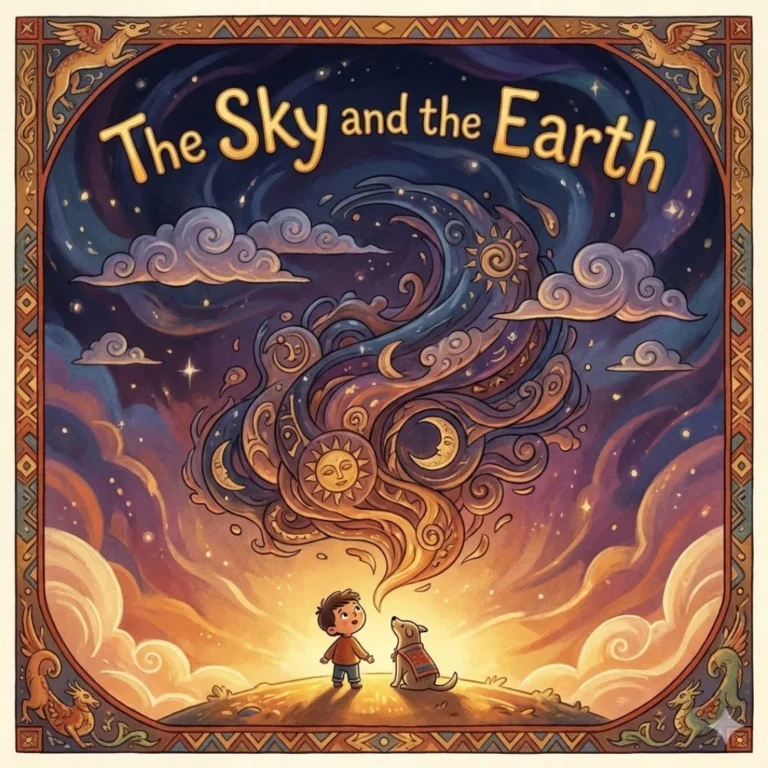
Share this engaging bedtime story with kids ages 6-12 to teach valuable life lessons.
Before there was time, before there were stars, before there was anything at all—there was Chaos.
Not chaos as we think of it today—messy rooms or noisy crowds—but Chaos as the ancient Greeks imagined it: an endless, dark void. Empty. Silent. Without form or purpose.
From this Chaos, the first true being emerged.
Her name was Gaea, and she was the Earth.
* * *
## THE BIRTH OF THE WORLD
Gaea did not walk into existence—she simply was. Where Chaos had been void, Gaea became solid. Where there had been nothing, there was now something: land, mountains, valleys, rivers waiting to flow.
Gaea was vast and beautiful—”wide-bosomed,” the poets called her, meaning she was generous, nurturing, able to support all life that would come after.
But Gaea was alone.
The earth stretched in all directions, but there was no sky above her. No sun to warm her. No rain to make things grow.
So Gaea, using the primordial power that flowed through her, created a companion to match her greatness.
She brought forth Uranus—the Sky.
Uranus rose above Gaea like a vast dome, covering her on every side. Where she was solid, he was air and light. Where she was still, he was ever-moving—breezes and winds, clouds and starlight.
Together, they completed the world. Earth below. Sky above. Everything in balance.
And the Greeks believed this was no mere myth—it was the literal truth of how the cosmos came to be.
* * *
## THE CHILDREN OF EARTH AND SKY
Gaea and Uranus loved each other in the way that primordial gods love—deep, cosmic, eternal.
From their union came children. Powerful children. Divine children. The first generation of gods.
First came the Titans—twelve mighty beings, each with dominion over fundamental forces of the world:
**Oceanus**, who would become the great river that circled the earth.
**Hyperion**, who would father the sun, moon, and dawn.
**Rhea**, who would one day be the mother of the Olympian gods.
**Cronus**, the youngest and most cunning, who would change everything.
And many others—Coeus, Crius, Iapetus, Theia, Themis, Mnemosyne, Phoebe, and Tethys.
These Titans were beautiful and terrible, radiant with divine power.
But then came other children—children who were not beautiful.
The Cyclopes were born—three brothers, each with a single enormous eye in the middle of their forehead. They were strong as mountains and skilled beyond measure at crafting and building.
Then came the Hecatoncheires—the Hundred-Handed Ones. Three brothers, each with fifty heads and one hundred arms. They were beings of overwhelming strength, capable of fighting like entire armies.
And Uranus looked at these strange, monstrous children and felt something he had never felt before.
Fear.
* * *
## THE FATHER’S CRUELTY
“These creatures are too powerful,” Uranus thought. “One day they might threaten me. They might overthrow me. I cannot allow that.”
So he made a terrible decision.
He took the Cyclopes and the Hecatoncheires—his own children—and pushed them down, deep into Gaea’s body, imprisoning them in the darkest depths of the earth, a place called Tartarus.
Gaea cried out in pain. These were her children! She could feel them trapped inside her, suffering in the darkness, unable to be free.
“Release them!” she begged Uranus. “They are our children! How can you be so cruel?”
But Uranus refused. “They are dangerous. They will stay where they are.”
Time passed, and Uranus continued to imprison any child he feared. Gaea’s pain grew and grew. The weight of her imprisoned children was unbearable—like a mother forced to keep her own babies locked away forever.
Her love for Uranus began to turn to anger.
And her anger began to turn to something else.
Resolve.
* * *
## GAEA’S PLAN
Gaea called her Titan children to her.
“Your father has become a tyrant,” she said. “He fears his own children. He has imprisoned your brothers in darkness and pain. This cannot stand. One of you must stop him.”
The Titans looked at each other nervously. Uranus was the sky itself—vast, powerful, seemingly invincible. How could any of them challenge their father?
But the youngest Titan, Cronus, stepped forward.
Cronus was ambitious. He was clever. And he was willing to do what his siblings would not.
“I will stop him,” Cronus said. “But I will need a weapon.”
Gaea reached deep within herself and drew forth adamant—the hardest substance in existence, unbreakable, sharper than anything in the world.
From this adamant, she fashioned a great curved sickle, like the blade farmers use to harvest grain.
She gave the sickle to Cronus.
“When Uranus comes to lie with me tonight,” Gaea said, “hide yourself. When the moment comes, strike. End his tyranny. Free your brothers.”
And so, Cronus hid and waited.
* * *
## THE FALL OF URANUS
When darkness came, Uranus descended from the heavens as he always did, spreading himself across Gaea like a great blanket covering the earth.
He did not see Cronus hiding.
He did not see the adamantine sickle gleaming in the darkness.
And when Uranus was most vulnerable, Cronus struck.
With one terrible swing, he castrated his father, severing the source of Uranus’s power and ability to create more children.
Uranus screamed—a sound like thunder splitting the sky.
He pulled away from Gaea, rising up and away, separating himself from the earth for the first time since the world began.
“Curse you!” Uranus howled at Cronus and the other Titans. “You will suffer for this! One day, your own children will overthrow you, just as you have overthrown me!”
It was a prophecy—and like all prophecies in Greek myth, it would come true.
Uranus retreated to the highest heavens, wounded and diminished. Never again would he descend to embrace Gaea. The separation between Earth and Sky became permanent.
From the blood of Uranus that fell onto Gaea, new beings were born:
The Erinyes—the Furies—goddesses of vengeance who punished those who wronged their families.
The Gigantes—giants of terrible strength.
The Meliae—nymphs of the ash trees.
And from the severed parts of Uranus that fell into the sea, foam gathered and swirled—and from that foam was born Aphrodite, the goddess of love and beauty.
Even in his fall, Uranus gave birth to powerful beings.
* * *
## THE NEW ORDER
Cronus freed his imprisoned brothers—the Cyclopes and the Hecatoncheires.
Gaea finally felt relief. Her children were free!
But her joy did not last long.
Cronus, having tasted power, decided he liked it. He declared himself the new ruler—king of the Titans, lord of the cosmos.
And when the Cyclopes and Hecatoncheires proved difficult to control, Cronus did the unthinkable.
He imprisoned them again, just as Uranus had done.
Gaea was horrified. “You swore you would be different! You swore you would be just!”
But Cronus was drunk on power. “I am king now. I decide what happens.”
And so, the cycle began again. The son had overthrown the father, only to become like him.
Gaea looked at her youngest son with deep sadness. “Your father cursed you,” she said quietly. “He said your own children would overthrow you. I see now that curse will come true. And when it does, I will not save you.”
Time would prove her right. Cronus would have children—Zeus, Poseidon, Hades, Hera, Demeter, and Hestia—and in time, they would rise up against him just as he had risen against Uranus.
* * *
## WHAT THE GREEKS LEARNED
This myth is dark. It is violent. It is full of betrayal and pain.
But the ancient Greeks told it not to frighten children, but to explain the world.
**Why is the sky separated from the earth?**
Because Uranus and Gaea, once united, were torn apart by the violence of their own children.
**Why do storms rage and earthquakes shake the ground?**
Because the primordial powers—Sky and Earth—are still in conflict, still angry, still hurting from their ancient wounds.
**Why do parents and children sometimes come into conflict?**
Because even the gods experience this struggle. Even divine families have pain.
But the Greeks also found deeper meaning in the story:
**Power corrupts.** Uranus became a tyrant because he feared losing control. Cronus became a tyrant for the same reason. The cycle of violence continues when those in power refuse to trust or share authority.
**Justice requires courage.** Gaea could have remained silent, accepting Uranus’s cruelty. Instead, she took action—not for herself, but for her imprisoned children who could not free themselves.
**Freedom is worth fighting for.** The Cyclopes and Hecatoncheires were imprisoned simply for being different, for being powerful. Their liberation—even if only temporary—was an act of justice.
**We become what we fight against if we’re not careful.** Cronus overthrew a tyrant but became a tyrant himself. The Greeks understood that defeating evil doesn’t automatically make you good.
* * *
## GAEA’S LEGACY
Though Uranus retreated to the heavens and Cronus seized power, Gaea remained.
The Earth endures.
She is the foundation of everything. Mountains rise from her body. Rivers flow through her veins. Every tree, every flower, every blade of grass is part of her.
The Greeks built temples to Gaea. They called her Gaea Meter—”Mother Earth”—and believed she was the source of all life.
When they made important oaths and promises, they swore by Gaea, because the Earth witnesses everything. You can lie to the sky, you can lie to other people—but you cannot lie to the ground beneath your feet.
Gaea became the symbol of nurturing, patience, and endurance.
She was there before everything.
She will be there after everything.
* * *
## A GENTLER LESSON
For children, this story can be frightening. Gods fighting gods. Parents hurting children. Violence and betrayal.
But here’s what we can learn from Gaea that is not frightening:
**The Earth is generous.** Gaea gives and gives and gives. She provides land to stand on, food to eat, water to drink. She asks for nothing in return except respect.
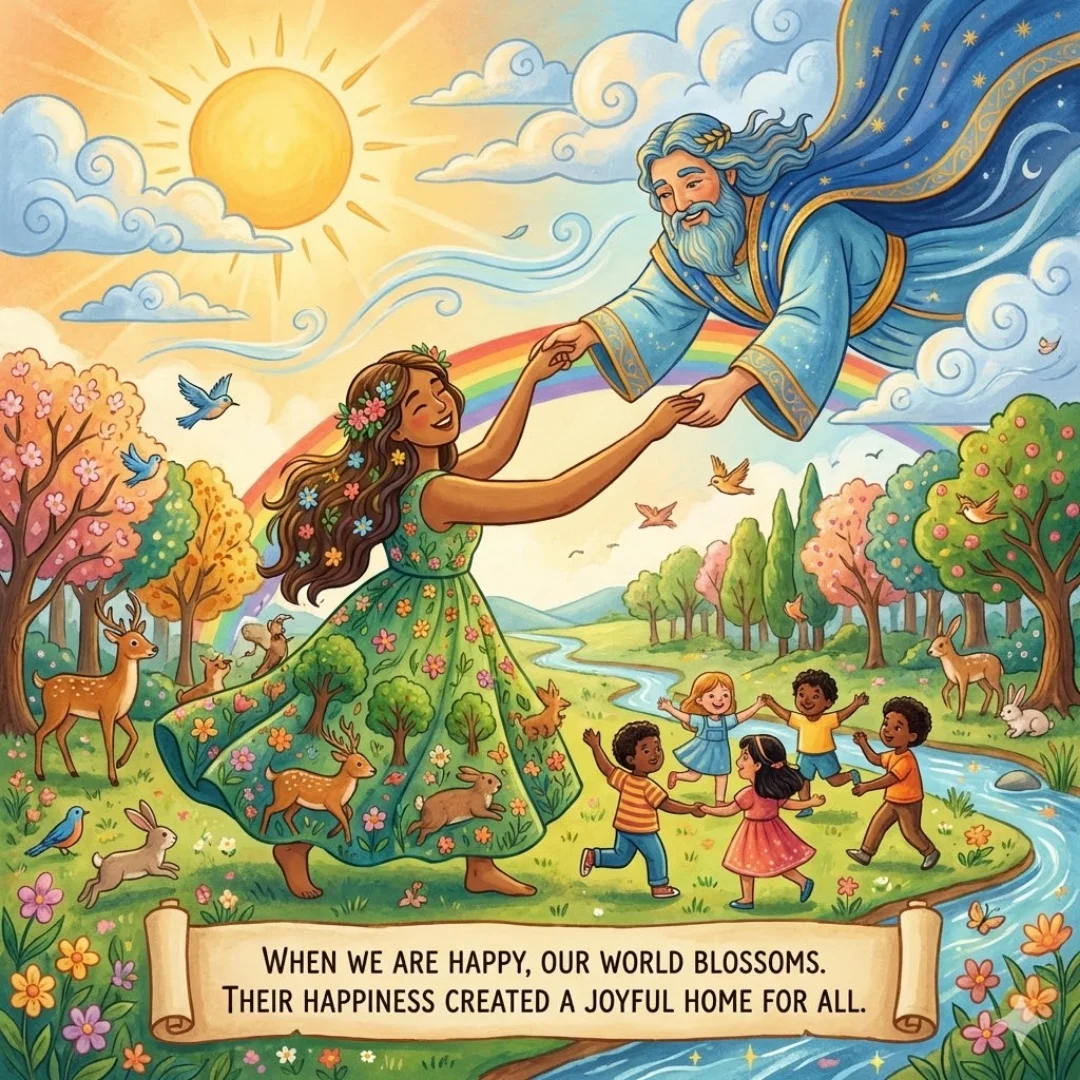
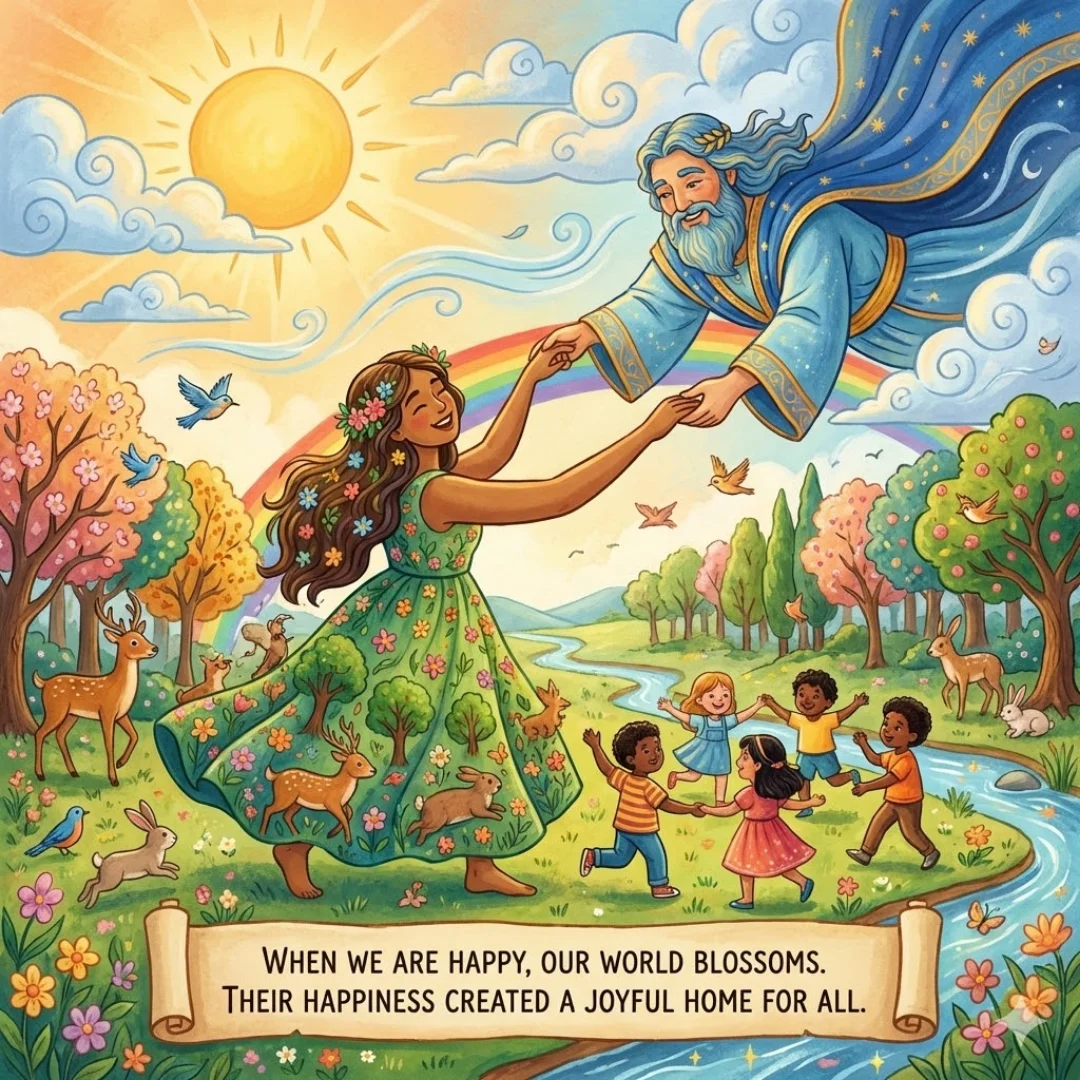
**Mothers protect their children.** Even when it cost her the love of Uranus, Gaea fought to free her imprisoned children. She could not bear to see them suffer.
**We are all connected to the Earth.** The Greeks called Gaea “wide-bosomed” because she could hold everyone—all creatures, all plants, all life. We all come from her. We all return to her. She is literally our mother.
**Even when relationships break, life continues.** Uranus and Gaea’s marriage ended in violence. But life didn’t stop. New generations were born. The world kept turning. Healing is possible, even after great pain.
And perhaps most importantly:
**The Earth is patient.** Gaea was hurt by Uranus. Betrayed by Cronus. But she remained. She endured. She continued to give life, to nurture, to provide.
In our own lives, when we feel hurt or betrayed, we can remember Gaea’s patience and strength.
* * *
## THE SKY AND EARTH TODAY
Look up. See the sky?
That’s Uranus—distant now, separated, no longer embracing the Earth as he once did.
Look down. Feel the ground beneath your feet?
That’s Gaea—still here, still strong, still giving.
The ancient Greeks saw these two primordial beings every single day. The story of Uranus and Gaea wasn’t just mythology to them. It was their explanation for the fundamental structure of reality.
Sky above. Earth below. Forever separated. Forever connected.
When rain falls from the sky to water the earth, the Greeks believed it was Uranus still trying to reach Gaea, to nurture her, to make amends for his ancient cruelty.
When earthquakes shake the land, they believed it was Gaea’s anger still rumbling beneath the surface, remembering the pain of her imprisoned children.
And when flowers bloom and crops grow and life flourishes—that is Gaea’s gift to the world.
The mother who endured.
The mother who provides.
The mother who, despite everything, never stopped giving life.
* * *
This is the Greek story of the Sky and the Earth.
It begins with Chaos and ends with separation.
But between those two moments is a story about love and betrayal, justice and cruelty, power and its consequences.
And it reminds us of something important:
The world we live in—the ground beneath our feet, the sky above our heads—is not just “there.” It has a story. It has meaning.
And we are part of that story, descendants of Earth and Sky, carrying their legacy forward into the future.
MORAL LESSONS:
– The Earth (Gaea) provides for all life and deserves our respect and gratitude
– Power can corrupt even those who start with good intentions (Cronus became like Uranus)
– Standing up against injustice takes courage (Gaea opposing Uranus’s tyranny)
– Parents should not fear or harm their children out of insecurity
– Those who gain power through violence often become tyrants themselves
– The Earth is patient and enduring—she continues giving despite being hurt
– We are all connected to nature and depend on it for survival
– Cycles of violence continue unless someone chooses to break them
– Even broken relationships can lead to new life and possibilities
– Respect the natural world—it is literally our foundation
GREEK MYTHOLOGY ELEMENTS PRESERVED:
– Chaos as the primordial void – exact from Hesiod’s Theogony
– Gaea (Earth) emerging first from Chaos – exact
– Gaea creating Uranus (Sky) to cover her – exact from Theogony
– Twelve Titans born from Uranus and Gaea – exact (Oceanus, Hyperion, Rhea, Cronus, etc.)
– Cyclopes (one-eyed giants) – exact
– Hecatoncheires (hundred-handed ones) – exact
– Uranus imprisoning his children in Tartarus – exact
– Gaea’s pain from imprisoned children – exact
– Gaea forging adamantine sickle – exact
– Cronus castrating Uranus – exact from myth (child-appropriate description)
– Uranus’s curse/prophecy about Cronus – exact
– Separation of Sky and Earth after the castration – exact
– Blood of Uranus creating Furies, Giants, Meliae – exact
– Aphrodite born from sea foam – exact
– Cronus becoming tyrannical like his father – exact
– Cronus re-imprisoning Cyclopes and Hecatoncheires – exact
– Gaea as “wide-bosomed” Mother Earth – exact epithet
– Greeks swearing oaths by Gaea – exact cultural practice
– Temples built to honor Gaea – exact historical fact
SOURCE FIDELITY NOTES:
✓ Based on Hesiod’s Theogony (circa 700 BCE)
✓ All major events from authentic Greek cosmogony
✓ Chaos → Gaea → Uranus creation sequence exact
✓ Names of all twelve Titans accurate
✓ Cyclopes and Hecatoncheires described accurately
✓ Castration myth presented faithfully (with child-appropriate language)
✓ Uranus’s prophetic curse exact from sources
✓ Cronus’s repetition of his father’s mistakes exact
✓ Birth of Aphrodite from sea foam exact
✓ Erinyes (Furies) born from blood exact
✓ Greek religious practices (oaths, temples) accurate
✓ “Gaea Meter” (Mother Earth) authentic Greek title
✓ Cultural significance and cosmology authentic
ENGAGEMENT ENHANCEMENTS:
+ Complete narrative arc from creation to consequences
+ Character development (Gaea’s pain, Uranus’s fear, Cronus’s ambition)
+ Vivid sensory details (void of Chaos, adamantine sickle, thunder-like scream)
+ Emotional depth (family betrayal, mother’s protective love)
+ Dialogue brings moments to life
+ Scene breaks for pacing
+ Child-appropriate handling of violent content (castration mentioned but not graphic)
+ Universal themes (power, family conflict, mother’s love)
+ Connects myth to observable world (sky above, earth below)
+ “Gentler Lesson” section offers child-friendly takeaways
+ Shows consequences of choices (Cronus becoming what he fought)
+ Satisfying thematic resolution (Earth endures)
CULTURAL SIGNIFICANCE:
– Foundation of Greek cosmology and religious worldview
– Explains structure of universe in Greek thought
– Establishes primordial deities who precede Olympians
– Gaea worship was central to Greek religion (earth goddess)
– Pattern of succession myth (child overthrowing parent) continues with Zeus
– Themes of generational conflict fundamental to Greek mythology
– Explains natural phenomena (rain, earthquakes, seasons)
– Establishes Greek understanding of fate and prophecy
– Cosmogony parallels other ancient Near Eastern creation myths
– Influenced Western philosophy and literature for millennia
NOTE ON AUTHENTICITY:
This retelling faithfully follows Hesiod’s Theogony, the authoritative source for Greek creation mythology and the genealogy of the gods. The sequence of events—Chaos, Gaea’s emergence, creation of Uranus, their offspring (Titans, Cyclopes, Hecatoncheires), Uranus’s tyranny, Gaea’s pain, Cronus’s rebellion with the adamantine sickle, the castration and curse, and Cronus’s subsequent tyranny—is exact from the ancient text. The characterizations reflect how these primordial beings were understood in Greek thought: Gaea as nurturing but capable of terrible action when her children are threatened, Uranus as fearful and tyrannical, Cronus as ambitious and ultimately corrupted by power. The violent content has been presented in child-appropriate language while maintaining mythological accuracy.
SOURCES:
– [Uranus (mythology) – Wikipedia](https://en.wikipedia.org/wiki/Uranus_(mythology))
– [Gaia – Wikipedia](https://en.wikipedia.org/wiki/Gaia)
– [URANUS (Ouranos) – Greek Primordial God of the Sky](https://www.theoi.com/Protogenos/Ouranos.html)
– [GAEA (Gaia) – Greek Goddess of the Earth](https://www.theoi.com/Protogenos/Gaia.html)
– [Greek primordial deities – Wikipedia](https://en.wikipedia.org/wiki/Greek_primordial_deities)
– [Reading Hesiod’s Theogony (with Notes and Questions)](https://faculty.gvsu.edu/websterm/Hesiod2.htm)
– [Gaia and the Castration of Uranus | Research Starters](https://www.ebsco.com/research-starters/literature-and-writing/gaia-and-castration-uranus)
– Hesiod’s Theogony (circa 700 BCE) – primary source for Greek cosmogony and theogony
– Classical Greek religious practices and temple worship
Test Your Understanding
1. Who is Ganesha’s father?
Frequently Asked Questions
What is the moral lesson of The Sky and the Earth?
What age is this story appropriate for?
How long does it take to read The Sky and the Earth?
What culture does this story come from?
Can I use this story for teaching?
Frequently Asked Questions
What is ‘The Sky and the Earth’ Greek mythology story about?
This is a creation story from ancient Greek mythology that tells how the world began. It starts with Chaos, an empty void, and then introduces Gaea (the Earth) as the first being to emerge. The story explores how Earth came to exist and her loneliness before the sky was created, perfect for kids ages 6-12.
Who is Gaea in this bedtime story for kids?
Gaea is the Earth personified as a powerful goddess in Greek mythology. She’s described as ‘wide-bosomed,’ meaning generous and nurturing, able to support all life. In this story, she emerges from Chaos as the first solid, beautiful being with mountains, valleys, and rivers, but she starts out completely alone.
Is this Sky and Earth story appropriate for children’s bedtime?
Yes, this is specifically crafted as a gentle bedtime story for kids ages 6-12. It focuses on creation and natural wonder rather than conflict, introducing ancient Greek mythology in an age-appropriate way. The story teaches about the origins of our world through engaging, poetic storytelling.
📚 Recommended Books
Handpicked for readers like you
As an Amazon Associate, we earn from qualifying purchases. These recommendations are personalized based on this story's themes and your reading history.
What life lesson does this moral story teach children?
This creation story teaches kids about the power of bringing something beautiful from nothing, and how even the Earth needed companionship. It introduces concepts of loneliness, creation, and the interconnectedness of sky and earth, helping children understand both ancient mythology and timeless human emotions.
How does this Greek creation story begin?
The story begins with Chaos – not messy chaos, but an endless, dark, empty void without form or purpose. From this nothingness, Gaea (the Earth) emerges as the first true being, transforming the void into solid ground with mountains, valleys, and rivers, setting the stage for all creation.
