

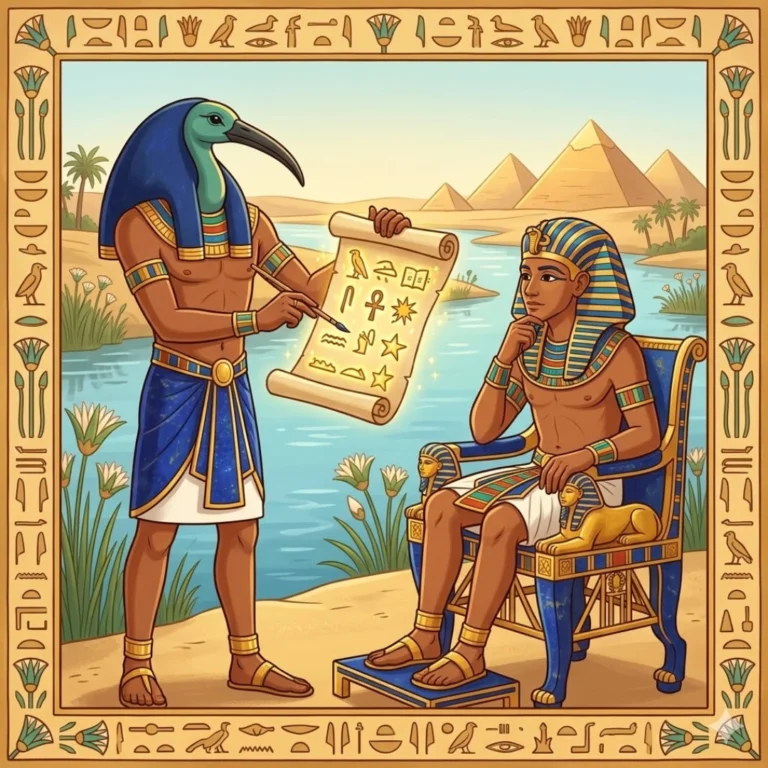
The god of knowledge creates writing—but one pharaoh questions whether this gift will truly make people wiser.
Before writing, everything had to be remembered. Priests memorised thousands of sacred hymns. Merchants kept accounts in their heads. Healers passed their knowledge from one mind to the next, hoping nothing would be lost.
Then came Thoth, the ibis-headed god of wisdom, who sat at his celestial desk and invented the art of writing. He went to Pharaoh with his gift.
“Great ruler,” said Thoth, “I bring you something that will transform Egypt. With marks on papyrus, your laws will be preserved forever. Your history will not die. Your healers’ knowledge will never be lost.”
Pharaoh studied the rows of hieroglyphs that Thoth demonstrated. He was thoughtful for a long time.
“I must respectfully question this gift,” Pharaoh said at last.
Thoth was surprised. “Why, great one?”
“If my people can write everything down,” said Pharaoh, “they will stop exercising their memories. They will no longer strive to truly understand—they will read and believe they know. A shallow reading is not the same as deep wisdom.”
Thoth considered this carefully. It was perhaps the most honest challenge he had ever received.
“You may be right,” said Thoth. “Writing will help people remember. But whether they remember with understanding or mere repetition—that will always be their own choice.”
Pharaoh accepted writing then. But he ordered that the scribes add a phrase to every important document: “Read this. Then close your eyes. Then think.”
Egypt became great partly because of its record-keeping—its inventories, its medical texts, its star charts. But its wisest citizens were those who did not just read but wrestled with what they had read, turned it over, questioned it, and made it their own.
Thoth’s gift was a tool. Wisdom was still the user’s responsibility.
Moral of the Story
Knowledge is a tool, not wisdom itself. Reading something is only the first step—true wisdom comes from thinking deeply about what you have learned.
Learn These Words
- hieroglyph
- a picture symbol used as writing in ancient Egypt
- papyrus
- a plant used in ancient Egypt to make a kind of paper
- celestial
- relating to the sky or heavens
- scribe
- a person in ancient times who copied or wrote documents
- inventory
- a complete list of items
Test Your Understanding
1What did Thoth invent?
2What was Pharaoh’s concern about writing?
3What phrase did Pharaoh add to every document?
4What made Egypt’s wisest citizens wise?
5What lesson does this story teach?
Frequently Asked Questions
Who is Thoth in Egyptian mythology?
Thoth is the ancient Egyptian god of wisdom, knowledge, and writing, often depicted with the head of an ibis bird. In mythology he served as a scribe of the gods and was credited with inventing hieroglyphics. He was also associated with the moon, magic, and the judgement of the dead.
Why did the Pharaoh question Thoth’s gift of writing?
The Pharaoh worried that if people could write everything down, they would stop training their memories and lose the habit of deep understanding. He feared they would read words on papyrus and mistake that shallow familiarity for true knowledge, making them appear wise without actually becoming wiser.
Is the story of Thoth and the gift of writing based on a real ancient text?
Yes, the core idea comes from an allegory told by Plato in his dialogue Phaedrus, where the Egyptian god Theuth (Thoth) presents writing to King Thamus. Plato used the story to explore whether written words help or hinder genuine understanding—a debate that has remained relevant for thousands of years.
📚 Recommended Books
Handpicked for readers like you
As an Amazon Associate, we earn from qualifying purchases. These recommendations are personalized based on this story's themes and your reading history.
What is the moral lesson in the myth of Thoth and writing?
The story teaches that tools alone don’t make us wise. Writing is powerful, but true knowledge requires active thinking, reflection, and deep understanding—not just recording or reading words. It encourages readers, especially children, to engage critically with information rather than passively consuming it.
How were knowledge and history preserved in ancient Egypt before writing existed?
Before writing, knowledge was preserved entirely through memory and oral tradition. Priests memorised sacred hymns, merchants tracked accounts in their heads, and healers passed down remedies by teaching apprentices directly. This made knowledge vulnerable, since anything not successfully passed from one person to another could be permanently lost.
