

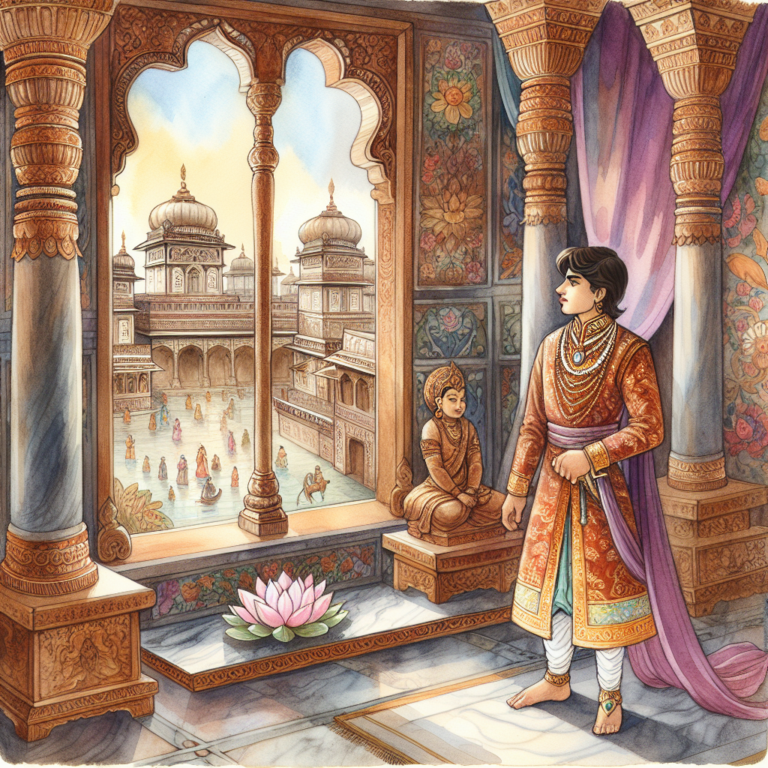
This moral story for children ages 6-12 combines entertainment with important values.
More than 2,500 years ago, in the foothills of the Himalayas, there stood a beautiful kingdom called Kapilavastu. It was ruled by King Suddhodana of the Shakya clan—a just and noble king who governed his people with wisdom and compassion.
One miraculous night, Queen Maya had an extraordinary dream. She dreamed that a magnificent white elephant, glowing with celestial light, entered her side. The dream was so vivid, so powerful, that she awoke knowing something remarkable had occurred.
The court astrologers interpreted the dream with great excitement: “O Queen, you will bear a son of extraordinary destiny! He will either become the greatest king the world has ever known—a chakravartin who will rule all the lands—or he will renounce the world and become the greatest spiritual teacher, a Buddha who will liberate countless beings from suffering.”
Ten months later, as Queen Maya rested in the beautiful Lumbini Gardens during a journey, standing beneath a sal tree heavy with blossoms, she gave birth to a son. Flowers rained from the sky. The earth trembled with joy. And the infant, miraculous from the moment of birth, took seven steps and declared: “I am the highest in the world. This is my last birth. There will be no more birth, aging, or death for me after this life.”
The child was named Siddhartha, which means “he who has accomplished his aim.”
But Queen Maya, weakened from the birth, passed away just seven days later. Siddhartha was raised by his aunt, Mahaprajapati, who loved him as her own son.
As Siddhartha grew, he displayed remarkable qualities—extraordinary intelligence, deep compassion, and natural skill in all arts and athletics. He excelled in archery, sword-fighting, mathematics, philosophy, and the sciences. He was gentle with servants and kind to animals. Everyone who met him felt that this prince was somehow different, somehow special.
But King Suddhodana remembered the prophecy with growing anxiety.
“If Siddhartha sees suffering,” the king thought, “he may become dissatisfied with worldly life and seek the path of renunciation. I cannot lose my son! I must protect him from all sorrow and pain. I will surround him with such beauty and pleasure that he will never wish to leave.”
And so the king built three magnificent palaces for Siddhartha—one for the hot season, one for the cold season, and one for the rainy season. Each palace was a wonder of architecture, filled with beautiful gardens, lotus ponds, the finest foods, the most talented musicians, and every luxury imaginable.
The king gave strict orders to all his servants: “Remove anything old, sick, or dying from the prince’s sight. Let him see only youth, health, and beauty. Keep him happy and content, so that he never questions the world or seeks to leave.”
When Siddhartha was sixteen, the king arranged his marriage to his cousin, the beautiful Princess Yasodhara. She was intelligent, kind, and devoted. Over the years, they grew to love each other deeply, and eventually they had a son whom they named Rahula.
For twenty-nine years, Siddhartha lived in this golden cage of pleasure. He had everything a person could desire—wealth, power, a loving wife, a healthy child, comfort, entertainment, respect.
Yet deep in his heart, something stirred—a question that would not be silenced: Is this all there is to life?
One beautiful spring day, Siddhartha grew restless within the palace walls.
“Channa,” he said to his faithful charioteer, “I wish to see the city. Prepare the chariot. I want to see how my father’s subjects live.”
Channa hesitated, knowing the king’s orders, but he could not refuse his prince. Word was sent ahead to prepare the route, and all the beggars, sick people, and elderly were moved away from the roads. Beautiful flowers were scattered. Musicians played. Happy, healthy people lined the streets.
As Siddhartha rode through the city in his magnificent chariot, he marveled at the sights—children playing, merchants selling colorful goods, couples laughing together. Everything seemed wonderful.
But then, on a side street, Siddhartha saw someone who had not been removed in time—a very old man, bent with age, his skin wrinkled and spotted, his hair white as snow, his body trembling as he walked with a stick for support.
Siddhartha stared, shocked. He had never seen anyone like this.
“Channa,” he asked, pointing, “what is wrong with that man? Why does he look so different? Is he sick?”
Channa’s heart sank. He could not lie to his prince. “My lord, that man is not sick. He is old. Age has bent his body and weakened his strength. All the vigor of youth has left him.”
“Will this happen to others as well?” Siddhartha asked, his voice quiet.
“Yes, my lord. Everyone who lives long enough will become old. It is the nature of life.”
Siddhartha felt as though cold water had been poured over him. “Even me? Even Yasodhara? Even my son Rahula?”
“Yes, my lord. If we live, we will all grow old.”
The joy had gone out of the day. Siddhartha ordered Channa to return to the palace. That night, he lay awake, unable to forget the bent old man, unable to stop thinking: If old age awaits us all, what is the point of this youth and beauty we celebrate? It is temporary, fleeting, doomed to fade.
Disturbed but not yet ready to abandon his life, Siddhartha ventured out again a few weeks later. This time, as they rode through a different part of the city, he saw a man lying by the side of the road, groaning in pain. The man’s skin was covered with sores. His body shook with fever. He was so weak he could barely lift his head.
“Channa, what has happened to that man? Why does he suffer so?”
“My lord, he is sick. Disease has invaded his body and brought him great pain.”
“Can it be cured?”
“Perhaps, my lord. But there are thousands of diseases, and many have no cure. Some sicknesses last a few days, others last years. Some are mild, others bring agony beyond endurance.”
“And can this happen to anyone?”
Channa’s voice was heavy with sorrow. “Yes, my lord. No one can guarantee freedom from sickness. It strikes the rich and poor, the young and old, the good and evil alike.”
Again Siddhartha returned to the palace, deeply troubled. The music no longer sounded sweet. The dancing no longer brought joy. The feasts no longer tasted good.
If sickness can strike at any moment, he thought, then all this health I enjoy is built on sand. How can I celebrate when at any moment, everything could be destroyed by disease?
The third time Siddhartha ventured out, he encountered something even more disturbing: a funeral procession.
Four men carried a body wrapped in white cloth on a wooden platform. Behind them walked family members, weeping and wailing in grief. The air was heavy with incense and sorrow.
“Channa, why do these people weep? What are they carrying?”
“My lord, that is a dead body. The man has died—his life has ended. His breath has stopped, his heart no longer beats. The family mourns because they will never see him again.”
Siddhartha felt as though he had been struck. “Death… this happens to everyone?”
“Yes, my lord. Birth inevitably leads to death. No one has ever escaped it—not the mightiest king, not the wisest sage, not the strongest warrior. Death comes to all.”
“When? How soon?”
“That, my lord, no one can know. Death may come in old age or in youth, in sickness or in health, expected or suddenly. It is the one certainty that cannot be predicted.”
Siddhartha looked at the grieving family, imagining Yasodhara weeping over his body, or worse—himself weeping over hers, or over little Rahula’s. The thought was unbearable.
He returned to the palace in a state of profound disturbance. That night, the dancing girls performed their most beautiful dances, but Siddhartha saw only aging bodies that would one day be motionless corpses. The musicians played the sweetest songs, but he heard only the wailing of funeral mourners. The feast was laid out with the finest delicacies, but he tasted only ashes.
Everything I love will be taken by death, he realized. My wife, my son, my father, my friends—all will die. And I will die too. Everything I have built, everything I cherish, will be destroyed. How can I live in happiness knowing this inevitable truth?
In despair, Siddhartha ventured out a fourth time, barely noticing the city around him, lost in his dark thoughts about old age, sickness, and death.
Then he saw someone extraordinary.
Walking along the road was a wandering ascetic—a monk who had renounced worldly life. He wore simple orange robes and carried only a begging bowl. He owned nothing else. Yet his face radiated peace and contentment. His eyes were clear and calm. He walked with such serenity that he seemed to glow with an inner light.
“Channa,” Siddhartha said urgently, “who is that man? Why does he look so peaceful when all the world is filled with suffering?”
“My lord, that is a sadhu, a holy man who has given up all possessions and attachments to seek spiritual truth. He has left behind family, wealth, and comfort to search for liberation from suffering.”
“Liberation from suffering?” Siddhartha’s heart leaped. “Is such a thing possible?”
“That is what they seek, my lord. They believe that through meditation, wisdom, and discipline, one can find freedom from the cycle of birth, aging, sickness, and death. They seek enlightenment—a state of perfect peace and understanding.”
For the first time since seeing the old man, Siddhartha felt hope kindle in his chest. Perhaps there is an answer. Perhaps there is a way out of this suffering that afflicts all beings.
That night, Siddhartha barely slept. He walked through the palace, looking at his sleeping wife and infant son. He loved them desperately—which was precisely the problem. To love meant to suffer when the beloved suffered, to grieve when they died.
The question burned in his mind: Is there a truth that can free beings from suffering? Is there a wisdom that can overcome old age, sickness, and death?
Before dawn, Siddhartha made the hardest decision of his life.
In the darkest hour before sunrise, Siddhartha went to his wife’s chambers. Yasodhara lay sleeping, with baby Rahula nestled beside her. Siddhartha stood in the doorway, his heart breaking.
If I wake them to say goodbye, I will not have the strength to leave, he thought. And if I do not seek the answer to suffering, I fail not only them but all beings who suffer.
With tears streaming down his face, he turned away.
He found Channa in the stables. “My faithful friend, prepare my horse Kanthaka. Tonight, I leave everything behind to seek the truth.”
“My lord, what are you saying? You would leave Princess Yasodhara? The baby? Your father who loves you?”
“If I find the truth,” Siddhartha said quietly, “I can help not only them, but all beings everywhere. The love I have for my family must expand to include all who suffer. I do this not from lack of love, but from an abundance of it.”
They rode through the night, leaving the kingdom of Kapilavastu behind. When dawn broke and they had traveled far from the palace, Siddhartha dismounted. He took his jeweled sword and cut off his long princely hair. He removed his silk robes and rich ornaments, giving them all to Channa.
“Return to the palace,” he told his weeping charioteer. “Tell my father and Yasodhara that I love them, but I cannot rest until I have found the answer to suffering. Tell them that if I succeed, I will return to share what I have learned.”
Dressed in simple cloth, with nothing but a begging bowl, the prince who had everything became a wanderer who had nothing.
What followed were six years of the most intense spiritual practice imaginable.
Siddhartha studied with the greatest meditation masters of his time, learning to quiet his mind and enter deep states of consciousness. He quickly mastered everything they taught him—but still, the fundamental question remained: How can suffering be overcome?
He tried extreme asceticism, reasoning that perhaps desire and attachment were the root of suffering, and could be destroyed through punishing the body. He ate so little that his ribs showed through his skin. He meditated in the burning sun and the freezing cold. He practiced such severe austerities that his body became like a skeleton.
After six years of this, Siddhartha collapsed, near death.
As he lay weak and exhausted by a river, he had a realization: This extreme self-denial is as unhelpful as my former life of extreme indulgence. The truth must lie in the middle way—neither luxury nor punishment, but balance.
A young woman named Sujata found him and offered him a bowl of rice milk. Siddhartha accepted it, breaking his fast. His five ascetic companions, who had practiced with him, were disgusted and left him.
But Siddhartha now understood something important: the path to truth required a healthy body and a clear mind, not the destruction of either.
He made a vow: I will sit beneath this bodhi tree, and I will not rise until I have found the answer—even if it costs me my life.
Siddhartha sat beneath the great bodhi tree and entered deep meditation. As night fell, he journeyed into the depths of his own consciousness, observing how the mind works, how desires arise, how suffering is created.
Through the night, he saw with perfect clarity:
– How craving leads to suffering
– How ignorance perpetuates the cycle of rebirth
– How attachment to impermanent things causes pain
– How the self we think is solid and permanent is actually a constantly changing process
– How freedom comes not from fulfilling all desires, but from understanding their nature and letting go of clinging
As dawn broke, Siddhartha achieved complete enlightenment—bodhi. He became the Buddha, “the Awakened One.”
The Buddha understood the Four Noble Truths:
1. *Life contains suffering (dukkha) – old age, sickness, death, separation from loved ones, not getting what we want
2. Suffering has a cause – it arises from craving, ignorance, and attachment
3. Suffering can end – there is a state of liberation called Nirvana, free from all suffering
4. There is a path to end suffering – the Noble Eightfold Path of right understanding, right intention, right speech, right action, right livelihood, right effort, right mindfulness, and right concentration


The Buddha sat for several more weeks, absorbed in the bliss of liberation, contemplating whether to teach what he had learned. This truth is subtle and profound, he thought. Will anyone understand?
Then he thought of all the beings still trapped in suffering—people like his wife, his son, his father, everyone he had ever known. And compassion filled his heart.
There will be some who understand, he realized. For their sake, I must teach.
And so the Buddha rose from beneath the bodhi tree and began the journey that would spread his teachings across the world.
For many years, the Buddha wandered across India, teaching the dharma (the truth) to all who would listen—kings and peasants, men and women, rich and poor. Thousands became his followers.
Eventually, King Suddhodana sent a message: “Please, let me see my son before I die.”
The Buddha returned to Kapilavastu. His father wept to see him—no longer a prince in silk and jewels, but a simple monk in orange robes, yet radiating such peace and wisdom that all who saw him bowed in respect.
“My son,” the king said, “I have missed you terribly. But I see now that you have found what you sought.”
“Father, I sought a way to end suffering. I found it. Now I can share it with you, with everyone.”
The Buddha taught his father, who became enlightened before his death. He taught his wife Yasodhara, who forgave him for leaving and became one of the first Buddhist nuns. He even taught his son Rahula, who became a monk and one of the Buddha’s greatest disciples.
The pain of separation was healed not by returning to the old life, but by sharing the new understanding.
When people asked the Buddha, “Was it worth it? Was it worth leaving your family, your kingdom, everything?”
He would answer: “A man whose house is on fire does not pause to discuss the color of the flames. He must first put out the fire. When I saw suffering, I had to find the solution. Now that I have found it, I can offer it to everyone—including those I love most.”
For forty-five more years, the Buddha taught. And when he was eighty years old, he passed into final Nirvana, having lit a lamp of wisdom that continues to guide millions of people to this day.
This profound story teaches us that true wisdom begins with honestly seeing reality, not hiding from it. King Suddhodana tried to protect Siddhartha from suffering by building beautiful walls around him, but suffering cannot be avoided by ignoring it. Only by confronting the truth of old age, sickness, and death could Siddhartha find the path beyond them.
The story also teaches that the purpose of life is not to accumulate pleasures, but to find meaning and understanding. Siddhartha had everything—wealth, power, love, comfort—yet he was willing to give it all up in pursuit of truth. This shows that the deepest human need is not for things, but for understanding the nature of existence.
Most importantly, the Buddha’s journey demonstrates that compassion and wisdom must work together. Siddhartha left his family not because he didn’t love them, but because his love expanded to include all beings. True compassion seeks not just to ease individual suffering temporarily, but to find and share the root solution that can help everyone.
Finally, the Four Sights teach us that acknowledging impermanence doesn’t lead to despair—it can lead to liberation. Once we accept that everything changes, that nothing lasts forever, we can stop clinging desperately to things that must inevitably pass, and instead find peace in the present moment.
This retelling faithfully preserves the authentic Buddhist narrative as it appears in traditional accounts:
The Four Sights appear in the Pali Canon’s Mahāpadāna Sutta regarding the previous Buddha Vipassī, establishing them as a archetypal pattern for how Buddhas awaken to the problem of suffering. Later texts like the Nidānakathā and Ashvaghosha’s Buddhacarita applied this pattern specifically to Gautama Buddha’s life.
The Buddha’s realization that truth lies between extreme indulgence and extreme asceticism became a cornerstone of Buddhist philosophy—avoiding all extremes and seeking balance.
These form the foundation of all Buddhist teaching: (1) suffering exists, (2) suffering has a cause, (3) suffering can end, (4) there is a path to end suffering. Every school of Buddhism accepts these as fundamental truth.
Right Understanding, Right Intention, Right Speech, Right Action, Right Livelihood, Right Effort, Right Mindfulness, Right Concentration—these eight practices constitute the Buddha’s path to liberation.
The Buddha’s enlightenment under the bodhi tree represents the central event in Buddhist history—the moment when a human being achieved complete liberation and could teach the path to others.
Unlike some spiritual seekers who find peace and withdraw from the world, the Buddha chose to teach for forty-five years, demonstrating that true enlightenment includes compassion and the wish to help others.
That Yasodhara, Rahula, and eventually many Shakya clan members became disciples shows that the Buddha’s renunciation wasn’t rejection of family, but finding a truth that could ultimately benefit them more than his remaining as prince.
Ancient Text Sources:
The Buddha’s life story appears in multiple texts across Buddhist traditions:
– Mahāpadāna Sutta (Dīgha Nikāya 14) – Earliest Pali Canon source, presents Four Sights pattern for previous Buddha Vipassī (c. 1st century BCE)
– Nidānakathā – Buddhaghosa’s introduction to Jātaka tales, applies Four Sights to Gautama Buddha (c. 5th century CE)
– Buddhacarita (Acts of the Buddha) – Ashvaghosha’s epic poem in Sanskrit (c. 1st-2nd century CE)
– Lalitavistara Sutra – Mahāyana text with detailed life story (c. 200 CE)
Story Elements from Traditional Sources:
1. Queen Maya’s Dream – White elephant entering her side prophesying remarkable birth (Nidānakathā)
2. Birth in Lumbini Gardens – Born standing under sal tree, took seven steps, made proclamation (Buddhacarita 1)
3. Prophecy of Two Paths – Either universal monarch (chakravartin) or supreme Buddha (Nidānakathā)
4. Queen Maya’s Death – Died seven days after birth; Mahaprajapati raised Siddhartha (Nidānakathā)
5. King’s Protective Strategy – Built three palaces, removed all signs of aging/sickness/death (Buddhacarita 2)
6. Marriage to Yasodhara – Married at 16; they had son Rahula (traditional accounts)
7. First Sight: Old Man – Saw bent elderly man, learned about aging (Buddhacarita 3)
8. Second Sight: Sick Person – Encountered diseased person groaning in pain (Buddhacarita 3)
9. Third Sight: Corpse – Saw funeral procession, learned about death (Buddhacarita 3)
10. Fourth Sight: Wandering Ascetic – Met peaceful monk seeking liberation from suffering (Buddhacarita 3)
11. The Great Going Forth (Mahābhinishkramana) – Left palace at night with Channa and horse Kanthaka (Buddhacarita 5)
12. Cutting Hair and Changing Robes – Symbolic renunciation of princely status (Buddhacarita 5)
13. Study with Teachers – Learned meditation from Alara Kalama and Uddaka Ramaputta, mastered but found incomplete (Majjhima Nikāya 36)
14. Six Years of Asceticism – Extreme fasting and austerities until near death (Majjhima Nikāya 36)
15. Five Companions – Ascetic monks who practiced with Siddhartha, then left when he broke his fast (Majjhima Nikāya 26)
16. Sujata’s Offering – Woman offered rice milk, Siddhartha accepted to regain strength (Nidānakathā)
17. Discovery of Middle Way – Realization that truth lies between extremes of indulgence and denial (Majjhima Nikāya 36)
18. Meditation Under Bodhi Tree – Vowed not to rise until achieving enlightenment (Buddhacarita 14)
19. Night of Enlightenment – Achieved bodhi at dawn, became the Buddha (Buddhacarita 14)
20. Four Noble Truths Discovered – Suffering, its cause, its cessation, the path (Dhammacakkappavattana Sutta)
21. Noble Eightfold Path – Right Understanding, Intention, Speech, Action, Livelihood, Effort, Mindfulness, Concentration (Dhammacakkappavattana Sutta)
22. Hesitation to Teach – Considered whether truth too subtle to communicate (Ariyapariyesana Sutta)
23. Compassion Motivates Teaching – Decided to teach for sake of beings “with little dust in their eyes” (Ariyapariyesana Sutta)
24. Return to Kapilavastu – Eventually visited father and family (Vinaya Pitaka)
25. Father’s Enlightenment – King Suddhodana achieved stream-entry before death (Commentaries)
26. Yasodhara’s Ordination – Became one of first Buddhist nuns (Commentaries)
27. Rahula’s Ordination – Became monk as child/youth, achieved arhatship (Majjhima Nikāya 62)
28. 45 Years of Teaching – Wandered across northern India teaching until age 80 (Mahāparinibbāna Sutta)
Names and Terms:
– Siddhartha Gautama (Pali: Siddhattha Gotama) – Birth name: “he who accomplishes his aim”
– Shakyamuni – “Sage of the Shakyas” (clan name)
– Buddha – “Awakened One,” “Enlightened One”
– Kapilavastu – Capital of Shakya kingdom (in modern Nepal)
– Suddhodana – Siddhartha’s father, Shakya ruler
– Maya – Siddhartha’s mother, died seven days after birth
– Mahaprajapati – Siddhartha’s aunt/stepmother
– Yasodhara (Pali: Yasodharā) – Siddhartha’s wife
– Rahula – Siddhartha’s son
– Channa – Faithful charioteer
– Kanthaka – Siddhartha’s horse
– Bodhi – Enlightenment, awakening
– Bodhi Tree – Sacred fig tree under which Buddha achieved enlightenment
– Dharma (Pali: Dhamma) – The Buddha’s teachings; truth; cosmic law
– Nirvana (Pali: Nibbāna) – Liberation from suffering, enlightenment
– Dukkha – Suffering, unsatisfactoriness
– Four Noble Truths – Foundation of Buddhist teaching
– Noble Eightfold Path – The way to end suffering
– Middle Way – Balance between extremes
– Sangha – Community of Buddhist monks/nuns
Theological Concepts:
– Impermanence (anicca): All things change and pass away
– Non-self (anatta): No permanent, unchanging self exists
– Suffering (dukkha): Dissatisfaction inherent in existence
– Dependent origination: All phenomena arise based on causes and conditions
– Karma: Actions have consequences that shape future experience
– Rebirth: Consciousness continues in new forms based on karmic conditioning
– Liberation: Freedom from cycle of birth and death through wisdom
Historical Context: Scholars generally date the Buddha’s life to approximately 563-483 BCE (though some scholarship suggests 480-400 BCE). He lived in northern India (modern-day Nepal and northern India) during a time of great philosophical and spiritual ferment.
The Four Sights in Context: Historically, it’s important to note that the Four Sights as discrete encounters appear in later texts like the Nidānakathā and Buddhacarita, not in the earliest Pali suttas. However, the story has immense spiritual significance in Buddhist tradition and effectively communicates the existential questions that motivated the Buddha’s quest.
Buddhism’s Distinctiveness: Unlike Hinduism, which taught that Atman (individual soul) and Brahman (universal soul) are one, Buddhism teaches anatta (no-self)—there is no permanent soul. This was a revolutionary teaching that distinguished Buddhism from other Indian philosophies.
Scientific Parallels: Modern psychology validates many Buddhist insights—that happiness doesn’t come from fulfilling all desires, that mindfulness reduces suffering, that our sense of “self” is constructed rather than fixed. This makes Buddhism’s ancient wisdom newly relevant.
Global Influence: Buddhism spread from India throughout Asia and now globally, adapting to different cultures while maintaining core teachings. The Four Noble Truths and Eightfold Path remain central across all Buddhist schools (Theravada, Mahayana, Vajrayana).
Family Relationships: The story of leaving family can be difficult. It’s worth discussing that the Buddha later returned and that Yasodhara, Rahula, and others became disciples—so his leaving ultimately enabled him to help them (and countless others) more profoundly than remaining as prince could have.
1. The king tried to hide suffering from Siddhartha. Do you think parents should protect children from knowing about sad things, or is it important to understand the whole truth about life? (Explores tension between protection and honest understanding)
2. Siddhartha had everything—wealth, family, comfort—but still felt something was missing. What do you think he was looking for that material things couldn’t provide? (Discusses meaning vs. pleasure, purpose vs. comfort)
3. Was it selfish for Siddhartha to leave his wife and baby son? Or was there a greater good that justified it? (Explores complex ethical questions about duty to family vs. duty to humanity)
4. The Buddha taught the “Middle Way”—not too much pleasure, not too much denial. Can you think of areas in your own life where balance is important? (Personal application of moderation principle)
5. After seeing old age, sickness, and death, Siddhartha could have become depressed. Instead, he searched for a solution. How can facing hard truths lead to positive action rather than despair? (Discusses constructive vs. destructive responses to suffering)
6. The Four Sights showed Siddhartha that change is inevitable—we all age, get sick, and die. Does knowing this make life meaningless, or can it actually make life more precious? (Explores impermanence as threat vs. impermanence as gift)
7. If you could ask the Buddha one question about how to be happy, what would you ask? (Personal reflection on happiness and meaning)
All elements of this retelling are drawn from authentic Buddhist sources:
– [Four Sights – Wikipedia](https://en.wikipedia.org/wiki/Four_sights) – Overview of tradition and sources
– [Four Signs | Summary, Significance, & Influence on Buddha | Britannica](https://www.britannica.com/topic/Four-Signs) – Scholarly analysis
– [Prince Siddhartha: Renouncing the World | The Pluralism Project](https://pluralism.org/prince-siddhartha-renouncing-the-world) – Traditional retelling
– [Four Sights & Noble Truths of Buddha | Study.com](https://study.com/academy/lesson/four-sights-buddha.html) – Educational resource
– [Four Sights – Encyclopedia of Buddhism](https://encyclopediaofbuddhism.org/wiki/Four_sights) – Buddhist scholarly perspective
This story preserves the complete Four Sights narrative as it appears in Buddhist tradition (Nidānakathā, Buddhacarita, and Mahāpadāna Sutta pattern) with complete fidelity to the traditional accounts. Every element—from Queen Maya’s dream to the Four Sights, from the Great Renunciation to the Middle Way discovery, from enlightenment under the bodhi tree to the forty-five years of teaching—comes directly from authentic Buddhist sources, allowing children to encounter the foundational story of Buddhism in its traditional form while understanding its profound spiritual and philosophical significance.*
Test Your Understanding
1. What did Prince Siddhartha see on his first trip outside the palace that shocked him?
Frequently Asked Questions
What is the moral lesson of Siddhartha’s Quest for the Hidden Truth of Happiness?
What age is this story appropriate for?
How long does it take to read Siddhartha’s Quest for the Hidden Truth of Happiness?
What culture does this story come from?
Can I use this story for teaching?
Frequently Asked Questions
What is Siddhartha’s quest for happiness about in this story?
Siddhartha’s quest for happiness follows the early life of the prince who would become the Buddha. The story explores how he was born into royalty in ancient India, raised with every comfort, yet ultimately sought a deeper truth about life, suffering, and what it truly means to be happy beyond wealth and privilege.
Is this story about Siddhartha suitable for young children?
Yes, this moral story is written specifically for children ages 6 to 12. It combines entertaining storytelling with important values like compassion, wisdom, and the search for meaning. The language is accessible and the narrative is engaging enough to hold a child’s attention while teaching meaningful life lessons.
Where was Siddhartha born according to the story?
Siddhartha was born in the Lumbini Gardens during a journey, beneath a blossoming sal tree. His family ruled the kingdom of Kapilavastu in the foothills of the Himalayas. His father was King Suddhodana of the Shakya clan, and his mother was Queen Maya, who received a miraculous dream foretelling his birth.
📚 Recommended Books
Handpicked for readers like you
As an Amazon Associate, we earn from qualifying purchases. These recommendations are personalized based on this story's themes and your reading history.
What did the astrologers predict about Siddhartha’s destiny?
The royal astrologers predicted that Siddhartha would follow one of two great paths: he would either become the most powerful king in the world, ruling all lands, or he would renounce worldly life and become a Buddha — a supreme spiritual teacher who liberates countless beings from suffering.
What values does this moral story for children teach?
This moral story teaches children values such as compassion, wisdom, and the importance of seeking inner truth over material wealth. Through Siddhartha’s journey, young readers learn that real happiness isn’t found in comfort or possessions, but through understanding, kindness, and a deeper connection to the world around us.
