‘Dharmaraja’s Quest for Bodhi’s Freedom’ is an educational moral story perfect for bedtime reading with children ages 6-12.
Chapter One: The King Who Had Everything
In a kingdom where rivers ran like ribbons of silver through emerald valleys, there lived a king named Dharmaraja. His name meant “King of Righteousness,” and he tried every day to deserve it.
King Dharmaraja’s palace stood at the heart of his capital city, its white marble towers catching the first pink light of dawn. Gardens filled with jasmine and lotus surrounded the palace, their sweet fragrance drifting through every window. Musicians played in the courtyards, scholars debated in the libraries, and his people lived in peace and plenty.
Yet for all his blessings, the king often felt a strange emptiness in his heart.
“I have gold and silver, silk and jewels,” he would say to his chief advisor, Vidura. “I have a kingdom that prospers and a people who are happy. Why, then, do I sometimes feel as if something is missing?”
Vidura, who was as wise as he was old, would simply smile and say, “Perhaps, Your Majesty, you will discover the answer when you stop looking for it.”
Chapter Two: The Gift of the Merchants
One blazing afternoon, when the sun beat down like a golden hammer and even the peacocks sought shade, a caravan of merchants arrived at the palace gates. They had traveled for many months across deserts and mountains, bringing treasures from distant lands.
“Great King,” said the leader of the merchants, bowing low, “we have traveled from far beyond the eastern mountains. We bring silks from the land of the rising sun, spices from the islands of the south, and jewels from the mines of the north. But our most precious treasure is neither gold nor silk.”
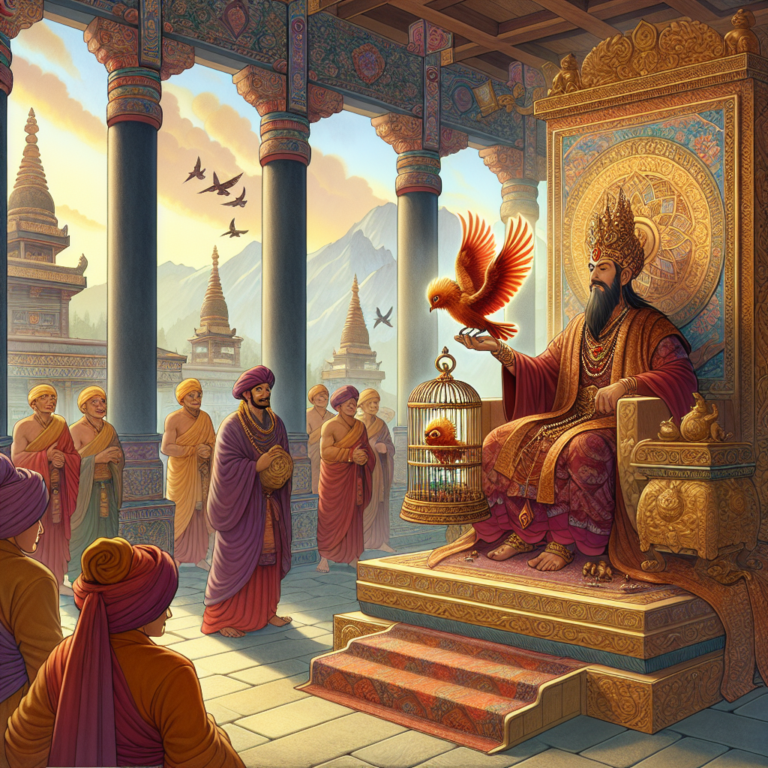
From a covered basket, the merchant gently lifted a small bird unlike any the king had ever seen. Its feathers shimmered with colors that seemed impossible, shifting from ruby red to golden yellow to emerald green as it moved. And when it opened its beak, a song poured forth that made everyone who heard it stop in wonder, as if they had heard the voice of heaven itself.
“This is Bodhi,” the merchant said, using the word that meant “awakening.” “She is the last of her kind, found in a hidden valley where mortals rarely venture. We thought the King of Righteousness should be her guardian.”
King Dharmaraja’s heart swelled with joy. Finally, he thought, this is what has been missing! This beautiful creature will fill my palace with song and wonder!
“What payment do you desire?” the king asked, ready to offer mountains of gold.
The merchant shook his head. “We ask for no payment, Great King. We ask only that you promise to protect her and keep her safe.”
“I swear it,” the king declared. “She will want for nothing.”
Chapter Three: The Brightest Days
For many weeks, the palace seemed transformed by Bodhi’s presence. Her song at dawn was more beautiful than any temple bell. Her song at dusk brought peace to troubled hearts. She would perch on the king’s shoulder as he heard the petitions of his people, and her presence seemed to make him wiser and more compassionate.
A magnificent cage was built for her, fashioned from gold and decorated with precious gems. Silk cushions lined its floor, and servants brought her the finest seeds and fruits from every corner of the kingdom.
“Are you not the luckiest bird in all the world?” King Dharmaraja would ask her each morning. “You live in a palace! You eat the finest food! You are loved by a king!”
And Bodhi would sing, but those who listened closely might have noticed that her song grew softer each day, like a river slowly running dry.
Chapter Four: The Fading Light
One morning, Princess Lakshmi, the king’s twelve-year-old daughter, came running to her father with tears streaming down her face.
“Father! Come quickly! Something is wrong with Bodhi!”
The king rushed to the bird’s golden cage. What he saw broke his heart. Bodhi’s magnificent feathers, once blazing with impossible colors, had faded to a dull brown. Her eyes, once bright as stars, had grown dim. And when she tried to sing, only a faint, mournful whisper emerged.
“Fetch the physicians!” the king commanded. “Bring the wisest healers in the land!”
Physicians came from every corner of the kingdom. They examined Bodhi, prescribed rare medicines, suggested special foods, but nothing helped. Day by day, the beautiful bird grew weaker.
“Father,” Princess Lakshmi said one evening, sitting beside the cage with tears in her eyes, “I have been watching Bodhi. She stares at the window all day long, watching the clouds drift by and the wild birds fly free. I think… I think she is dying of sadness.”
“Sadness? How can she be sad? She has everything!”
“Everything except the sky,” Lakshmi whispered.
Chapter Five: The Hermit’s Wisdom
Unable to bear watching Bodhi fade, King Dharmaraja resolved to seek help from the ancient hermit who lived in a cave high in the Blue Mountains. This hermit was said to understand the languages of all creatures and the secrets of all hearts.
After three days of climbing steep paths through cloud and mist, the king reached the hermit’s cave. Inside, an old man sat in meditation, his white hair flowing like a waterfall, his eyes closed in perfect peace.
“Holy one,” the king began, “I need your wisdom. A precious bird I love is dying, and I do not know how to save her.”
Without opening his eyes, the hermit spoke. “Describe to me her home.”
“She lives in a cage of pure gold, decorated with the finest jewels! Her cushions are silk, her food is the best in the kingdom!”
“And what does she see from this golden cage?”
“She sees… she sees the window. And beyond it, the sky.”
“Now tell me, O King, what does the sky see when it looks at your bird?”
The king fell silent, for he had never considered such a question.
“The sky sees a creature of the wind, born to soar among the clouds, locked in a box,” the hermit said gently. “Your cage is made of love, but it is still a cage. Your bird is not dying from any illness that medicine can cure. She is dying because you have imprisoned her soul.”
“But I only wanted to protect her! To keep her safe!”
The hermit finally opened his eyes, and they were filled with deep compassion. “Sometimes, O King, the greatest gift we can give to those we love is to set them free. True love does not imprison. True love gives wings.”
Chapter Six: The Hardest Choice
King Dharmaraja climbed down from the mountain with a heavy heart. He loved Bodhi. The thought of his palace without her song filled him with grief. But the hermit’s words echoed in his mind, and he knew what he had to do.
On the morning of his return, he gathered the entire court, a sea of nobles, ministers, and servants all wondering what announcement their king would make.
“My people,” the king said, his voice steady though his heart was breaking, “I have learned a lesson that has taken me many years to understand. I thought that because I loved Bodhi, I had the right to keep her. I thought that because I gave her comfort and safety, she would be happy. But I was wrong.
Love does not mean possession. Safety without freedom is not safety at all, it is a beautiful prison. Today, I will set Bodhi free.”
Gasps echoed through the hall. Some nobles protested, saying such a rare bird was too valuable to release. But Princess Lakshmi stepped forward and took her father’s hand.
“You are truly the King of Righteousness,” she said, her eyes shining with pride.
Chapter Seven: Wings to the Sky
The entire court gathered in the garden as King Dharmaraja carried Bodhi’s golden cage outside. The little bird lay on her cushions, barely breathing, her feathers dull as dead leaves.
The king opened the cage door and gently lifted Bodhi in his hands. “Dear one,” he whispered, “I am sorry I did not understand sooner. I give you back to the sky.”
He lifted his hands high and opened them.
For a long moment, Bodhi simply lay in his palms, too weak to move. The king’s heart clenched with fear, was he too late?
Then, slowly, the little bird raised her head. She felt the breeze on her feathers, warm and free. She saw the endless blue sky above, filled with drifting clouds.
And something miraculous happened.
Color began to flow back into her feathers, like dawn spreading across the horizon. First a blush of red, then streaks of gold, then waves of green and blue and purple. Her eyes brightened. She spread her wings, once so frail, now strong and gleaming.
Bodhi looked at the king with eyes full of gratitude. She opened her beak and sang, and her song was more beautiful than it had ever been, a song of joy, of freedom, of love without chains.
Then she rose into the air, circling once, twice, three times above the garden before soaring up into the endless blue sky.
Chapter Eight: The Richest King
Some say Bodhi flew back to her hidden valley beyond the eastern mountains. Others say she still lives in the wild forests of the kingdom, her song echoing through the trees for those who listen carefully.
King Dharmaraja never caged another bird again. Instead, he created great gardens and forests where wild creatures could live free, and his kingdom became known as a sanctuary for all living things.
“Father,” Princess Lakshmi asked one evening, “do you miss Bodhi?”
“Every day,” the king admitted. “But now when I hear birds singing in the garden, I know they sing because they choose to, not because they must. And that brings me more joy than any golden cage ever could.”
The emptiness that had haunted the king’s heart was gone at last. He had learned that true love is not about holding on, but about letting go. He had discovered that the greatest gift we can give to those we love is the freedom to be themselves.
And sometimes, on quiet evenings, a flash of impossible colors would appear in the garden, a shimmer of red and gold and green. The servants would whisper that it was Bodhi, returning to visit the king who had set her free, singing a song of thanks that only his heart could hear.
Moral Lessons
- True love does not seek to possess or control. The greatest gift we can give to those we love is the freedom to be themselves. A golden cage is still a cage, no matter how beautiful.
Test Your Understanding
1Who was Dharmaraja?
Frequently Asked Questions
What is the moral lesson of Dharmaraja’s Quest for Bodhi’s Freedom?
What age is this story appropriate for?
How long does it take to read Dharmaraja’s Quest for Bodhi’s Freedom?
What culture does this story come from?
Can I use this story for teaching?
Frequently Asked Questions
What age group is Dharmaraja’s Quest for Bodhi’s Freedom suitable for?
Dharmaraja’s Quest for Bodhi’s Freedom is designed for children ages 6 to 12. It works especially well as a bedtime story, combining an engaging adventure with meaningful moral lessons that parents and kids can explore and discuss together.
What is the main lesson in Dharmaraja’s Quest for Bodhi’s Freedom?
The story explores themes of inner fulfillment, righteousness, and freedom. King Dharmaraja discovers that true happiness cannot be found in wealth or power alone, guiding young readers to reflect on what really matters in life beyond material possessions.
Who is Dharmaraja and what does his name mean?
Dharmaraja is a wise and just king whose name literally means King of Righteousness. Despite ruling a prosperous and peaceful kingdom filled with beauty and abundance, he feels an unexplained emptiness, which drives the central journey of the story.
📚 Recommended Books
Handpicked for readers like you
As an Amazon Associate, we earn from qualifying purchases. These recommendations are personalized based on this story's themes and your reading history.
Is this story based on Indian mythology or folklore?
The story draws inspiration from Indian cultural traditions, using names like Dharmaraja and Vidura that echo ancient Sanskrit and Hindu mythology. It blends these influences into an original moral tale crafted specifically for modern children.
Can parents read this bedtime story with young children together?
Absolutely. The story is written in clear, accessible language perfect for shared reading between parents and children ages 6 to 12. Its moral themes naturally spark meaningful conversations about values like kindness, purpose, and what it truly means to live a good life.