Share this engaging bedtime story with kids ages 6-12 to teach valuable life lessons.
Chapter One: Five Pies and a Fib
In the county of Suffolk, where the fields stretched golden with wheat and the hedgerows bloomed wild with roses, there lived a widow and her daughter in a small cottage by the crossroads.
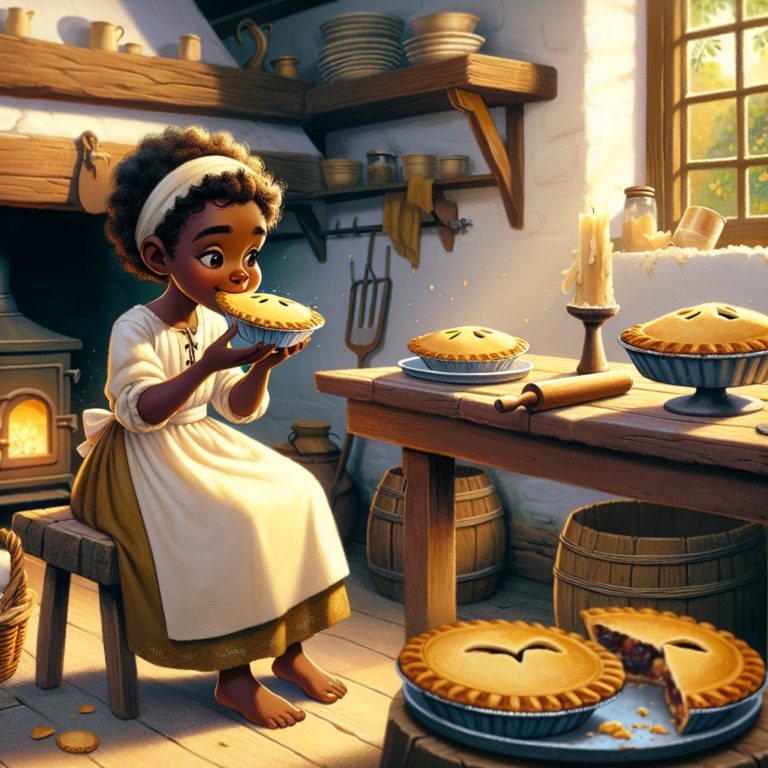
Now, this widow was an excellent cook, famous throughout the village for her meat pies with crusts as golden as autumn sunshine. One fine September morning, she rose early and baked five pies, filling the cottage with the most mouth-watering aroma you could imagine.
“There now,” she said, pulling them from the oven, “these will feed us for the whole week!”
But when she tapped the crusts with her wooden spoon, she frowned. “Oh dear, oh dear! I’ve baked them too long. The crusts are as hard as old leather boots! No matter, I’ll set them on the shelf to soften up overnight. The steam will make them lovely and tender by tomorrow.”
She called to her daughter, who was sitting by the window daydreaming. “Margery! Put these pies up on the high shelf, there’s a good girl. Don’t touch them until tomorrow!”
Margery was a pretty girl of sixteen with bright eyes and a quick smile, but she had one terrible flaw: she couldn’t leave well enough alone. She carried the pies to the shelf, and as she set each one down, the delicious smell made her stomach rumble.
“If they’re going to soften anyway,” she reasoned, “surely it won’t matter if I have just a tiny taste now.”
One taste became two. Two became three. And before she quite knew what she was doing, Margery had eaten every last crumb of all five pies.
“Oh no,” she gasped, staring at the empty dishes. “What have I done?”
Chapter Two: A Mother’s Pride
When dinnertime came, the widow asked, “Margery dear, fetch one of those pies, would you? They should be perfect by now.”
Margery’s heart pounded like a drum. “They… they haven’t softened up yet, Mother.”
“Well, never mind if they haven’t. I’m hungry enough to manage a hard crust. Bring me one anyway.”
“But Mother, there aren’t any!”
“What do you mean, there aren’t any? I baked five pies this very morning!”
“They’re gone, Mother. All five of them.”
The widow stared at her daughter, and understanding slowly dawned. “Margery… did you eat all five pies?”
Margery hung her head in shame. “I couldn’t help it, Mother. I’m sorry.”
The widow sat down heavily in her chair. Her face flushed red with embarrassment. Five pies! What would the neighbors think if they knew her daughter had eaten five pies in a single day?
To calm herself, she took up her spinning wheel and went to sit on the porch, where the evening breeze might cool her temper. As she spun, she began to sing to herself, making up words to match her frustration, though she kept her voice low so the neighbors wouldn’t hear the shameful truth.
“Five pies my daughter ate today, ate today, ate today…”
Chapter Three: A Royal Misunderstanding
Now, as it happened, the young king was riding by that very evening, returning from a hunt with his courtiers. He heard the widow singing and was enchanted by her voice, though he couldn’t quite make out the words.
“Good woman,” he called out, reining in his horse, “what is that song you’re singing? The tune is lovely!”
The widow nearly fell off her stool in surprise. The king himself! She couldn’t possibly tell him the truth about her greedy daughter. So in a panic, she made up new words on the spot:
“Five skeins my daughter spun today, spun today, spun today! Five skeins of gold my daughter spun, all before the close of day!”
The king’s eyes widened. “Five skeins of gold? Spun from ordinary flax? Is such a thing possible?”
“Oh yes, Your Majesty!” the widow said, getting caught up in her fib. “My Margery is the finest spinner in all the land. She can spin straw into gold as easily as I spin wool into yarn!”
“Well!” exclaimed the king. “I have been seeking a bride. A wife who could spin gold would be a treasure indeed. I shall marry your daughter!”
The widow’s jaw dropped. This was not what she had intended at all!
“Here is my bargain,” the king continued. “For eleven months of the year, your daughter shall live in the palace and have everything her heart desires. But in the twelfth month, she must spin five skeins of gold each day for thirty days. If she succeeds, she shall remain my queen forever. If she fails…” He paused dramatically. “Well, let us hope she does not fail.”
Before the widow could think of how to untangle this terrible mess, the king had ridden off, and servants arrived the very next morning to fetch Margery to the palace.
Chapter Four: A Year of Luxury
And so poor Margery, who had never spun a skein of gold in her life (for nobody had, except perhaps in fairy tales), found herself married to the king and living in a palace grander than anything she had ever imagined.
For eleven months, she lived like a princess in a dream. She wore gowns of silk and velvet. She ate roast peacock and sugared almonds. She had servants to brush her hair and musicians to play her to sleep. She almost forgot about the impossible task that awaited her.
Almost, but not quite.
As the eleventh month drew to a close, Margery began to worry. She lay awake at night, staring at the embroidered canopy above her bed, her heart heavy with dread. How could she spin gold from flax? It was impossible! And what would happen when the king discovered the truth?
On the first day of the twelfth month, a servant came to fetch her.
“The king wishes to see you, Your Majesty.”
With trembling legs, Margery followed the servant to a small room at the top of a tower. Inside, she found nothing but a spinning wheel, a stool, and great bales of flax piled against the walls.
The king appeared in the doorway. “My dear wife,” he said, though his smile did not quite reach his eyes, “here is the flax. You shall spin five skeins of gold each day for thirty days. I shall come each evening to collect them.” He paused. “Do not disappoint me.”
The door closed. The lock clicked. And Margery sank onto the stool and wept.
Chapter Five: The Little Black Thing
Margery cried until she had no tears left. Then she just sat, staring at the spinning wheel she had no idea how to use. Outside the window, the sun began to set, painting the sky orange and pink.
Suddenly, she heard a scratching at the window. When she looked up, she saw the strangest creature perched on the windowsill.
It was small and black, with a long tail like a monkey’s, pointed ears, and eyes that gleamed like hot coals. It grinned at her with teeth too sharp for comfort.
“What ails you, pretty maid?” the creature asked in a voice like dry leaves rustling.
Margery was so surprised she forgot to be afraid. “I’m supposed to spin five skeins of gold every day, but I don’t know how! If I fail, something terrible will happen!”
The little black thing’s grin grew wider. “I could help you. I could spin all the gold you need.”
“You could? Oh, please! What do you want in return?”
The creature hopped down from the windowsill. “For the first three days, I shall spin your gold, and each night you must guess my name. If you guess right, our bargain is done. If you guess wrong all three nights… you must come away with me forever.”
Margery hesitated. Forever? That sounded terrible. But what choice did she have?
“Agreed,” she said.
Chapter Six: The Guessing Game
The little black thing set to work, and oh, how it could spin! Its little hands flew so fast they were a blur, and where there had been plain flax, gleaming threads of gold appeared as if by magic.
When evening came, the creature stopped and said, “Now then, what’s my name?”
Margery thought hard. “Is it… William?”
“Nope!” the creature cackled.
“Is it… Thomas?”
“Nope!”
“Is it… Henry?”
“Nope, nope, nope!” And with a whisk of its tail, the creature vanished out the window.
The king came and found five perfect skeins of gold. “Well done, my dear,” he said, actually smiling. “Twenty-nine days to go.”
The next night was the same. The creature spun gold all day, and Margery guessed names all evening: Edward, Robert, Richard, Geoffrey. But none were right.
By the third day, Margery was desperate. She had run out of ordinary names. That evening, she tried every strange name she could think of: Zebedee! Nicodemus! Methusalem! Balthazar! But the creature only laughed and laughed.
“One more chance, pretty maid,” it said. “Guess right tomorrow night, or you’re mine forever!”
Chapter Seven: The King’s Discovery
That night, Margery couldn’t sleep. She paced her room until dawn, trying to think of every name she had ever heard. But there were so many names in the world! How could she possibly guess the right one?
Meanwhile, the king was out hunting in the forest. As evening fell, he lost his way and found himself in a dark part of the woods he had never seen before. There, in a clearing, he saw the strangest sight.
A small black creature with a long tail was dancing around a fire, spinning in circles and singing at the top of its voice:
“She’ll never guess, not in a million years!
My name’s not Jack, my name’s not Tim!
Tomorrow night, she’ll belong to ME!
For my name is TOM TIT TOT!”
The king crept closer, amazed. He watched the creature dance until it finally vanished in a puff of smoke. Then he hurried back to the palace, bursting to tell his wife what he had seen.
“My dear!” he said, finding Margery in her chamber. “You won’t believe what I witnessed in the forest!” And he told her all about the little black creature and its strange song.
Margery’s heart nearly burst with joy. Now she knew the creature’s name!
Chapter Eight: The Final Night
The next evening, the little black thing appeared one last time, its grin wider than ever.
“This is it, pretty maid! Last chance! What’s my name?”
Margery pretended to think very hard. “Is it… Solomon?”
“Nope!” The creature rubbed its hands together gleefully.
“Is it… Zebedee?”
“Nope!” It began to bounce with excitement.
Margery looked the creature straight in its gleaming eyes. “Is it… TOM TIT TOT?”
The creature’s grin vanished. Its eyes went wide. Its mouth fell open. “WHO TOLD YOU?” it shrieked.
And then, with a terrible wail, it flew out the window and was never seen again.
Margery sank back in her chair, shaking with relief. She was free!
Chapter Nine: The Honest Truth
But now Margery faced another problem. The thirty days were not yet over, and she still couldn’t spin gold herself.
That night, she went to the king and fell on her knees before him.
“My lord,” she said, “I have a confession. I cannot spin gold. I never could. My mother made up that story because she was embarrassed that I had eaten five pies in one day.”
She told him everything: the pies, her mother’s fib, the little black creature, all of it.
When she finished, she waited for the king’s anger. But to her amazement, he began to laugh.
“Five pies!” he chuckled. “Well, you do have a healthy appetite!” Then his face grew serious. “But you tricked me.”
“I know,” Margery said miserably. “I’m sorry. I was afraid.”
The king was quiet for a long moment. Then he reached down and helped her to her feet.
“I think,” he said slowly, “I would rather have an honest wife who cannot spin gold than a dishonest one who can. And besides,” he added with a smile, “I already have more gold than I know what to do with. What I need is someone brave enough to tell me the truth.”
And so Margery became a true queen, beloved by her people. She never pretended to be anything other than what she was: an ordinary girl who had learned, the hard way, that honesty is worth more than all the gold in the world.
As for those meat pies, she learned to bake them herself, and they became famous throughout the kingdom. But she always made sure to let them cool properly before serving.
Moral Lessons
- Honesty is always the best path, even when the truth is embarrassing. Small fibs can grow into big problems, but courage and truthfulness can set things right again.
Test Your Understanding
1Who ate all the pies that the woman baked?
Frequently Asked Questions
What is the moral lesson of Sheila’s Tasty Secret and the Mysterious Missing Pies?
What age is this story appropriate for?
How long does it take to read Sheila’s Tasty Secret and the Mysterious Missing Pies?
What culture does this story come from?
Can I use this story for teaching?
Frequently Asked Questions
What age group is the bedtime story about Sheila’s tasty secret suitable for?
This bedtime story is written for children ages 6 to 12. It’s designed to be read aloud at bedtime and weaves entertaining characters and situations into lessons that are easy for kids in that age range to understand and relate to.
What life lessons does the mysterious missing pies story teach children?
The story explores themes like honesty, temptation, and the consequences of telling fibs. Through characters like Margery and her mother, children learn why telling the truth matters and what can happen when we give in to temptation or try to cover up a mistake with a lie.
What happens to the missing pies in the story?
The mystery of the missing pies unfolds around Margery, a sixteen-year-old girl who can’t resist temptation. After being told not to touch the freshly baked meat pies, she struggles to leave them alone. The story follows what happens next and how the truth eventually comes to light.
📚 Recommended Books
Handpicked for readers like you
As an Amazon Associate, we earn from qualifying purchases. These recommendations are personalized based on this story's themes and your reading history.
Is this bedtime story based on a traditional or classic tale?
The story draws on the feel of classic English folk tales, set in the countryside of Suffolk with a widow famous for her golden-crusted meat pies. While it has a traditional storytelling style with moral lessons, it reads as an original bedtime story rather than a well-known fairy tale retelling.
How long is this bedtime story about the missing pies?
The story is divided into chapters, making it ideal for reading in installments over several nights or in one sitting. Chapter one sets up the mystery with the five baked pies and Margery’s temptation. The chapter format keeps it manageable for younger readers while holding their attention.