

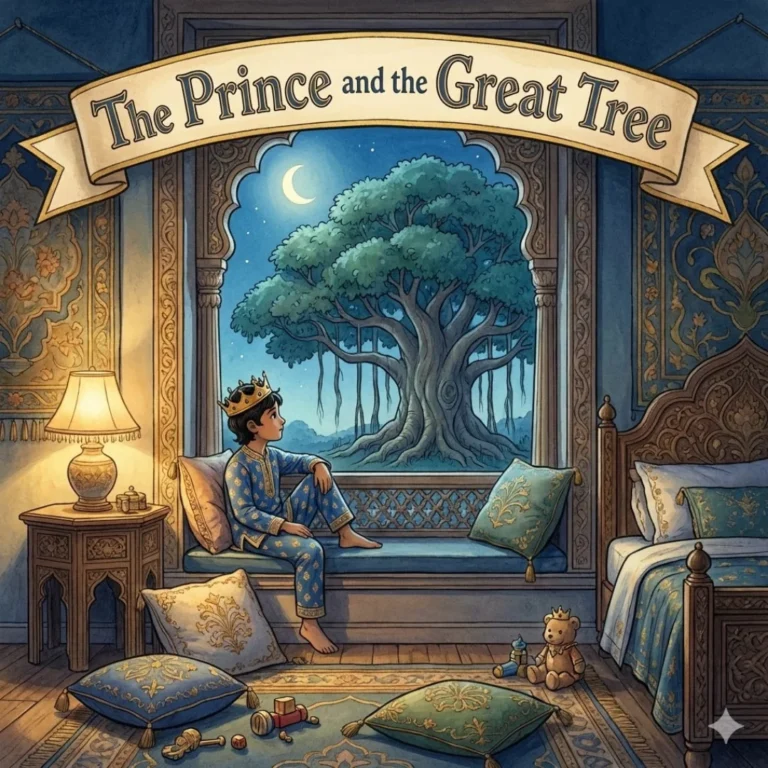
‘The Prince and the Great Tree’ is an educational moral story perfect for bedtime reading with children ages 6-12.
In the ancient kingdom of Kapilavastu, nestled at the foothills of the Himalayas, there lived a young prince named Siddhartha Gautama. He was born into the Shakya clan, his father King Suddhodana ruling with wisdom and his mother Queen Maya known for her gentle compassion. The night of Siddhartha’s birth had been marked by extraordinary signs – it was said that the earth trembled gently, celestial flowers fell from the sky, and a great light illuminated the palace.
Seven days after giving birth to Siddhartha, Queen Maya passed away, and the infant prince was raised by his aunt Mahaprajapati with deep love. When wise sages came to see the newborn, the most learned among them, the sage Asita, made a startling prediction: “This child will become either a great chakravartin – a universal king who rules the world – or a Buddha, one who achieves complete enlightenment and shows the path to liberation for all beings.”
King Suddhodana, hearing this prophecy, made a fateful decision. He wanted his son to inherit the throne, to be a mighty ruler, not a wandering spiritual seeker. So he created a world of perfection for Siddhartha – three palaces for different seasons, gardens of exquisite beauty, servants to attend his every need, and strict orders that the young prince should never witness suffering, old age, sickness, or death.
Siddhartha grew up surrounded by luxury and learning. He mastered archery, swordsmanship, mathematics, philosophy, and the arts. At sixteen, he married the beautiful princess Yashodhara, and together they lived in a paradise carefully maintained to shield him from life’s harsh realities. Years passed in this way, and Siddhartha became known for his kindness, intelligence, and skill in all princely arts.
But the human heart cannot be forever satisfied with pleasure alone. As Siddhartha approached his thirtieth year, a restlessness grew within him. The palace walls, once comforting, began to feel confining. The endless entertainment seemed hollow. Questions arose in his mind: “Is this all there is to life? What lies beyond these walls? What is the true nature of existence?”
One day, Siddhartha convinced his charioteer Channa to take him beyond the palace gates. What he saw shattered his carefully constructed world. An old person, bent with age, struggling to walk. A sick person, writhing in pain. A funeral procession carrying a corpse. And finally, a wandering ascetic – a samana – walking with peaceful dignity despite owning nothing but his simple robes.
These became known as the Four Sights, and they transformed Siddhartha’s understanding completely. “Channa,” he asked his charioteer, “will I too grow old like that person?”
“Yes, my prince,” Channa replied sadly. “All who are born must age.”
“Will I too fall sick?”
“None can escape illness, my prince.”
“Will I too die?”
“Death comes to all living beings without exception.”
Siddhartha sat in silence, absorbing this truth. Then he pointed to the samana. “But that person – he has seen suffering, yet his face holds peace. How is this possible?”
“He seeks the end of suffering, my prince. He has renounced worldly life to find liberation.”
That night, Siddhartha could not sleep. The silk pillows felt too soft, the palace too stifling. He rose quietly and walked to his infant son Rahula’s room, watching the child sleep beside his wife Yashodhara. Love filled his heart, but so did a deeper calling. “Forgive me,” he whispered. “I must find the truth about suffering and its end, not just for myself, but for all beings. Only then can I truly help you and everyone who suffers.”
In the dark hours before dawn, Siddhartha left the palace. He shed his royal robes, cut his long hair with his sword, and sent Channa back with his jewelry and his horse Kanthaka. At age 29, the prince became a wandering seeker.
For six years, Siddhartha practiced extreme asceticism. He studied with the greatest meditation masters of his time, learning to enter profound states of consciousness. He joined a group of five ascetics who believed that punishing the body would free the spirit. Siddhartha practiced these austerities more intensely than anyone – eating only a single grain of rice per day, holding his breath for extended periods, exposing himself to extreme heat and cold.
His body became skeletal, his ribs visible through his skin, his eyes sunken. Yet enlightenment eluded him. One day, weak from fasting, he collapsed while bathing in the Neranjara River and nearly drowned. As he lay on the bank, a memory arose from his childhood.
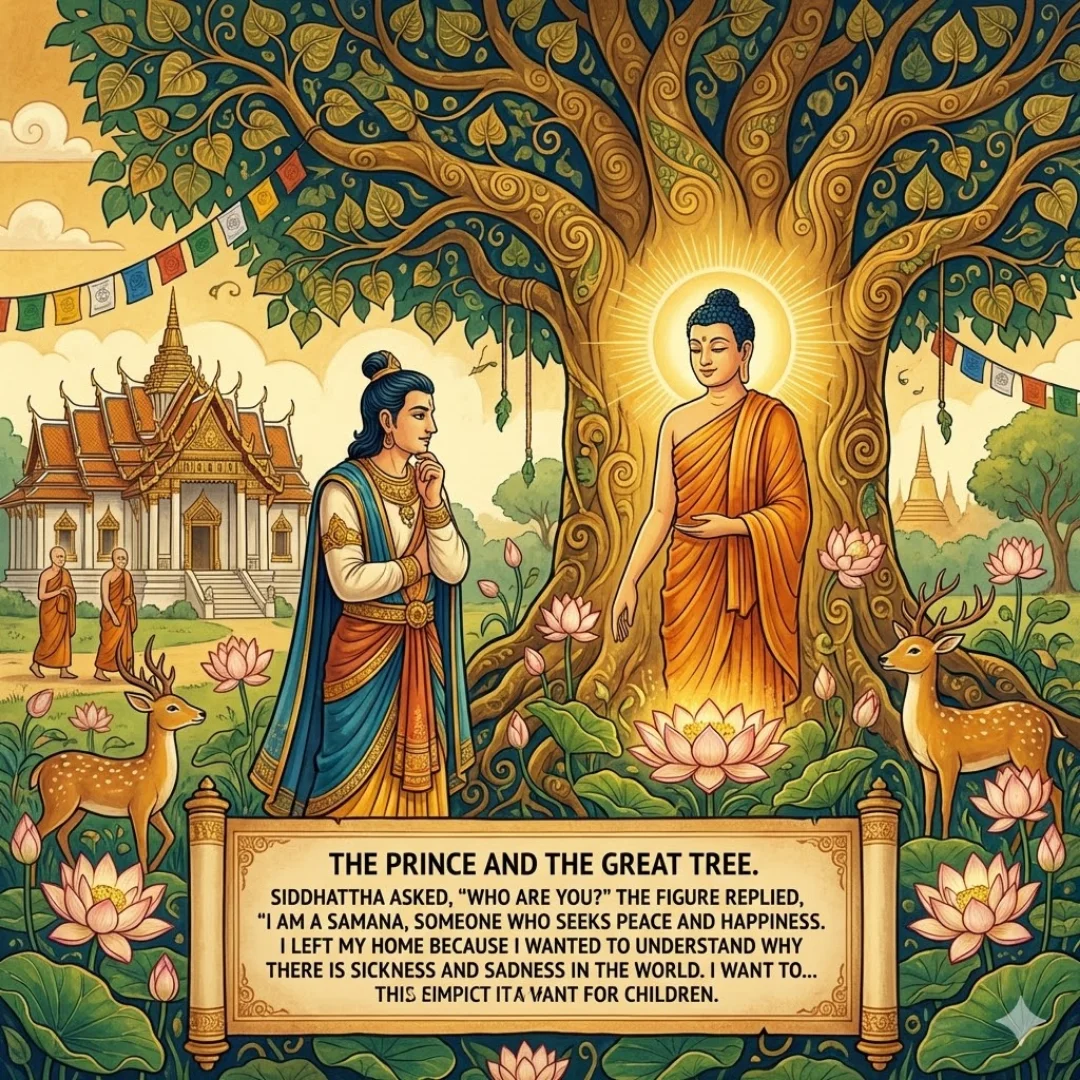
He was seven years old, sitting beneath a rose-apple tree (jambu tree) during a spring plowing festival. While others worked and celebrated, young Siddhartha had spontaneously entered a state of deep meditation. In that moment, he experienced profound peace and clarity – not through forcing or punishing his body, but through natural, focused awareness. Joy arose without the need for sensory pleasure. Calm descended without the need for harsh austerity.
Lying by the river, the emaciated Siddhartha realized his error. “How can a mind work properly when the body is tortured and weak?” he thought. “This is not the path. The truth must lie in the middle – neither lost in luxury nor destroyed by austerity. There must be a Middle Way.”
At that moment, a young village girl named Sujata approached. Seeing the starving ascetic, her heart filled with compassion. She offered him a bowl of milk-rice pudding (kheer) she had prepared. Siddhartha accepted it, breaking his fast.
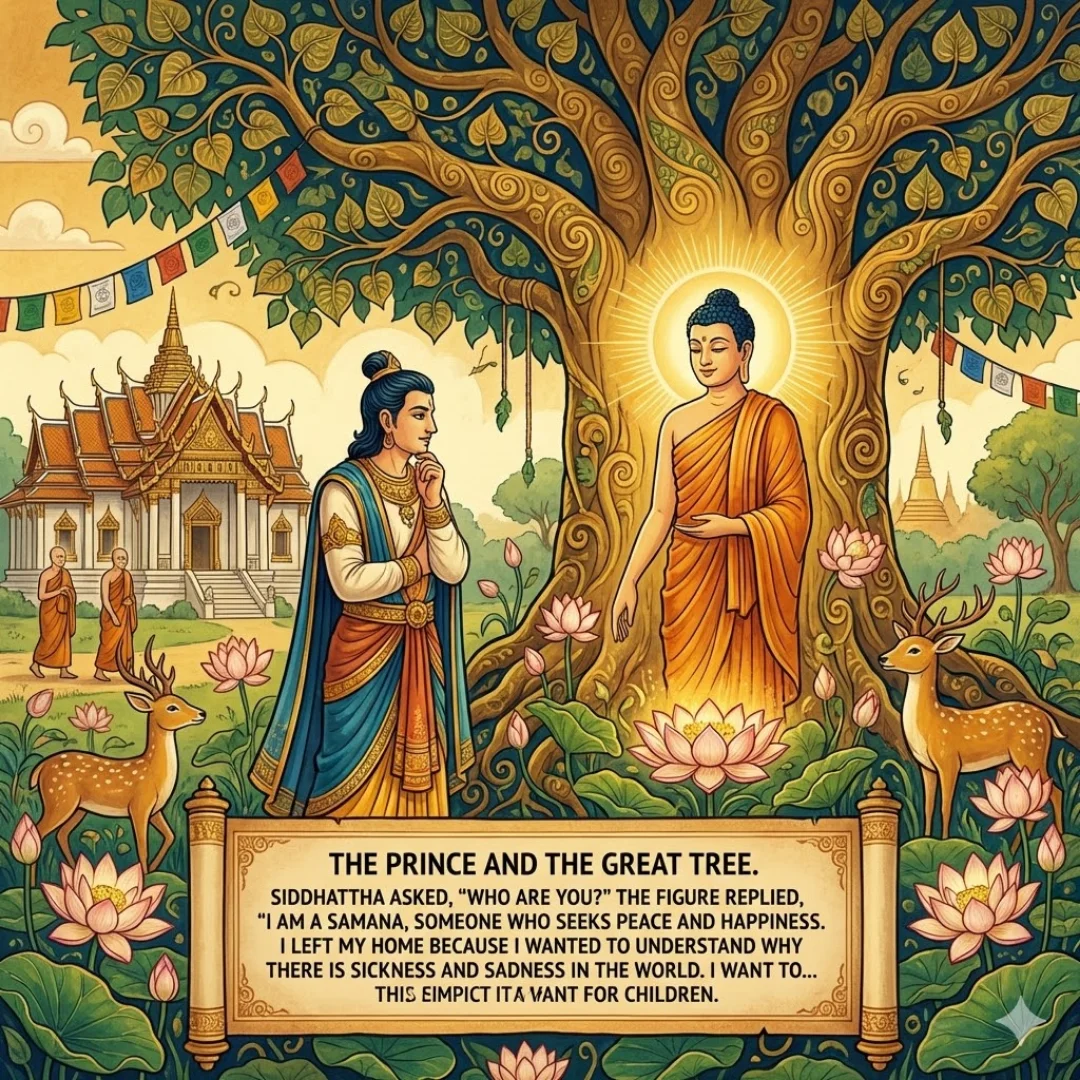
When the five ascetics who had been his companions saw him eating, they were disgusted. “Siddhartha has given up!” they declared. “He has abandoned the austere path. He is no longer worthy of our company.” They left him, convinced he had failed.
But Siddhartha felt strength returning to his body and clarity to his mind. He knew, with certainty deeper than doubt, that he was finally on the right path. He walked to a large pipal tree (later to be known as the Bodhi tree – the Tree of Enlightenment) near the village of Bodh Gaya. The tree’s broad leaves rustled in the wind, and its strong roots spread deep into the earth.
Siddhartha gathered kusha grass and made a simple seat beneath the tree. As he sat down in meditation posture, he made an unshakeable vow: “Let my skin wither, let my blood dry up, let all the flesh and bones in my body dissolve – I will not rise from this seat until I have attained complete enlightenment.”
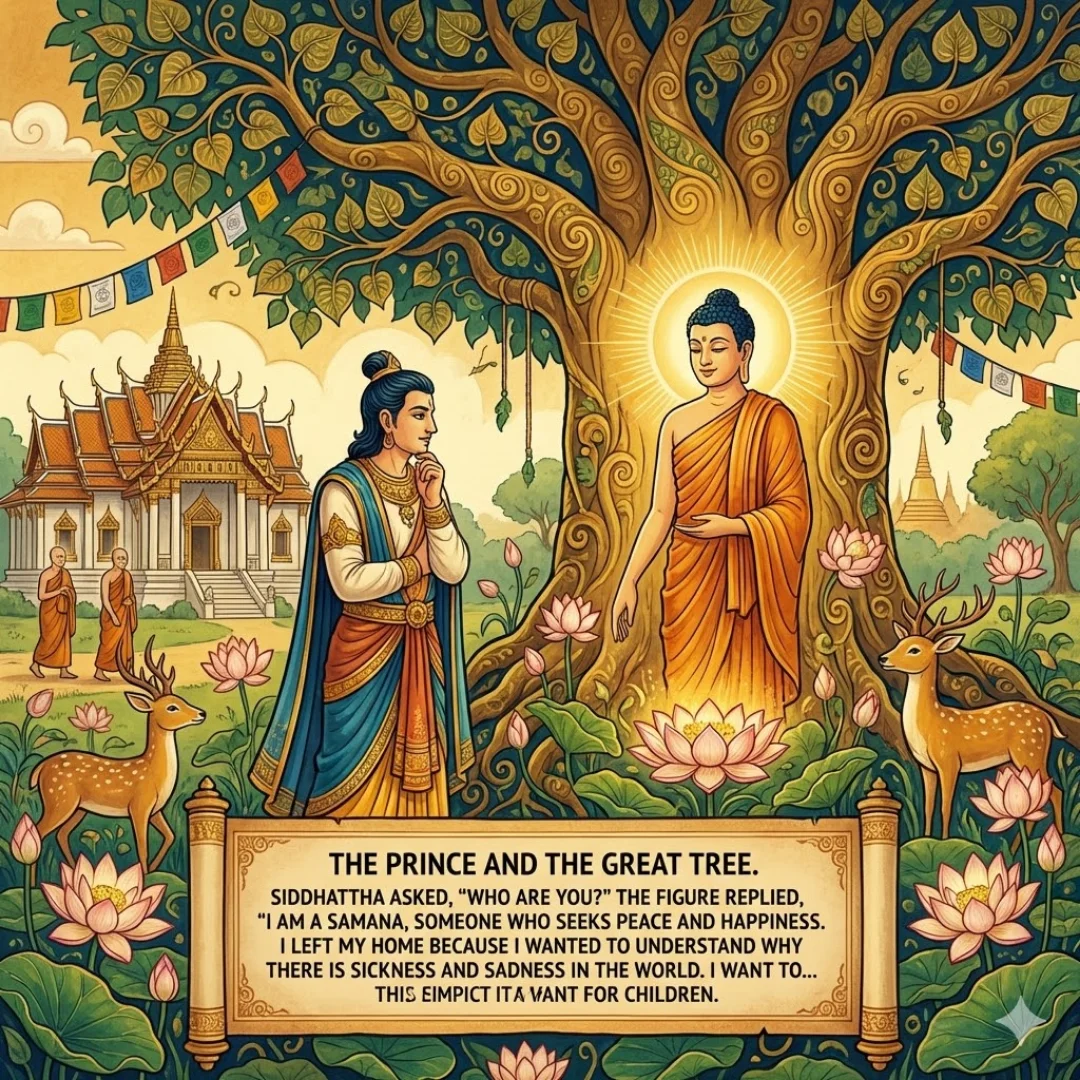
The sun set, and night descended. Siddhartha’s mind grew still, focused, clear as a calm mountain lake. In this clarity, he began to perceive truth after truth.
First, he saw his own past lives – hundreds, thousands of existences stretching back through time. He had been a king, a merchant, a animal, a deity – the wheel of birth and death turning endlessly. This was the first watch of the night.
During the second watch, his awareness expanded further. He perceived how all beings are born, die, and are reborn according to their karma – their actions, intentions, and the patterns they create. He saw how suffering perpetuates itself through ignorance, craving, and attachment.
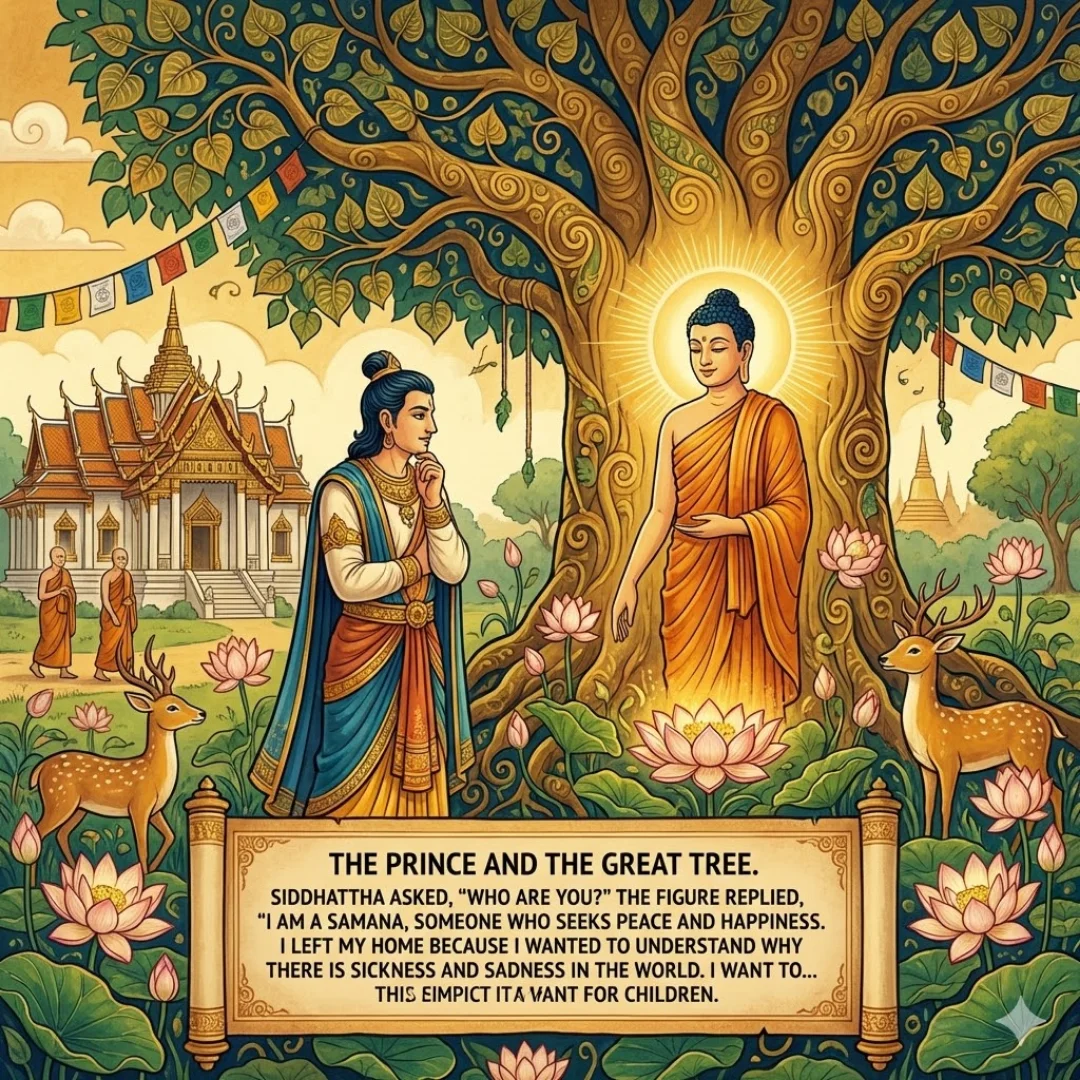
As the third watch of night approached dawn, the final breakthrough came. Like a lotus emerging from muddy water into sunlight, Siddhartha’s mind pierced through all illusions and grasped the fundamental nature of reality. The Four Noble Truths crystallized in his consciousness:
The truth of suffering (dukkha): Life inherently contains suffering – birth, aging, sickness, death, separation from what we love, encountering what we hate, not getting what we want.
The truth of suffering’s origin: Suffering arises from tanha – craving, clinging, and attachment. We suffer because we desperately grasp at pleasure, push away pain, and cling to a false sense of permanent self.
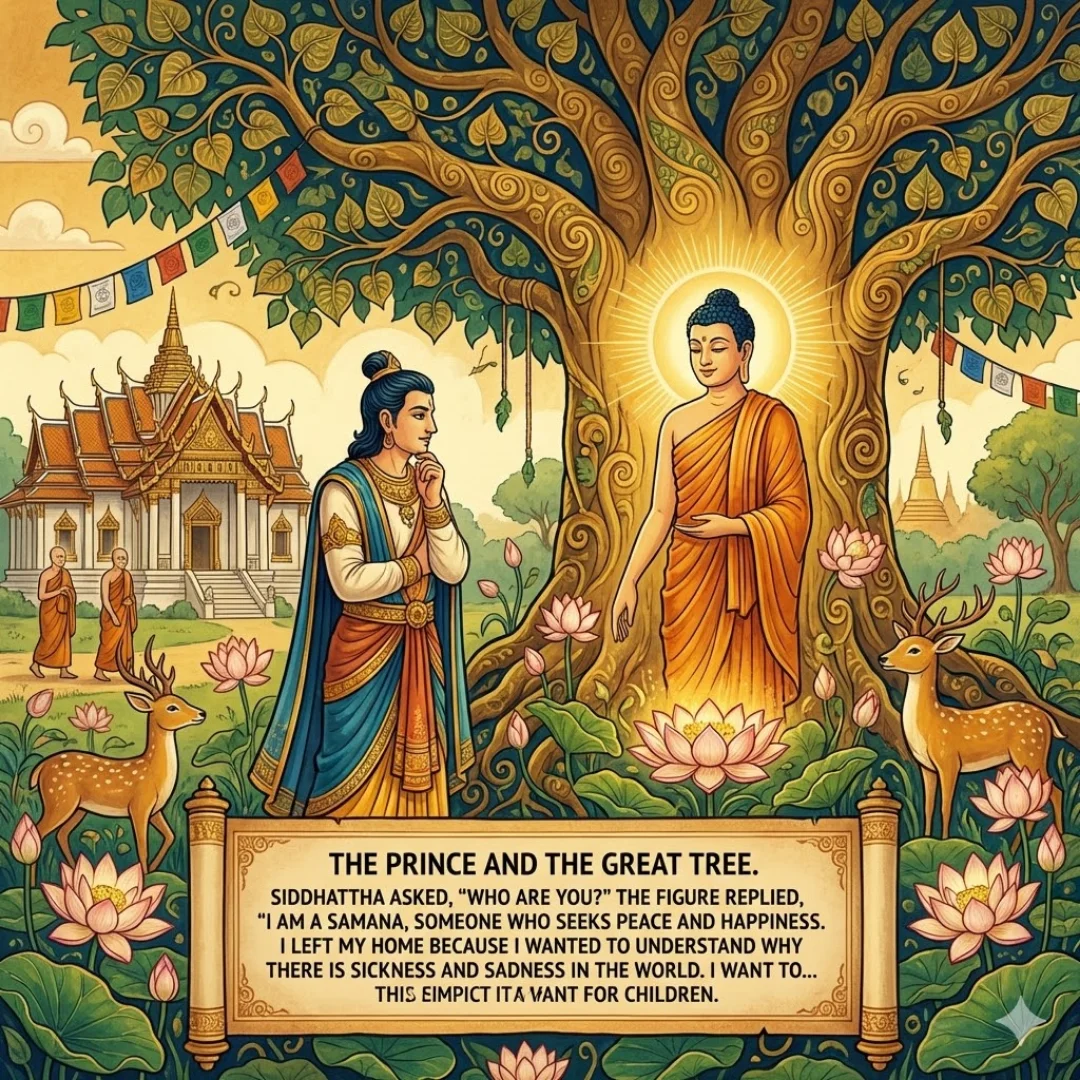
The truth of suffering’s cessation: There is an end to suffering! Nirvana exists – a state of liberation where craving has been extinguished, where peace and freedom reign.
The truth of the path leading to suffering’s cessation: The Noble Eightfold Path – right view, right intention, right speech, right action, right livelihood, right effort, right mindfulness, right concentration.
As the morning star appeared in the eastern sky, Siddhartha’s enlightenment became complete. He was no longer Siddhartha the seeker – he had become the Buddha, the Awakened One. His mind was free from all defilements, his understanding perfect, his compassion boundless.
The texts say that at this moment, the earth trembled six times in celebration. Flowers fell from the sky. The Bodhi tree’s leaves shimmered with an otherworldly light. But the greatest miracle was internal – the Buddha had discovered what countless beings had sought for eons: the complete end of suffering and the path to liberation.
For seven weeks, the Buddha remained near the Bodhi tree, experiencing the bliss of liberation, contemplating how to share what he had discovered. Initially, he wondered if what he had realized was too subtle, too profound for others to understand. “People are so lost in craving and confusion,” he thought. “How can I explain truths that transcend ordinary experience?”
Then, according to tradition, Brahma Sahampati, one of the highest deities in Hindu-Buddhist cosmology, appeared before the Buddha and entreated him: “Please, Blessed One, teach! There are beings with only a little dust in their eyes who will understand. If you do not teach, they will be lost.”
The Buddha’s infinite compassion stirred. He reflected: “Some beings will indeed understand. Not everyone is completely lost in ignorance.” So he made the decision that would transform human history – he would teach the Dharma, the truth he had discovered, for the liberation of all beings.
He traveled to Sarnath, where his five former companions were staying. When they saw him approaching, they initially decided to ignore him, still believing he had given up the spiritual path. But as the Buddha came closer, something in his bearing, his radiance, his peace made them involuntarily rise and bow.
“Friends,” the Buddha addressed them, “I have found what we were seeking. Listen, and I will teach you.”
In the Deer Park at Sarnath, the Buddha delivered his first sermon, “Turning the Wheel of Dharma.” He explained the Middle Way between luxury and austerity, taught the Four Noble Truths, and described the Eightfold Path. The five ascetics, hearing these teachings, themselves achieved enlightenment and became the first bhikkhus – Buddhist monks.
From that day forward, the Buddha spent 45 years traveling across northern India, teaching all who would listen regardless of their caste, gender, or background. He established the Sangha – the community of monks and nuns. His message was revolutionary: liberation from suffering is possible for all beings through their own efforts, by following the path of wisdom, ethical conduct, and mental discipline.
The Buddha’s enlightenment under the Bodhi tree represents humanity’s highest potential – the possibility of awakening from the sleep of ignorance, of transforming suffering into compassion, of finding unshakeable peace amid life’s turmoil. The great tree that sheltered him on that pivotal night became a symbol of refuge, of the natural world supporting spiritual seeking, and of the deep roots of wisdom that can sustain all beings.
Moral Lessons
- True peace and happiness come not from indulging desires or punishing the body, but from understanding the nature of suffering and following the middle path of wisdom, ethics, and mindfulness. Liberation from suffering is possible through one’s own efforts and awakening.
Test Your Understanding
1. What were the “Four Sights” that changed Prince Siddhartha’s life?
Frequently Asked Questions
What is the moral lesson of The Prince and the Great Tree?
What age is this story appropriate for?
How long does it take to read The Prince and the Great Tree?
What culture does this story come from?
Can I use this story for teaching?
Frequently Asked Questions
Who is Prince Siddhartha in this bedtime story for kids?
Prince Siddhartha Gautama is the main character in this Buddhist story – the young prince who would later become the Buddha. Born in the ancient kingdom of Kapilavastu to King Suddhodana and Queen Maya, he was raised with love after his mother passed away seven days after his birth.
What age group is The Prince and the Great Tree appropriate for?
This moral story is perfect for children ages 6-12. It’s designed as an educational bedtime story that teaches important Buddhist values like compassion and wisdom in an age-appropriate way that young readers can easily understand and enjoy.
What moral lessons does this educational story for kids teach?
This Buddhist tale teaches children about compassion, wisdom, and the early life of one of history’s most important spiritual teachers. It shows how even as a young prince, Siddhartha demonstrated the qualities that would later make him the Buddha.
📚 Recommended Books
Handpicked for readers like you
As an Amazon Associate, we earn from qualifying purchases. These recommendations are personalized based on this story's themes and your reading history.
Where does The Prince and the Great Tree story take place?
The story is set in the ancient kingdom of Kapilavastu, nestled at the foothills of the Himalayas. This was the historical birthplace and home of Prince Siddhartha Gautama, where the powerful Shakya clan ruled in ancient India, creating the perfect setting for this meaningful tale.
Is this story based on real historical events?
Yes, this story is based on the historical accounts of Prince Siddhartha Gautama’s early life. While some elements are told in a child-friendly way, the core details about his birth, family, and the prophecies surrounding him come from Buddhist historical texts.
