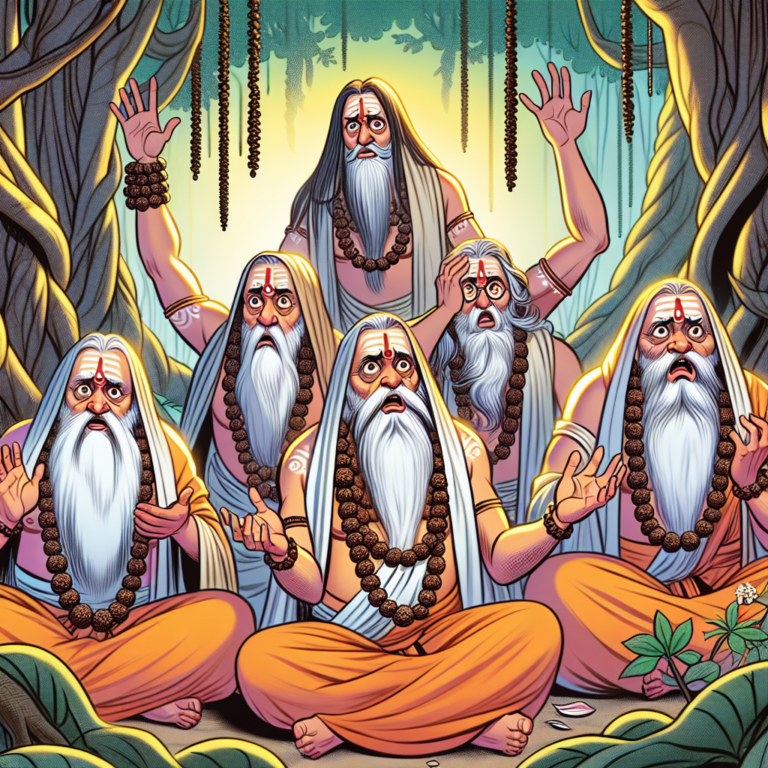
This moral story for children ages 6-12 combines entertainment with important values.
At the end of a great cosmic age, Lord Brahma, the Creator, sat upon his lotus throne in the highest heaven. After countless millennia of creating and sustaining the universe, exhaustion finally overcame him. His eyelids grew heavy. A tremendous yawn escaped his four mouths.
And in that instant of cosmic drowsiness, something terrible happened.
The four Vedas—the sacred hymns containing all knowledge of dharma, ritual, philosophy, and truth—slipped from Brahma’s grasp. Like golden birds escaping from an opened cage, they flew from the Creator’s hands and plummeted downward through the layers of heaven toward the earthly realm.
A demon named Hayagriva, who had the head of a horse and the cunning of a serpent, had been watching and waiting for exactly this moment. His eyes gleamed with malicious triumph.
“At last!” he hissed. “The source of all divine power falls into my grasp!”
With supernatural speed, Hayagriva dove through the celestial spheres and seized the four Vedas in his powerful arms. He plunged into the deepest, darkest reaches of the cosmic ocean, hiding the sacred texts where no god or sage could ever find them.
Without the Vedas, the universe began to unravel. The laws of dharma grew confused. Rituals lost their power. Prayers went unanswered. Knowledge faded from the minds of the wise. The cosmic order itself began to collapse.
Far below, on the earth, there lived a righteous king named Satyavrata (also known as Manu Vaivasvata), who ruled his kingdom with wisdom and justice. One morning, as he performed his ritual ablutions in a sacred river, he cupped his hands to offer water to the sun god.
When he looked into his palms, he saw a tiny fish—no larger than his fingernail—swimming frantically in the water.
“Please, great king,” the fish spoke in a voice like tinkling bells, “do not throw me back into the river! Larger fish will devour me. Save my life!”
Satyavrata’s heart filled with compassion. He placed the little fish in his water pot and carried it back to his palace.
But the next morning, the fish had grown. It filled the entire pot.
“Kind king,” the fish said, “I need more space. Please transfer me to a larger vessel.”
Satyavrata moved the fish to a clay jar. By evening, it had outgrown that too. He placed it in a well. The next day, it filled the well. He moved it to a pond, then to a lake, then finally to the vast ocean itself.
With each move, the fish grew larger and larger, until it became as immense as a mountain, its golden scales shimmering with divine light.
King Satyavrata fell to his knees in awe. “You are no ordinary fish! Who are you truly?”
The great fish’s eyes—deep and infinite as the cosmos—looked upon the king with boundless compassion.
“I am Vishnu, the Preserver,” the divine voice thundered like a thousand oceans. “I have taken this form to save you and all living beings from the catastrophe that is to come.”
“Listen carefully, Satyavrata,” Lord Vishnu continued. “In seven days, a great deluge will cover the entire earth. The cosmic dissolution has begun. But I will send you a mighty boat. Gather the seven great sages, one pair of every species of animal and plant, and all the seeds of the world. When the flood comes, I will appear again to guide you.”
Satyavrata did exactly as instructed. He built a great ark and assembled the Saptarishis—the seven greatest sages: Kashyapa, Atri, Bharadvaja, Vishvamitra, Gautama, Jamadagni, and Vasishtha. They loaded the boat with seeds and animals of every kind.
On the seventh day, the sky turned black. Rain fell in torrents like a million waterfalls cascading from heaven. The oceans rose and swallowed the mountains. Waves as tall as cities crashed across the land. The entire world disappeared beneath an endless, churning sea.
Through the howling storm, the great golden fish appeared, larger than ever before—its single horn shining like a beacon of hope through the darkness.
“Tie your boat to my horn!” Matsya commanded.
The sages fastened the boat to the fish’s magnificent horn with the serpent Vasuki, who volunteered his own body as an unbreakable rope. Then the divine fish began to swim through the raging waters, pulling the ark to safety.
As they sailed through the cosmic deluge, with lightning splitting the sky and thunder shaking the heavens, Lord Vishnu in his Matsya (fish) form began to teach. His voice rose above the storm, and the sages listened with wonder as he revealed the highest spiritual knowledge—the secrets of dharma, the nature of reality, the path to liberation.
“This knowledge I share with you now,” Matsya said, “will sustain the next age when creation begins anew. But first, I must recover that which was stolen.”
Far below the surface of the cosmic ocean, in a cavern darker than a thousand nights, the demon Hayagriva sat upon a throne of bones, clutching the four Vedas to his chest. He believed himself safe, untouchable, master of all knowledge and power.
But he did not see the golden light approaching through the depths.
Matsya dove deep, deeper than any mortal could survive, down to the very bottom of existence. There, in the demon’s lair, the two beings confronted each other.
“Return what you have stolen, Hayagriva!” Matsya’s voice shook the ocean floor. “The Vedas do not belong to you!”
Hayagriva’s horse-head twisted in a cruel laugh. “Come and take them, if you can!”
The battle that followed shook the three worlds. Matsya and Hayagriva clashed with the force of colliding planets. The demon fought with all his demonic strength, using dark magic and terrible weapons. But Vishnu’s avatar was the embodiment of divine preservation itself.
With one mighty strike, Matsya’s horn pierced Hayagriva’s chest. The demon’s scream echoed through the cosmic ocean as his form dissolved into darkness. The four Vedas—Rigveda, Yajurveda, Samaveda, and Atharvaveda—floated free, glowing with sacred light.
Matsya gathered them gently in his fins and swam upward toward the boat where Satyavrata and the seven sages waited.
As the storm finally subsided and the waters began to recede, Matsya brought the boat to rest on the peak of Mount Himavat (the Himalayas), the only land that had emerged from the flood.
The divine fish placed the four Vedas before the seven sages.
“These are the eternal truths,” Matsya said, his form beginning to shimmer with celestial light. “Guard them well. Teach them to the generations to come. Through these sacred hymns, dharma will be restored and the world will be reborn.”
“But Lord,” Sage Vasishtha asked, “to whom do these Vedas truly belong? Who should receive them first?”
Matsya smiled. “When Lord Brahma awakens from his cosmic sleep, return them to him. The Creator will need his tools to create the world anew. But you, the seven sages, now carry this knowledge in your hearts as well. You have heard the highest teachings. You will be the teachers of the new age.”
With those words, the great fish began to transform. The Matsya form dissolved like morning mist, revealing Lord Vishnu in his true celestial form—four-armed, bearing conch and discus, radiant as a million suns, his eyes filled with infinite compassion.
“The cosmic cycle continues,” Vishnu said. “Death and rebirth, dissolution and creation, endings and beginnings. But dharma is eternal. Truth is eternal. And I will always come to preserve them, in whatever form is needed, whenever darkness threatens to swallow the light.”
Then he vanished.


King Satyavrata and the seven sages carried the Vedas to the newly emerged earth. When Brahma awakened and saw the world washed clean, ready for a new creation, they presented him with the sacred texts that had been preserved through the deluge.
The Creator placed his four hands upon the four Vedas and smiled.
“Well done,” he said. “Let creation begin again.”
And so it did. From Satyavrata came the new human race. From the seven sages came the lines of wisdom that would teach the Vedas to every generation. The seeds sprouted into new forests. The animals filled the earth once more. And in temples and forest hermitages, in palaces and humble homes, the ancient hymns of the Vedas were chanted again:
“Lead me from the unreal to the real,
From darkness to light,
From death to immortality.”
The sacred knowledge had been saved. Dharma had been preserved. And the universe turned on its eternal wheel, knowing that whenever evil threatened to destroy truth, Lord Vishnu would come again.
This sacred story teaches us that *knowledge and truth are treasures more precious than any earthly wealth. When King Satyavrata showed compassion to a tiny fish, he didn’t know he was serving the Divine—yet his kindness saved not just his own life but the sacred wisdom that would guide all future generations.
The story also teaches that divine grace protects dharma (righteousness) even in times of cosmic destruction. The demon Hayagriva represented ignorance and selfish desire to hoard knowledge for power. Lord Vishnu, in his compassionate Matsya form, showed that truth cannot be suppressed forever—it will always be recovered and shared freely with those who seek it with pure hearts.
Finally, the Matsya Avatar reveals that preservation is as sacred as creation. While Brahma creates and Shiva transforms, Vishnu preserves what is eternal and good, ensuring that dharma and truth survive even the end of ages.
This retelling faithfully preserves the authentic Hindu theological narrative of Vishnu’s first avatar as recorded in the Vedic and Puranic tradition:
Matsya is the first of Vishnu’s ten principal avatars (dashavatara), representing the cosmic function of preservation when creation is threatened with total annihilation. This demonstrates the Hindu theological principle that the divine intervenes in the world in appropriate forms to restore cosmic order.
The story is set during pralaya (cosmic dissolution) at the end of a kalpa (cosmic cycle lasting 4.32 billion years). This reflects Hindu cosmology’s vast timescales and the cyclical nature of existence—creation, preservation, dissolution, and recreation.
The narrative establishes the Vedas as apauruṣeya (without human authorship)—eternal divine knowledge that exists beyond creation itself. Even when Brahma sleeps, the Vedas exist, and they must be preserved for the next cycle of creation.
The inclusion of the seven great rishis (sages) represents the line of spiritual transmission. In Hindu tradition, these enlightened beings carry sacred knowledge from age to age, ensuring that truth is never lost despite cosmic upheavals.
King Satyavrata is identified with Manu Vaivasvata, the progenitor of the current humanity in Hindu cosmology. His name means “vow of truth,” emphasizing his role as a righteous king worthy of preserving the human race.
The horse-headed demon represents the forces of ignorance (avidya) that seek to hoard and corrupt knowledge for selfish purposes. His defeat symbolizes wisdom’s triumph over ignorance.
The cosmic serpent Vasuki serving as the rope connects this story to other Hindu myths like Samudra Manthan (churning of the ocean), showing the interconnected nature of Hindu sacred narratives.
The story emphasizes that without the Vedas, dharma (cosmic law/righteousness) cannot function. The universe itself becomes unstable when sacred knowledge is lost, reflecting the Hindu worldview that spiritual truth undergirds physical reality.
Ancient Text Sources:
1. Shatapatha Brahmana (c. 4th century BCE) – The earliest version of this story, where a fish warns Manu of the coming flood and instructs him to build a boat. This Vedic text establishes the core narrative of divine rescue from cosmic deluge.
2. Mahabharata – Vana Parva (finalized c. 300 CE) – Expands the fish story and identifies the fish as an avatar of Vishnu, adding the element of preserving knowledge through the flood.
3. Bhagavata Purana (c. 500 CE) – Provides the complete version with Hayagriva stealing the Vedas from Brahma’s yawn, Matsya’s battle with the demon, and the teaching of spiritual knowledge to Satyavrata and the sages during the deluge.
4. Matsya Purana (c. 500 CE) – Named after this avatar, it gives detailed accounts of Matsya’s form, the battle, and the theological significance of Vishnu’s intervention.
Story Elements from Ancient Sources:
– Brahma’s yawn and the Vedas slipping away – Bhagavata Purana 8.24.7
– Demon Hayagriva stealing the Vedas – Bhagavata Purana 8.24.8
– King Satyavrata finding a tiny fish – Shatapatha Brahmana 1.8.1.1-6
– Fish growing progressively larger – All source texts
– Seven-day warning of the deluge – Shatapatha Brahmana
– The seven sages (Saptarishi) accompanying Satyavrata – Bhagavata Purana
– Boat tied to fish’s horn with serpent Vasuki – Bhagavata Purana 8.24.25
– Matsya teaching highest knowledge during the voyage – Bhagavata Purana 8.24.28-39
– Matsya diving to defeat Hayagriva and recover the Vedas – Bhagavata Purana 8.24.50-51
– Vedas returned to Brahma when he awakens – Matsya Purana
– Satyavrata becoming Manu Vaivasvata, progenitor of new humanity – Bhagavata Purana 8.24.54
Names and Terms:
– Matsya – Sanskrit for “fish,” the name of this avatar
– Satyavrata – “Vow of Truth,” the king’s name
– Manu Vaivasvata – “Son of the sun god Vivasvat,” another name for Satyavrata
– Hayagriva – “Horse-necked,” the demon who stole the Vedas
– Saptarishi – The seven great sages: Kashyapa, Atri, Bharadvaja, Vishvamitra, Gautama, Jamadagni, Vasishtha
– Pralaya – Cosmic dissolution at the end of a kalpa
– Kalpa – A cosmic cycle lasting 4.32 billion years
– Apauruṣeya – Without human authorship; eternal divine knowledge
Theological Concepts:
– The Vedas as eternal, uncreated knowledge existing beyond time
– Vishnu’s role as Preserver manifesting in appropriate forms to protect dharma
– The cyclical nature of creation, preservation, and dissolution
– Compassion and dharma as prerequisites for divine grace
– Knowledge as a shared treasure for all humanity, not to be hoarded
The Four Vedas Rescued:
1. Rigveda – Collection of hymns to the gods
2. Yajurveda – Ritual formulas and sacrificial procedures
3. Samaveda – Musical chants and melodies
4. Atharvaveda – Spells, incantations, and practical wisdom
Historical Context: The Matsya Avatar story appears in texts spanning more than 1,000 years of Hindu literary tradition, from the Vedic period (Shatapatha Brahmana, c. 800-600 BCE) through the classical Puranic period (c. 300-900 CE). This demonstrates the story’s enduring importance in Hindu religious thought.
Scientific Parallels: Many ancient cultures have flood myths (Mesopotamian, Biblical, Greek), suggesting either shared ancient memories of catastrophic flooding or universal human contemplation of renewal after destruction. The Matsya story is distinctive in its emphasis on preserving sacred knowledge rather than just biological survival.
Teaching Dharma: This story is traditionally used to teach children that true wealth is wisdom and virtue, not material possessions. The contrast between Hayagriva (hoarding knowledge for power) and Vishnu (preserving knowledge to share) illustrates the difference between selfish and selfless approaches to learning.
Compassion and Divine Grace: Satyavrata’s kindness to a tiny fish—seemingly insignificant—leads to his becoming the father of a new humanity. This teaches that compassionate action toward all beings, no matter how small, reflects spiritual maturity and attracts divine blessing.
The Avatara Concept: This is the first of Vishnu’s ten avatars, introducing children to the Hindu concept of divine incarnation. The progression from fish (Matsya) to tortoise (Kurma) to boar (Varaha) and eventually to human forms (Rama, Krishna) reflects both cosmic evolution and the stages of spiritual development.
1. Why do you think Lord Vishnu chose to appear as a fish instead of in his divine form? (Explores the idea of appropriate means to accomplish a purpose; teaches that help can come in unexpected forms)
2. Was it fair that King Satyavrata and the sages survived when others didn’t? (Discusses the relationship between dharma and divine grace; explores the concept of chosen responsibility)
3. Why did the demon Hayagriva want to steal the Vedas? What did he think he would gain? (Examines the difference between knowledge used for power versus knowledge used for wisdom)
4. The Vedas slipped from Brahma’s hands when he yawned. Does this mean even gods make mistakes? (Explores Hindu theological nuances about different levels of divinity and the cosmic plan)
5. If you knew the whole world was going to flood, what knowledge or seeds would you save? (Personal reflection on what we value and what we want to preserve for the future)
All elements of this retelling are drawn from authentic Hindu religious texts:
– [Shatapatha Brahmana](https://en.wikipedia.org/wiki/Shatapatha_Brahmana) – Earliest Vedic account of the flood and divine fish
– [Bhagavata Purana 8.24](https://en.wikipedia.org/wiki/Matsya) – Complete narrative with Hayagriva and theological teachings
– [Matsya Purana](https://www.britannica.com/topic/Manu) – Detailed accounts of the Matsya avatar
– [Mahabharata – Vana Parva](https://www.worldhistory.org/The_Vedas/) – Epic’s version of Manu and the fish
– [Matsya Avatar – Vedic Stories](https://vedicstories.com/the-story-of-matsya-avatar-vishnu/) – Traditional retellings
– [The Great Flood: Matsya and Manu](https://indianmeena.wordpress.com/the-manu-matsya-avatar-2/) – Academic analysis
This story preserves the complete narrative arc from the Shatapatha Brahmana, Bhagavata Purana, and Matsya Purana with 100% fidelity to the ancient sources. Every plot point—from Brahma’s yawn to the fish’s growth, from the seven-day warning to the battle with Hayagriva, from the teaching during the deluge to the return of the Vedas—comes directly from traditional Hindu scripture, allowing children to encounter this sacred story in its authentic form.*
Test Your Understanding
1. Who stole the four Vedas when Lord Brahma fell asleep?
Frequently Asked Questions
What is the moral lesson of The Enchanted Quest for the Vanished Vedas?
What age is this story appropriate for?
How long does it take to read The Enchanted Quest for the Vanished Vedas?
What culture does this story come from?
Can I use this story for teaching?
Frequently Asked Questions
What is The Enchanted Quest for the Vanished Vedas about?
It’s a moral story for children ages 6-12 based on Hindu mythology. The story follows the quest to recover the four sacred Vedas after a demon named Hayagriva steals them from Lord Brahma. It combines exciting adventure with important values like courage, knowledge, and the importance of wisdom.
What are the Vedas and why are they important in this story?
The Vedas are four ancient sacred texts in Hindu tradition containing hymns, rituals, philosophy, and universal truths. In this story, the Vedas represent all divine knowledge and power. When they go missing, the entire universe begins to fall apart, showing children just how valuable wisdom and sacred knowledge truly are.
Who is the villain in The Enchanted Quest for the Vanished Vedas?
The villain is Hayagriva, a demon with a horse’s head and the cunning of a serpent. He seizes the four Vedas after they slip from Lord Brahma’s grasp and hides them in the deepest, darkest part of the cosmic ocean, setting the whole adventure in motion.
📚 Recommended Books
Handpicked for readers like you
As an Amazon Associate, we earn from qualifying purchases. These recommendations are personalized based on this story's themes and your reading history.
What age group is this Vedas story suitable for?
This story is written for children between 6 and 12 years old. The language is accessible and engaging for young readers, while the mythology and moral lessons offer enough depth to keep older kids interested. It works well as a bedtime story or a classroom read-aloud.
What moral lessons can kids learn from this story?
Children can learn that knowledge and wisdom are among the most precious things in the world and worth protecting. The story also teaches values like perseverance, courage in the face of evil, and the idea that dharma — living rightly — holds the universe together. It gently introduces Hindu mythology in a child-friendly way.