

This moral story for children ages 6-12 combines entertainment with important values.
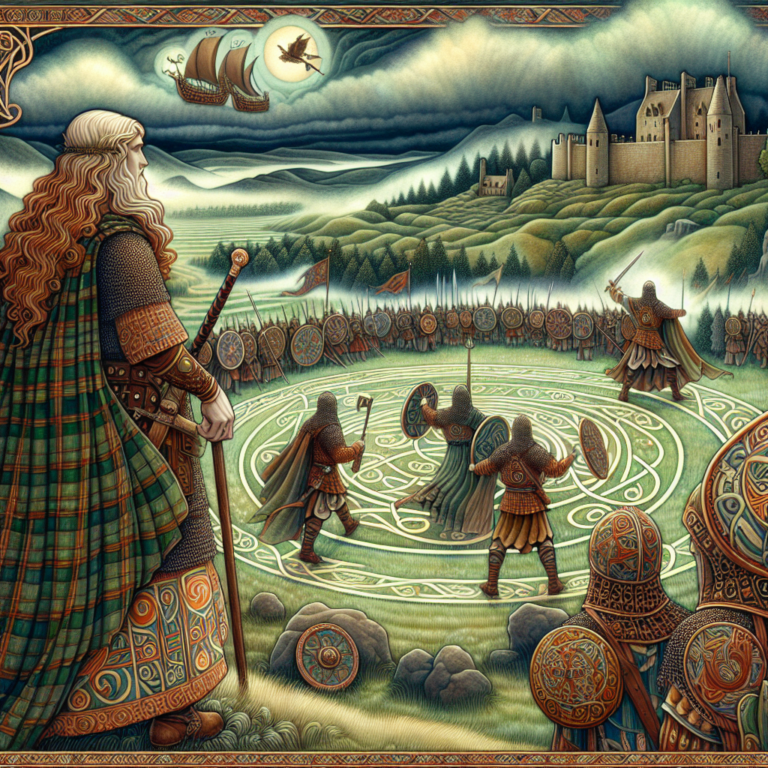
In the time when Ireland was young and magic walked openly in the world, there lived a chieftain named Bran, son of Febal. He ruled his people justly from his hall in the green hills of Munster, and his days were filled with the ordinary concerns of a mortal lord—cattle and crops, disputes and alliances, feasts and gatherings.
But Bran was not an ordinary man. There was a restlessness in him, a longing he could not name, a sense that somewhere beyond the horizon of his world lay something wondrous and strange that called to him in dreams.
One evening, as the sun painted the western sky in shades of rose and gold, Bran walked alone outside his hall. The scent of apple blossoms drifted on the breeze, though no apple trees grew nearby. The air seemed to shimmer, and Bran felt the hairs on his arms rise as if before a thunderstorm.
Then he heard the music.
It was unlike any music he had ever known—not the harps of his bards or the pipes of shepherds, but something sweeter and stranger, as if the stars themselves had found voices and begun to sing. The melody wrapped around him like a cloak of silver light, and though he tried to resist, he found his eyes closing and sleep pulling him down.
When he woke, his warriors and druids surrounded him, their faces pale with concern. But Bran cared nothing for them. In his hand, clutched tight, was something that had not been there before.
A silver branch, bearing nine apples of red gold.
“Where did this come from?” his druid asked, reaching toward it with trembling fingers. “Such a thing does not belong to our world.”
Before Bran could answer, the air shimmered again, and a woman appeared in their midst.
She was beautiful beyond mortal measure, her hair like flowing sunlight, her eyes the color of the sea on a perfect summer day. She wore a gown that seemed woven from mist and moonbeams, and her feet did not quite touch the ground.
“I have come from the Land of Women,” she said, and her voice was the music Bran had heard, made into words. “I have come to invite the son of Febal to journey to my realm.”
The woman—for she never gave her name—began to sing, and her song painted pictures in the minds of all who heard it.
“There is a distant isle,
Where sea-horses glisten,
A beauty of a land throughout the ages of the world,
On which the many blossoms fall.
“There is a wood of various gold
Beneath the crown of the sun,
The sweet voice of the cuckoo is heard
From the crest of the yew tree.
“In that lovely land is no weeping,
No sorrow, no death, no sickness,
The meadows are fair without a blemish,
And the leaves drop mead.
“The sea washes the wave against the land,
With crystal tresses its foam,
And from the plain comes brightness
With the song of birds in the morning.
“There all is gentle, nothing rough,
The yellow is gold, the white is silver,
The grass is soft as silk beneath the feet,
And all live in joy without end.”
As she sang, Bran saw it all—the shimmering island, the forests of golden leaves, the crystal waters, the birds whose songs were sweeter than any earthly melody. He saw people who never aged, whose smiles held no trace of sorrow, who knew neither hunger nor cold nor the grief of loss.
And his restless heart, that had always longed for something he could not name, recognized at last what it had been seeking.
“I must go there,” he breathed. “I must find this land.”
The woman smiled—a smile that held secrets deeper than the sea.
“Follow the setting sun,” she said. “The sea will carry you. But remember: what you find may not be what you expect. And when you return—IF you return—the world will not be as you left it.”
Then she was gone, vanishing like morning mist, taking the silver branch with her. Only the memory of her song remained, echoing in the hearts of all who had heard it.
Within days, Bran had gathered a company of twenty-seven warriors—men whose spirits also yearned for wonders beyond the ordinary world. They provisioned three currachs, the seaworthy boats of hide and wood that could ride even the wildest waves, and they set out from the western coast of Ireland as the sun descended toward the endless sea.
At first, the voyage was peaceful. The sea lay calm and glassy, reflecting the sky so perfectly that it seemed they sailed through heaven itself. Dolphins played alongside their boats, and seabirds wheeled overhead as if guiding them toward their destination.
But on the second day, they saw something that stopped their hearts.
A man approached them—not in a boat, but riding UPON the waves as if the water were a broad green plain. His chariot was drawn by horses that seemed made of sea-foam, and he drove across the rolling swells as easily as any lord might drive across a meadow.
“I am Manannán mac Lir,” the figure declared, his voice carrying over the water like the tolling of a great bell. “Lord of the sea, guardian of the ways between worlds. You have passed through the veil, travelers. The Ireland you left is already far behind you—not in distance, but in nature. You sail now upon waters that border the Otherworld.”
Bran’s warriors gripped their oars and their courage alike. “We seek the Land of Women,” Bran said. “We heard its song and cannot rest until we find it.”
Manannán laughed—a sound like waves crashing on a distant shore.
“Many have sought it. Few have found it. Fewer still have returned.” He gestured toward the west, where the sun was sinking into clouds of purple and gold. “Continue on, son of Febal. The island you seek will appear when the time is right. But heed this warning: TIME moves differently in the realms beyond this world. What seems a day there may be a year here—or a century. Be careful what you choose.”
Then he drove on, his sea-horses carrying him toward some destination Bran could not imagine, and the voyagers were alone once more upon the endless sea.
For many days and nights, Bran and his companions sailed westward, and each day brought new marvels.
They passed islands of silver, where trees bore fruit that chimed like bells when the wind blew. They saw creatures that could not exist in the mortal world—birds of every color imaginable, fish that leaped and sang, horses that galloped across the waves as Manannán’s had done.
They came to an island where the people laughed ceaselessly, unable to stop, rolling on the ground in helpless mirth. Bran’s friend Nechtan volunteered to explore, stepping onto the shore with a grin—and the moment his foot touched the sand, he began to laugh as well, and could not be persuaded to leave. They sailed on without him, his laughter fading slowly behind them.
They passed through a sea that seemed made of mist rather than water, where their oars stirred clouds instead of waves, and strange shapes moved in the depths below them—or perhaps above them, for direction had lost all meaning. When they emerged from the mist, they found that a day had passed, though it had seemed only an hour.
And then, at last, they saw it.
An island rose from the sea like a dream made solid—green hills covered in flowers that never faded, forests of trees whose leaves shimmered with gold, beaches of white sand washed by waves of crystal clarity. The air that drifted from it carried the scent of apple blossoms—the same scent Bran had smelled before the woman appeared.
“This is it,” Bran whispered. “The Land of Women. The realm the song promised.”
As their currachs approached the shore, figures emerged from the trees—women of surpassing beauty, their faces aglow with welcome, their voices raised in songs of greeting. Among them, Bran recognized the woman who had come to his hall, her silver-bright hair flowing behind her as she waded into the shallows to meet him.
“You have come at last,” she said, taking his hand. “I am the queen of this land, and you are welcome here, Bran son of Febal. You and all your companions. Here you will find rest from sorrow, pleasure without guilt, joy without shadow.”
The warriors needed no further invitation. They leaped from their boats and were embraced by the women of the island, led to halls of silver and gold, given food and drink that satisfied every hunger they had ever known.
And time… time ceased to matter.
Days flowed into one another like water merging with water. Bran and the queen walked together in gardens that never faded, talked of matters both profound and light, shared a happiness that seemed to have no end. His companions found their own joys, their own companions, their own contentments. All the longings that had driven them to this place were fulfilled beyond their wildest imaginings.
A year passed. Then another. Then another.
Or so it seemed to them. In the Land of Women, time was gentle, and counting it seemed as pointless as counting the petals on a rose.
But eventually—perhaps after many years, perhaps after only a few—one of Bran’s companions, a man named Nechtan (not the one lost to the Island of Laughter, but another of the same name), began to feel the stirrings of homesickness.
“I want to see Ireland again,” he said one evening, as they sat in the queen’s hall. “I want to stand on the hills where I grew up, see the faces of my kin, hear the speech of my own people.”
Other warriors nodded. They too felt it—a pull toward the land of their birth, however wonderful this paradise might be.
Bran felt it as well, though he had been happy here. Something in his blood called him home.
“We will go,” he told the queen. “At least to see Ireland one more time. Then perhaps we will return.”
The queen’s face grew troubled. “If you must go, I cannot stop you. But remember what Manannán told you: time moves differently between the worlds. Much has changed since you departed. Much will have changed when you return.”
“How much time?” Bran asked.
“I cannot say. Our years here are not Ireland’s years. Be cautious, Bran. Whatever you do, do not set foot on Irish soil until you understand what you will find there. The earth of the mortal world will remind your bodies that they too were mortal, and the years you have not felt here will claim you all at once.”
The voyage back was swift—far swifter than the journey there, as if the sea itself were eager to deliver them home. Within days, they saw the green coast of Ireland rising before them, the familiar hills and valleys of their homeland.
But something was wrong.
As they approached the shore, they saw people gathered—farmers, fishermen, children playing in the sand. But their clothing was strange, their tools unfamiliar. And when Bran called out a greeting, the people stared at him with blank incomprehension.
“Who are you?” an old man asked, wading into the shallows. “From what land do you come?”
“We are men of Ireland,” Bran said, confused. “We sailed from this very coast. I am Bran, son of Febal, chieftain of—”
“Bran son of Febal?” The old man’s face went pale. “That is a name from the ancient tales! Bran son of Febal sailed into the western sea hundreds of years ago, in the time of our great-grandfathers’ great-grandfathers! You cannot be he!”
Bran felt the world tilt beneath him. Hundreds of years? It could not be. They had spent only a few years in the Land of Women—surely no more than ten…
Nechtan, the homesick one, could not believe it either. “This is some trick!” he cried, and before anyone could stop him, he leaped from the currach and waded toward the shore.
The moment his feet touched Irish soil, he changed.
The years that had not touched him in the Otherworld fell upon him all at once. His hair whitened, his skin wrinkled, his strong body bent and withered. In the space of a heartbeat, he aged hundreds of years, crumbling to dust before the horrified eyes of his companions.
A great cry went up from Bran and his men, a wail of grief and terror.
“Do not land!” Bran shouted to his companions. “Whatever you do, do not touch the shore!”
They pulled back on their oars, keeping the currachs in the shallows while waves lapped at the hulls. The people on the shore stared at them in wonder and fear, seeing ghosts from a forgotten age.
There was nothing to be done.
They could not go home—home no longer existed, not as they had known it. Everyone they had loved was dead, their halls crumbled, their descendants strangers who knew them only from legends.
And they could not touch Irish soil without suffering Nechtan’s fate.
They were caught between worlds—no longer mortal, but not quite belonging to the Otherworld either.
Bran called out to the people on the shore. “Tell our story! Remember that Bran son of Febal and his companions found the Land of Women across the western sea! Remember that we lived there in joy, but that the joy had a price! Tell your children and your children’s children, so that if any should seek to follow us, they will know what they may find—and what they may lose!”
Then, as the sun began to set in the west, painting the sky with the same rose and gold colors that had heralded the woman’s coming so long ago, Bran and his remaining companions turned their currachs toward the open sea.
Some say they returned to the Land of Women, to live out eternity in that blessed realm.
Some say they still wander the waters between worlds, appearing in mist and moonlight to sailors who venture far from shore.
Some say they found another fate entirely, known only to themselves and the gods of the sea.
But on the shores of Ireland, the story was told and retold, passed down through generations: the tale of Bran son of Febal, who heard the song of the Otherworld and followed it to wonders beyond imagining—and learned that some journeys, once begun, can never truly end.
This ancient Irish tale carries profound wisdom about the nature of longing and its costs:
*Every choice has consequences we cannot foresee. Bran followed his heart to the Otherworld and found joy beyond measure, but he also lost everything he had known. The choice was not wrong, but it was irrevocable.
Some things cannot be reversed. Once Bran stepped into the Otherworld, he could never simply step back. The years that did not touch him there still passed in the mortal world. This reminds us that time moves only forward, and the opportunities we miss do not wait for us.
Longing itself can be a guide—or a trap. Bran’s restlessness led him to wonders, but Nechtan’s homesickness led to his destruction. Our deepest desires can take us to extraordinary places, but we must be wise about which desires we follow.
The boundary between worlds is real. In Irish tradition, the Otherworld is not distant but close—separated from our world by thin veils that can be crossed, but never without transformation.
“Immram Brain” (The Voyage of Bran) is one of several Irish voyage tales (immrama) that tell of journeys to mysterious islands in the western sea. These tales include:
– Immram Brain (Voyage of Bran) – 7th-8th century
– Immram Curaig Maíle Dúin (Voyage of Máel Dúin) – 8th-9th century
– Navigatio Sancti Brendani (Voyage of St. Brendan) – 9th-10th century
These stories blend pre-Christian Celtic mythology with later Christian elements.
The ancient Irish conceived of the Otherworld (Tír na nÓg, the Land of Youth; Mag Mell, the Plain of Delight; Tír na mBan, the Land of Women) as:
– Located across the western sea or beneath the earth
– A place of eternal youth, beauty, and plenty
– Accessible to mortals under special circumstances
– Operating on a different time-scale than the mortal world
Manannán was the Irish god of the sea and guardian of the Otherworld. He:
– Drove a chariot across the waves
– Possessed a magical cloak of mist
– Ferried the dead to the Otherworld
– Could see all that happened on the sea
The concept that time moves differently in the Otherworld is central to Irish mythology. Mortals who visit the Otherworld often return to find that centuries have passed. This theme appears in many Irish tales, including:
– The voyage of Bran
– The story of Oisín in Tír na nÓg
– Various fairy abduction narratives
Primary Source:
“Immram Brain” exists in several manuscripts from the 10th-12th centuries, though the text itself dates to the 7th-8th century. It is one of the oldest vernacular texts in any European language.
Story Elements from the Original:
1. The woman appearing with a silver branch – Exact detail from the original text
2. Her song describing the Otherworld – Many stanzas preserved; this retelling summarizes them
3. Twenty-seven warriors accompanying Bran – Original number
4. Encounter with Manannán mac Lir – Described in the original
5. The Island of Laughter – One of several islands encountered
6. The Land of Women – Central destination in the tale
7. The queen’s warning about time – Present in the original
8. Nechtan’s destruction upon touching Irish soil – Exact detail from the text
9. Bran never landing but calling out his story – How the original tale ends
Variations:
Some details have been slightly expanded for narrative clarity, but the fundamental story is faithfully preserved.
Historical Context: “Immram Brain” was composed in early Christian Ireland but preserves many pre-Christian Celtic beliefs about the Otherworld. It shows how Irish culture blended old and new religious ideas.
Literary Significance: This tale is a foundational text in Irish literature and has influenced countless later works, from the legends of St. Brendan’s voyage to modern fantasy novels.
Geographic Speculation: Some historians have wondered whether Irish voyage tales preserve memories of actual expeditions to Iceland, the Faroe Islands, or even North America. While this is unprovable, the tales certainly reflect Irish seafaring culture.
Discussion Starters:
1. If you could visit a magical land but might never return, would you go?
2. What does this story suggest about the relationship between time and experience?
3. Why do you think the Irish imagined the Otherworld as lying across the western sea?
4. What does Nechtan’s fate teach us about the impossibility of going back?
1. Bran heard a song that called him to adventure. Have you ever felt a longing for something you couldn’t quite name? (Explores the universal experience of yearning)
2. The queen warned Bran about the time difference, but he chose to leave anyway. Was this wise or foolish? (Discusses the nature of informed choice)
3. When Nechtan touched Irish soil, the years caught up with him all at once. What does this image suggest about the nature of time? (Metaphorical exploration of mortality)
4. Bran and his companions cannot land in Ireland but also cannot truly return to the Otherworld. What do you think happened to them? (Imaginative engagement with the open ending)
5. The story ends with Bran calling out his tale to be remembered. Why is preserving stories important? (Reflects on the value of cultural memory)
6. The Irish Otherworld is described as a place without sorrow, sickness, or death. Would you want to live in such a place? What might be missing? (Philosophical exploration of what gives life meaning)
– Immram: An Irish voyage tale describing journeys to supernatural islands
– Otherworld: The supernatural realm in Celtic mythology
– Tír na nÓg: “Land of Youth,” one name for the Irish Otherworld
– Tír na mBan: “Land of Women,” the specific destination in this tale
– Manannán mac Lir: The Irish god of the sea
– Currach/Coracle: A traditional Irish boat made of hide stretched over a wooden frame
– Sidhe: The fairy folk of Irish tradition, inhabitants of the Otherworld
– [Immram Brain – CELT](https://celt.ucc.ie/published/T302001/) – Original text in translation
– [Irish Mythology – Encyclopaedia Britannica](https://www.britannica.com/topic/Celtic-religion) – Overview
– [The Voyage of Bran – Sacred Texts](https://www.sacred-texts.com/neu/celt/vob/index.htm) – Early translation
– [Manannán mac Lir](https://www.irishcentral.com/roots/history/manannan-mac-lir-celtic-god) – Mythological context
This story is faithfully adapted from “Immram Brain” (The Voyage of Bran, Son of Febal), one of the oldest Irish literary texts, dating to the 7th-8th century CE. The narrative preserves the original’s haunting exploration of longing, otherworldly beauty, and the bittersweet nature of choices that cannot be undone. Young readers encounter authentic Irish mythology while contemplating timeless questions about what we desire, what we sacrifice, and what remains when we cannot go home again.*
Test Your Understanding
1Who is Bran in the story?
Frequently Asked Questions
What is the moral lesson of Bran’s Courageous Voyage to the Wisdom of Legends?
What age is this story appropriate for?
How long does it take to read Bran’s Courageous Voyage to the Wisdom of Legends?
What culture does this story come from?
Can I use this story for teaching?
Frequently Asked Questions
What is Bran’s Courageous Voyage to the Wisdom of Legends about?
It’s a Celtic-inspired moral story for children ages 6-12 about Bran, a chieftain from Munster in ancient Ireland, who follows a mysterious magical calling beyond the horizon of his known world. The story blends adventure and wonder with important values like courage, curiosity, and the pursuit of wisdom.
What age group is Bran’s Courageous Voyage suitable for?
This story is designed for children aged 6 to 12. It combines entertaining fantasy elements drawn from Celtic mythology with moral lessons, making it engaging for both independent young readers and children enjoying a read-aloud experience with a parent or teacher.
What moral lessons does Bran’s Courageous Voyage teach kids?
The story explores values such as courage, following one’s inner calling, and the pursuit of wisdom. Through Bran’s journey into the unknown, children learn that restlessness and curiosity can lead to meaningful discovery, and that true leadership involves more than ordinary responsibilities.
📚 Recommended Books
Handpicked for readers like you
As an Amazon Associate, we earn from qualifying purchases. These recommendations are personalized based on this story's themes and your reading history.
Is Bran’s Courageous Voyage based on real Celtic mythology?
Yes, the story draws inspiration from the ancient Irish myth ‘The Voyage of Bran,’ one of Ireland’s earliest adventure tales. The narrative is reimagined and adapted to make it accessible and meaningful for modern children while preserving the magical, mythological atmosphere of the original legend.
What kind of magic appears in Bran’s Courageous Voyage?
The story features classic Celtic magic, including mysterious music that seems to come from the stars, the scent of apple blossoms with no source, and a shimmering otherworldly atmosphere. These elements signal the presence of a magical realm beyond the ordinary world, drawing Bran toward his legendary voyage.
