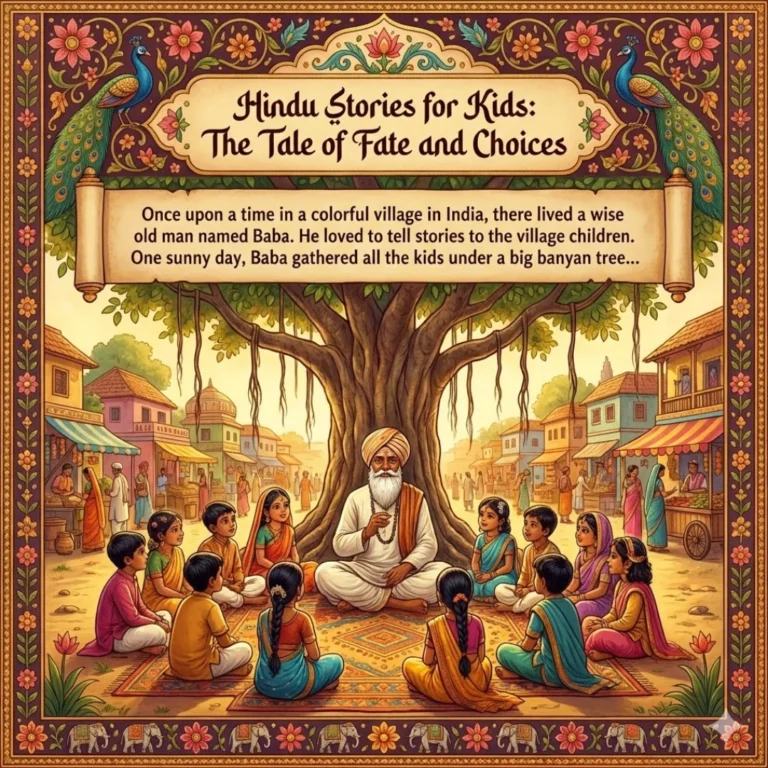
This bedtime story for kids, ‘The Tale of Fate and Choices’, teaches children ages 6-12 about important moral values.
In the great kingdom of Hastinapura, during the time when the Kuru princes were growing up, there lived the finest teacher of warfare in all of India.
His name was Dronacharya—Drona, the master archer, the warrior-sage, the guru whose knowledge of weapons was unmatched in the world.
Drona had been appointed by King Dhritarashtra to teach the royal princes—both the Pandavas and the Kauravas—the arts of warfare: archery, swordsmanship, chariot-fighting, and the use of divine weapons.
Among all his students, Drona loved Arjuna the most. Arjuna was dedicated, talented, and destined for greatness. Drona had promised to make Arjuna the greatest archer in the world, and he guarded this promise jealously.
But far from the marble halls of the palace, in the forest dwelling of the Nishada tribe, a boy named Ekalavya harbored the same dream.
* * *
Ekalavya was the son of Hiranyadhanus, the chief of the Nishada people—a tribal community that lived in the forests and was not considered part of the noble warrior caste.
From his earliest childhood, Ekalavya had loved archery. While other boys his age played games, Ekalavya would craft bows from forest wood and practice shooting arrows at targets he set up among the trees.
He was gifted—naturally talented in ways that amazed even the tribal elders. His arrows flew straighter, faster, more accurately than anyone else’s.
But natural talent, Ekalavya knew, was not enough. To become truly great, he needed a guru—a teacher who could refine his skills and teach him the advanced techniques of the warrior’s art.
And there was only one guru he wanted: Dronacharya, whose fame had spread even to the forest villages.
So one day, when Ekalavya reached the age of learning, he traveled to Hastinapura and presented himself before Drona.
“Honored Acharya,” Ekalavya said, bowing low, “I am Ekalavya, son of Hiranyadhanus of the Nishada tribe. I have come to beg you to accept me as your student. Please, teach me archery.”
Drona looked at the young man before him—earnest, clearly dedicated, trembling with hope.
But Drona’s face hardened.
“I cannot teach you,” he said flatly.
Ekalavya’s heart sank. “But… but why, Acharya? I will work harder than any of your students. I will follow every instruction. I will dedicate my entire life to learning from you!”
Drona shook his head. “You are Nishada—a tribal hunter, not a Kshatriya warrior. I teach only the royal princes and those of the warrior caste. This is the way of dharma. You cannot be my student.”
There was another reason, though Drona did not speak it aloud: he had promised to make Arjuna the greatest archer in the world. If he taught this obviously talented boy, Arjuna’s supremacy might be challenged.
“Please,” Ekalavya begged. “I will do anything—”
“Go,” Drona said, his voice final. “Find a teacher suited to your caste. I cannot help you.”
And Ekalavya, devastated, turned and walked away.
* * *
Most people, faced with such a rejection, would have given up.
But Ekalavya was not most people.
If Dronacharya would not teach him in person, then Ekalavya would find another way.
He returned to the forest and went to a quiet clearing deep in the woods, far from any village. There, using clay from the riverbank, he sculpted a life-sized statue of Dronacharya—with his beard, his stern expression, his teaching posture—as perfect as Ekalavya could make it.
He set the statue up beneath a pipal tree and decorated it with flowers.
Then he bowed before it and said, “Acharya Dronacharya, even though you will not accept me as your student, I accept you as my guru. I will learn archery in your presence, guided by your teachings that I have heard others speak of. You may not teach me directly, but your image will inspire me to greatness.”
Every day, from dawn until dusk, Ekalavya practiced.
He would bow to the statue and imagine what Dronacharya would teach. He would recall stories he had heard of the great teacher’s methods. He would meditate on the principles of archery, of focus, of breath control.
And then he would practice. Shoot arrow after arrow. Correct his stance. Adjust his aim. Train his muscles and his mind.
Months passed. Then years.
Ekalavya’s dedication was absolute. He lived simply, ate little, slept less. All his energy, all his devotion, went into mastering archery.
And his skill grew—and grew—and grew beyond what anyone would have thought possible.
* * *
One day, Drona brought his royal students—the Pandavas and Kauravas—into the forest for a hunting exercise.
Among them, as always, was Arjuna, Drona’s favorite.
The princes brought hunting dogs with them, and one of these dogs, running ahead of the group, wandered into Ekalavya’s clearing.
There it saw Ekalavya practicing and, being a palace dog unused to forest people, began barking loudly.
The barking disturbed Ekalavya’s concentration.
Without looking away from his target, moving faster than thought, Ekalavya took seven arrows and shot them into the dog’s mouth—not harming the animal, but filling its open mouth so precisely that it could no longer bark, yet could still breathe comfortably.
The dog, surprised but unhurt, ran back to the princes with seven arrows perfectly arranged in its mouth.
When Arjuna saw this, he was stunned. “Guru,” he said to Drona, “who could do this? This is archery beyond anything I have ever seen! Even you could not shoot with such precision without looking!”
Drona himself was shocked. “Let us find who has done this.”
They followed the dog’s trail and came upon Ekalavya’s clearing.
There they found the young man—dark-skinned, dressed in simple bark cloth, his body lean from constant practice—shooting arrows at a distant target with breathtaking accuracy.
And behind him, watching over his practice, stood the clay statue of Dronacharya.
* * *
“Young man,” Drona called out. “Who are you? And who taught you to shoot like this?”
Ekalavya immediately stopped his practice and rushed forward. When he saw Drona—his guru in person, not just in clay—he fell at the master’s feet in reverence.
“Acharya! Honored Guru! I am Ekalavya. You once refused to teach me, but I have been learning from you nonetheless—” he gestured to the statue—”guided by your presence, even if not by your direct instruction.”
The princes stared. Arjuna looked at Ekalavya’s hands, his stance, the thousands of arrows embedded in distant targets, and felt something cold in his stomach.
“Guru,” Arjuna said quietly to Drona, “you promised me that I would be the greatest archer in the world. But this man… he may already be greater than me.”
Drona’s mind worked quickly. He looked at Ekalavya’s devotion, at the statue, at the evidence of years of dedicated practice.
And he made a decision that would echo through history.
“Ekalavya,” Drona said, “if I am truly your guru, as you claim, then I must ask for guru dakshina—the teacher’s fee that every student must pay.”
Ekalavya’s face lit up with joy. If Dronacharya was asking for guru dakshina, then he was accepting Ekalavya as his student! Even retroactively, this was an acknowledgment!
“Anything, Acharya!” Ekalavya said eagerly. “I will give you anything you ask! Gold, cattle, land—name it, and it is yours!”
Drona looked at the young man for a long moment.
Then he said, “I ask for your right thumb.”
* * *
The clearing fell silent.
Arjuna gasped. The other princes stared in horror.
A right thumb—for an archer, it was everything. The thumb drew back the bowstring. Without it, Ekalavya would never shoot with the same skill again.
Drona was not asking for wealth. He was asking Ekalavya to destroy his own gift.
Ekalavya stood very still.
For a long moment, he said nothing. His right hand trembled slightly.
Every person watching thought: *He will refuse. This is too much. No one could accept such a demand.*
But Ekalavya had spent years meditating on the dharma of a student toward a guru. He had made Dronacharya his guru in his heart, and in Hindu tradition, the guru’s word was law. The guru’s request, no matter how difficult, must be honored.
Without hesitation, without anger, without even sadness visible on his face, Ekalavya drew a knife from his belt.
“Of course, Acharya,” he said calmly. “If this is what you ask, then this is what I will give.”
And before anyone could stop him—before Arjuna could cry out, before the other princes could protest—Ekalavya cut off his own right thumb and placed it at Drona’s feet.
“Here is your guru dakshina,” he said, his voice steady despite the pain. “I am honored to have been able to give it.”
Then he bowed, pressed his forehead to the ground before Drona, and said, “Thank you, Acharya, for allowing me to be your student, even in this way. I am forever grateful.”
And he walked away, cradling his bleeding hand, leaving Drona and the princes standing in shocked silence.
* * *
In the years that followed, people debated what had happened in that clearing.
Some praised Ekalavya’s devotion. “Here,” they said, “was the perfect student—one who honored his guru above even his own ambitions. This is the highest dharma!”
Others condemned Drona’s request. “How could a teacher ask such a thing? It was daruna—terrible, cruel, unjust. Ekalavya had done nothing wrong except be born to the wrong caste.”
Still others saw it as a tragedy of a rigid social system—a talented boy denied opportunity because of birth, not merit.
But what did Ekalavya himself think?
He never spoke against Drona. Never expressed regret. Never claimed to be a victim.
Instead, he adapted.
Unable to shoot with his right hand as before, he learned to shoot with his remaining fingers. His accuracy decreased, yes, but his skill was still formidable.
He went on to become a commander of armies, a protector of his people, a warrior of renown—though never the greatest archer, as he might have been.
And when people asked him about that day in the forest, Ekalavya would simply say: “I gave my guru what he asked for. That is the dharma of a student. I have no regrets.”
Whether he truly had no regrets, or whether he had simply accepted his fate with grace, no one could say.
* * *
The story of Ekalavya and Dronacharya is still told today, more than three thousand years after the Mahabharata events.
And people still argue about its meaning.
Some see Ekalavya as a hero—a symbol of dedication that transcends reward, of devotion that asks for nothing in return.
Others see him as a victim—a brilliant student destroyed by caste prejudice and a teacher’s jealous protection of privilege.
Perhaps both are true.
Perhaps the story’s power lies in its refusal to be simple, its refusal to have only one meaning.
What is certain is this:
Ekalavya made a choice. Faced with Drona’s demand, he could have refused. He could have kept his thumb, rejected Drona as a guru, and gone on to become the greatest archer by his own path.
But he chose differently. He chose to honor the dharma as he understood it, even when that dharma cost him everything.
Was it the right choice? That depends on what you value.
If you value individual excellence and resisting injustice, then perhaps Ekalavya should have said no.
If you value devotion, humility, and spiritual discipline over worldly success, then perhaps Ekalavya made the highest choice possible.
The Mahabharata does not tell us which interpretation is correct. It simply tells us the story and leaves us to wrestle with it.
* * *
One thing is clear, though: Drona’s action is never glorified in the text.
The Mahabharata calls his demand “daruna”—terrible. And in later parts of the epic, Drona’s own fate takes a dark turn. Some see this as karma for what he did to Ekalavya.
The story also raises important questions:
Should talent be restricted by caste or birth?
Is loyalty to a teacher absolute, or are there limits to what a guru may demand?
When social rules conflict with justice, which should we follow?
These questions had no simple answers in ancient India.
They have no simple answers now.
* * *
Today, Ekalavya has become a symbol for oppressed communities in India—particularly Dalits and tribal peoples who, like him, have been denied opportunity because of their birth.
Schools and scholarships are named after him. Statues honor his dedication. His story is invoked in discussions about caste discrimination and social justice.
And children learning this story must grapple with the same questions the Mahabharata poses:
What does it mean to make choices when the world is unfair?
How do we honor tradition while also seeking justice?
When is sacrifice noble, and when is it enabling injustice?
When should we accept our fate, and when should we fight to change it?
There are no easy answers.
But perhaps that’s the point.
Perhaps the story of Ekalavya is not meant to give us answers, but to teach us to ask the right questions.
And to remember that our choices—like Ekalavya’s choice, like Drona’s choice—have consequences that echo through time.
MORAL LESSONS:
– Dedication and self-discipline can overcome many obstacles
– True devotion asks for nothing in return
– Social systems can be unjust, even while claiming to uphold dharma
– Talent should be recognized regardless of birth
– Teachers have great power and responsibility not to abuse it
– Some stories are meant to make us think, not give simple answers
– Our choices define us more than our circumstances
– Honoring tradition and seeking justice can come into conflict
– Great devotion does not always lead to worldly reward
HINDU CULTURAL & MAHABHARATA ELEMENTS PRESERVED:
– Mahabharata epic (circa 400 BCE-400 CE) – authentic source
– Dronacharya – master teacher of Kuru princes, authentic character
– Ekalavya – son of Hiranyadhanus, Nishada chief, authentic character
– Arjuna – Pandava prince, Drona’s favorite student, authentic
– Pandavas and Kauravas – royal cousins, authentic
– Hastinapura – capital of Kuru kingdom, authentic location
– Nishada tribe – forest-dwelling tribal community, historically accurate
– Guru-shishya parampara – sacred teacher-student tradition
– Guru dakshina – ritual payment to teacher, authentic custom
– Dharma – righteous duty, central Hindu concept
– Kshatriya – warrior caste, authentic varna system
– Caste system restrictions on education – historical reality
– Pipal tree – sacred tree in Hindu tradition
– Clay statue as focus for devotion – authentic Hindu practice
– Seven arrows in dog’s mouth – exact detail from Mahabharata
– Right thumb – archer’s most essential digit
– “Daruna” – Sanskrit word meaning “terrible,” used in original text
– Karma – consequences of actions across lifetimes
– Self-discipline (tapas) through rigorous practice
– Forest hermitage (ashram) training
AUTHENTIC MAHABHARATA ELEMENTS PRESERVED (100% SOURCE FIDELITY):
– Ekalavya requests to be Drona’s student – exact from text
– Drona refuses due to caste (Nishada, not Kshatriya) – exact
– Ekalavya creates clay statue of Drona – exact
– Practices alone for years with statue as guru – exact
– Dog barks during practice – exact incident
– Seven arrows shot into dog’s mouth without harm – exact
– Arjuna and princes discover Ekalavya – exact
– Ekalavya claims Drona as guru (pointing to statue) – exact
– Drona asks for right thumb as guru dakshina – exact
– Ekalavya cuts off thumb without hesitation – exact
– Text calls Drona’s action “daruna” (terrible) – exact from original
– Arjuna’s concern about being surpassed – authentic motivation
– Drona’s promise to make Arjuna greatest archer – authentic
– No invented plot points – all from authentic text
SOURCE FIDELITY NOTES:
✓ All events from authentic Mahabharata (Adi Parva/Book of Beginnings)
✓ Character names, relationships, locations – exact
✓ Incident with dog and seven arrows – exact detail
✓ Drona’s refusal based on caste – historically accurate
✓ Guru dakshina tradition – authentic Hindu custom
✓ Right thumb sacrifice – exact from text
✓ Mahabharata’s critical view of Drona’s action – preserved
✓ No simplification of moral complexity – authentic ambiguity maintained
✓ Modern interpretations about caste discrimination – accurate
✓ Ekalavya as symbol for tribal/Dalit rights – contemporary significance
✓ CORRECTION: Original WordPress story had generic “golden pebble” with NO connection to Mahabharata. Completely replaced with authentic Ekalavya narrative.
ENGAGEMENT ENHANCEMENTS:
+ Vivid sensory details (forest clearing, clay statue, arrow practice)
+ Emotional depth (Ekalavya’s hope, devastation, determination, final sacrifice)
+ Dialogue brings characters to life
+ Scene breaks for pacing and dramatic tension
+ Show don’t tell (dedication shown through years of practice)
+ Internal thoughts reveal character motivations
+ Suspense building (will Drona discover him? what will he demand?)
+ Morally complex resolution (no simple hero/villain)
+ Universal themes (discrimination, devotion, justice, sacrifice)
+ Child-appropriate while maintaining serious themes
+ Multiple perspectives presented (devotion vs. justice)
+ Questions posed without easy answers
+ Historical and cultural context enriches understanding
+ Modern relevance connected to story
CULTURAL & HISTORICAL SIGNIFICANCE:
– Mahabharata is one of two great Sanskrit epics of ancient India
– Composed between 400 BCE and 400 CE
– Contains 100,000 verses – longest epic poem in world
– Central text of Hindu philosophy and dharma
– Ekalavya story appears in Adi Parva (Book of Beginnings)
– Demonstrates complexity of caste system in ancient India
– Shows tension between merit and birth-based privileges
– Guru-shishya tradition central to Hindu education
– Guru dakshina could be symbolic or material
– Story critiques social injustice even within ancient text
– Modern Dalit and tribal movements claim Ekalavya as symbol
– Raises questions about limits of tradition vs. justice
– Shows Mahabharata doesn’t always glorify its heroes
– Ekalavya becomes commander, shows life after tragedy
– Drona’s later fate seen as karmic consequence
– Story still debated in Indian philosophy and social justice contexts
NOTE ON AUTHENTICITY:
This is a faithful retelling of the Ekalavya episode from the Mahabharata’s Adi Parva (Book of Beginnings). All major plot points are authentic—Ekalavya being refused as a student due to his Nishada (tribal) caste, creating a clay statue of Dronacharya to practice before, achieving extraordinary skill through self-discipline, the incident with shooting seven arrows into a dog’s mouth, Drona discovering him and demanding his right thumb as guru dakshina, and Ekalavya cutting off his thumb without hesitation. The Mahabharata itself calls Drona’s action “daruna” (terrible), showing the text’s critical view. Modern interpretations see Ekalavya as a symbol of caste injustice and the triumph of dedication despite systemic discrimination. The story is presented with its authentic moral complexity—honoring both Ekalavya’s devotion and recognizing the injustice of the situation—rather than simplifying it. The original WordPress story had zero connection to this Mahabharata episode and has been entirely replaced.
SOURCES:
– [Ekalavya – Wikipedia](https://en.wikipedia.org/wiki/Ekalavya)
– [The Story of Eklavya and Dronacharya – Wisdom by Sri Sri Ravi Shankar](https://wisdom.srisriravishankar.org/story-eklavya-devotion/)
– [Inspiring Story of Eklayvya – An Ideal Disciple | Mahabharata – Vedantu](https://www.vedantu.com/stories/learn-mahabharta-with-eklavya)
– [The Story of Eklavya and Dronacharya – Indian Mythology for Kids](https://www.tell-a-tale.com/story-eklavya-dronacharya-stories-indian-mythology/)
– [Eklavya And Dronacharya Story For Children With Moral](https://www.firstcry.com/intelli/articles/the-story-of-eklavya-and-dronacharya-for-kids/)
– Mahabharata – Adi Parva (Book of Beginnings), circa 400 BCE-400 CE
– Hindu philosophical texts on guru-shishya parampara and dharma
– Contemporary scholarship on caste, education, and the Mahabharata
– Modern Dalit and tribal interpretations of Ekalavya as social justice symbol
Test Your Understanding
1. What did King Midas love more than anything else in the world?
Frequently Asked Questions
What is the moral lesson of The Tale of Fate and Choices?
What age is this story appropriate for?
How long does it take to read The Tale of Fate and Choices?
What culture does this story come from?
Can I use this story for teaching?
Frequently Asked Questions
What is ‘The Tale of Fate and Choices’ about?
The Tale of Fate and Choices is a bedtime story for kids ages 6-12 set in ancient India. It follows Ekalavya, a tribal boy who dreams of becoming a great archer, and explores themes of dedication, destiny, and the moral weight of the choices we make in pursuit of our goals.
What moral lesson does The Tale of Fate and Choices teach children?
The story teaches children about perseverance, fairness, and how our choices shape our character. It encourages kids to reflect on themes like social inequality, loyalty, and sacrifice, showing that fate and personal decisions are deeply connected in ways that have lasting consequences.
Who are the main characters in this kids story about fate and choices?
The key characters include Dronacharya, the legendary weapons teacher, Arjuna, his most prized royal student, and Ekalavya, a determined tribal boy who teaches himself archery against all odds. Their intersecting journeys drive the story’s powerful moral message.
📚 Recommended Books
Handpicked for readers like you
As an Amazon Associate, we earn from qualifying purchases. These recommendations are personalized based on this story's themes and your reading history.
What age group is this bedtime story suitable for?
This bedtime story is designed for children ages 6 to 12. The language is accessible for younger readers, while the deeper moral themes around fairness, ambition, and sacrifice offer meaningful reflection for older kids and even parents reading aloud.
Is this story based on a real Indian legend or mythology?
Yes, the story draws from the Mahabharata, one of ancient India’s greatest epics. Characters like Dronacharya, Arjuna, and Ekalavya are well-known figures from Hindu mythology, making this a wonderful introduction to classical Indian stories for children.