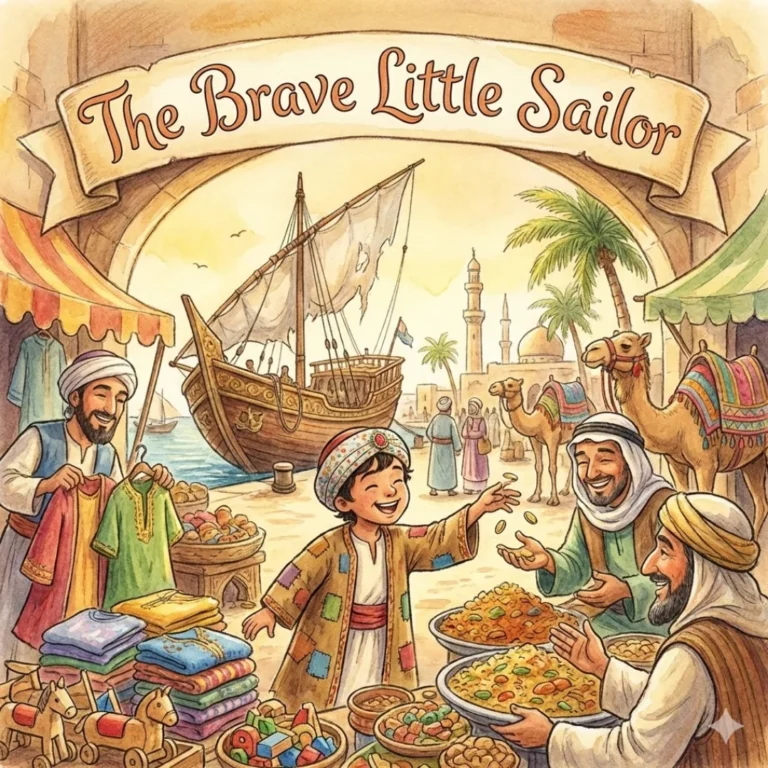
This bedtime story for kids, ‘The Brave Little Sailor’, teaches children ages 6-12 about important moral values.
Chapter One: The Young merchant
In the great city of Baghdad, where golden domes sparkled under the desert sun and the markets overflowed with silks and spices from distant lands, there lived a young man named Hassan.
Hassan had been born wealthy. His father, a respected cloth merchant, had left him a fortune in gold dinars, a fine house near the river, and a warehouse full of precious goods. For a time, young Hassan lived as many young men do when they suddenly possess great wealth: carelessly.
He bought the finest horses without learning to ride them properly. He threw lavish parties for friends who disappeared when the wine ran out. He purchased silks and jewels without a thought for their cost, and gave generous gifts to anyone who flattered him.
Within three years, Hassan found himself standing in an empty house, looking at an empty purse, wondering where his fortune had gone.
“You were a fool,” his old servant Mahmoud told him bluntly. “Your father worked his whole life to build what you wasted in three summers.”
Hassan bowed his head in shame. “I know. But what can I do now? I have no trade, no skills, no way to earn a living.”
“You have two hands and a strong back,” Mahmoud replied. “And you have something more valuable still: you have learned that easy riches bring easy ruin. Use that lesson well.”
Chapter Two: The Journey Begins
Hassan sold his remaining possessions, including his father’s warehouse, and gathered enough money to join a merchant expedition. A great ship was being outfitted in the port of Basra, bound for the East Indies, where rare spices and precious woods could be traded for enormous profits.
“It is a dangerous journey,” the ship’s captain, a grizzled sailor named Omar, warned him. “Many who set out never return. Are you prepared for that?”
Hassan thought of his empty house, his wasted inheritance, the years of foolishness that had brought him to this moment.
“I have nothing left to lose,” he said. “And everything to learn.”
Captain Omar studied the young man’s face and nodded slowly. “That attitude might just keep you alive. Welcome aboard the Crescent Moon.”
The ship set sail on a morning when the sky was painted in shades of rose and gold. Hassan stood at the rail, watching Baghdad fade into the distance. His stomach churned, whether from seasickness or fear he could not tell, but beneath the discomfort was something else: a spark of excitement, of adventure, of new possibilities.
Chapter Three: The Living Island
For many weeks, the voyage proceeded smoothly. Hassan learned to climb the rigging, to read the stars, to tie the complicated knots that sailors used. He worked harder than he ever had in his pampered life, and slowly, his soft hands grew calloused and his weak arms grew strong.
Then, one morning, the lookout cried out: “Land ho! An island to starboard!”
The sailors rushed to look. Before them lay a beautiful island, green with vegetation, surrounded by calm blue waters. It seemed like paradise after weeks of nothing but endless ocean.
“We should anchor and rest,” suggested the first mate. “Fill our water barrels, gather fresh fruit.”
Captain Omar studied the island through his spyglass. Something about it made him uneasy, but he could not say what. The crew was tired, and fresh water was running low.
“Very well,” he agreed reluctantly. “But be careful. In these waters, things are not always what they seem.”
Half the crew rowed to shore in small boats, including Hassan. They set foot on the island, marveling at its beauty. Some gathered fruit from the strange trees. Others lit fires to cook food. Hassan walked along what he thought was a beach, enjoying the feeling of solid ground beneath his feet.
Then the ground moved.
Not like an earthquake. Like something breathing.
“Back to the boats!” Hassan screamed, understanding suddenly washing over him like cold water. “It is not an island! It is a whale!”
Chapter Four: Alone on the Sea
What Hassan had recognized, what the others had been too slow to realize, was that they had landed on the back of an enormous sleeping whale. The fires the sailors had lit had wakened it, and now the great creature was diving beneath the waves.
Chaos erupted. Men scrambled for the boats. The “island” tilted and sank. Waves crashed over everything as the whale descended.
Hassan grabbed a piece of floating driftwood and clung to it with all his strength. Around him, the sea boiled and churned. He heard screaming, saw figures struggling in the water, then saw nothing at all as a wave crashed over his head.
When he surfaced, gasping for air, the whale was gone. The Crescent Moon was gone, pulled down by the rushing water. Of all the crew, Hassan could see no one.
He was alone in the middle of the ocean, clinging to a piece of wood, with no land in sight.
Chapter Five: The Second Island
For a full day and night, Hassan drifted. His lips cracked from salt and sun. His muscles ached from holding onto the driftwood. He thought of his wasted youth, of all the stupid choices he had made, of how unfair it was that he should die just when he was beginning to learn better.
But then another thought came: “This is not over yet. I am still alive. While I breathe, there is hope.”
As dawn broke on the second day, Hassan spotted something on the horizon. A dark shape against the pale sky. Real land this time, with trees that swayed in the wind and beaches that did not move.
Using the last of his strength, he paddled toward the island. The currents helped him, as if the sea itself wanted him to survive. When at last he crawled onto the sandy beach, he collapsed and lay still for a long time, too exhausted to move.
When he woke, his first thought was of water. His throat felt like sand. He forced himself to stand on shaky legs and walked inland, searching for a stream or pool.
What he found instead was even more remarkable: a beautiful mare, pure white, tied to a post near a clearing.
Chapter Six: The King’s Grooms
“Do not touch that horse.”
Hassan spun around. Behind him stood a man in strange clothes, watching him warily. Two others emerged from the trees, carrying spears.
“Please,” Hassan said, his voice a dry croak. “I mean no harm. I am shipwrecked. I only need water.”
The man studied Hassan’s sun-burned face, his salt-crusted clothes, his obvious exhaustion. The wariness in his eyes softened.
“Come with us,” he said. “There is a spring nearby. You can drink your fill, and then you will explain how you came to be on this island.”
They led Hassan to their camp, where more men waited. He learned that they were grooms in the service of King Mihrajan, ruler of an island kingdom many leagues away. They had come to this remote place on a special mission.
“Once a year,” the chief groom explained, “we bring the king’s finest mares here at the time of the full moon. The sea-horses come from the depths to mate with them, and the foals that result are the swiftest and most beautiful in all the world.”
“Sea-horses?” Hassan asked, amazed.
“Creatures of legend, but real as you or me in these waters. The king’s cavalry rides only horses with sea-blood in their veins.”
Hassan shared his own story, the wasted wealth, the voyage, the whale that was not an island, his miraculous survival. The grooms listened with interest.
“You have been through much,” the chief groom said when Hassan finished. “And yet you speak not with bitterness but with wonder. That is rare in one who has suffered.”
“I have learned,” Hassan said slowly, “that suffering is often the best teacher. I was a fool before. Perhaps the sea is teaching me wisdom.”
Chapter Seven: The Kindness of Strangers
The grooms took Hassan back with them to King Mihrajan’s island. There, the young man was presented to the king, a wise and generous ruler who loved nothing more than a good story.
Hassan told his tale again, this time with more detail and better words, for rest and food had restored his strength. The king listened with fascination.
“You have seen wonders that most men only dream of,” King Mihrajan said when the story was finished. “And you have survived trials that would have destroyed a lesser man. I would like to help you return to your home, but more than that, I would like you to stay here for a time. We have much to learn from each other.”
Hassan bowed deeply. “Your Majesty is too kind. I am nobody, a foolish young man who wasted his inheritance.”
“You were nobody,” the king corrected gently. “But suffering has carved channels in your soul where wisdom can flow. Stay with us. Learn our ways. And when the time is right, you will return home a different man than you left.”
Chapter Eight: The Return
Hassan stayed on the island for nearly a year. He helped the grooms tend the marvelous horses. He learned the local language and customs. He assisted the king’s merchants with their accounts, showing a head for numbers that surprised even himself.
When a trading ship finally arrived bound for Basra, King Mihrajan gave Hassan gifts: gold coins, precious stones, and letters of introduction to merchants in Baghdad. But the greatest gift was something that could not be touched or spent.
“You came to my shores with nothing but your life,” the king said at their parting. “You leave with treasure, yes, but also with something more valuable: the knowledge of who you truly are. Use it well.”
The voyage home was long but uneventful. When Hassan finally walked through the gates of Baghdad, he was not the same person who had left. His body was lean and strong from hard work. His eyes were clear and thoughtful from experience. His heart was humble from suffering.
He did not immediately spend his new fortune. Instead, he invested it wisely, setting up a modest trading business. He treated his servants with kindness, remembering his own time of need. He gave to the poor, understanding now that fortune was a gift that could be taken away at any moment.
Years passed. Hassan married, had children, built a respected business. And every evening, he gathered his family around him and told stories: of the whale that was an island, of the sea-horses that came from the deep, of the kindness of strangers and the wisdom that only hardship can teach.
“Remember,” he would tell his children, “wealth is just numbers in a ledger. It can appear and disappear like morning mist. But what you learn, how you treat others, the courage you show when everything seems lost, these things are the true treasure. They cannot be stolen or wasted, and they will guide you through any storm.”
And his children, listening to these stories and heeding these lessons, grew to be wise and kind themselves, passing the tales down to their own children, so that the lessons Hassan learned on the strange seas of the East Indies would never be forgotten.
Moral Lessons
- True wealth is not money or possessions, but wisdom, kindness, and courage. When we face hardship with grace and learn from our mistakes, even our greatest losses can become the foundation for a richer and more meaningful life.
Test Your Understanding
1. What happened to Hassan’s fortune before he joined the merchant expedition?
2. What was the dangerous discovery about the “island” where the sailors landed?
3. What kept Hassan going when he was alone clinging to driftwood in the ocean?
4. What special animals did the king’s grooms bring mares to the island to meet?
5. What did King Mihrajan say was the greatest gift he could give Hassan?
6. What is the main moral lesson of this story?
Frequently Asked Questions
What is the moral lesson of The Brave Little Sailor?
What age is this story appropriate for?
How long does it take to read The Brave Little Sailor?
What culture does this story come from?
Can I use this story for teaching?
Frequently Asked Questions
What age group is The Brave Little Sailor story suitable for?
This moral story is designed for children ages 6-12. The content teaches important values about responsibility and consequences while remaining age-appropriate for young readers who can understand deeper life lessons.
Is The Brave Little Sailor a good bedtime story for kids?
Yes, this is an excellent bedtime story for kids. It combines adventure with meaningful moral lessons about making wise choices, perfect for thoughtful bedtime reading that sparks valuable conversations.
What moral lesson does this story teach children?
The story teaches children about the consequences of being careless with wealth and resources. Through Hassan’s journey from riches to poverty, kids learn the importance of responsibility, hard work, and making thoughtful decisions.
📚 Recommended Books
Handpicked for readers like you
As an Amazon Associate, we earn from qualifying purchases. These recommendations are personalized based on this story's themes and your reading history.
How does Hassan lose his fortune in the story?
Hassan squanders his inheritance through careless spending on expensive horses, lavish parties for fair-weather friends, and costly gifts for flatterers. Within three years, he goes from wealthy merchant to having nothing left.
Are moral stories for children like this based on real lessons?
Yes, this story draws from timeless wisdom about financial responsibility and personal growth. These moral stories for children help kids understand real-world consequences in an engaging, story-based format they can easily remember.