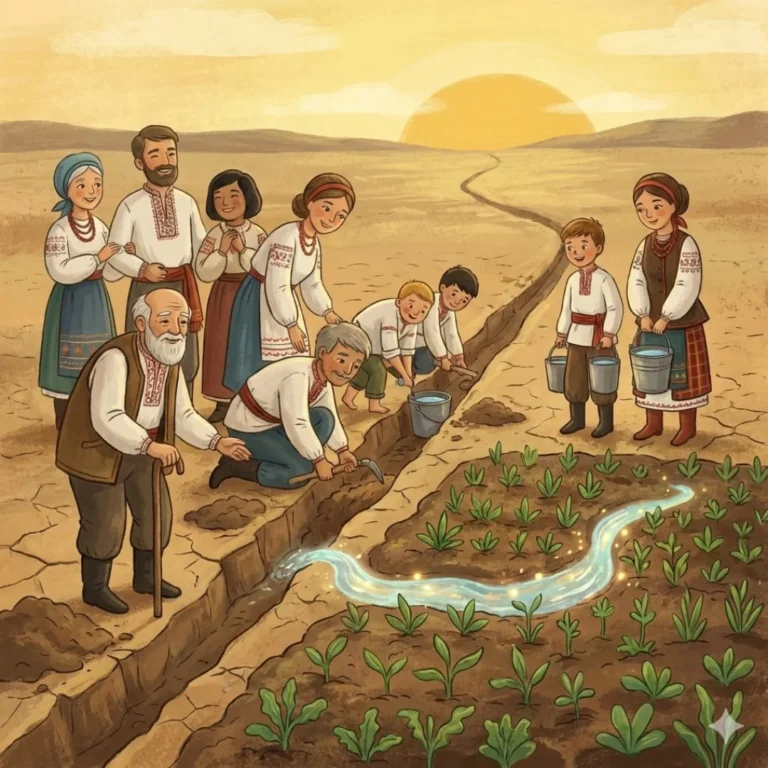
This bedtime story for kids, ‘Baba’s Unity: The Village That Defied The Drought’, teaches children ages 6-12 about important moral values.
Chapter 1: The Village of Singing Hearts
In the rolling hills of a vast African savanna, where baobab trees stretched their ancient arms toward endless blue skies, there stood a village called Amani – which means “peace” in Swahili. But this village was known far and wide not just for its peace, but for something even more precious: its spirit of Ubuntu.
The villagers of Amani greeted each other every morning with the words “Sawubona” – “I see you.” And they didn’t just mean with their eyes. They saw each other with their hearts.
At the center of the village lived Baba Themba, an elder whose white beard flowed like a waterfall and whose eyes sparkled with the wisdom of eighty rainy seasons. Children would gather around him each evening as fireflies danced in the warm air, eager to hear his stories.
“Baba,” young Jengo would often ask, tugging at the elder’s colorful robes, “why do we always share everything? My friend from the distant village says each family there keeps their harvest to themselves.”
Baba Themba would chuckle, his deep laugh rumbling like distant thunder. “Ah, little one, let me tell you what my grandmother told me, and her grandmother told her. We are like the fingers of one hand.” He held up his weathered palm. “Alone, one finger cannot grasp anything. But together?” He made a fist. “Together, we can hold the world.”
Jengo lived with his mother, Mama Zuri, who was known for her beautiful voice that could make even the birds pause to listen. His best friend was Amara, a clever girl who could track animals through the bush better than hunters twice her age. Together, they explored the world around their village, learning the ways of Ubuntu from everyone they met.
Chapter 2: The Sky That Forgot to Weep
One year, something terrible happened. The rains did not come.
At first, the villagers weren’t worried. “The clouds are just resting,” they said. “They will return.”
But weeks passed. Then months. The great river that had always sung through their village grew quieter and quieter until it was nothing more than a trickle, then a memory. The crops that should have been tall and green wilted under the merciless sun.
Jengo watched his mother’s smile grow smaller each day. The other children stopped playing their usual games. Even the birds seemed to sing sadder songs.
“Baba,” Jengo said one evening, finding the old man alone under the great baobab tree, “I’m scared. The elders are saying this is the worst drought in living memory. How will we survive?”
Baba Themba’s face was serious, but his eyes still held a gentle light. “Come, sit with me, young one.”
Jengo settled beside him on the warm, cracked earth.
“Do you see this baobab?” Baba Themba gestured to the massive tree above them. “It has lived for over a thousand years. It has seen droughts before – droughts that would make this one look like a light summer day. Do you know how it survives?”
Jengo shook his head.
“It stores water within itself. But more importantly, it shares. The baobab gives shelter to birds, bats, and insects. It provides fruit and leaves for food. It teaches us that survival is not about hoarding – it is about sharing and supporting one another.”
“But Baba, how can we share when there’s nothing left to share?”
The old man smiled. “There is always something to share, little one. Sometimes it is food. Sometimes it is water. But always – always – we can share our strength, our hope, and our love. That is the true meaning of Ubuntu.”
Chapter 3: The Council of Empty Hands
As the drought worsened, fear began to creep into some hearts like a shadow at dusk. At a village meeting, a man named Kofi spoke harshly.
“We should each keep what little we have! My family comes first. If we share everything equally, we will all starve together!”
Murmurs spread through the crowd. Some heads nodded.
Jengo’s heart sank. Was this the end of Ubuntu?
But then Amara’s grandmother, Mama Eshe, stood up. Though her body was frail, her voice rang out clear and strong.
“I remember the great famine of my childhood,” she said. “Some families tried to hide their grain, keeping it only for themselves. Do you know what happened to them?”
The crowd fell silent.
“They survived a few weeks longer than others, but then they too faced starvation – alone, with no one to help them. But my family? We shared our last handful of millet with our neighbors. And when we had nothing, those same neighbors shared with us. We took turns having empty bellies so that no belly stayed empty for long. Together, we survived. Because Ubuntu is not about dying together – it is about living together.”
Baba Themba rose slowly, his presence commanding attention. “My children, let me share what my ancestors whispered to me last night in my dreams. They said: ‘Hold onto your faith. Seek wisdom in the old ways. Remember, in times of despair, unity is strength.’”
The villagers listened intently as Baba Themba continued.
“There is a spring in the hills, three days’ walk from here. It is small, but it never dries. If we work together – every man, woman, and child who is able – we can build channels to bring that water to our fields.”
“Three days’ walk?” Kofi scoffed. “And channels across such distance? It would take months!”
“Then we had better start tomorrow,” Baba Themba replied calmly.
Chapter 4: The River That Climbed the Mountain
The next morning, something remarkable happened. As the first rays of sunlight painted the sky in shades of orange and gold, nearly every villager gathered at the edge of Amani, tools in hand.
Old Mama Eshe came with her wooden walking stick. “My hands may be weak, but they can still fill baskets with stones.”
Young children like Jengo and Amara came too. “We can carry water to the workers!” Amara declared.
Even Kofi stood among them, looking slightly ashamed. “Perhaps… perhaps I spoke too hastily,” he muttered. “An axe forgets what the tree remembers, but the tree does not hold grudges.”
Baba Themba nodded warmly. “In Ubuntu, there is always room to return to the family.”
The work was grueling. Under the scorching sun, villagers dug channels through hard, cracked earth. They carried rocks to line the waterways. They cleared brush and leveled ground.
Each day, they sang work songs together, their voices rising and falling like the waves of a great ocean. When one person grew tired, another would step in. When someone felt like giving up, a neighbor would offer words of encouragement.
Jengo and Amara worked side by side, their small hands blistered but their spirits unbroken. “Look,” Amara said one evening, pointing at the channel they had helped dig. “It’s like we’re teaching the water a new path to walk.”
“The water will walk to us,” Jengo agreed, “because we are calling it together.”
Chapter 5: The First Drop
After forty days and forty nights of work – a number the villagers would remember for generations – the channel was complete. It stretched from the spring in the hills all the way down to the village fields, a testament to human cooperation.
The entire village gathered to watch as workers at the spring removed the final barrier.
For a long moment, nothing happened.
Then… a trickle. Just a small stream at first, finding its way down the channel. Jengo watched, holding his breath.
The trickle became a stream. The stream became a flow. And then, water – precious, life-giving water – began to pool in the village fields.
A cheer erupted that could be heard for miles. Villagers laughed and cried. Children danced in the water. Old men and women embraced.
Baba Themba’s eyes glistened with tears. “Do you see now, my children? Do you see what Ubuntu can do?”
The water transformed the village. Within weeks, green shoots pushed through the earth. The crops that had seemed lost began to revive. The great river might have forgotten them, but they had remembered something even more powerful – each other.
Chapter 6: The Lessons of the Drought
That year, the harvest was smaller than usual, but it was enough. More importantly, every single person in Amani survived the drought. Neighboring villages, which had heard of their success, came to learn their methods – not just the irrigation channels, but the spirit of cooperation that built them.
Kofi, who had once argued for keeping resources separate, became one of Ubuntu’s greatest champions. “I was a fool,” he would tell visitors. “I thought strength meant holding tightly to what I had. But real strength means holding tightly to each other.”
Years later, Jengo grew into a young man who would one day become an elder himself. But he never forgot the lesson of the great drought.
One evening, he sat with Baba Themba, now so old his white hair seemed to glow in the firelight.
“Baba, I understand now why you never seemed afraid during the drought,” Jengo said.
“Oh, I was afraid,” Baba Themba admitted with a gentle smile. “But I was never alone. And as long as we are together, fear cannot defeat us.”
He looked out at the village, where children played and families shared their evening meals, where the sound of laughter and singing filled the air.
“Remember this, Jengo, and teach it to your children, and your children’s children: We are because you are. You are because we are. This is Ubuntu. This is who we are.”
The stars above seemed to shine a little brighter, as if the ancestors themselves were smiling down at the village that had remembered the old ways – the village that knew the greatest treasure was not what you kept, but what you shared.
Moral Lessons
- True strength comes not from what we hold onto for ourselves, but from what we share with others. In times of hardship, unity and cooperation can overcome any challenge. We are strongest when we remember that our wellbeing is connected to the wellbeing of our community.
Test Your Understanding
1Who is Baba in the story?
Frequently Asked Questions
What is the moral lesson of Baba’s Unity: The Village That Defied The Drought?
What age is this story appropriate for?
How long does it take to read Baba’s Unity: The Village That Defied The Drought?
What culture does this story come from?
Can I use this story for teaching?
Frequently Asked Questions
What is Baba’s Unity: The Village That Defied The Drought about?
Baba’s Unity is a bedtime story for kids ages 6-12 set in an African village called Amani. It follows elder Baba Themba and his community as they face a drought together, teaching children important moral values like sharing, cooperation, and the African philosophy of Ubuntu — the belief that we are stronger together.
What age group is this drought bedtime story best suited for?
This story is ideal for children ages 6 to 12. The gentle storytelling style, relatable characters, and clear moral lessons make it perfect for bedtime reading, either independently or read aloud with a parent or caregiver.
What moral lessons does Baba’s Unity teach children?
The story teaches kids about unity, generosity, and community resilience. Through Baba Themba’s wisdom and the village of Amani’s response to drought, children learn that sharing resources, looking out for one another, and working together can help overcome even the toughest challenges.
📚 Recommended Books
Handpicked for readers like you
As an Amazon Associate, we earn from qualifying purchases. These recommendations are personalized based on this story's themes and your reading history.
What does Ubuntu mean in this story?
Ubuntu is an African philosophy meaning ‘I am because we are.’ In Baba’s Unity, the village of Amani lives by this spirit — greeting each other with ‘Sawubona’ (meaning ‘I see you’) and sharing everything they have. The story uses Ubuntu to show children the power of empathy and collective strength.
Is Baba’s Unity a good story to teach kids about African culture?
Yes! The story is set in an African savanna village and weaves in Swahili words, baobab trees, and the Ubuntu philosophy, giving children a warm, respectful introduction to African cultural values. It’s a great conversation starter about community, cultural traditions, and the wisdom of elders.