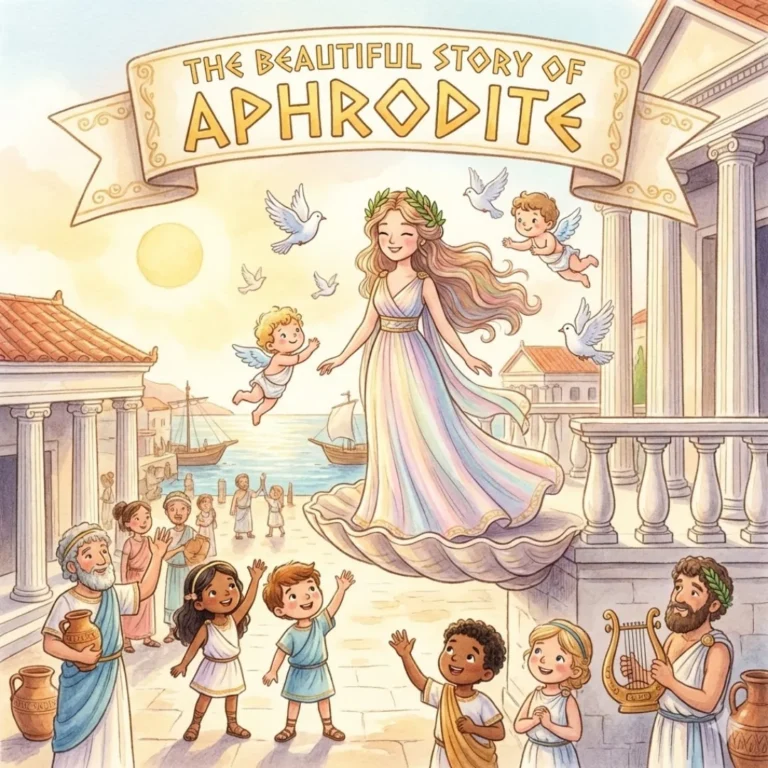
This moral story for children ages 6-12 combines entertainment with important values.
Long ago, in the time when the world was young and the gods were first coming into being, a wondrous event took place that would be remembered forever. This is the story of how Aphrodite, the most beautiful of all goddesses, was born from the sea itself.
In those ancient days, there ruled a cruel god named Ouranos, the Sky. He was married to Gaia, the Earth, and they had many children. But Ouranos was afraid of his children’s power, so he pushed them deep inside the Earth, causing Gaia terrible pain.
Gaia could bear this cruelty no longer. She called upon her youngest son, Kronos, to help her. “Will you free your brothers and sisters?” she asked. “Will you stand against your father’s tyranny?”
Kronos agreed. When Ouranos next came down to embrace the Earth, Kronos was waiting with a great sickle made of adamant, the hardest stone. With one swift stroke, he cut away part of Ouranos’s divine form and cast it far into the sea.
The piece of Ouranos fell into the waters with a tremendous splash. Where it landed, something magical began to happen. A white foam formed around it—not ordinary sea foam, but a luminous, sparkling substance that glowed with divine light. The Greeks called this foam “aphros.”
For a long time, the foam floated on the waves, growing and swirling, forming patterns like mother-of-pearl. Inside this foam, a goddess was taking shape—a being of perfect beauty, born not from mother and father like other gods, but from the sea itself and the severed divinity of the sky.
The foam-cradle drifted first to the holy island of Kythera. As it touched the shore, flowers bloomed all around, and the very air seemed to shimmer with beauty. But Kythera was too small to contain such divine glory, so the waves carried the foam onward.
At last, the foam washed up on the shores of Cyprus, the island blessed by the warm sun. There, upon the beach, the foam parted like a curtain, and from it stepped a goddess so beautiful that the very earth seemed to bow before her. This was Aphrodite, whose name means “foam-born.”
Her skin was pale as moonlight, her eyes sparkled like the sea in sunlight, and her hair flowed golden and long. Wherever she stepped, grass sprang up green and soft, and flowers opened their petals. The Horai, goddesses of the seasons, appeared at once to greet her and dress her in garments woven from clouds and starlight.
They placed a crown of violets and roses upon her head and adorned her with golden jewelry. Even the winds seemed to sing as they wove themselves through her hair. Everything in nature recognized her as the goddess of beauty, love, and desire—powerful forces that would now enter the world of gods and mortals alike.
Aphrodite smiled, and her smile was so enchanting that even the rocks and trees seemed to lean toward her. The Horai led her up to Mount Olympus, home of the immortal gods, where she would take her place among them.
When Aphrodite arrived at the council of the gods, all fell silent. Zeus himself, king of the gods, was struck by her beauty. Hera, queen of heaven, felt both admiration and wariness. Athena, goddess of wisdom, recognized the power that walked beside beauty. And Ares, god of war, felt his fierce heart soften for the first time.
From that day forward, Aphrodite held great power among gods and mortals. She could make the proudest heart overflow with love and the coldest soul burn with desire. Even mighty Zeus could not resist her influence.
The other gods called her by many names: Aphrodite Ourania, born from Ouranos; Aphrodite Anadyomene, rising from the sea; Kypris, the Lady of Cyprus. Her sacred birds were the dove and the swan. Her flowers were the rose and the myrtle. The evening star, that bright light that appears at dusk, became sacred to her, for she was as beautiful as that star.
Aphrodite went on to play many roles in the great stories of Greece. She was given in marriage to Hephaestus, the smith-god, though her heart belonged to others. She became mother to Eros, the winged god of love, and to Harmonia, goddess of harmony. She aided the Trojan hero Aeneas, her mortal son, guiding him to his destiny.
But most of all, Aphrodite reminded everyone—god and mortal alike—that beauty and love are powerful forces in the world. They can bring joy or suffering, peace or war. They can make a person act bravely or foolishly. They are part of the very fabric of existence, born from chaos and violence, yet emerging as something wonderful.
The ancient Greeks honored Aphrodite in temples throughout their lands, but especially on the island of Cyprus, where she first touched the earth. There, they would offer her roses and myrtle, doves and incense, remembering the day when the goddess rose from the foam of the sea.
And so the story teaches us that even from difficult beginnings—from conflict and turmoil—something beautiful can emerge. Like Aphrodite born from the sea foam, beauty and love can arise from the most unlikely places, bringing light and grace to the world.
To this day, when you see sea foam sparkling on the waves, perhaps you will remember the ancient story of how a goddess was born from such foam, and how she brought the gift of love to the world.
Moral Lessons
- Beauty and love are powerful forces that can emerge even from chaos and conflict, reminding us that transformation and grace are always possible.
Test Your Understanding
1. What was Krishna’s role in the Mahabharata war?
Frequently Asked Questions
What is the moral lesson of The Beautiful Story of Aphrodite?
What age is this story appropriate for?
How long does it take to read The Beautiful Story of Aphrodite?
What culture does this story come from?
Can I use this story for teaching?
Frequently Asked Questions
Who is Aphrodite in Greek mythology?
Aphrodite is the Greek goddess of love and beauty, known as the most beautiful of all goddesses. In this story for children ages 6-12, we learn about her magical birth from the sea and how she came to be one of the most important figures in Greek mythology.
How was Aphrodite born according to this story?
According to Greek mythology, Aphrodite was born from the sea when Kronos cast part of his father Ouranos into the ocean. This magical event created the goddess of beauty and love, making her birth story one of the most fascinating tales in ancient Greek culture.
Is this Aphrodite story appropriate for kids?
Yes, this version is specifically adapted for children ages 6-12. While it includes mythological elements like gods and conflict, the story focuses on wonder and magic rather than violence, making it suitable as a bedtime story that teaches about ancient cultures.
📚 Recommended Books
Handpicked for readers like you
As an Amazon Associate, we earn from qualifying purchases. These recommendations are personalized based on this story's themes and your reading history.
What moral lessons can children learn from this Greek story?
This moral story teaches children about standing up against cruelty and injustice, as shown when Gaia and Kronos work together to stop Ouranos’s tyranny. It also introduces kids to the beauty of ancient Greek culture and mythology in an age-appropriate way.
Who are Ouranos, Gaia, and Kronos in this story?
Ouranos is the Sky god, Gaia is the Earth goddess (his wife), and Kronos is their youngest son. These powerful figures from Greek mythology play important roles in Aphrodite’s birth story, representing the forces of sky, earth, and time in ancient Greek beliefs.