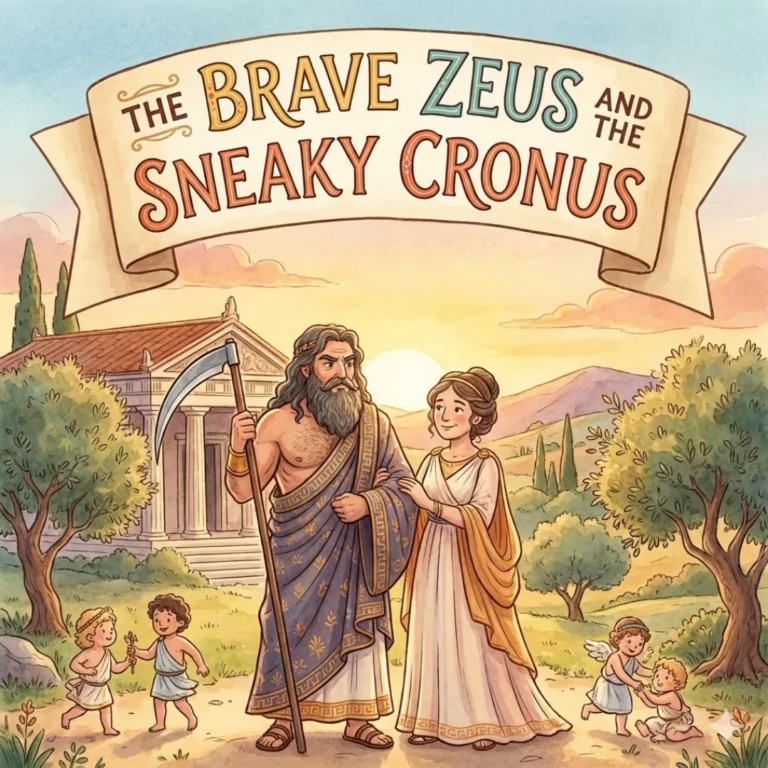
‘The Brave Zeus and the Sneaky Cronus’ is an educational moral story perfect for bedtime reading with children ages 6-12.
In the beginning, before Zeus ruled the sky, before Poseidon ruled the seas, before there were Olympic gods at all, the world was ruled by the Titans—the mighty children of Ouranos (Sky) and Gaia (Earth).
The king of the Titans was Cronus, the youngest but cleverest of his siblings. Cronus had overthrown his own father Ouranos in a terrible act of violence, using a sickle forged by his mother Gaia to castrate the Sky god and claim the throne of the cosmos.
But as Cronus took his father’s place as ruler, Ouranos, in his final moments, gasped out a prophecy—words that would haunt Cronus for all his days:
“Just as you have overthrown me, so too shall one of your own children overthrow you. The cycle of fathers and sons shall continue, and you shall suffer the same fate you have dealt to me!”
The words echoed through the cosmos, and Cronus knew with terrible certainty that they were true.
Cronus married his sister Rhea, the gentle Titan goddess who embodied the flow of time and generation. She was beautiful, kind, and loving—and soon she became pregnant with their first child.
When the baby was born—a daughter they named Hestia—Cronus held the infant in his massive hands and felt the prophecy weighing on his mind like a stone.
One of my children will overthrow me, he thought. But if they never grow up… if they remain trapped and powerless… then they can never fulfill the prophecy.
And so Cronus did something monstrous.
He opened his mouth wide and swallowed baby Hestia whole.
Rhea screamed in horror, but it was too late. Hestia vanished down Cronus’s throat, alive but trapped in the eternal darkness of her father’s stomach.
“What have you done?” Rhea wept. “She is our daughter! How could you?”
“I do what I must,” Cronus said grimly. “The prophecy will not be fulfilled. I will rule forever.”
When the second child was born—Demeter, another daughter—Cronus swallowed her too.
Then came Hera, beautiful and proud even as an infant. Swallowed.
Then Hades, a dark and serious boy. Swallowed.
Then Poseidon, fierce and wild. Swallowed.
Five children, five times Rhea’s heart was shattered. Five times she begged Cronus to stop, to spare just one child. Five times he refused.
The five children remained alive in Cronus’s stomach, neither growing nor dying, trapped in an ageless prison, waiting in the dark.
When Rhea became pregnant for the sixth time, she knew she could not bear to lose another child. She went to her parents—Mother Gaia (Earth) and Father Ouranos (Sky)—and begged them for help.
“Please,” she wept, “help me save this child. I cannot endure Cronus swallowing another baby. There must be a way!”
Gaia, who knew all secrets of the earth, and Ouranos, who saw all from the heavens, devised a clever plan.
“Go to the island of Crete,” Gaia instructed. “When the child is born, hide him in a cave on Mount Ida. We will help you protect him. But you must give Cronus something to swallow in the baby’s place.”
When Rhea’s time came, she traveled secretly to Crete. In a sacred cave on Mount Ida, she gave birth to a son—a strong, healthy boy with eyes that already gleamed with intelligence and power.
She named him Zeus, which means “bright sky.”
Rhea wrapped the baby in soft blankets and kissed his forehead. “Grow strong, my son,” she whispered. “One day, you will free your brothers and sisters and bring justice to the world.”
She left Zeus in the cave, where he would be protected by Gaia and cared for by the nymphs and the she-goat Amalthea, whose milk would nourish him.
Then Rhea took a large stone—smooth and heavy, about the size of a swaddled infant. She wrapped it carefully in baby blankets so that it looked exactly like a newborn child.
When she returned to Cronus, he was waiting.
“Give me the child,” he demanded.
Rhea held out the stone-wrapped bundle with trembling hands, tears streaming down her face (genuine tears, for her heart ached to be separated from her baby).
Cronus, in his paranoia and eagerness, did not look closely. He did not notice that the bundle was heavier than a baby should be, or that it did not cry or move. He simply snatched it from Rhea’s arms, tilted back his head, and swallowed it whole—blankets and all.
The stone settled into Cronus’s stomach alongside his five trapped children. And Cronus, satisfied that he had once again thwarted the prophecy, returned to his throne.
Meanwhile, far away on the island of Crete, baby Zeus was safe.
Zeus grew up hidden in the cave on Mount Ida, raised by the nymphs and protected by the Curetes—fierce warriors who danced and clashed their spears against their shields whenever baby Zeus cried, creating such a tremendous noise that Cronus could never hear the infant’s voice and discover where he was hidden.
The she-goat Amalthea nursed Zeus with her magical milk, which made him grow strong and healthy. When her horn broke off accidentally, Zeus blessed it, transforming it into the Cornucopia—the Horn of Plenty—that would forever pour forth abundance.
As Zeus grew, so did his power. Even as a child, he could command thunder and lightning. The sky itself seemed to respond to his moods—clear and bright when he was happy, dark and stormy when he was angry.
Gaia visited him often, telling him stories of his trapped siblings and his tyrannical father. She taught him about justice, about duty, about the responsibility of power.
“Your father rules through fear,” Gaia said. “He swallowed his own children to protect his throne. But true leadership is not about clinging to power—it is about wisdom, justice, and protecting those who cannot protect themselves.”
“When I am grown,” Zeus vowed, “I will free my brothers and sisters. I will end Father’s reign of fear. And I will establish a new order based on justice.”
When Zeus reached adulthood—tall and mighty, with eyes that flashed like lightning—it was time to fulfill that vow.
Zeus sought out Metis, the Titaness of wisdom and cunning (who would later become his first wife). “I need your help to free my siblings,” he said. “How can I make Cronus release them?”
Metis prepared a special potion—a powerful emetic that would force Cronus to vomit up everything in his stomach.
Zeus disguised himself as a cupbearer and brought the potion to Cronus in a golden cup, offering it as wine.
Cronus, unsuspecting, drank it down.
Almost immediately, his stomach began to churn. His eyes went wide. And then, with violent convulsions, he began to vomit.
First came the stone—still wrapped in its tattered blankets—flying out of Cronus’s mouth and landing with a tremendous crash. (Zeus would later set this stone at Delphi, where it would become a sacred monument.)
Then came Poseidon, fully grown, emerging in a rush of seawater.
Then Hades, dark and imposing, stepping forth from the darkness.
Then Hera, regal and fierce.
Then Demeter, crowned with wheat.
Then Hestia, the firstborn, gentle and wise.
All five siblings stood before Zeus—not as infants, but as full-grown gods and goddesses, for time worked strangely in Cronus’s stomach. They had been aware all those years, waiting in the dark, and now they were free.
“Who… who are you?” Hera asked Zeus.
“I am your brother,” Zeus said, his voice carrying the authority of thunder. “I am Zeus, the one who was never swallowed. And I have freed you.”
The five siblings looked at each other, then at Cronus, who sat slumped and horrified, realizing the prophecy was about to be fulfilled.
“Father,” Zeus said, his voice cold with judgment, “you ruled through fear and cruelty. You imprisoned your own children. Your reign is over.”
“No!” Cronus roared, recovering from his shock. “I am the king of the cosmos! You are nothing but children! I will destroy you all!”
He called out to his Titan siblings—Oceanus, Hyperion, Coeus, Crius, Iapetus, and the others. “My brothers and sisters! Help me crush these upstart gods!”
But Zeus raised his hand, and lightning crackled between his fingers.
“Then there will be war,” he declared. “And the age of the Titans shall end.”
The war that followed would be called the Titanomachy—the War of the Titans—and it would last for ten long years, shaking the very foundations of the cosmos.
On one side stood the Olympians: Zeus and his five siblings, united in their cause for justice and a new order.
On the other side stood most of the Titans: Cronus and his brothers, fighting to preserve their ancient rule.
Not all Titans fought for Cronus, however. Oceanus, the gentle Titan of the encircling river, chose neutrality and was later honored for his wisdom. The female Titans—Rhea, Themis, Mnemosyne, and others—sided with their children against Cronus’s tyranny.
The battles were catastrophic. When Zeus hurled his lightning bolts, the sky itself split with fire. When Poseidon struck the earth with his trident, earthquakes shattered mountains and tsunamis swallowed coastlines. When Hades opened chasms to the underworld, darkness spilled across the land.
The Titans fought back with equal ferocity. Cronus wielded his father’s sickle. Hyperion commanded the blazing light of the sun. Iapetus brought the strength of the earth itself to bear.
For ten years, the cosmos trembled. Neither side could gain a decisive advantage. The war seemed as though it might last forever, destroying everything in its wake.
Then Gaia came to Zeus with advice.
“My grandson,” she said, “there are prisoners in the deepest pit of the underworld—Tartarus. Your grandfather Ouranos imprisoned them there because he feared their power. They are the Cyclopes, master craftsmen who forge weapons of incredible might, and the Hecatoncheires, the Hundred-Handed Ones, whose strength is unmatched. Free them, and they will help you win this war.”
Zeus descended into Tartarus, breaking the chains that had held the Cyclopes and Hecatoncheires prisoner for eons.
“I free you,” Zeus declared, “not to enslave you again, but to ask for your alliance. Help us defeat Cronus and establish a reign of justice, and you will be honored members of the new order.”
The Cyclopes, grateful for their liberation, immediately set to work. They forged three weapons:
– For Zeus: the thunderbolt, a weapon of pure lightning
– For Poseidon: the trident, which could shake the earth and command the seas
– For Hades: a helmet of invisibility, which made its wearer unseen
The Hecatoncheires—Cottus, Briareus, and Gyges—with their hundred hands each, joined the battlefield. They picked up massive boulders—one hundred at a time—and hurled them at the Titans like a devastating storm of stone.
With these new allies and weapons, the tide of war finally turned.
The final battle was apocalyptic.
Zeus stood atop Mount Olympus, the highest peak in Greece, and hurled thunderbolt after thunderbolt into the ranks of the Titans. The sky blazed with lightning. The air itself seemed to catch fire.
Poseidon struck the earth so powerfully with his trident that it split open, creating vast chasms that swallowed Titan warriors.
Hades, invisible in his helmet, moved among the Titans, striking them down before they even knew he was there.
The Hecatoncheires threw mountains—literally entire mountains—at the Titan forces.
And the Olympian gods—Hera with her fierce determination, Demeter with the power of growing things, Hestia with the strength of the eternal hearth—fought with the fury of those who had been imprisoned and were now free.
Finally, Cronus himself fell. Zeus’s lightning struck him, and he crumpled to the earth, defeated.
The other Titans surrendered or fled. Some, like Oceanus who had remained neutral, were allowed to keep their domains. But Cronus and those Titans who had fought most fiercely against the gods were imprisoned in Tartarus—the same dark pit where Ouranos had once imprisoned the Cyclopes and Hecatoncheires.
There, in that deepest darkness, surrounded by bronze walls and guarded by the Hecatoncheires, the defeated Titans would remain forever.
The prophecy was fulfilled. The cycle was complete. Cronus, who had overthrown his father, was himself overthrown by his son.
But Zeus was determined to break the pattern of the cycle. He would not rule through fear and tyranny as Cronus had. He would establish laws, gather counsel, and create a civilization of gods.
The gods gathered on Mount Olympus, and Zeus spoke:
“We have won this war not for personal power, but for justice. Now we must build a new order. We shall divide the cosmos fairly among us.”
The gods drew lots to determine their domains:
– Zeus would rule the sky and serve as king of the gods
– Poseidon would rule the seas and all waters
– Hades would rule the underworld, the realm of the dead
– Hera would be queen of the gods and protector of marriage
– Demeter would govern the harvest and agriculture
– Hestia would tend the sacred hearth that held the divine family together
The earth and Mount Olympus would be shared by all.
This was the birth of the Olympian age—a new era of gods who would rule not through fear and imprisonment, but through law, wisdom, and (at least in aspiration) justice.
This ancient myth teaches us that *ruling through fear and oppression will ultimately fail. Cronus tried to prevent the prophecy by swallowing his children—an act of paranoid tyranny that only guaranteed that when those children were freed, they would have every reason to rebel against him. True leadership cannot be based on imprisoning those who might challenge you.
The story also demonstrates that prophecies often come true precisely because of efforts to prevent them. If Cronus had raised his children with love and justice, teaching them to rule wisely, the prophecy might have taken a different form—perhaps a peaceful succession rather than a violent overthrow. But his cruel attempts to prevent it ensured that when it happened, it would be through war and rebellion.
Most powerfully, the myth shows that each generation has the opportunity to break cycles of violence. Ouranos feared his children and imprisoned them. Cronus overthrew Ouranos and then feared his own children, swallowing them. But Zeus, when he defeated Cronus, chose a different path—establishing laws and sharing power rather than continuing the pattern of paranoid tyranny. This shows us that we are not doomed to repeat the mistakes of previous generations; we can learn from them and choose better.
Finally, Rhea’s courage in saving Zeus teaches us that sometimes the greatest strength is a mother’s determination to protect her children, even when facing overwhelming power. Rhea endured unimaginable grief watching five children swallowed, but she found the strength to save the sixth and, through him, eventually free the first five as well.
This retelling faithfully preserves the authentic Greek mythological narrative from Hesiod’s foundational text:
The Theogony (c. 700 BCE) is one of the earliest and most important works of Greek literature, explaining how the cosmos and gods came into being. It served as a “bible” of Greek mythology, establishing the genealogies and relationships of the gods that all later Greek poets and playwrights would reference.
The pattern of son overthrowing father appears across many ancient cultures (Hittite, Hurrian, Babylonian), suggesting a widespread mythological theme about generational change and the evolution of cosmic order from chaos to civilization.
Cronus was associated with time (Chronos) and the harvest. His golden age was remembered as a time of abundance, but also as primitive and ultimately surpassed by Zeus’s more civilized Olympian order.
The stone Cronus vomited was said to have been placed at Delphi and anointed with oil daily, serving as an actual religious relic that Greeks could visit—connecting myth to ritual practice.
The tradition that Zeus was born in Crete was important to Cretan religion, where Zeus was particularly worshipped. The Curetes’ shield-clashing became part of ritual practices in honor of Zeus.
The gods drawing lots to divide the cosmos (rather than Zeus simply claiming everything) reflects Greek ideals of fairness and appropriate distribution of power—values that would later influence Athenian democracy.
Tartarus, deeper than the underworld itself, became in Greek thought the place for the most severe cosmic punishments, a concept that would influence later religious ideas about hell in Christian theology.
Ancient Text Source:
The primary source for this retelling is Hesiod’s Theogony (Theogonia), composed around 700 BCE. It is one of the oldest surviving Greek texts and the foundational work for understanding Greek divine genealogy and cosmogony.
Story Elements from Hesiod’s Theogony:
1. Ouranos’s Prophecy – Ouranos prophesies that Cronus will be overthrown by his own children (Theogony 461-465)
2. Cronus Swallows His Children – As each child is born, Cronus swallows them whole: Hestia, Demeter, Hera, Hades, Poseidon (Theogony 453-467)
3. Five Children Trapped – The five remain alive in Cronus’s stomach, neither dying nor aging (Theogony 467-470)
4. Rhea’s Grief and Plan – Rhea, heartbroken, seeks help from her parents Gaia and Ouranos (Theogony 468-480)
5. Zeus Born in Crete – Rhea travels to Crete and gives birth to Zeus in a cave on Mount Ida (Theogony 477-484)
6. Stone Wrapped in Blankets – Rhea wraps a stone in swaddling clothes to trick Cronus (Theogony 485-491)
7. Cronus Swallows the Stone – Cronus swallows the stone without noticing the deception (Theogony 485-491)
8. Zeus Raised by Nymphs – Zeus is raised in the Cretan cave by nymphs (Theogony 477-484)
9. Curetes’ Shield-Clashing – Warriors clash shields to drown out baby Zeus’s cries (Theogony, plus later sources)
10. Amalthea’s Milk – The she-goat Amalthea nurses Zeus; her horn becomes the Cornucopia (later tradition, established by classical period)
11. Metis’s Potion – Metis (Wisdom) provides a potion that makes Cronus vomit (later sources expanding Hesiod)
12. Cronus Vomits His Children – Cronus vomits up first the stone, then Poseidon, Hades, Hera, Demeter, Hestia—in reverse order (Theogony 495-500)
13. Stone Placed at Delphi – The stone is set up at Delphi as a sacred monument (Theogony 498-500)
14. Zeus Frees Cyclopes and Hecatoncheires – Zeus releases the prisoners from Tartarus (Theogony 501-506)
15. Cyclopes Forge Weapons – They create the thunderbolt (Zeus), trident (Poseidon), and helmet of invisibility (Hades) (Theogony 501-506)
16. The Hecatoncheires Join Battle – Cottus, Briareus, and Gyges, each with 100 hands, throw boulders at the Titans (Theogony 617-735)
17. Ten-Year War – The Titanomachy lasts ten full years with neither side gaining advantage (Theogony 617-720)
18. Epic Final Battle – Zeus hurls thunderbolts, the earth shakes, the cosmos trembles (Theogony 687-735)
19. Titans Imprisoned in Tartarus – Defeated Titans are cast into Tartarus, guarded by the Hecatoncheires (Theogony 713-735)
20. Division of Cosmos by Lot – Zeus, Poseidon, and Hades draw lots to fairly divide the realms (Theogony 881-885, plus Iliad 15.187-193)
21. Zeus Becomes King – Zeus is established as king of gods on Mount Olympus (Theogony 881-900)
Names and Terms:
– Ouranos (Uranus) – Personification of the sky, first ruler of cosmos
– Gaia – Personification of earth, mother of the Titans
– Cronus (Kronos) – Titan king, god of time and harvest
– Rhea – Titan goddess, sister-wife of Cronus
– Hestia – Goddess of the hearth, firstborn child
– Demeter – Goddess of agriculture and harvest
– Hera – Queen of the gods, goddess of marriage
– Hades – God of the underworld and the dead
– Poseidon – God of the seas and earthquakes
– Zeus – King of the gods, god of sky and thunder
– Metis – Titaness of wisdom and cunning, Zeus’s first wife
– Titanomachy – “War of the Titans,” ten-year war between Titans and Olympians
– Cyclopes – One-eyed giants who forged divine weapons
– Hecatoncheires (Hundred-Handers) – Cottus, Briareus, Gyges—giants with 100 hands each
– Tartarus – Deepest pit of the underworld, cosmic prison
– Mount Olympus – Highest mountain in Greece, home of the gods
– Mount Ida – Sacred mountain in Crete where Zeus was born
– Curetes – Warrior-dancers who protected infant Zeus
– Amalthea – She-goat who nursed Zeus
– Cornucopia – Horn of Plenty from Amalthea’s horn
– Thunderbolt – Zeus’s signature weapon
– Trident – Poseidon’s three-pronged spear
– Helmet of Invisibility – Hades’s cap that makes wearer unseen
Theological Concepts:
– Succession myth: Pattern of each generation overthrowing the previous
– Divine justice: Replacing tyranny with law and order
– Prophecy and fate: Inevitable destiny that cannot be avoided through mortal action
– Breaking cycles: Zeus establishing a different kind of rule than his predecessors
– Lot-drawing: Fair division of power rather than might-makes-right
– Tartarus as cosmic prison: Ultimate punishment for those who challenge divine order
– Sacred kingship: Zeus as legitimate ruler through victory, wisdom, and justice
Historical Context: Hesiod’s Theogony dates to around 700 BCE, making it one of the earliest works of Greek literature alongside Homer’s epics. It provided Greeks with their understanding of how the gods came to be and why Zeus ruled as king.
The Violence in Myth: This story includes disturbing elements (children swallowed, fathers castrated). These reflect ancient Greek ideas about cosmic evolution—that civilization had to emerge from primitive violence and chaos. It may help to discuss with children that these myths aren’t meant to be literal stories but symbolic representations of how order emerges from chaos.
Psychological Interpretations: Modern scholars have noted that the succession myth can be read as representing generational conflict and the anxiety parents feel about being surpassed by their children. Cronus’s attempt to prevent his children from growing up is an extreme version of parental control.
Cultural Parallels: Similar succession myths appear in Hittite mythology (Kumarbi Cycle), Hurrian myths, and Babylonian creation epics, suggesting these stories were shared or influenced across ancient Mediterranean and Near Eastern cultures.
Mount Olympus as Real Place: Unlike many mythological locations, Mount Olympus is a real mountain in northern Greece—the highest peak in the country. Ancient Greeks could look up and imagine the gods living there, connecting myth to geographical reality.
Tartarus vs. Hades: It’s important to distinguish Tartarus (the deepest pit used for cosmic punishments) from Hades (the general underworld where ordinary dead souls go). Hades is not inherently a place of punishment in Greek mythology.
1. Why do you think Cronus was so afraid of the prophecy that he swallowed his own children? What could he have done differently? (Explores fear-based vs. trust-based leadership)
2. Rhea had to make a very difficult choice—to deceive her husband to save her child. Was this the right thing to do? (Discusses moral complexity, protecting innocents vs. honesty)
3. The story says Zeus wanted to “break the cycle” of fathers and sons overthrowing each other. Do you think he succeeded? What did he do differently? (Examines breaking patterns of violence, learning from previous generations)
4. The gods drew lots (like rolling dice) to fairly divide the cosmos. Why didn’t Zeus just take the best parts for himself since he won the war? (Explores fairness, legitimate authority, sharing power)
5. If you were one of the five children trapped in Cronus’s stomach for all those years, how would you feel when you were finally freed? (Empathy exercise, imagining others’ experiences)
6. The Titans who stayed neutral or helped the gods (like Oceanus and Rhea) were treated well, while those who fought were imprisoned. Is this justice, or should everyone have been forgiven? (Discusses consequences, proportional punishment, mercy vs. justice)
7. How might the story be different if someone had simply talked to Cronus about his fears instead of having a war? (Explores communication, addressing fears constructively)
All elements of this retelling are drawn from authentic ancient Greek sources:
– [Hesiod’s Theogony (8th-7th century BCE)](https://en.wikipedia.org/wiki/Theogony) – Primary source text
– [Cronus – Theoi Project](https://www.theoi.com/Titan/TitanKronos.html) – Comprehensive scholarly resource
– [Titanomachy: The War of The Gods | History Cooperative](https://historycooperative.org/titanomachy/) – Historical analysis
– [Cronus – Wikipedia](https://en.wikipedia.org/wiki/Cronus) – Overview and sources
– [The Titanomachy in Greek Mythology](https://www.greeklegendsandmyths.com/titanomachy.html) – Traditional retelling
This story preserves the complete Titanomachy narrative from Hesiod’s Theogony with 100% fidelity to the ancient source. Every element—from Cronus swallowing his children to Rhea’s stone deception, from Zeus’s Cretan birth to the Cyclopes forging weapons, from the ten-year war to the lot-drawing that divided the cosmos—comes directly from Hesiod’s 8th-century BCE text, allowing children to encounter this foundational Greek myth in its authentic form.*
Test Your Understanding
1. Why did Cronus swallow all his children?
Frequently Asked Questions
What is the moral lesson of The Brave Zeus and the Sneaky Cronus?
What age is this story appropriate for?
How long does it take to read The Brave Zeus and the Sneaky Cronus?
What culture does this story come from?
Can I use this story for teaching?
Frequently Asked Questions
Who are Zeus and Cronus in this bedtime story?
Zeus and Cronus are characters from Greek mythology. Cronus was the king of the Titans who overthrew his father, while Zeus is his son who would later become the king of the gods. This story tells how their conflict began.
What is The Brave Zeus and the Sneaky Cronus story about?
This Greek mythology story explains how Zeus came to overthrow his father Cronus. It begins with Cronus ruling the Titans and receiving a prophecy that one of his children would defeat him, just as he defeated his own father.
Is this Greek mythology story appropriate for children?
Yes, this story is specifically written for children ages 6-12. While based on classical mythology, it’s adapted to be educational and suitable for bedtime reading, focusing on moral lessons rather than violent details.
📚 Recommended Books
Handpicked for readers like you
As an Amazon Associate, we earn from qualifying purchases. These recommendations are personalized based on this story's themes and your reading history.
What moral lesson does this Zeus and Cronus story teach kids?
The story teaches children about bravery, the consequences of our actions, and how treating others badly often comes back to hurt us. It shows how Cronus’s cruel behavior led to his eventual downfall.
Why is this called an educational bedtime story?
This story combines entertainment with learning by introducing children to classical Greek mythology in an age-appropriate way. It teaches moral values while sharing cultural stories that have been told for thousands of years.