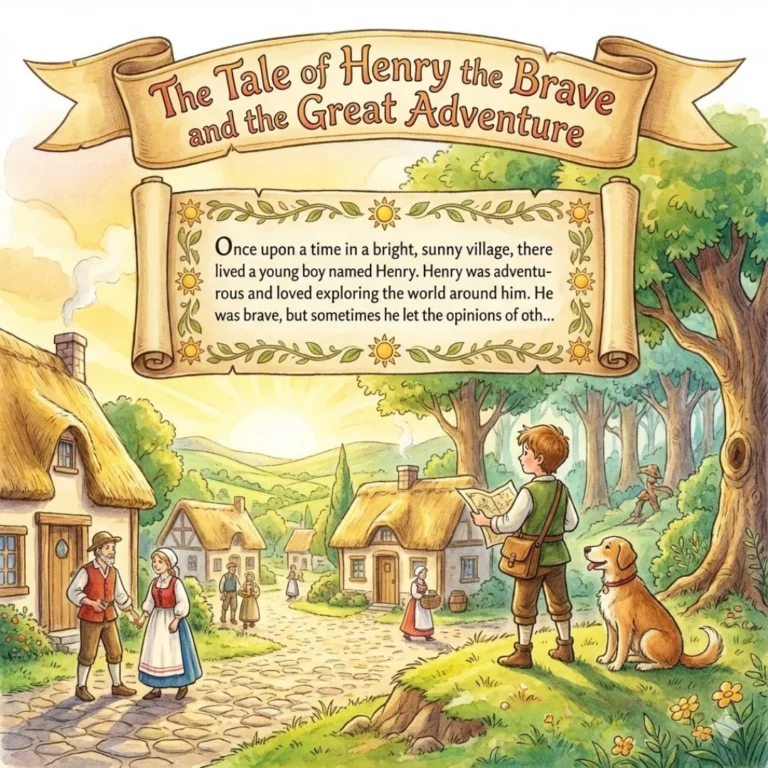
This moral story for children ages 6-12 combines entertainment with important values.
Chapter One: The Boy Who Dreamed of adventure
Long ago, in a kingdom where great forests stretched as far as the eye could see and ancient castles rose above the morning mist, there lived a young boy named Henry. He was twelve years old, with hair the color of ripe wheat and eyes as blue as the summer sky.
Henry lived with his mother and father in a small cottage at the edge of a village called Willowmere. His father was a carpenter, known throughout the region for the beautiful furniture he crafted from the forest’s oak and ash. His mother wove tapestries that told stories of heroes and dragons, kings and peasants.
But Henry, though he loved his parents dearly, often felt restless. While other boys were content to learn their fathers’ trades and dream of simple futures, Henry’s heart burned with a desire for something more.
“One day,” he would say to his best friend, a clever girl named Elena who lived in the mill, “I’m going to have a real adventure. I’m going to prove that I’m more than just a carpenter’s son.”
Elena would laugh, but kindly. “And what makes a person more than what their parents are?” she would ask. “My mother is a miller, and I am proud to be her daughter.”
Henry would frown and shake his head. “I don’t mean I’m ashamed of my father. I just feel like there’s something inside me, something waiting to come out. Something that wants to be tested.”
Elena would smile mysteriously. “Perhaps that something is your character, Henry. And perhaps it will be tested sooner than you think.”
Chapter Two: The Merchant’s Tale
One autumn evening, a traveling merchant arrived in Willowmere. His name was Master Bartholomew, and he had journeyed through distant lands, trading in silks and spices. The villagers gathered in the tavern to hear his stories of far-off cities and strange customs.
But the tale that caught Henry’s attention was about the Enchanted Forest.
“Deep within the forest,” Master Bartholomew said, his voice dropping to a whisper, “there lies a treasure hidden by the Fairy Queen herself. They say it’s guarded by trials that only the truly brave can pass. Many have sought it, knights and princes and powerful warriors. None have returned with the treasure. Some say they failed the tests. Others say they never came back at all.”
“What kind of treasure?” a boy asked.
“Ah,” the merchant smiled, “that’s the strange part. No one knows exactly what it is. The stories say only that whoever claims it will have their heart’s desire fulfilled. But be warned: those who seek it for selfish reasons find only sorrow. The Fairy Queen, they say, can see into the depths of one’s soul.”
That night, Henry couldn’t sleep. The story of the Enchanted Forest treasure played over and over in his mind. He imagined himself passing the trials, claiming the prize, returning home as a hero.
But Elena’s words echoed too: “Perhaps that something is your character.”
Was he brave? Was he worthy? There was only one way to find out.
Chapter Three: The Journey Begins
Henry left home before dawn, leaving a note for his parents. He felt guilty for not telling them face to face, but he knew they would try to stop him. He promised to return soon, and he meant it.
The Enchanted Forest was a full day’s walk from Willowmere. By the time Henry reached its edge, the sun was sinking toward the horizon, painting the sky in shades of orange and purple. The forest loomed before him, its ancient trees rising like the pillars of a vast, dark cathedral.
“I’m not afraid,” Henry said out loud, though his voice trembled slightly.
He stepped into the forest.
At first, the path was clear, winding between mossy oaks and silver birches. Birds sang in the branches, and sunlight filtered through the leaves in golden shafts. It was beautiful, not frightening at all.
But as Henry walked deeper, the forest began to change. The trees grew closer together, their branches tangling overhead until the sky was almost invisible. The birdsong faded into silence. The air grew cold.
And then Henry heard something, a faint, high-pitched sound. A cry for help.
Chapter Four: The First Test – The Bird in the Thorns
Henry followed the sound and found a small bird caught in a thorny bush. It was beautiful, with feathers of blue and gold, but its wings were tangled in the sharp thorns, and every time it struggled, it wounded itself more.
“Please,” the bird chirped in a voice Henry could somehow understand, “please help me! I’ve been trapped here for hours!”
Henry looked at the bush. The thorns were long and sharp. If he tried to free the bird, he would certainly hurt his hands. He might lose precious time on his quest.
But the bird was suffering.
Henry didn’t hesitate. He carefully reached into the bush, ignoring the pain as thorns pierced his fingers, and gently untangled the bird’s wings from the cruel branches.
“Thank you, kind boy,” the bird said, hopping onto a branch and stretching its wings. “You could have walked past. Many have. But you chose to help me even though it cost you pain. Here.” The bird plucked a feather from its tail. “Take this. It may help you when you need light in the darkness.”
Henry took the feather, which glowed with a soft golden light, and placed it carefully in his pocket.
“Wait,” he said as the bird prepared to fly away. “Is this one of the Fairy Queen’s tests?”
The bird tilted its head. “Every choice is a test, young one. The question is what kind of person you prove yourself to be.” And with that, it flew away into the trees.
Chapter Five: The Second Test – The Turtle on the Rock
Henry continued deeper into the forest, his hands stinging from the thorn wounds but his heart feeling strangely light. The golden feather in his pocket seemed to pulse with warmth.
Soon he came to a rushing stream. There was no bridge, and the water looked cold and deep. On a rock in the middle of the stream sat a large turtle, looking at the far bank with frustration in its ancient eyes.
“Excuse me,” Henry called. “Are you all right?”
The turtle turned its wrinkled head. “I was trying to cross to lay my eggs on the sandy shore,” it said in a slow, thoughtful voice. “But my old legs gave out, and now I am stuck on this rock. The water is too strong for me. I fear I will never reach the shore.”
Henry looked at the stream. Crossing it himself would be difficult. Crossing it while carrying a heavy turtle would be nearly impossible. He might be swept away. He might drown.
But the turtle needed help.
“Hold on,” Henry said. “I’m coming.”
He waded into the icy water, gasping at the cold. The current tugged at his legs, but he planted his feet firmly and made his way to the rock. Carefully, he lifted the turtle, who was much heavier than she looked, and began the slow journey to the far shore.
Twice, Henry almost fell. Once, the water reached his chin, and he had to hold the turtle above his head to keep her from being swept away. But finally, with strength he didn’t know he had, he made it to the sandy shore.
“Thank you, brave child,” the turtle said as she began to dig a nest for her eggs. “Many have passed by this stream. Some saw me and laughed. Others saw me and walked away. You alone stopped to help.”
She reached out with one leg and touched his hand with her leathery foot. “Take this shell that fell from my back years ago. It may help you when you need protection.”
Henry accepted the small piece of shell, smooth and hard as stone, and placed it with the golden feather.
“Is this another test?” he asked.
The turtle smiled with her ancient eyes. “Life is full of tests, young one. What matters is not whether you pass or fail, but what each choice reveals about who you truly are.”
Chapter Six: The Third Test – The Frightened Deer
By now, Henry was tired, cold, and hungry. His clothes were wet from the stream, and his hands ached from the thorns. Part of him wanted to give up and go home.
But he had come so far. He couldn’t stop now.
As night fell, Henry used the golden feather to light his way. Its gentle glow pushed back the darkness and warmed his spirits. He walked for hours through the now-silent forest.
Finally, he came to a clearing where the moonlight shone down like silver rain. And there, cowering against a fallen tree, was a young deer with a wound on its leg. The deer looked at Henry with eyes wide with fear.
“Please don’t hurt me,” the deer whimpered. “A hunter shot me, and I escaped, but now I cannot walk. I am so afraid.”
Henry’s heart went out to the creature. He approached slowly, showing his empty hands. “I’m not going to hurt you,” he said softly. “Let me look at your leg.”
The wound was not deep, but it was dirty and needed cleaning. Henry tore a strip from his shirt and used water from his flask to clean the wound. Then he bandaged it as best he could.
“You should be able to walk now,” he said, “but you need to rest and heal. Is there somewhere safe you can go?”
“My family lives in a grove not far from here,” the deer said. “But I’m too scared to go alone. What if the hunter comes back?”
Henry was exhausted. He needed to find the treasure. Every moment he spent with the deer was a moment away from his quest.
But the deer was frightened and alone.
“I’ll take you to your family,” Henry said. “Which way?”
The deer led him through the forest for what seemed like hours, but Henry didn’t complain. When they finally reached the grove, a group of deer emerged from the shadows, surrounding the young one with joyful relief.
The oldest deer, a great stag with antlers like the branches of an oak tree, approached Henry. “You have brought our youngest back to us,” he said. “You could have left her. Your quest called to you. But you chose compassion over ambition.”
The stag lowered his mighty head and breathed on Henry’s forehead. “I give you the blessing of the forest. May your heart always know the right path.”
Henry felt warmth spread through his body, chasing away the cold and fatigue. He bowed to the stag. “Thank you. But tell me, is there really a treasure in this forest?”
The stag’s eyes twinkled with ancient wisdom. “There is indeed. And you are closer to it than you know.”
Chapter Seven: The Heart of the Forest
Following the stag’s directions, Henry walked until he reached a clearing unlike any place he had ever seen. The trees here seemed to glow from within, their leaves shimmering with light. In the center of the clearing stood a throne carved from living wood, and upon it sat the most beautiful being Henry had ever seen.
She was tall and slender, with hair like moonlight and eyes that held the depth of the night sky. A crown of flowers rested on her head, and her gown seemed to be woven from the forest itself, leaves and petals and starlight.
The Fairy Queen.
“Welcome, Henry of Willowmere,” she said, and her voice was like music. “You have passed through my forest and faced my trials. Tell me, why have you come?”
Henry thought about what to say. Part of him wanted to say he had come for adventure, for glory, to prove himself. But standing before the Fairy Queen, he felt that lies would be impossible.
“I came because I wanted to be brave,” he said honestly. “I wanted to prove I was more than just an ordinary boy. I wanted to have an adventure and become a hero.”
The Fairy Queen nodded slowly. “That is what you wanted when you began. But tell me, what do you want now?”
Henry thought about the bird, the turtle, the deer. He thought about how good it had felt to help them, even when it cost him time and comfort.
“I… I think I understand now,” he said. “I thought bravery was about doing dangerous things to get rewards. But the bravest thing I did wasn’t facing danger for myself. It was helping others when I didn’t have to.”
The Fairy Queen smiled, and the whole clearing seemed to brighten. “You have learned what many never learn, Henry. True courage is not the absence of fear, nor is it the pursuit of glory. True courage is choosing kindness when it would be easier to walk away. It is putting others’ needs before your own desires.”
She rose from her throne and walked toward him. “You came seeking treasure. And treasure you shall have. But not gold or jewels, which rust and fade. Your treasure is the truth you have discovered within yourself.”
She touched his forehead, and Henry felt knowledge flow into him, a deep understanding of what it meant to be truly brave, truly good.
“Go home, Henry of Willowmere,” the Fairy Queen said. “Your adventure is not ending. It is just beginning. Every day will bring new chances to be brave, new opportunities to help others. The treasure you carry within you will grow richer with every kind act.”
Chapter Eight: The Return Home
Henry returned to Willowmere the next day, just as he had promised in his note. His parents embraced him, relieved and a little angry, but mostly just glad he was safe.
“Did you find your adventure?” his mother asked.
“I did,” Henry said. “And I found something even better.”
He told them about the bird, the turtle, and the deer. He told them about the Fairy Queen and the lesson she had taught him. And when he finished, his father put a hand on his shoulder.
“You wanted to be more than a carpenter’s son,” his father said. “But being my son was never something to escape. It’s something to build upon. Just as I build chairs and tables from raw wood, you can build a good life from the raw material of your character.”
“I understand that now, Father,” Henry said.
Elena was the first person Henry told outside his family. They sat by the mill stream, watching the water wheel turn, and Henry shared everything.
“I told you,” Elena said with a knowing smile. “Your character was what needed to be tested. And you passed.”
“Because of you,” Henry said. “Your questions made me think. When I was in the forest, facing each choice, I kept hearing your voice asking me what kind of person I wanted to be.”
Elena laughed. “Then I suppose we’re heroes together. You for the doing, and me for the asking.”
“Partners in adventure,” Henry agreed. “Speaking of which, Master Bartholomew said there are other magical places in the world. Other forests, other kingdoms, other tests.”
Elena’s eyes sparkled. “Are you suggesting we go looking for them?”
“Not right away,” Henry said. “I have a lot to learn first. Carpentry from my father. Wisdom from my mother. Patience from you.”
“Patience?” Elena raised an eyebrow.
“You’ve been patient with me for years,” Henry grinned. “Now it’s my turn to learn that skill.”
And so Henry grew up in Willowmere, learning his father’s trade and helping anyone who needed help, whether they were humans or animals, young or old, rich or poor. He kept the golden feather, the turtle shell, and the stag’s blessing close to his heart, reminding himself every day of what true courage meant.
Years later, Henry did have more adventures. He traveled to distant lands, helped those in need, and earned a reputation not as a mighty warrior but as a kind and brave man who made the world better wherever he went.
And whenever young people asked him the secret of his courage, he would tell them the story of the Enchanted Forest.
“Bravery isn’t about fighting monsters,” he would say. “It’s about helping the bird stuck in thorns when you could walk by. It’s about carrying the turtle across the stream when you could keep yourself dry. It’s about guiding the frightened deer home when you could pursue your own goals.”
“The greatest adventures,” Henry would conclude, “are the ones where we discover who we truly are. And the greatest treasures are the kind hearts we build, one act of kindness at a time.”
Moral Lessons
- True bravery is not about seeking glory or proving yourself through daring deeds. It is about choosing kindness and helping others, even when it is difficult or inconvenient. The greatest treasure we can find is the discovery of our own good character.
Test Your Understanding
1. Why did Henry set out on his quest to the Enchanted Forest?
Frequently Asked Questions
What is the moral lesson of The Tale of Henry the Brave and the Great Adventure?
What age is this story appropriate for?
How long does it take to read The Tale of Henry the Brave and the Great Adventure?
What culture does this story come from?
Can I use this story for teaching?
Frequently Asked Questions
What age is The Tale of Henry the Brave appropriate for?
This moral story is specifically designed for children ages 6-12. The content combines age-appropriate adventure themes with important life values, making it perfect for elementary school kids who are developing their sense of identity and wondering about their own potential for greatness.
Is this a good bedtime story for kids who love adventure?
Yes! This bedtime story for kids features exciting adventure themes while maintaining a gentle, reassuring tone perfect for bedtime. Henry’s journey through magical forests and ancient castles captivates young imaginations while teaching valuable lessons about courage and self-worth.
What moral lesson does Henry the Brave teach children?
The story teaches that true bravery isn’t about proving you’re better than your family’s humble background, but about finding courage within yourself. Henry learns that adventure and heroism come from character, not from rejecting who you are or where you come from.
📚 Recommended Books
Handpicked for readers like you
As an Amazon Associate, we earn from qualifying purchases. These recommendations are personalized based on this story's themes and your reading history.
What happens in The Tale of Henry the Brave adventure?
Henry is a 12-year-old carpenter’s son who dreams of grand adventures beyond his village of Willowmere. Feeling restless with his simple life, he embarks on a journey through magical forests and encounters that will test his courage and teach him about true heroism.
What makes this an educational story for kids?
This educational story for kids combines entertainment with character development, teaching children about self-acceptance, courage, and finding adventure in unexpected places. Set in a richly imagined medieval world, it helps kids explore themes of identity and personal growth through Henry’s relatable journey.