 clever-hare-and-the-cr-featured.png”/>
This bedtime story for kids, ‘The Clever Hare and the Crocodiles’, teaches children ages 6-12 about important moral values.
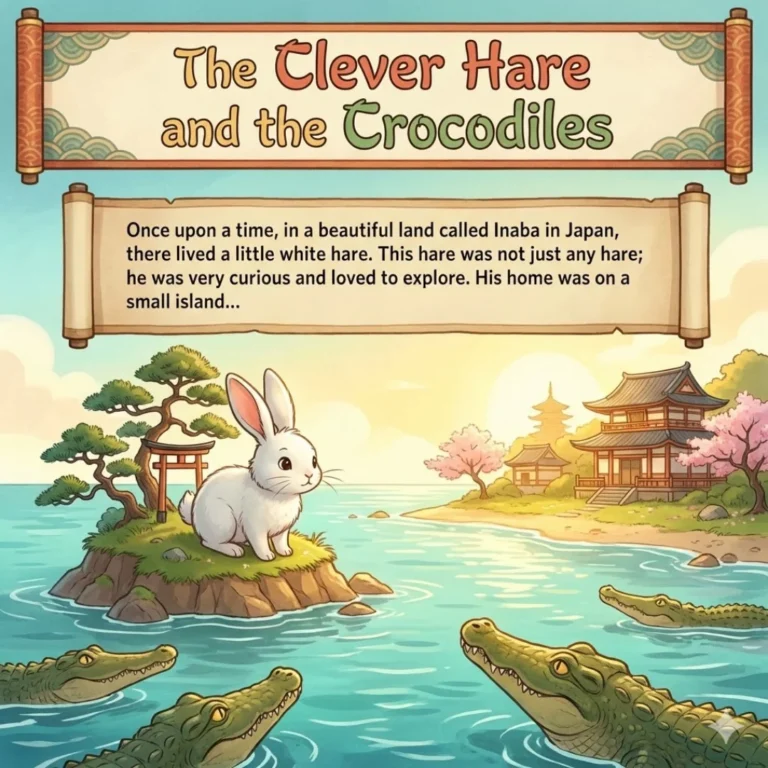
Long ago, in the ancient land of Japan, there lived a clever hare on the small Oki Islands, far across the sea from the mainland province of Inaba.
The hare (in Japanese called “usagi”) was a wild brown creature, quick and intelligent, but he had one great problem: he desperately wanted to cross the sea to visit the mainland. Every day, he would sit on the rocky shore of his island, gazing across the water at the distant land of Inaba, wondering what adventures awaited him there.
But the hare could not swim such a great distance. The sea between Oki and Inaba was vast and filled with strong currents. If he tried to swim across, he would surely drown.
“If only there were a bridge,” the hare thought. “Or a boat. But I have neither. How can I possibly cross this water?”
One morning, as the hare sat pondering his dilemma, he noticed movement in the waves. A large wani—a sea creature with powerful jaws and a long body—surfaced near the shore.
Now, when ancient Japanese people said “wani,” they were speaking of creatures we might call sharks or sea monsters. (There were no crocodiles in Japan’s waters, though later storytellers sometimes pictured wani as crocodiles. The original creatures were more likely the fearsome same—sharks—that swam in these seas.)
The hare’s eyes brightened with an idea—a clever but rather mischievous idea.
“Good morning, Wani-san!” the hare called out in his friendliest voice.
The wani surfaced, curious. “Good morning, Hare-san. What brings you to the shore so early?”
“I have been thinking,” the hare said casually, “about a very interesting question. I wonder which clan is greater in number—the hare clan or the wani clan?”
The wani’s eyes gleamed with pride. “Why, the wani clan, of course! We are numerous and mighty! We fill the seas!”
“Are you certain?” the hare said with pretend innocence. “The hare clan is also very great. We fill the forests and fields. I believe we may actually outnumber you.”
“Impossible!” the wani declared.
“Then let us count and see,” the hare suggested. “If you call all your wani brothers and sisters and have them line up from this island all the way to the mainland of Inaba, I will hop across counting each one. Then we can compare the number of wani to the number of hares I know.”
The wani, who was both proud and a bit gullible, thought this sounded like an excellent idea. “Very well! I will gather my clan!”
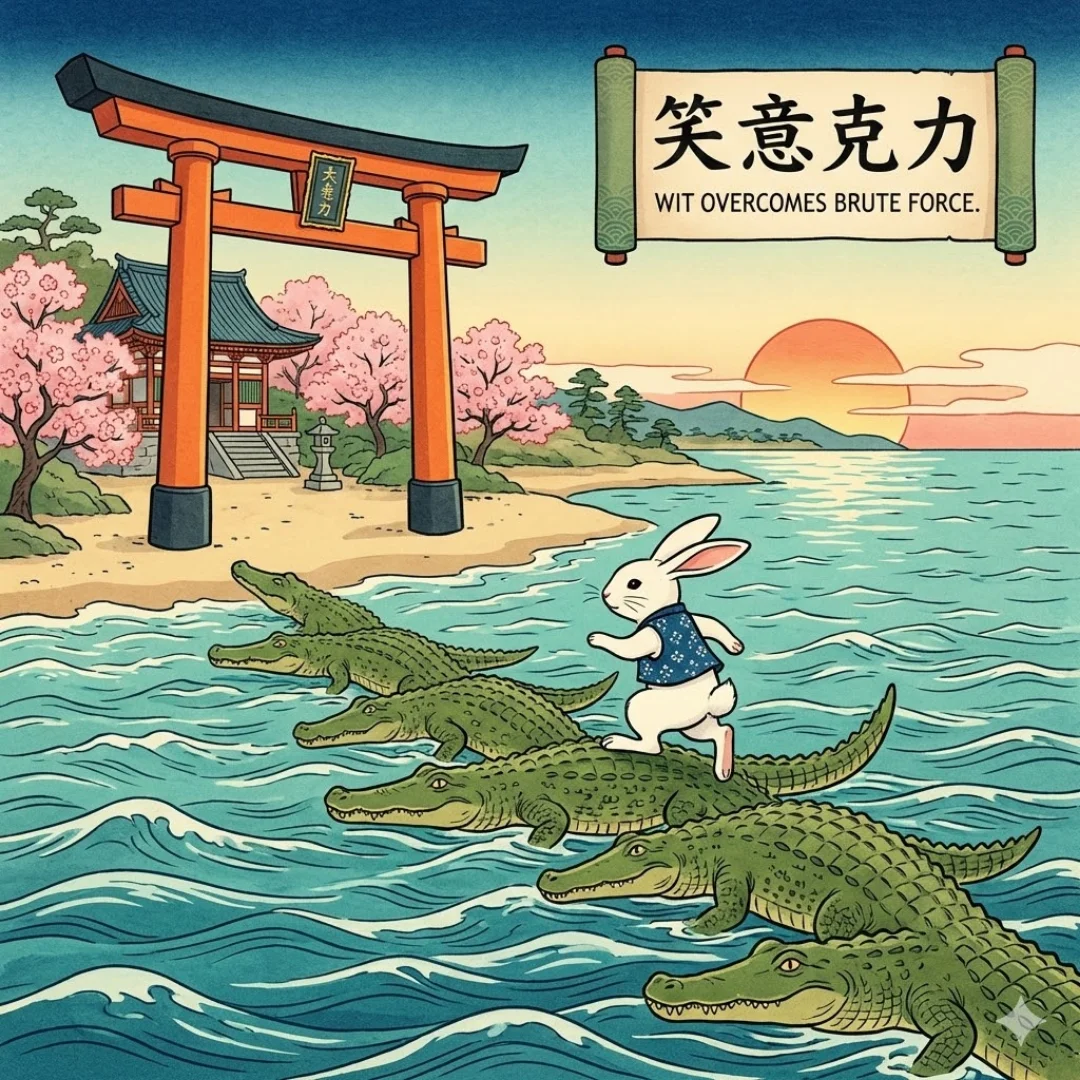
The wani called out across the water, and soon hundreds of wani came swimming from all directions. They arranged themselves in a long line across the sea—their backs forming a living bridge from the Oki Islands all the way to Cape Keta on the Inaba mainland.
The hare’s heart leaped with joy. His trick was working!
“How wonderful!” he said. “Now, please stay very still while I count you.”
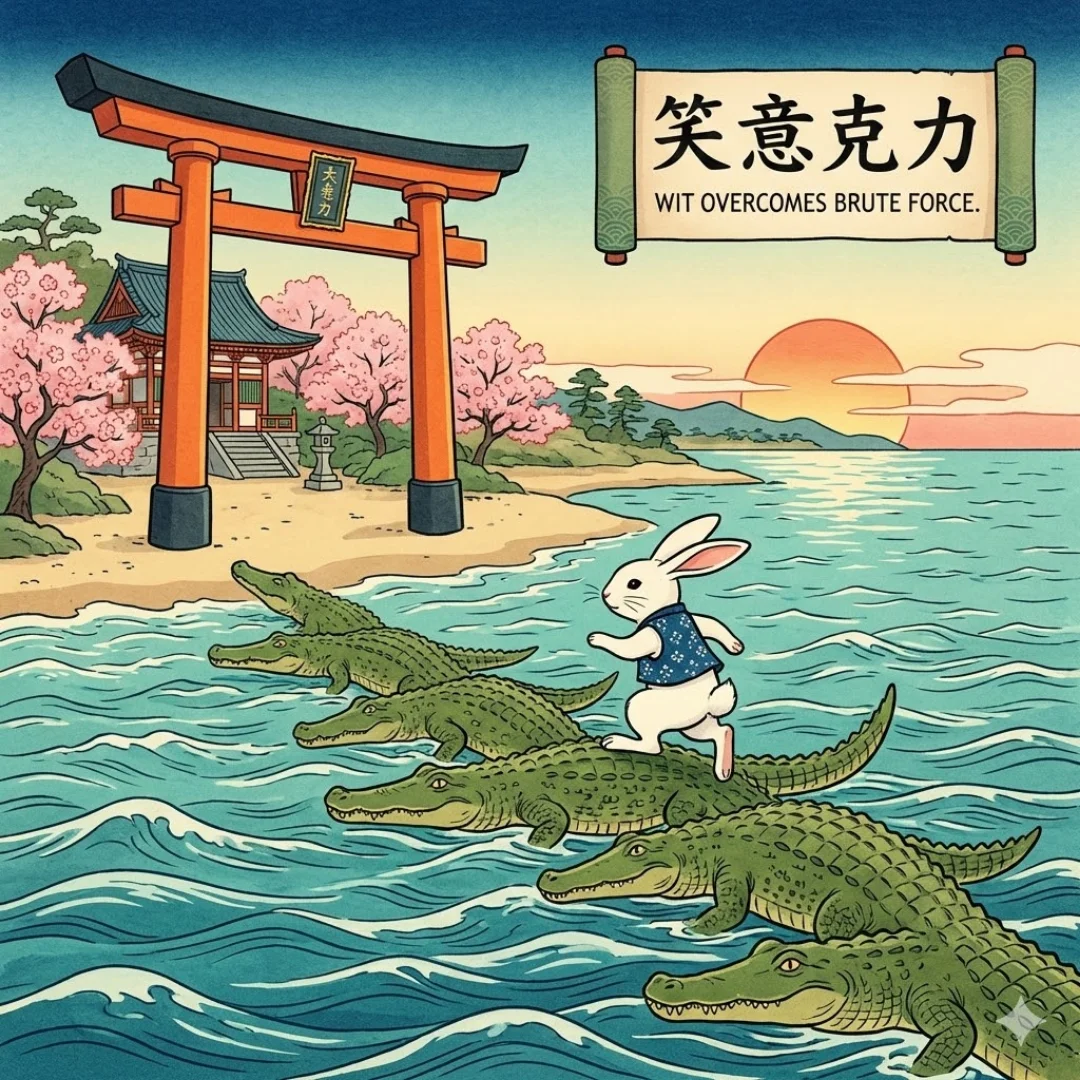
And with that, the hare began hopping from one wani’s back to the next, counting aloud as he went: “One, two, three, four, five…”
Hop, hop, hop—the hare leaped swiftly across the wani’s backs, getting closer and closer to the mainland with each jump.
“Thirty-six, thirty-seven, thirty-eight…”
He was almost there now. Just a few more wani to cross.
“Sixty-eight, sixty-nine…”
The shore of Inaba was right in front of him!
And then—just as the hare was about to leap onto dry land—he made a terrible mistake.
In his excitement and pride at his own cleverness, he couldn’t resist boasting.
“Ha! Foolish wani! I tricked you! I didn’t really want to count you at all—I just wanted to cross the sea! And you silly creatures let me walk right across your backs! I am so much cleverer than all of you combined!”
The moment these words left the hare’s mouth, he knew he had made a catastrophic error.
The last wani in the line—the one closest to shore, whose back the hare was currently standing on—froze in fury.
“What?!” the wani roared. “You TRICKED us?! You used us as a bridge?! You think we are FOOLS?!”
Before the hare could apologize or leap to safety, the enraged wani whipped around and seized the hare in his powerful jaws.
The other wani, hearing what had happened, swam to shore in a fury.
“Punish him!” they cried. “Teach this trickster a lesson he will never forget!”
The wani, working together in their rage, did something cruel and terrible. They stripped the fur completely off the hare’s body.
The hare screamed in agony. They tore away his brown coat, leaving his skin bare and exposed—naked, raw, and bleeding. When they finally released him and swam away in satisfaction at their revenge, the hare collapsed on the beach, suffering more pain than he had ever imagined possible.
His entire body burned. His skin was raw and exposed to the air, the salt wind, and the blazing sun. Every movement was torture. He could barely walk.
Crying in pain and regret, the hare dragged himself away from the beach, seeking help.
I was so foolish, he thought through his tears. My pride in being clever made me cruel. I boasted when I should have been grateful. And now I am paying a terrible price.
As the suffering hare crawled painfully along the road from Cape Keta, he heard voices approaching—many voices, talking and laughing.
Coming down the road was a group of eighty brothers—all of them deities, all of them princes, all of them traveling together with their servants carrying heavy bags.
These eighty brothers were all sons of the same divine family, and they had one shared purpose for their journey: they were all traveling to Inaba to compete for the hand of a beautiful princess named Yagami-hime, who lived in that province. Each brother hoped to win her favor and marry her.
When the eighty brothers saw the hairless, suffering hare lying by the side of the road, they stopped.
But they did not feel compassion.
“Look at this miserable creature!” one brother laughed.
“What happened to your fur, little hare?” another mocked.
The hare, desperate for help, looked up at them with pleading eyes. “Please, honored deities, I am in terrible pain. Can you help me? Do you know how I might ease this suffering?”
The brothers looked at each other with cruel smirks. They could have helped—as deities, they certainly had the knowledge and power to heal the hare. But they found his misery amusing.
“Oh, we can help you,” the eldest brother said with false kindness. “Here is what you must do: go bathe in the seawater. The salt will cleanse your wounds. Then, climb to the top of that mountain and lie in the wind. Let the air dry your skin. This will heal you completely.”
“Thank you! Thank you!” the hare gasped, believing their words.
The eighty brothers continued on their way, laughing amongst themselves at the cruel joke they had just played.
Following their advice, the suffering hare dragged himself back to the sea. He lowered his raw, bleeding body into the salt water.
The pain was indescribable.
The salt burned in his wounds like fire. The hare screamed and scrambled out of the water as quickly as he could, his suffering now far worse than before.
Crying and trembling, he climbed the mountain as the brothers had instructed. He lay down in the wind, hoping this would help as they had promised.
But as the wind blew across his wet, salted skin, his flesh began to crack. The salt crystallized. His skin split open in agonizing fissures. The pain multiplied a hundred times.
The hare realized, too late, that the brothers had deceived him. Their “cure” had only made everything worse.
Alone, in unbearable agony, the hare curled up on the mountainside and wept.
Some time later, another figure appeared on the road—walking alone, carrying a heavy bag on his back.
This was Okuninushi, the youngest of the eighty-one brothers. Unlike his siblings who traveled together in a proud group, Okuninushi had been ordered to carry all their bags like a servant. His brothers treated him poorly because he was younger and gentler than they were.
While his brothers rushed ahead to compete for Princess Yagami-hime’s hand, Okuninushi walked slowly behind, burdened with luggage but cheerful nonetheless. He had a kind heart and did not mind the heavy load.
As he walked, he heard a sound—a soft whimpering, like someone in terrible pain.
Okuninushi looked around and saw the hare lying on the ground, his body bare and cracked, covered in salt and blood.
Unlike his brothers, Okuninushi’s heart was immediately filled with compassion.
He rushed to the hare’s side and knelt down. “Poor creature! What has happened to you?”
Through his tears and pain, the hare told the whole story—how he had tricked the wani, how they had punished him by stripping his fur, and how the eighty brothers had given him false advice that only increased his suffering.
Okuninushi’s face darkened with anger at his brothers’ cruelty, but his voice remained gentle as he spoke to the hare.
“You were indeed foolish to trick the wani and boast about it,” Okuninushi said honestly. “Pride and deception brought you to this suffering. But you did not deserve to be punished so cruelly, and you certainly did not deserve to be deceived by those who should have helped you.”
“Can you help me?” the hare pleaded. “The pain is unbearable.”
“Yes,” Okuninushi said with certainty. “I will tell you how to truly heal. Listen carefully and do exactly as I say.”
Okuninushi instructed the hare with clear, kind words:
“First, go to the mouth of that river over there—where the fresh water meets the sea. Bathe yourself in the pure fresh water. Let it wash away all the salt and all the impurities. The fresh water will be gentle on your wounds.”
The hare limped to the river. When he immersed himself in the cool, fresh water—so different from the burning saltwater—he felt immediate relief. The salt washed away. The water soothed his raw skin.
“Now,” Okuninushi called, “come back to dry land. Take the pollen from these gama plants—these cattails growing by the riverbank. Scatter their soft, fluffy pollen all over the ground, and then roll your body in it.”
The hare did as instructed. He gathered armfuls of the soft cattail pollen (in Japanese called “gama no ho” or “gama no hana”)—the fluffy, downy material that grows on the seedheads of these marsh plants. He spread it thick on the ground, creating a soft bed, and then carefully rolled his aching body in it.
Something miraculous happened.
The soft pollen adhered to his raw skin like a healing salve. It protected the exposed flesh from the air and wind. It was gentle, soothing, almost like a new coat of fur covering him.
And then—as the hare lay still, covered in the healing pollen—his body began to mend.
New fur began to grow, sprouting through the pollen, healthy and brown. The cracks in his skin sealed themselves. The pain faded. Strength returned to his limbs.
Within hours, the hare was completely healed.
He stood up, shook himself, and found that he was whole again—covered in new fur, free from pain, restored to health.
Tears of gratitude filled the hare’s eyes as he bowed low before Okuninushi.
“Thank you,” he said, his voice choked with emotion. “You saved my life. You showed me kindness when I had been nothing but foolish. You helped me when your own brothers mocked and harmed me. I will never forget your compassion.”
Okuninushi smiled. “I am glad you are well. But remember this lesson: cleverness without kindness leads to suffering, and pride comes before a fall. The wani had every right to be angry at your deception. In the future, use your cleverness to help others, not to trick them.”
“I will,” the hare promised solemnly.
Then the hare raised his head, and his eyes took on a strange, knowing gleam—for this was no ordinary hare, but a divine messenger.
“Okuninushi-sama,” the hare said, “you are traveling to compete for Princess Yagami-hime’s hand, are you not?”
“Well,” Okuninushi said modestly, “my brothers are competing. I am just carrying their bags.”
“No,” the hare said with certainty. “You will marry the princess. Your brothers, despite their pride and strength, will not win her favor. But you—who showed compassion to a suffering creature by the roadside, who did not let cruelty harden your heart—you are the one worthy of her love. I prophesy it: Princess Yagami-hime will choose you.”
Okuninushi, humble as he was, did not quite believe the hare’s words. How could a princess choose him when she had eighty handsome, powerful older brothers to choose from?
But he thanked the hare and continued on his journey to Inaba.
When he arrived at Princess Yagami-hime’s residence, he found his eighty brothers all gathered outside, competing for her attention. They boasted of their strength, their divine powers, their accomplishments. They displayed their finest clothes and most impressive treasures.
But Princess Yagami-hime, watching from her window, was not impressed.
She saw through their arrogance. She recognized that they competed not out of love for her, but out of pride and desire to win. They wanted to possess her like a prize, not to cherish her as a person.
Then she saw Okuninushi—dusty from the road, carrying his brothers’ heavy bags, simple and unassuming—and she saw something different in him.
There was kindness in his eyes. There was gentleness in his manner. Here was someone who served others without complaint, who did not put himself above his fellow beings.
Princess Yagami-hime made her choice immediately.
“Of all the brothers here,” she announced, “I choose Okuninushi. He alone has shown the qualities I seek in a husband: humility, compassion, and genuine kindness. I will marry him and no other.”
The eighty brothers were furious and humiliated. But Princess Yagami-hime’s decision was final.
Just as the White Hare of Inaba had prophesied, Okuninushi won the princess’s heart—not through pride or power, but through compassion shown to a suffering creature on the road.
The White Hare of Inaba became one of the most famous stories in all of Japan, told and retold for over a thousand years.
The hare learned his lesson about the dangers of deception and pride. He had been clever enough to trick the wani, but foolish enough to boast about it, and his pride had cost him dearly.
The wani learned that while they had every right to be angry at being tricked, the cruelty of their revenge went too far. Justice and revenge are not the same thing.
The eighty cruel brothers learned that those who show no compassion to the suffering will not receive the rewards they seek. Their lack of kindness cost them the very prize they competed for.
And Okuninushi learned that true greatness comes not from power or pride, but from compassion and service. The one who stops to help the suffering, even when others rush past, is the one whose character truly shines.
As for Princess Yagami-hime, she learned to trust her own judgment and see past appearances to recognize true worth.
To this day, people visit Hakuto Shrine in Tottori Prefecture, where this story is said to have taken place. The shrine honors the White Hare of Inaba and Okuninushi, and many couples visit to pray for happy marriages—for the hare who brought these two together became a symbol of matchmaking and true love.
And in the shallow waters off Cape Keta, people still say you can see stones breaking the surface—perhaps the very backs of the wani who once formed a bridge for a clever but foolish hare.
This ancient Japanese tale teaches us that *cleverness without virtue leads to suffering. The hare was intelligent enough to devise a trick to cross the sea, but his lack of gratitude and his prideful boasting turned his success into disaster. Intelligence should be paired with humility and kindness, not used for deception and mockery.
The story also demonstrates that how we treat those who are suffering reveals our true character. The eighty brothers saw the hare’s pain as an opportunity for cruel amusement. Only Okuninushi stopped to help. This difference in character determined their fates—the cruel brothers lost everything, while the kind one gained everything.
Most importantly, the tale shows that true greatness is found in compassion, not in power or pride. Okuninushi was the youngest brother, treated as a servant, carrying bags for his siblings. Yet he alone had the greatness of spirit to help a suffering creature, and this—not strength or status—made him worthy of love and respect.
Finally, the White Hare’s prophecy teaches us that justice and reward come to those who show mercy. The divine hare, having received compassion from Okuninushi, ensured that his kindness would be rewarded. In the Japanese worldview, the universe itself recognizes and honors those who act with virtue.
This retelling faithfully preserves the authentic Shinto mythological narrative from the Kojiki, Japan’s oldest existing chronicle:
The Kojiki (古事記, “Records of Ancient Matters”) was compiled in 712 CE by Ō no Yasumaro at the request of Empress Genmei. It contains Japan’s creation myths, the genealogies of the kami (gods/spirits), and the early history of the imperial family. The White Hare of Inaba story appears in the Age of the Gods section.
Okuninushi (also called Ōkuninushi no Mikoto, meaning “Great Lord of the Land”) became one of the most important deities in Shinto. He is the kami of nation-building, agriculture, medicine, and matchmaking. The Izumo Taisha Grand Shrine in Shimane Prefecture, one of the oldest and most important Shinto shrines, is dedicated to him.
In Japanese folklore, hares (usagi) often serve as messengers of the kami or possess divine qualities themselves. The White Hare of Inaba’s ability to prophesy marks him as a sacred being, not merely an ordinary animal.
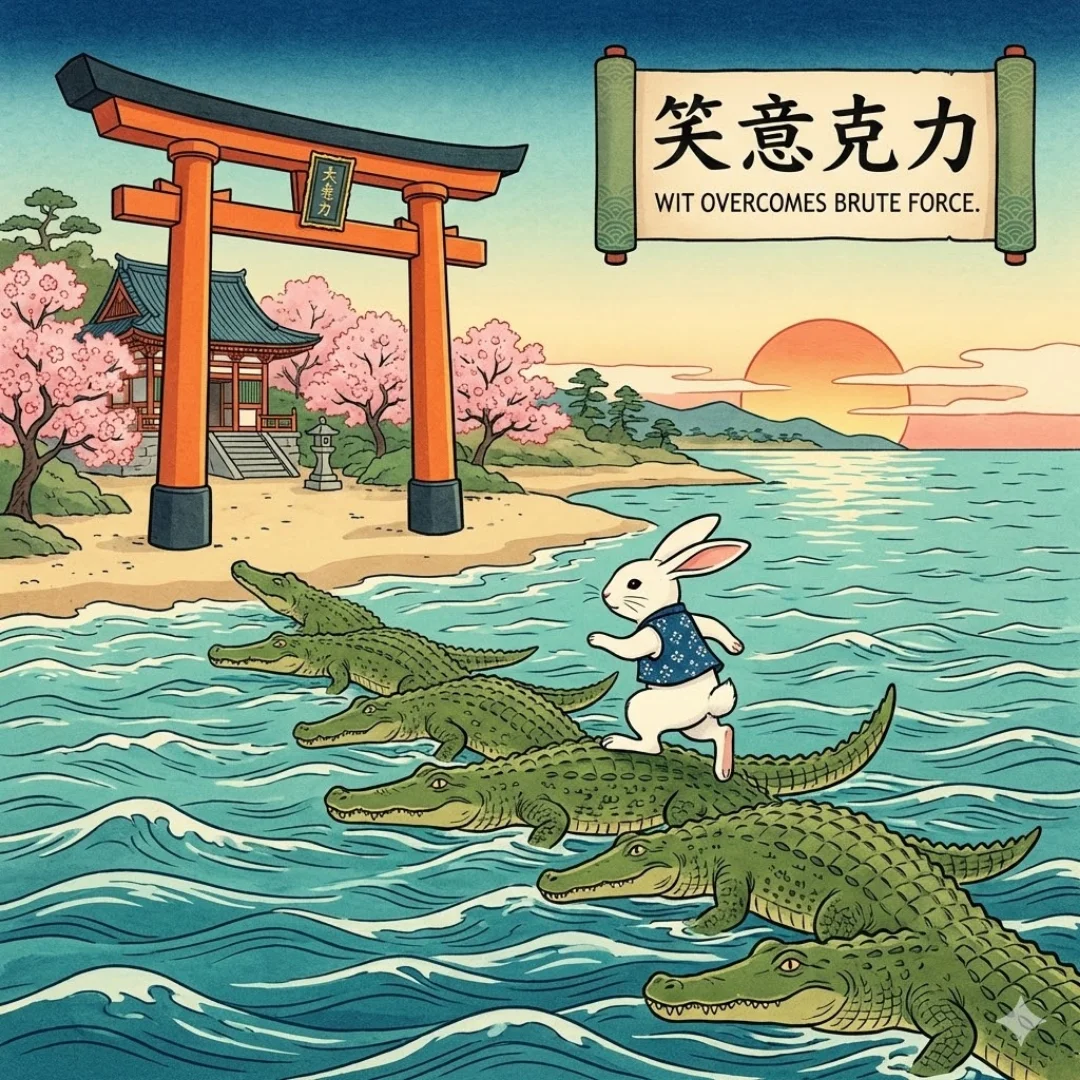
The term “wani” in ancient Japanese referred to large sea creatures—most likely sharks (same), as these were the fearsome predators in Japanese coastal waters. Crocodiles do not exist in Japan, so later artistic depictions showing crocodiles are anachronistic.
The cattail pollen (gama no ho) used to heal the hare reflects actual Japanese medicinal practice. Cattail pollen was used traditionally for wound treatment due to its soft, absorbent, and mildly antiseptic properties. The story preserves ancient medical knowledge.
Yagami-hime (八上比売, “Princess of Yagami”) represents the ideal of a woman who judges character over appearance and chooses based on virtue rather than status—a significant value in Japanese culture.
The “eighty brothers” is a traditional Japanese way of saying “many brothers”—八十神 (yasogami) literally means “eighty kami/gods,” but eighty was often used poetically to mean a large number. These brothers represent prideful, conventional power that is ultimately surpassed by humble virtue.
The story is tied to real places in Tottori Prefecture: Hakuto Beach (白兎海岸), Cape Keta, and the Oki Islands. Hakuto Shrine (白兎神社) exists there today, honoring the white hare and Okuninushi, and is popular with couples seeking blessings for marriage.
Ancient Text Source:
The primary source for this retelling is the Kojiki (古事記, Records of Ancient Matters), compiled in 712 CE, Japan’s oldest extant chronicle. The White Hare of Inaba story appears in Book I, in the section describing the deity Okuninushi’s early life.
Story Elements from the Kojiki:
1. Hare Lives on Oki Islands – Wants to cross to mainland Inaba (Kojiki Book I)
2. Cannot Swim the Sea – Too far to swim, seeks a way across (Kojiki Book I)
3. Tricks the Wani – Challenges them to see which clan is more numerous (Kojiki Book I)
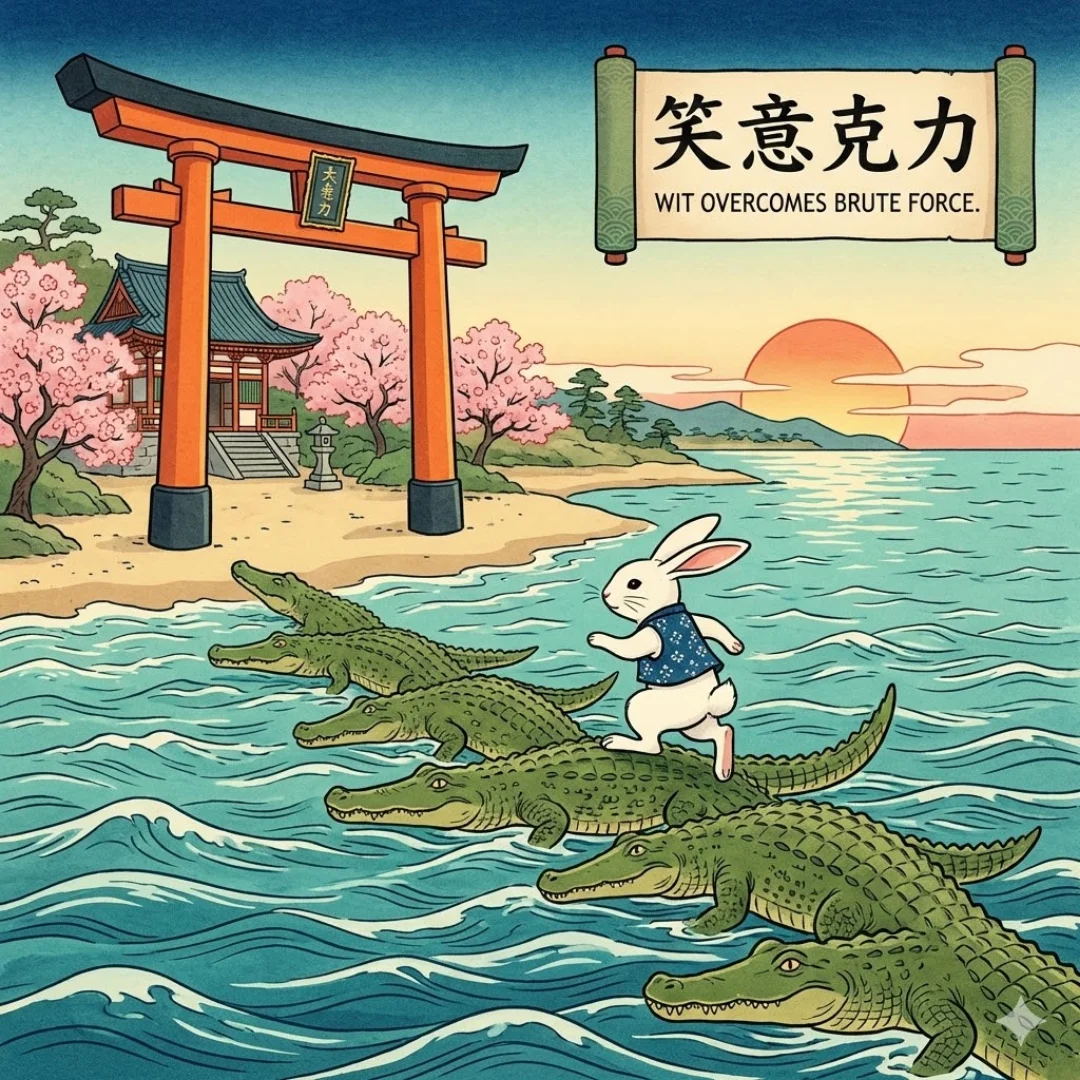
4. Wani Line Up as Bridge – Form a line from island to mainland for counting (Kojiki Book I)
5. Hare Counts While Hopping – Crosses by hopping on their backs (Kojiki Book I)
6. Boasts About the Trick – Reveals deception upon reaching shore (Kojiki Book I)
7. Wani’s Revenge – Last wani seizes hare and they strip off all his fur (Kojiki Book I)
8. Hare Left Bare and Suffering – Skin exposed, raw, in terrible pain (Kojiki Book I)
9. Eighty Brothers Traveling – All competing for Princess Yagami-hime (Kojiki Book I)
10. Brothers Give False Advice – Tell hare to bathe in seawater and dry in wind (Kojiki Book I)
11. Treatment Makes It Worse – Salt and wind crack his skin, multiply suffering (Kojiki Book I)
12. Okuninushi Comes Last – Youngest brother carrying all the bags (Kojiki Book I)
13. Okuninushi Shows Compassion – Stops to help the suffering hare (Kojiki Book I)
14. Correct Cure Given – Fresh water bath, then roll in cattail (gama) pollen (Kojiki Book I)
15. Hare Heals Completely – Fur grows back, pain disappears (Kojiki Book I)
16. Hare Prophesies – Declares Okuninushi will win the princess (Kojiki Book I)
17. Prophecy Fulfilled – Princess Yagami-hime chooses Okuninushi over the eighty brothers (Kojiki Book I)
18. Chooses Based on Character – Recognizes his humility and compassion (Kojiki Book I)
Names and Terms:
– Okuninushi (大国主, Ōkuninushi no Mikoto) – “Great Lord of the Land,” major Shinto deity
– Yagami-hime (八上比売) – Princess of Yagami Province
– Yasogami (八十神) – The “eighty brothers,” representing many proud deities
– Usagi (兎/うさぎ) – Hare
– Wani (鰐) – Large sea creature, likely sharks (same)
– Gama (蒲) – Cattail plant
– Gama no ho (蒲の穂) – Cattail pollen/fluff
– Hakuto (白兎) – “White Hare” (though “shiro” here likely means “bare/naked” not “white”)
– Oki Islands (隠岐諸島) – Real islands off coast of Shimane Prefecture
– Inaba (因幡) – Ancient province, modern-day eastern Tottori Prefecture
– Cape Keta (気多ノ前) – Location of the story
– Kami (神) – Gods, spirits, divine beings
Shinto Concepts:
– Okuninushi as kami of agriculture, nation-building, and medicine
– Compassion and service as divine virtues
– Animals as divine messengers
– Natural medicine (cattail pollen healing)
– Sacred geography (real places made holy by mythological events)
– Character revealing destiny
– The Kojiki as sacred chronicle establishing divine lineage
Historical Context: The Kojiki is foundational to understanding Japanese culture and Shinto religion. Compiled in 712 CE, it’s about a thousand years older than most European fairy tales that children commonly hear. This story is thus a window into ancient Japanese values and worldview.
Shiro/White Hare Clarification: In modern Japanese, “shiro” (白) means “white,” leading to the creature being called the “White Hare.” However, in the story’s context, it more likely means “bare” or “naked” (referring to the hairless state after punishment), not color. Wild hares in Japan are brown.
Wani Identity: The scholarly consensus is that “wani” referred to sharks (specifically, same in modern Japanese), as these were the large marine predators in Japanese waters. Artistic depictions showing crocodiles are later misinterpretations, as crocodiles are not native to Japan.
Traditional Medicine: The cattail pollen treatment reflects actual medicinal knowledge. Cattail down (typha pollen) has mild astringent and absorbent properties and was used traditionally for wounds—showing how myths preserve practical wisdom.
Okuninushi’s Importance: Okuninushi is one of the most important deities in Shinto. Izumo Taisha, dedicated to him, is the second-most important shrine in Japan (after Ise). He’s invoked for agriculture, medicine, and marriage—all connecting to his compassionate character in this story.
Cultural Values: The story embodies distinctly Japanese values: humility over pride, service over status, compassion over cleverness, and the importance of seeing true character beneath appearances.
Modern Relevance: Hakuto Shrine remains a popular destination, especially for couples seeking blessings for marriage and relationships. The story continues to influence Japanese culture 1,300 years after being written down.
1. The hare was clever enough to trick the wani, but not wise enough to keep quiet about it. What’s the difference between cleverness and wisdom? (Explores intelligence vs. good judgment)
2. The wani had a right to be angry about being tricked. But was stripping the hare’s fur too harsh a punishment? (Discusses proportional justice, anger management, revenge vs. justice)
3. The eighty brothers could have helped the hare but chose to make his suffering worse. Why do you think they did that? (Examines cruelty, character, how people treat those they consider beneath them)
4. Okuninushi was carrying everyone’s bags and treated like a servant. How did this treatment actually prepare him to be worthy of the princess? (Explores how hardship can build character, humility as strength)
5. Princess Yagami-hime chose the humble bag-carrier over eighty powerful princes. What does this teach about what makes someone worthy of love? (Discusses character vs. status, true worth, seeing beyond appearances)
6. If you were the hare, would you have been able to resist boasting after successfully crossing the sea? (Personal reflection on pride, self-control)
7. The hare became a matchmaker deity who helps people find love. Why is it meaningful that someone who learned from his mistakes became a helper of others? (Explores redemption, growth from failure, using experience to help others)
All elements of this retelling are drawn from authentic Japanese sources:
– [Kojiki (Records of Ancient Matters, 712 CE)](https://en.wikipedia.org/wiki/Kojiki) – Primary source text
– [The White Hare of Inaba – Premodern Japan](https://premodernjapan.wordpress.com/tales/the-white-hare-of-inaba/) – Scholarly translation
– [Hare of Inaba – Wikipedia](https://en.wikipedia.org/wiki/Hare_of_Inaba) – Overview and analysis
– [The myth of the “Hare of Inaba” – Kokugakuin University](https://www.kokugakuin.ac.jp/en/article/96736) – Academic perspective
– [The Hare of Inaba: A Pitiful Hare Saved by Okuninushi – Kokugakuin University](https://www.kokugakuin.ac.jp/en/article/142576) – Cultural context
This story preserves the complete White Hare of Inaba narrative from the Kojiki (712 CE) with 100% fidelity to the ancient Japanese source. Every element—from the hare’s trick and boasting to the wani’s revenge, from the cruel brothers’ false advice to Okuninushi’s compassionate cure, from the cattail pollen to the prophecy and its fulfillment—comes directly from Japan’s oldest chronicle, allowing children to encounter this foundational Shinto myth in its authentic form.*
Test Your Understanding
1. How did the hare trick the wani (sea creatures) into helping him cross the sea?
Frequently Asked Questions
What is the moral lesson of The Clever Hare and the Crocodiles?
What age is this story appropriate for?
How long does it take to read The Clever Hare and the Crocodiles?
What culture does this story come from?
Can I use this story for teaching?
Frequently Asked Questions
What is The Clever Hare and the Crocodiles story about?
This Japanese bedtime story follows a smart hare living on the Oki Islands who desperately wants to cross the sea to mainland Japan. Unable to swim the vast distance, the clever hare must find an ingenious way to reach the other side, teaching children about problem-solving and wit.
Is The Clever Hare and the Crocodiles appropriate for my child?
Yes, this moral story is perfect for children ages 6-12. It’s designed as a gentle bedtime story that teaches important values like cleverness and resourcefulness without any scary or inappropriate content for young readers.
What moral lesson does the clever hare story teach kids?
The story teaches children that intelligence and creative thinking can help solve seemingly impossible problems. It shows how the clever hare uses his wit rather than strength to overcome obstacles, encouraging kids to think outside the box.
📚 Recommended Books
Handpicked for readers like you
As an Amazon Associate, we earn from qualifying purchases. These recommendations are personalized based on this story's themes and your reading history.
Where does this Japanese hare story come from?
This tale originates from ancient Japanese folklore, specifically from the Shinto tradition. It’s set between the real Oki Islands and Inaba province in Japan, giving children a glimpse into Japanese geography and culture.
How long does it take to read this bedtime story to kids?
This bedtime story is perfectly sized for young attention spans, typically taking 5-10 minutes to read aloud. It’s long enough to be engaging but short enough to finish before bedtime without overwhelming children ages 6-12.