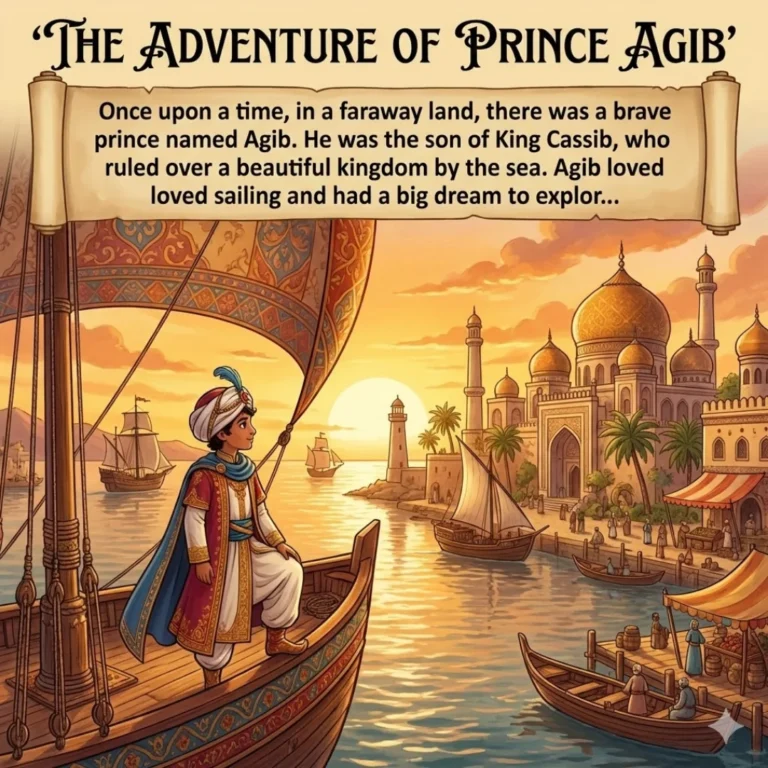
This moral story for children ages 6-12 combines entertainment with important values.
In the great city of Baghdad, during the golden age of the Caliphs, there lived a young prince named Agib, son of King Cassib. From the windows of his father’s palace, Agib could see the mighty Tigris River flowing toward distant seas, and his heart yearned for adventure beyond the horizons.
Unlike many princes who were content with palace life, Agib loved to visit the harbors and listen to merchants tell tales of far-off lands—of islands where trees grew pearls instead of fruit, of cities built entirely of brass, of seas where fish sang like nightingales. Each tale fed the fire of wanderlust in his young heart.
“Father,” Agib said one day to King Cassib, “grant me permission to outfit a fleet of ships and sail forth to trade with distant lands. Let me bring glory and riches to our kingdom!”
King Cassib was reluctant. “My son, the sea is treacherous. Many who sail forth never return. Stay here in safety, and one day this kingdom will be yours.”
But Agib persisted with such passion and promising words that finally his father relented. “Very well, my son. But take with you the finest captains and sailors, the best ships our gold can buy, and the blessings of Allah to protect you.”
And so Prince Agib outfitted ten great ships, each laden with precious goods for trade: silks and spices, pearls and perfumes, gold and silver. He gathered a company of fifty merchants, all eager for profit, and hired the most experienced sea-captains in all Baghdad.
On the appointed day, with his father’s blessing and his mother’s tears upon his cheeks, Prince Agib set sail. The ships departed down the Tigris, their sails billowing white as doves’ wings, and soon they reached the great sea.
For many days, the voyage was blessed. They stopped at many islands and ports, trading their goods for profit. Agib proved himself a shrewd merchant and a fair leader. His sailors loved him, for he treated them with respect/” title=”More stories about respect”>respect and shared generously from his profits.
But one night, as they sailed far from any known land, a terrible storm arose. The sky turned black as ink. Lightning cracked the heavens. Waves rose like mountains and crashed upon the ships with the anger of djinn. The wind howled and tore at the sails.
“Strike the sails!” the captain shouted. “Or the wind will snap the masts like twigs!”
The sailors fought the storm through the long, terrible night. When dawn finally came, the sea calmed—but the ships found themselves in waters unknown to any chart or map.
The old pilot, who had sailed these seas for forty years, climbed to the highest mast and looked at the sun and stars. When he descended, his face was pale with fear.
“My prince,” he said, his voice trembling, “the storm has driven us far off course. We have entered the waters of the Loadstone Mountain. May Allah have mercy on us all.”
“What is this Loadstone Mountain?” Agib asked.
The pilot’s face grew even paler. “It is a mountain of black iron that draws all ships to their doom. Its power is so great that it pulls the very nails from a ship’s timbers. Any vessel that comes near is drawn helplessly toward the mountain, where the rocks tear it apart. The sea around it is filled with the bones of a thousand ships, and no one who has gone there has ever returned to tell the tale.”
Even as he spoke, the sailors noticed something strange. The ships were moving—not from wind or current, but as if pulled by invisible ropes. They were drifting steadily in one direction, no matter how they set their sails.
“There!” a sailor cried, pointing. “The Loadstone Mountain!”
On the horizon rose a monstrous black mountain, its iron flanks gleaming dully in the sun. As they drew closer, they could see the wrecks of countless ships scattered around its base like toys cast aside by a giant child.
“Turn the ships!” Agib commanded. “Steer away!”
But it was useless. The mountain’s magnetic force was too strong. Closer and closer they were pulled, helpless as leaves in a whirlpool.
Then a terrible groaning sound filled the air. One by one, the iron nails were being pulled from the timbers of the ships! The planks began to separate. Water poured in through the growing gaps.
“The ships are coming apart!” the merchants cried in terror. “We’re doomed!”
The sailors dove into the water, trying to swim away, but most were dragged down by the weight of their clothes. The ten beautiful ships, which had cost King Cassib so much gold, were torn to splinters against the black mountain.
Prince Agib, who was a strong swimmer, fought the waves with all his might. As his ship broke apart around him, he grabbed a piece of timber and used it to stay afloat. The mountain’s pull was so strong that even the iron nails were flying through the air like arrows, and one struck the pilot who had served them faithfully, killing him instantly.
For hours, Agib struggled in the water. All around him, he saw his companions drowning, pulled down by the hungry sea. He prayed to Allah for strength and mercy, and his prayers were answered. A current caught him and carried him away from the mountain’s deadly pull.
Finally, exhausted almost to death, he was washed up on a rocky shore at the base of the mountain. He dragged himself above the waterline and collapsed, more dead than alive.
When he awoke, the sun was setting. He sat up and looked around. He was entirely alone—the only survivor of all ten ships and all their crews. His fine robes were in tatters. His body was bruised and cut. He had lost everything: his ships, his wealth, his companions.
Weeping with grief and exhaustion, Agib climbed higher on the mountainside, seeking shelter for the night. As he climbed, he noticed something strange—a stairway carved into the iron mountain, leading upward.
“Perhaps there is help above,” he thought. “Or perhaps there are people who live on this cursed mountain.”
He climbed the stairs as the last light faded from the sky. At the top of the mountain, he found something wondrous—a domed building made entirely of brass, gleaming in the moonlight. Its door stood open, as if inviting him in.
Inside, he found a chamber with a great brass dome overhead. In the very center of the chamber stood a brass horse with a rider—both made of the same shining metal. The rider held a brass lance pointed downward, and engraved upon his chest were mysterious words in ancient script.
Agib was about to examine these writings when a door opened, and an old hermit entered, carrying a lamp.
“Welcome, Prince Agib,” the hermit said. “I have been expecting you.”
“You know my name?” Agib asked in wonder. “How is this possible?”
“It is written that a prince would come here on this very night,” the hermit explained. “Long ago, a great king built this brass statue to protect this mountain. The magnetic power of the mountain was placed here by ancient sorcerers to guard a great treasure. But it has caused too much suffering. Every year, ships are destroyed here.”
The hermit led Agib to the inscriptions on the brass rider’s chest. “It is written here that only a prince of royal blood can break the curse. If you can remove this brass rider from his horse and throw him into the sea below, the magnetic power will be broken. Ships will sail these waters safely again.”
Agib looked at the statue. It seemed firmly fixed in place. But he thought of all the sailors who had drowned, of the pilot who had died trying to save them, of the ships that would be destroyed in the future if nothing changed.
“I will do it,” he declared. “Tell me what I must do.”
The hermit instructed him in prayers and rituals. For three days, Agib fasted and prayed. On the third day, at sunrise, he approached the brass horse. Placing his hands on the rider, he pulled with all his strength.
At first, nothing happened. Then, with a great creaking sound, the rider began to move. The brass groaned. The very mountain seemed to shake. With one final effort, Agib wrenched the rider free and carried it to the edge of the cliff.
“For all those who died here,” he said, “and for all who might die in the future, I break this curse!” And he hurled the brass rider far out to sea.
It fell for a long moment, glinting in the sunlight, before it struck the water with a tremendous splash. Immediately, the magnetic force ceased. The mountain stopped pulling at iron. The curse was broken.
But Agib’s triumph was short-lived. When he turned around, he saw that the brass dome was collapsing! The hermit had vanished. The mountain itself was shaking as if in an earthquake.
Agib ran for his life down the stairs. Behind him, the brass building collapsed in ruins. He reached the shore just as a huge wave rose up—not from the magnetic force this time, but from the sea itself, as if in gratitude for being freed from the curse.
The wave caught Agib and carried him far across the water. For days he floated, clinging to a piece of driftwood, until at last another wave cast him up on a beautiful island covered with fruit trees and sweet springs.
There he was found by woodcutters who took him to their city. Through many further adventures (which are another story entirely), Prince Agib eventually made his way home to Baghdad, to the joy of his father King Cassib.
But Agib never forgot the lesson he learned at the Loadstone Mountain. He had set out seeking riches and glory, but he had lost everything. Yet in losing everything, he had found something more valuable: the knowledge that true nobility lies not in wealth or conquest, but in courage to face adversity and the willingness to sacrifice for the greater good.
And sailors still bless the name of Prince Agib, for after he broke the curse, ships could sail safely through those waters. The Loadstone Mountain still stands, they say, but its deadly power is gone forever, broken by a prince who gave up everything to save others from the fate that had befallen him.
Moral Lessons
- True nobility is shown not in seeking glory, but in having the courage to face adversity and sacrifice for others. Sometimes we must lose everything to discover what truly matters.
Test Your Understanding
1. Why did Prince Agib want to sail away from Baghdad?
Frequently Asked Questions
What is the moral lesson of The Adventure of Prince Agib?
What age is this story appropriate for?
How long does it take to read The Adventure of Prince Agib?
What culture does this story come from?
Can I use this story for teaching?
Frequently Asked Questions
What is The Adventure of Prince Agib about?
This story follows Prince Agib of Baghdad, a young prince who dreams of sailing to distant lands for adventure and trade. Against his father King Cassib’s wishes, he sets out on a sea voyage that promises to teach valuable lessons about courage, determination, and growing up.
Is this a good bedtime story for kids?
Yes! This moral story is specifically designed for children ages 6-12 and makes an excellent bedtime story. It combines exciting adventure with important values, has an engaging Arabian setting, and is the perfect length to capture young imaginations before sleep.
What moral lessons does this story teach children?
Prince Agib’s adventure teaches kids about following their dreams, showing courage in the face of uncertainty, and the importance of respectful persistence when pursuing goals. It also explores the loving tension between protective parents and adventurous children seeking independence.
📚 Recommended Books
Handpicked for readers like you
As an Amazon Associate, we earn from qualifying purchases. These recommendations are personalized based on this story's themes and your reading history.
Where does this Prince Agib story come from?
This tale is rooted in Middle Eastern storytelling traditions, set in historical Baghdad during the golden age of the Caliphs. It draws from the rich Arabian narrative heritage that gave us classics like the Arabian Nights, bringing authentic cultural wisdom to modern children.
How old should children be to understand this educational story?
This story is perfect for kids ages 6-12. Younger children will enjoy the adventure and colorful setting, while older kids can better grasp the deeper themes about parent-child relationships, courage, and making important life decisions through respectful dialogue.