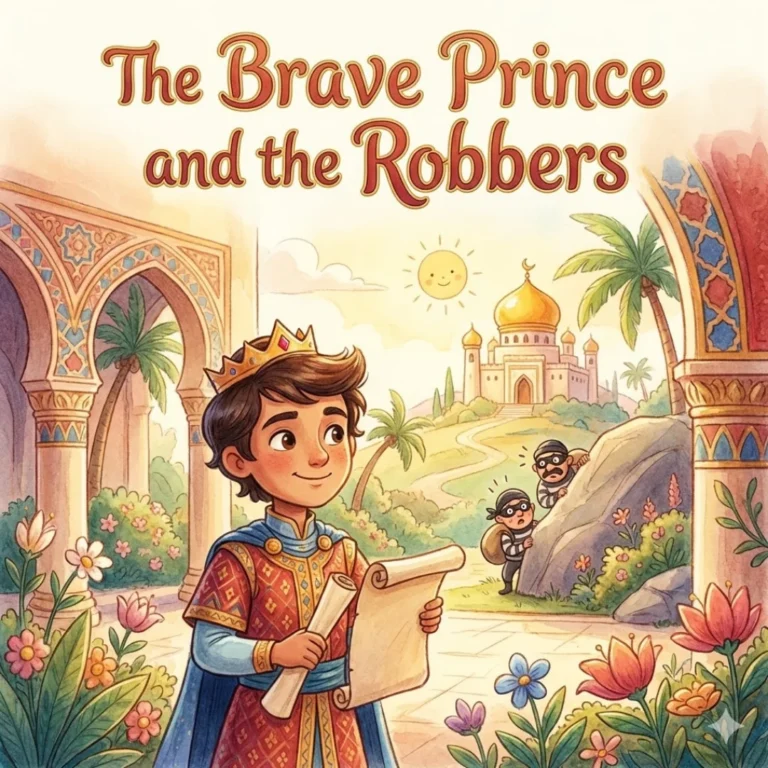
This moral story for children ages 6-12 combines entertainment with important values.
Long ago, in a prosperous city of Persia, there lived two brothers whose lives had taken very different paths. The elder brother, Cassim, had married the daughter of a wealthy merchant and now lived in a grand house filled with servants and fine possessions. The younger brother, Ali Baba, had married a poor woman and earned his living by cutting firewood in the forest and selling it in the city market.
Though brothers, they rarely spoke. Cassim was embarrassed by Ali Baba’s poverty, while Ali Baba simply accepted his humble lot and worked hard each day to feed his small family.
One fateful morning would change everything.
**The Secret of the Cave**
Ali Baba had taken his three donkeys deep into the forest to gather wood. As he worked near a rocky hillside, he heard the thunder of approaching hooves. Forty horsemen were riding toward him at great speed!
Ali Baba was frightened. These were clearly not ordinary travelers. He quickly climbed a tall tree and hid among the thick branches, watching with wide eyes as the riders gathered before a sheer rock face.
The leader of the band, a fierce-looking man with a curved sword at his side, dismounted and approached the stone wall. In a loud voice, he called out:
“Open, Sesame!”
To Ali Baba’s astonishment, the rock face split apart, revealing the entrance to a vast cave. The forty men entered with their horses, laden with heavy sacks that clinked with the sound of gold. The rock closed behind them.
Ali Baba hardly dared to breathe. These must be thieves – a notorious band that had terrorized caravans and villages for years! The cave was their secret hideout, and those sacks contained their stolen loot!
After some time, the rock opened again and the thieves emerged. “Close, Sesame!” the captain commanded, and the stone sealed itself once more, showing no trace of an opening.
When the robbers had galloped away, Ali Baba climbed down from his tree. His heart was pounding, but curiosity overcame fear. He approached the rock face and, in a trembling voice, spoke the magic words:
“Open, Sesame!”
The rock obeyed him as it had obeyed the thieves.
Inside, Ali Baba found treasures beyond imagination. Gold coins were piled in mountains. Silks and carpets, jewels and precious metals filled the cavern from floor to ceiling. The thieves had been collecting their plunder for generations!
Ali Baba was an honest man. He did not wish to become a thief himself. But surely, he reasoned, taking a small portion from criminals was not truly stealing? His family was hungry, his children needed clothes, and this wealth was ill-gotten anyway.
He loaded his three donkeys with as many gold coins as they could carry – a mere fraction of the cave’s contents – and hurried home.
When he poured the gold onto the floor of his humble house, his wife could hardly believe her eyes.
“Where did this come from?” she gasped. “Husband, what have you done?”
Ali Baba told her everything. “We must keep this secret absolutely,” he warned. “If the thieves discover someone knows about their cave, our lives will be in danger.”
But keeping such a secret was harder than it seemed.
**Cassim’s Greed**
Ali Baba’s wife needed to measure the gold to know how much they had. She went to borrow a measuring cup from Cassim’s wife, who grew curious about why her poor sister-in-law needed to measure anything at all.
Cassim’s wife was cunning. She stuck a piece of wax to the bottom of the measuring cup. When the cup was returned, a gold coin was stuck to the wax!
“Brother!” Cassim stormed into Ali Baba’s house. “You have been hiding wealth from your own family! Where does a poor woodcutter get gold?”
Ali Baba, who had always loved his brother despite everything, foolishly told him about the cave. Cassim’s eyes lit up with greed.
The very next morning, Cassim took ten mules to carry away as much treasure as possible. He found the rock, spoke the magic words, and entered the cave.
But once inside, surrounded by more wealth than he had ever imagined, Cassim’s mind went blank with greed. He stuffed his bags, loaded his mules, and then realized he could not remember the magic words to open the door!
“Open, Wheat!” he cried. Nothing happened.
“Open, Barley! Open, Corn! Open, Rye!”
He tried every grain he could think of, but none was right. The sesame seed – smallest and most humble of all – had been forgotten.
When the forty thieves returned, they found Cassim trapped inside with their gold. Their justice was swift and terrible. They killed him and cut his body into four pieces, hanging them inside the cave as a warning to any other intruder.
**Morgiana’s Cleverness**
When Cassim did not return, his wife went to Ali Baba in tears. Ali Baba, though grieved by his brother’s fate, ventured to the cave and recovered Cassim’s remains for proper burial.
But how could they bury a man cut into four pieces without arousing suspicion?
Here the story introduces its true hero: Morgiana, a slave girl in Cassim’s household. Morgiana was not born a slave – she had been captured as a child during a raid on her village. But unlike many in her situation, she had kept her sharp mind and fierce spirit.
“I have a plan,” Morgiana told Ali Baba. “Leave everything to me.”
She went to an old cobbler named Baba Mustafa, blindfolded him, and led him through winding streets to Cassim’s house. There, she had him sew Cassim’s body back together so it could be properly washed and buried. She paid him well and warned him to keep silent.
The thieves, returning to their cave, discovered that someone had taken Cassim’s body. This meant someone else knew about the cave! They decided they must find and kill this person before he could reveal their secret.
The captain sent one of his men into the city to gather information. By luck and cunning, the thief found Baba Mustafa and, through bribery, convinced the cobbler to lead him – blindfolded, as before – to the house where he had done his strange sewing.
The thief marked the door with white chalk so his companions could find it. But Morgiana, ever watchful, noticed the mark. She immediately went out and marked every other door on the street with the same chalk symbol!
When the thieves came to attack, they found fifty identical marks and could not determine which house was their target. The captain was furious and had the failed spy executed.
A second thief tried the same approach, marking the door with red chalk. Again, Morgiana copied the mark onto every door in the neighborhood. The second thief met the same fate as the first.
Now the captain decided to handle matters himself. He memorized the house’s location without leaving any mark. Then he devised a cunning plan.
**The Oil Jars**
The captain disguised himself as an oil merchant. He filled thirty-seven large oil jars with his remaining thirty-seven thieves, each man armed with a dagger. Only one jar actually contained oil. He loaded the jars onto mules and went to Ali Baba’s house (for Ali Baba had moved into Cassim’s home after his brother’s death).
“Good sir,” the captain said to Ali Baba, “I am a merchant come to sell oil at tomorrow’s market. But I have arrived too late to find lodging. Might I stable my mules in your courtyard and sleep in your home tonight?”
Ali Baba, who was generous by nature, welcomed the stranger warmly. He had no idea that death was hiding in the jars in his own courtyard.
Late that night, Morgiana needed oil for her cooking. She went to the courtyard to take some from the merchant’s jars.
As she approached the first jar, she heard a voice whisper from inside: “Is it time?”
Any ordinary servant would have screamed and fled. But Morgiana was extraordinary. Without missing a beat, she whispered back: “Not yet, but soon.”
She moved to each jar in turn, and from each came the same whispered question. She answered each the same way. Only the last jar actually contained oil.
Morgiana now understood everything. The “merchant” was the captain of the thieves, and his men were hidden in the jars, waiting to murder the household as they slept!
She did not panic. She did not run to her master. Instead, she heated an enormous cauldron of oil until it was boiling and poured it into each jar, killing the hidden thieves instantly and silently.
Then she hid and waited.
At midnight, the captain came down to the courtyard and whispered to his jars: “Come out!” When no one emerged, he lifted the lids and found his entire band destroyed.
He fled into the night, vowing revenge.
**The Dance of Death**
Morgiana told Ali Baba everything the next morning. Ali Baba was horrified at how close he had come to death and eternally grateful to the brave girl who had saved his family.
But the captain was still alive and still dangerous.
Months passed. The captain returned to the city in a new disguise, this time as a wealthy merchant. He cultivated a friendship with Ali Baba’s son, eventually receiving an invitation to dine at Ali Baba’s house.
Morgiana recognized him the moment he entered, despite his disguise. She noticed that he refused to eat any food with salt in it – a sign, in Middle Eastern custom, that he did not wish to be bound by the obligations of shared hospitality. He planned to kill Ali Baba and did not want to break the sacred bond of salt.
Morgiana said nothing but prepared her own plan.
After dinner, she asked permission to perform a traditional dance for the guest. Ali Baba, proud of her many talents, agreed.
Morgiana danced beautifully, swirling and spinning in a costume that glittered with tiny bells. In her hand, she held a dagger, which was customary in certain dances. The “merchant” watched, unsuspecting.
At the climax of the dance, Morgiana plunged the dagger into the captain’s heart.
“What have you done?” Ali Baba cried in horror. “You have killed my son’s friend!”
“I have killed your enemy,” Morgiana replied calmly. She pulled open the dead man’s robe to reveal a hidden dagger. “This is the captain of the forty thieves. He came here tonight to murder you.”
The household searched the body and found it was true. Ali Baba fell to his knees before Morgiana.
“You have saved my life three times,” he said. “First with the chalk marks, then with the boiling oil, and now with your dance. How can I ever repay you?”
**A Just Reward**
Ali Baba immediately granted Morgiana her freedom. More than that – he asked if she would accept his son’s hand in marriage, raising her from slave to daughter of the house.
Morgiana, who had long admired Ali Baba’s son for his kindness and honesty, accepted.
Ali Baba returned to the cave one final time. With all the thieves dead, the treasure was now truly ownerless – or rather, it belonged to the many victims from whom it had been stolen.
Being a just man, Ali Baba used the wealth carefully. He found the families of those who had been robbed and returned what he could. He gave generously to the poor. He lived comfortably but not extravagantly, never forgetting his years of honest poverty.
He also guarded the secret of the cave carefully, teaching it only to his son and Morgiana. The magic words “Open, Sesame!” remained hidden from the world.
And in that household, Morgiana was honored above all others. The former slave had proven that courage, quick thinking, and loyalty were worth more than all the gold in a thousand caves.
**The Lessons of the Tale**
This famous story teaches many lessons. It shows that the humble and honest are often rewarded while the greedy, like Cassim, come to terrible ends. It demonstrates that quick thinking and cleverness can defeat brute strength and numbers. It celebrates loyalty and the bonds between master and servant that transcend social position.
Most of all, it gives us Morgiana – one of the greatest heroines in all of folklore. A slave girl, with no weapons but her wits and no power but her courage, defeats forty armed thieves and saves an entire family from destruction.
When we remember “Open, Sesame!” – which has become a universal phrase for magical passwords – let us also remember Morgiana, who taught us that the greatest treasures are not gold or jewels, but the virtues of courage, loyalty, and wisdom.
Moral Lessons
- Cleverness and virtue triumph over greed and violence. Those who help others will be helped in return. Quick thinking and loyalty are more valuable than brute strength. True treasure is found in courage and wisdom, not gold.
Test Your Understanding
1. What magic words opened the thieves’ cave?
Frequently Asked Questions
What is the moral lesson of The Brave Prince and the Robbers?
What age is this story appropriate for?
How long does it take to read The Brave Prince and the Robbers?
What culture does this story come from?
Can I use this story for teaching?
Frequently Asked Questions
What is The Brave Prince and the Robbers moral story about?
This moral story for children follows Ali Baba, a poor woodcutter who discovers a secret cave used by forty thieves. It’s a retelling of the classic Middle Eastern tale that teaches valuable lessons about honesty, courage, and the consequences of greed while entertaining young readers.
Is this bedtime story appropriate for kids ages 6-12?
Yes, this bedtime story is specifically designed for children ages 6-12. The content focuses on adventure and moral lessons without scary or inappropriate elements, making it perfect for bedtime reading while teaching important values through engaging storytelling.
What moral lessons will my children learn from this story?
Children will learn about the importance of hard work, honesty, and humility through Ali Baba’s character. The story also teaches about family relationships, the dangers of greed, and how good character matters more than wealth or social status.
📚 Recommended Books
Handpicked for readers like you
As an Amazon Associate, we earn from qualifying purchases. These recommendations are personalized based on this story's themes and your reading history.
Is this based on a traditional Persian tale?
Yes, this story is adapted from the famous Middle Eastern folk tale ‘Ali Baba and the Forty Thieves’ from One Thousand and One Nights. It’s been retold in a child-friendly way while preserving the cultural heritage and timeless wisdom of the original.
How long does it take to read this educational story?
This educational story for kids is designed to be read in about 10-15 minutes, making it ideal for bedtime or classroom reading. The length is perfect for holding children’s attention while delivering meaningful moral lessons and an exciting adventure.