

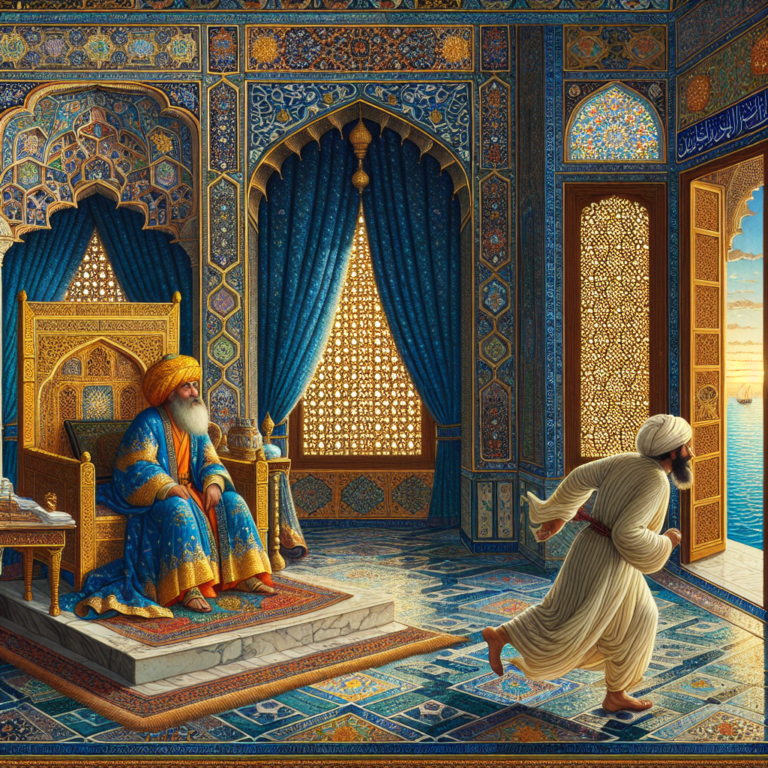
This moral story for children ages 6-12 combines entertainment with important values.
This is the tale told by the Young King of the Black Isles to the fisherman who discovered him, a story of love, betrayal, magic, and transformation that Scheherazade herself wove into her endless tapestry of tales.
In a land far from here, there once flourished a mighty kingdom called the Black Isles, named for the four islands of black stone, white stone, red stone, and yellow stone that formed its territory. Over this prosperous realm ruled a young king, beloved by his people, blessed with wealth and power, and married to his cousin, a princess of exceptional beauty.
The young king loved his wife with all his heart. He had chosen her as his bride from among many princesses, and he believed that she loved him equally in return. For the first five years of their marriage, they lived in perfect happiness, or so he thought.
But the young king did not know that his wife practiced dark magic—sorcery learned from an old woman who lived in the palace disguised as a servant. Nor did he know that his wife had taken a lover, a slave from the kitchens, and that she visited this man each night while her husband slept.
The king’s cousin, suspicious of the queen’s behavior, tried to warn him, but he refused to believe that his beloved wife could be false. “You are jealous of our happiness,” he told his cousin, and sent him away.
One night, however, the king decided to test his wife. He announced that he was going on a hunting expedition and would be gone for three days. He took his party and rode out of the city gates, but once out of sight, he returned secretly and hid himself in his own bedchamber.
At midnight, he watched in horror as his wife rose from their bed. She went to a small table where she kept perfumes and oils, took up a flask, and sprinkled its contents upon her husband, saying:
“Sleep, and stir not from this place until I return!”
Immediately, the king felt a strange heaviness come over him. Though his mind remained awake and aware, his body became as still as stone. He could not move or speak—he could only watch and listen.
His wife then adorned herself in her finest robes and jewels and left the palace. The king, trapped in his own paralyzed body, could do nothing. After what seemed like hours, she returned just before dawn, still wearing her finery. She sprinkled different water upon him and said:
“Arise from your enchantment!”
The spell broke, and the king could move again. He pretended to wake naturally, yawning and stretching as if he had slept peacefully all night. But rage and heartbreak burned in his chest.
The next night, he pretended to sleep again. Again, his wife enchanted him with her spell and left. This time, however, the king had prepared himself. Before sleeping, he had not drunk the wine she offered him—wine that would have sent him into a deep slumber. So when she spoke her spell, he had enough control to follow her secretly once she left.
He trailed his wife through the darkened streets of the city, through narrow alleys and hidden passages, until she came to the poorest quarter of the city. There, in a hovel that housed the sick and the slaves, she entered a small room.
The king crept close and peered through a crack in the door. What he saw made his blood run cold. His wife, the queen of the Black Isles, dressed in her royal jewels, was kneeling before a filthy slave who lay upon a ragged mat. The man was a kitchen worker—one of the lowest servants in the palace—and he was ill with leprosy and covered with sores.
“My lord, my love,” the queen whispered to this wretched man, “why do you not speak to me? Why do you not look at me? Three years I have visited you every night, and still you turn away from me!”
The slave groaned and replied in a weak voice: “As long as you remain married to the king, as long as you share his bed, I will not speak to you or love you. If you truly love me, you must be rid of him.”
The young king heard these words and understood their meaning. He returned quickly to the palace, lay down in his bed, and pretended to be still under the enchantment.
When his wife returned, she did not wake him as she usually did. Instead, she took up another flask—one that contained a more terrible spell—and poured it over him. As the liquid touched his skin, the king felt a horrible transformation begin.
His legs began to merge together, his skin became hard and scaly, and he could not move his lower body. The queen had transformed him into a creature that was half man, half fish—a merman unable to walk, confined forever to the palace.
“Now you are neither fully alive nor fully dead,” his wife said with cold satisfaction. “You will sit here forever, unable to move, unable to rule, while I go to my true love.”
She left him there, paralyzed and transformed, and went back to the slave’s hovel.
But though the king’s body was enchanted, his mind remained free. The next day, when his Grand Vizier came to the bedchamber and discovered what had happened, the king told him everything.
“You must help me,” the king said. “Follow the queen and discover where she goes.”


The Grand Vizier did as commanded. When he learned where the slave lived, he went there in secret and struck the slave with his sword, wounding him grievously but not killing him—for he knew that if the slave died suddenly, the queen’s rage would be terrible.
When the queen came that night and found her lover near death, she screamed with fury. She knew immediately that the king had discovered her secret and that someone from the palace had attacked her lover.
In her rage and grief, the queen unleashed a terrible curse upon the entire kingdom. She took up her magical herbs and potions and spoke words of dark sorcery. A great transformation swept across the land.
All the people of the Black Isles—the nobles and the merchants, the craftsmen and the farmers, the rich and the poor—were turned to stone. Some became black stone, some white, some red, some yellow, depending on their faith and virtue. Only the four islands themselves remained, now populated entirely by fish of four colors instead of human beings.
The queen kept her lover alive through her magic, preserving him in his hovel though he remained unable to speak or move. And she kept her husband alive as well, transformed into a half-man, half-fish, confined to a single room in the palace where he sat day after day, year after year, weeping for his lost kingdom and his cursed people.
Thus it remained for many years, until the day when a fisherman, fishing in the waters near the Black Isles, caught four fish of different colors and brought them to a king from a distant land. This king was curious about where such unusual fish came from, and he sent an expedition to find the Black Isles.
When the expedition arrived at the islands, they found only stone statues and empty palaces—until they discovered the young king in his chamber, sitting in a pool of water, his lower body that of a fish.
The young king told them his sad tale. The wise king who had come from the distant land listened carefully. “I will help you,” he said. “This injustice cannot stand.”
That night, the king from the distant land followed the queen to the slave’s hovel. After she left, he entered and, with one swift stroke of his sword, he killed the enchanted slave, ending his suffering at last.
He then dressed himself in the slave’s clothes and lay down in his place. When the queen came the next night with food and drink for her lover, she found what she thought was her beloved, but he spoke in a strange voice:
“Your curse upon your husband and his kingdom causes me great pain,” the disguised king said. “The suffering of so many innocent people disturbs my rest. If you truly love me, you must undo your spell and restore the kingdom.”
The queen, desperate to please the man she loved, agreed. She went immediately to the palace and sprinkled special water upon her husband, saying:
“By the power of my enchantment, I restore you to your true form!”
Immediately, the young king felt his legs separate, his skin become soft again, and his ability to walk return. He stood for the first time in years, tears of joy streaming down his face.
The queen then went throughout the islands, sprinkling her counter-spell upon the stones. All across the Black Isles, the stones transformed back into people—men and women who had been frozen for years suddenly could move and speak again. The four islands came back to life with the sounds of joy and celebration.
But when the queen returned to her lover’s hovel, she found not the slave she adored but the wise king from the distant land, holding a bloody sword.
“Your lover is dead,” he told her. “And now you must face justice for your crimes.”
The queen let out a terrible shriek and tried to speak words of magic to destroy him, but the young king had followed her. Before she could complete her spell, he drew his sword and struck off her head. Thus ended the treacherous queen who had brought such suffering to an entire kingdom.
The young king thanked the wise king from the distant land who had freed him and his people. “You have restored my kingdom and saved my people,” he said. “I owe you a debt I can never repay.”
“You owe me nothing,” the wise king replied. “I did only what was just and right. Now you must rule your people well and wisely, and never again be deceived by false love.”
The young king took this advice to heart. He ruled the Black Isles justly for many years, and he never married again, for his heart had been too deeply wounded by betrayal. But he ensured that his people lived in peace and prosperity, and the Black Isles became famous throughout the world for their wisdom and their king’s devotion to justice.
And Scheherazade, who told this tale to the Sultan, said: “See, O King, how a wife’s betrayal can destroy not just one man but an entire kingdom. Trust is the foundation of love, and when it is broken, the damage can spread like ripples across water, touching everyone.”
The Sultan listened and understood, and Scheherazade lived another day to tell another tale.
Moral Lessons
- Betrayal can have consequences far beyond the individuals involved. Justice, though delayed, will eventually prevail. Trust is sacred and should never be violated. Those who practice deceit and dark arts will ultimately be brought to account.
Test Your Understanding
1. What terrible secret did the young king discover about his wife when he pretended to sleep?
Frequently Asked Questions
What is the moral lesson of The Story of the Young King of the Black Isles?
What age is this story appropriate for?
How long does it take to read The Story of the Young King of the Black Isles?
What culture does this story come from?
Can I use this story for teaching?
Frequently Asked Questions
What is the Story of the Young King of the Black Isles about?
The Story of the Young King of the Black Isles is a classic tale from Arabian Nights about a young king who discovers his wife practices dark magic and has been unfaithful. It’s a story of love, betrayal, sorcery, and transformation, originally told by Scheherazade as part of her endless collection of tales.
What age group is the Young King of the Black Isles story suitable for?
This moral story is recommended for children ages 6 to 12. It combines entertaining fantasy elements like magic and kingdoms with important life values, making it a great read-aloud or independent reading choice for kids in that age range.
What moral lessons does the Young King of the Black Isles teach?
The story explores themes of trust, betrayal, and the consequences of blind love. It teaches children about the dangers of ignoring warning signs, the impact of deception, and how unchecked actions can harm others, all wrapped in an engaging magical adventure.
📚 Recommended Books
Handpicked for readers like you
As an Amazon Associate, we earn from qualifying purchases. These recommendations are personalized based on this story's themes and your reading history.
Where does the Story of the Young King of the Black Isles come from?
The story originates from One Thousand and One Nights, also known as Arabian Nights. It is one of the tales woven by the legendary storyteller Scheherazade, making it part of a rich tradition of Middle Eastern folklore passed down through centuries.
Why is the kingdom called the Black Isles in this story?
The kingdom is called the Black Isles because it is made up of four distinct islands, each formed from a different colored stone — black, white, red, and yellow. This unique geographical detail gives the prosperous realm its memorable and mysterious-sounding name.
