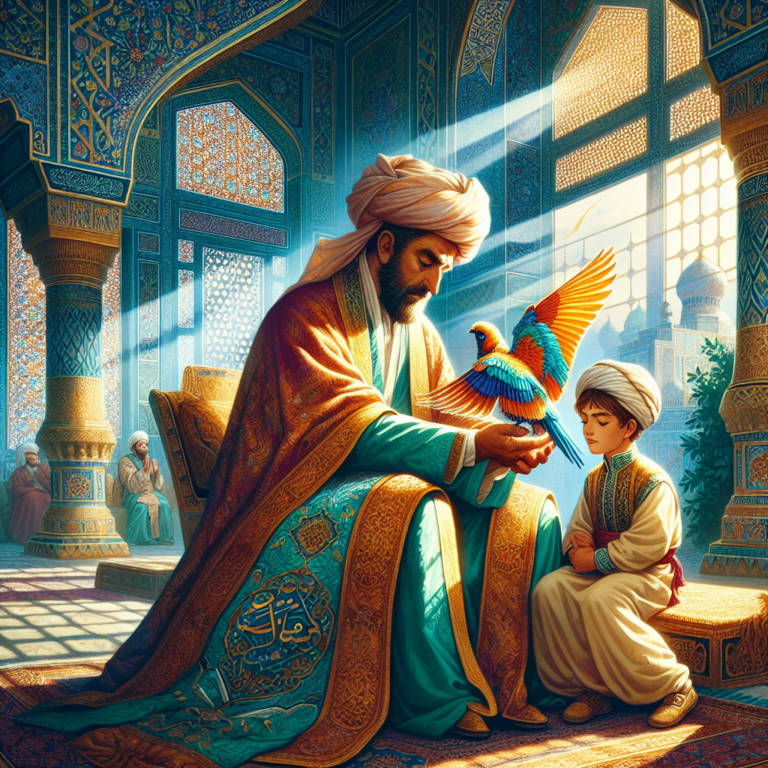
Share this engaging bedtime story with kids ages 6-12 to teach valuable life lessons.
In the magnificent city of Baghdad during the reign of Sultan Mahmoud, there lived three princes who were the pride of their father’s heart. The eldest, Prince Hussain, was strong and brave. The middle prince, Ali, was clever and quick-witted. And the youngest, Prince Ahmed, possessed something rare – an insatiable curiosity and deep love for learning that reminded many of the great scholars who filled Baghdad’s famed House of Wisdom.
One day, the Sultan summoned his three sons to his palace chambers. The afternoon sun streamed through intricate latticed windows, casting geometric patterns across the Persian carpets. The Sultan, a wise ruler who had always encouraged his sons to seek knowledge, had something important to share.
“My beloved sons,” he began, stroking his silver beard, “I have decided that it is time for you to venture out into the world beyond our palace walls. Too long have you lived in comfort and ease. A true prince must understand the vast world that Allah has created.”
The three princes bowed respectfully, their hearts quickening with excitement and anticipation.
“I want each of you,” the Sultan continued, “to travel to distant lands for one full year. During your journeys, seek out the most remarkable and wondrous object you can find – something that will benefit humanity, something that demonstrates the marvels of Allah’s creation and human ingenuity. When you return, you will present your discoveries, and through this, I will see which of you has truly opened your eyes to the wisdom of the world.”
The Sultan smiled at his youngest son. “Ahmed, my dear boy, I know you have always filled your hours reading the works of Ibn Sina, Al-Khwarizmi, and other great scholars in our library. Now you will see if the knowledge in books matches the wonders of the living world.”
Prince Ahmed’s eyes sparkled. “Father, I have read in the works of the travelers and geographers about lands beyond our realm where mountains touch the clouds and seas stretch to the edge of the world. The scholar Ibn Battuta wrote that traveling – in search of knowledge is an act of worship. I am eager to begin this journey.”
The next morning, after offering Fajr prayers at dawn, the three princes embraced their father and set out from Baghdad in different directions. Prince Hussain rode west toward the lands of Rum. Prince Ali headed east toward the kingdoms of Persia and India. Prince Ahmed, his saddlebags filled with a few belongings and several books, turned his horse south toward the ancient kingdoms of Yemen and beyond.
For weeks, Prince Ahmed traveled through changing landscapes. He crossed desert expanses where Bedouin tribes shared their tents and stories under stars so bright they seemed close enough to touch. He visited bustling market cities where merchants from as far as China and Andalusia traded silks, spices, precious gems, and, most precious to Ahmed, books and manuscripts.
In each place, Ahmed asked questions. He learned about the astrolabes used by navigators to map the stars, the clever irrigation systems that brought water to arid lands, the mathematical innovations that allowed architects to build soaring domes and minarets. But nothing he encountered seemed remarkable enough to present to his father.
One day, after months of travel, Ahmed arrived in a port city on the Arabian Sea. The marketplace there was unlike anything he had seen before – merchants from islands he had only read about in geography texts displayed goods from across the known world.
As Ahmed wandered through the covered bazaar, an elderly merchant with kind eyes called out to him. “Young traveler! You have the look of a scholar about you. Come, see what I have – treasures from lands where jinn and men once walked together.”
Intrigued, Ahmed approached the merchant’s stall. Among the carpets, perfumes, and jeweled daggers, one object caught his eye – a small telescope made of brass and fitted with carefully ground glass lenses that seemed to catch and hold the light in mysterious ways.
“Ah,” the merchant said, noticing Ahmed’s interest. “You have good eyes, young prince – yes, I can see you are of noble birth. This is no ordinary spyglass. It was crafted by a master of optics in a distant land, using the principles discovered by the great Ibn al-Haytham, who understood how light and vision work. But this particular instrument has something more – a touch of the miraculous.”
“What do you mean?” Ahmed asked, picking up the telescope carefully.
“Look through it,” the merchant invited. “But first, think of something or someone you wish to see, no matter how far away.”
Ahmed raised the telescope to his eye, thinking of his father in Baghdad, hundreds of miles away. Instantly, with perfect clarity, he saw the Sultan sitting in his favorite garden, reading a letter. Ahmed gasped and lowered the telescope, his heart racing.
“By Allah’s will,” Ahmed breathed. “This is indeed wondrous! How is such a thing possible?”
The elderly merchant smiled. “There are more mysteries in Allah’s creation than even our greatest scholars have yet discovered. Knowledge is infinite, and its pursuit is the highest calling. The Prophet, peace be upon him, told us that seeking knowledge is obligatory for every Muslim. This instrument embodies that pursuit – it allows the seeker to overcome distance, to see what would otherwise be hidden.”


Ahmed knew immediately that this was what he had been searching for. He purchased the telescope, paying a fair price from the gold his father had given him, and carefully wrapped it for the journey home.
As the year drew to a close, Ahmed began his return journey to Baghdad. The voyage back was long and not without hardships. His ship encountered fierce storms in the Arabian Sea. Bandits threatened his caravan in the desert. He fell ill with fever in a remote village and was nursed back to health by kind strangers who asked nothing in return.
Through each trial, Ahmed maintained what his teachers had called “sabr” – patient perseverance. He remembered a verse from the Quran that his father had taught him: “Indeed, Allah is with those who patiently persevere.” When he was sick, he was grateful for the healers’ knowledge of medicine. When storms threatened, he marveled at the sailors’ expertise in navigation. Every hardship became a lesson, every difficulty an opportunity to learn something new about human resilience and divine wisdom.
Finally, exactly one year after his departure, Prince Ahmed rode through the gates of Baghdad. The city had never looked more beautiful – its minarets rising toward heaven, the calls to prayer echoing across the rooftops, the scent of jasmine and orange blossoms filling the air.
At the palace, he found his brothers had also returned. Prince Hussain had brought an extraordinary flying carpet, woven by master craftsmen in a distant land, which could carry a person through the air to any destination. Prince Ali had acquired a magical apple from the gardens of an enchanted kingdom, which could cure any illness simply by inhaling its fragrance.
The Sultan received his sons in the great durbar hall, filled with courtiers and wise men. Each prince presented his discovery.
When it was Ahmed’s turn, he stepped forward holding the telescope. “Honorable father,” he said, bowing deeply, “I have brought an instrument that embodies the pursuit of knowledge – the highest calling of a Muslim. This telescope allows one to see across vast distances, to observe what would otherwise remain hidden. Our great scholar Ibn al-Haytham wrote treatises on optics, explaining how vision works, and this instrument applies that sacred knowledge.”
The Sultan took the telescope and looked through it, amazed at its power. “Remarkable! Tell me, my son, what did you learn on your journey beyond the object you acquired?”
Ahmed’s face brightened. “Father, I learned that the world is far vaster and more wondrous than any book can fully capture. I learned that knowledge exists in many forms – in the wisdom of Bedouin elders who navigate by stars, in the skills of craftsmen who create beauty with their hands, in the kindness of strangers who helped a sick traveler. I learned that seeking knowledge requires sabr – patience – and that every hardship on the path of learning is a teacher in itself.”
He continued, “I also learned that the greatest treasures are not gold or jewels, but understanding and wisdom. The Prophet Muhammad, peace be upon him, said that ‘The ink of a scholar is more sacred than the blood of a martyr.’ This journey helped me understand what that means – that learning, questioning, seeking to understand Allah’s creation – this is a form of worship and service.”
The Sultan’s eyes filled with pride. He looked at all three of his sons and their remarkable discoveries. “Each of you has brought something valuable. Hussain, your carpet could unite distant lands. Ali, your apple could save countless lives from disease. Ahmed, your telescope could expand human knowledge of the cosmos.”
Then the Sultan made his decision. “But Ahmed, you have brought something more than an object. You have brought the understanding that the journey itself – the seeking, the struggling, the learning – is as valuable as what we find. You have embodied the teaching of our faith that ‘the pursuit of knowledge is a path to Paradise.’”
Prince Ahmed bowed humbly. “Father, my brothers’ discoveries are equally worthy. Each represents a different kind of wisdom – Hussain’s courage to seek the impossible, Ali’s dedication to finding what heals, and my curiosity about how the world works. Together, we are stronger than any one of us alone.”
The Sultan nodded approvingly. “Spoken with true wisdom, my son. You have learned not just from your journey, but from your brothers as well.”
From that day forward, Prince Ahmed continued his pursuit of knowledge. He established a library in Baghdad, collecting manuscripts from across the Islamic world. He corresponded with scholars in Cordoba, Cairo, and beyond. He used his telescope to study the stars and planets, adding to the astronomical knowledge that Muslim scientists had been accumulating for centuries.
But Ahmed never forgot the lesson of his journey – that knowledge is not meant to be hoarded but shared, not pursued for pride but for the benefit of all humanity, and that the greatest wealth is not what we possess but what we understand and how we use that understanding to serve others.
Years later, when Ahmed himself became Sultan, he would often tell the story of his year-long journey to young scholars, always ending with the teaching of the Prophet: “Seek knowledge from the cradle to the grave, for seeking knowledge is obligatory upon every Muslim.” And he would add, with a smile, “The pursuit of knowledge is not just a duty – it is the greatest adventure a person can undertake.”
Moral Lessons
- The pursuit of knowledge and wisdom is more valuable than the pursuit of material wealth or power. True learning requires patience, perseverance through hardship, and humility – and its greatest purpose is to benefit all of humanity, not just oneself.
Test Your Understanding
1. What task did Sultan Mahmoud give to his three sons?
Frequently Asked Questions
What is the moral lesson of Prince Ahmed’s Quest for the Wisdom Feather?
What age is this story appropriate for?
How long does it take to read Prince Ahmed’s Quest for the Wisdom Feather?
What culture does this story come from?
Can I use this story for teaching?
Frequently Asked Questions
What is Prince Ahmed’s Quest for the Wisdom Feather about?
It’s a bedtime story set in ancient Baghdad about three princes sent by their father, Sultan Mahmoud, to explore the world. Prince Ahmed, the youngest, stands out for his love of learning. The story follows his quest for the Wisdom Feather while teaching kids valuable life lessons about knowledge, curiosity, and perseverance.
What age group is Prince Ahmed’s Quest for the Wisdom Feather suitable for?
This story is recommended for children ages 6 to 12. It uses engaging, accessible language perfect for bedtime reading, while weaving in meaningful moral lessons that resonate with kids in that age range.
What life lessons does this story teach children?
The story encourages a love of learning, curiosity, and the value of seeking knowledge. Through Prince Ahmed’s journey, kids learn that wisdom and understanding the world around them are more valuable than comfort or material wealth.
📚 Recommended Books
Handpicked for readers like you
As an Amazon Associate, we earn from qualifying purchases. These recommendations are personalized based on this story's themes and your reading history.
Is this a good bedtime story for kids who love adventure?
Absolutely! The story blends adventure and moral lessons in a rich, imaginative setting inspired by the golden age of Baghdad. Kids who enjoy quests, royal characters, and exciting journeys will find Prince Ahmed’s story both entertaining and inspiring at bedtime.
Why is the Wisdom Feather important in Prince Ahmed’s quest?
The Wisdom Feather represents the pursuit of knowledge and understanding — values central to Prince Ahmed’s character. His quest for it drives the story forward, symbolising that true wisdom must be earned through curiosity, effort, and real-world experience rather than simply inherited.