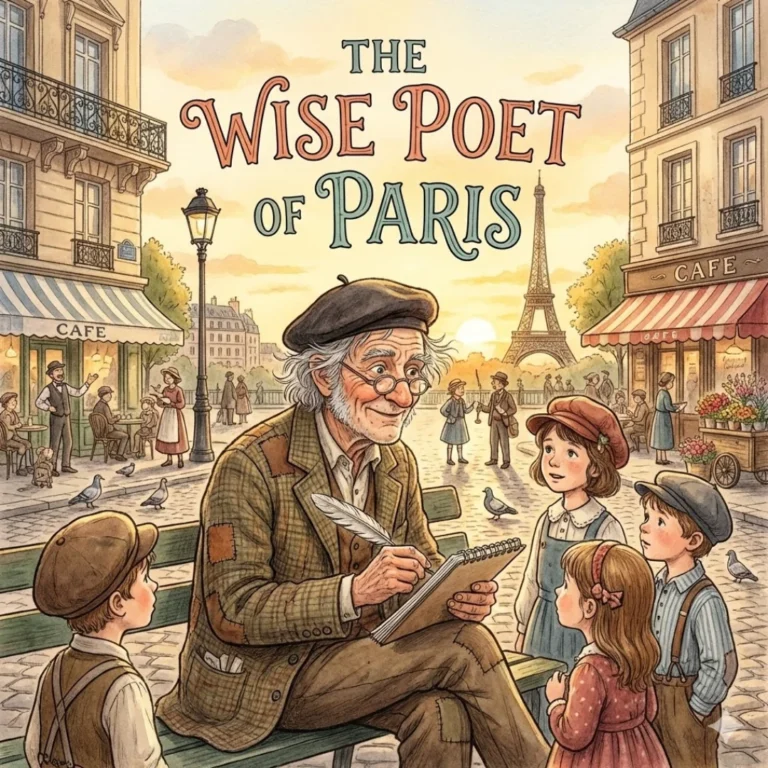
Share this engaging bedtime story with kids ages 6-12 to teach valuable life lessons.
Chapter One: The Poet Who Saw Differently
In the heart of Paris, where cobblestone streets wind past ancient buildings and the River Seine flows like a silver ribbon, there lived a remarkable man named Miguel. He was a poet, which means he used words the way a painter uses colors – to create beautiful pictures in people’s minds.
Miguel lived in a small apartment high above a bakery, and every morning he would open his window to breathe in the smell of fresh bread and watch the city wake up below. He had wild silver hair that never seemed to agree with his comb, round spectacles that perched on his nose like curious owls, and eyes that sparkled with a special kind of light – the light of someone who truly sees the world.
You see, most people look at things without really seeing them. They walk past a flower without noticing its colors, or pass a stranger without wondering about their story. But Miguel had trained himself to see differently. He called this special way of looking “The Pattern.”
“Everything in the world is connected,” Miguel would say to anyone who would listen. “Every person, every tree, every raindrop – we are all threads in the same great tapestry.”
Chapter Two: The Garden of Ideas
Every Sunday afternoon, Miguel would walk to the Luxembourg Gardens, a beautiful park where Parisians came to sit by the fountain, sail toy boats on the pond, and enjoy the shade of ancient chestnut trees. There, he would find a sunny bench and wait.
Soon, children would gather around him like curious sparrows, knowing that the silver-haired poet always had something wonderful to share.
“Tell us about The Pattern, Miguel!” called out a girl named Colette, her braids bouncing as she plopped down on the grass.
“Yes, please!” added her brother Pierre. “How does it work?”
Miguel smiled and pulled an orange from his pocket. “Look at this orange,” he said, holding it up so the sunlight made its skin glow like a small sun. “What do you see?”
“An orange!” the children laughed.
“Yes, but look deeper. This orange grew on a tree in Spain, watered by rain that fell from clouds, warmed by the same sun that warms your faces now. A farmer picked it with careful hands. A truck driver brought it across the mountains. A shopkeeper arranged it on a shelf. And now it sits in my hand, connecting me to all those people I will never meet.”
The children’s eyes grew wide as they began to understand.
“That is The Pattern,” Miguel continued. “We are all connected to each other through countless invisible threads. When we understand this, we begin to see that every person we meet matters.”
Chapter Three: The Face That Teaches
One rainy Tuesday, as Miguel sat in his favorite cafe writing poems, a young boy named Jean-Luc came and stood beside his table. The boy’s clothes were worn, and he looked hungry, but it was something in his eyes that caught Miguel’s attention – a mixture of hope and fear that told a thousand stories.
“Sir,” Jean-Luc said quietly, “I have nothing to offer, but I wondered if you might spare a bit of bread?”
Miguel looked up from his notebook and truly saw the boy – not just his shabby coat or his dirty face, but him. He saw Jean-Luc’s courage in approaching a stranger, his dignity in asking politely, and his trust that someone might be kind.
“Sit down, my friend,” Miguel said, pulling out a chair. “Let me tell you something important. When I look at your face, I see something that teaches me.”
Jean-Luc looked confused. “Teaches you? But I’m just a poor boy. What could I teach a wise poet?”
Miguel leaned forward. “When I truly see your face – really see it, not just glance at it – I am reminded that you are a person with thoughts and dreams and feelings just as real as my own. Your face calls out to me and says, ‘Here I am! I matter!’ And that call teaches me my most important lesson: I have a responsibility to care for others.”
He ordered a warm meal for Jean-Luc and another for himself, and they ate together like old friends.
Chapter Four: The Painting That Spoke
After lunch, Miguel took Jean-Luc to the Louvre, the great museum of Paris where masterpieces from around the world hung on the walls. They walked through hall after hall until they came to a painting that made Miguel stop.
It was a painting by El Greco, showing a man with a gentle face and kind eyes. The figure seemed to glow from within, as if light were shining from his very soul.
“This painting has taught me much,” Miguel said softly. “Look at his eyes, Jean-Luc. What do you see?”
Jean-Luc studied the painting carefully. “He looks… like he understands. Like he would forgive you no matter what you did wrong.”
“Exactly!” Miguel exclaimed. “The artist, El Greco, understood something precious. He knew that the highest wisdom is to see others with compassionate eyes, to forgive instead of condemn, to understand instead of judge.”
Jean-Luc thought about this. “Even when people are mean to me? Even when they chase me away from their shops or call me names?”
Miguel nodded gently. “Especially then. You see, when people are cruel, it is usually because they are hurting inside. Forgiveness is not saying that what they did was right. Forgiveness is freeing yourself from the weight of anger. It is like opening a cage door and letting a bird fly free.”
Chapter Five: The Gift That Grows
Days turned to weeks, and weeks turned to months. Jean-Luc began visiting Miguel every Sunday in the Luxembourg Gardens, joining the circle of children who gathered to hear the poet’s wisdom.
But something was changing. Jean-Luc wasn’t just listening anymore – he was beginning to see The Pattern himself.
One afternoon, he noticed an old woman struggling to carry her groceries up a steep hill. Without thinking, he ran to help her.
“Thank you, young man,” she said, surprised and grateful. “Most people just walk by.”
“We are all connected,” Jean-Luc replied with a smile. “Your groceries are heavy, but sharing the load makes them light.”
The old woman’s eyes filled with tears. “You speak like a poet.”
Another time, Jean-Luc saw a younger boy being teased by bullies in an alley. He remembered what Miguel had taught him about truly seeing others and walked over to the bullies.
“Look at his face,” Jean-Luc said calmly. “Really look. He is afraid. Is that what you want – to make someone afraid?”
The bullies, caught off guard by such a strange approach, looked at the smaller boy. For a moment, they really saw him – not as a target, but as a person. Mumbling awkwardly, they shuffled away.
Chapter Six: The Pattern Spreads
Years passed. Jean-Luc grew up and became a teacher himself. He taught his students about The Pattern, just as Miguel had taught him. And his students taught their friends and families, and they taught others still.
Miguel grew old, his silver hair turning white as snow, but his eyes never lost their sparkle. On his last Sunday in the Luxembourg Gardens, surrounded by generations of friends who had learned to see the world differently, he shared one final poem:
“Look at each face you meet today,
Really see what it has to say.
A call to kindness, a plea to care,
A reminder that love is meant to share.
We are not strangers, you and I,
Connected like stars across the sky.
The Pattern weaves us, every one,
A tapestry that is never done.
So open your eyes, open your heart,
Understanding is the wisest art.
When you truly see another’s face,
You find your own most sacred place.”
The city of Paris had changed. Oh, it still had its cobblestone streets and its silver river, its bakeries and its beautiful gardens. But now it was filled with people who really saw each other – who understood that every face they met was a teacher, calling them to kindness, reminding them that we are all threads in the same great tapestry.
And it all began with one wise poet who dared to see differently.
Moral Lessons
- Understanding and forgiveness can transform our lives and the lives of others. When we truly see the people around us – not just glance at them, but really see them – we discover that we are all connected and all worthy of kindness and compassion.
Test Your Understanding
1. What did Miguel call his special way of seeing the world?
2. What did Miguel teach using the example of an orange?
3. What important lesson did Miguel teach Jean-Luc about truly seeing another person’s face?
4. What did Miguel explain about forgiveness using the El Greco painting?
5. How did Jean-Luc stop the bullies from hurting the younger boy?
6. What is the main moral lesson of this story?
Frequently Asked Questions
What is the moral lesson of The Wise Poet of Paris?
What age is this story appropriate for?
How long does it take to read The Wise Poet of Paris?
What culture does this story come from?
Can I use this story for teaching?
Frequently Asked Questions
What is The Wise Poet of Paris bedtime story for kids about?
This is a heartwarming story about Miguel, a special poet who lives in Paris and has learned to see the world differently. He notices connections between everything around him through something he calls ‘The Pattern,’ teaching children the importance of truly observing and appreciating the world.
Who is Miguel in this story?
Miguel is a wise poet who lives in a small apartment above a bakery in Paris. He has wild silver hair, round spectacles, and sparkling eyes. Unlike most people who just look at things, Miguel has trained himself to truly see the world and notice how everything is connected.
What is ‘The Pattern’ that Miguel talks about?
The Pattern is Miguel’s special way of seeing the world. He believes everything is connected – every person, tree, and object has a relationship with everything else. It’s about paying attention and noticing details that most people miss when they’re rushing through life.
📚 Recommended Books
Handpicked for readers like you
As an Amazon Associate, we earn from qualifying purchases. These recommendations are personalized based on this story's themes and your reading history.
Is this moral story for children appropriate for bedtime?
Yes, this gentle story is perfect for ages 6-12 and bedtime reading. It’s peaceful and thoughtful, set in the beautiful city of Paris, without scary or intense moments. The story encourages children to be more observant and appreciative of their surroundings.
What life lesson does this story teach kids?
The story teaches children to slow down and truly see the world around them. Instead of rushing past flowers, people, and everyday moments, kids learn the value of being present, noticing details, and understanding that everything in life is beautifully connected.