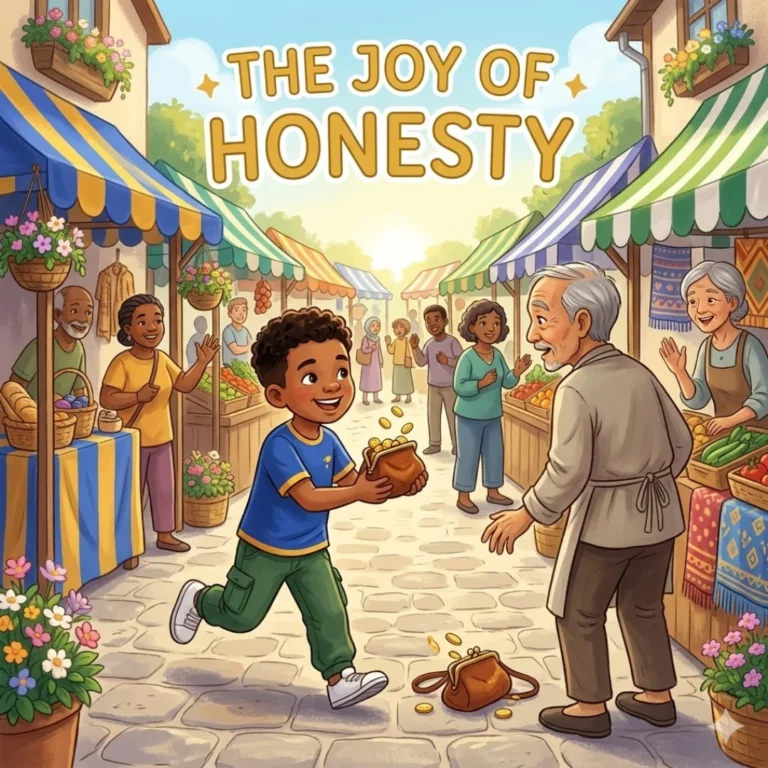
This bedtime story for kids, ‘Honesty/” title=”More stories about honesty”>Honesty is the best policy’, teaches children ages 6-12 about important moral values.
In the ancient Greek city of Corinth, where marble columns rose toward the blue sky and the scent of olive groves filled the air, there lived a boy named Theodoros.
Theodoros was twelve years old, with quick eyes and an even quicker mind. He was the son of a potter—an honest tradesman who made simple clay vessels for the homes of Corinth. They were not wealthy, but they were respectable, and their word was trusted throughout the marketplace.
One afternoon, while running an errand for his mother through the crowded agora, Theodoros noticed something glittering in the dust near a merchant’s stall.
He bent down and picked it up. It was an amulet—a pendant made of gold, shaped like an owl, the sacred bird of the goddess Athena. Delicate craftsmanship decorated its surface, and when Theodoros turned it over, he saw words inscribed in tiny letters:
“To Ariadne, from her father, with all my love.”
The amulet was beautiful—and clearly very valuable. Theodoros looked around. The marketplace was chaotic with shoppers and merchants calling their wares. No one seemed to be searching for anything. No one was looking his way.
His heart beat fast. This amulet could change his family’s fortunes. They could pay off their debts. His father could rest more. His mother could buy new clothes for his sisters.
Who would ever know?
Theodoros slipped the amulet into his tunic and hurried home, trying to act normal. But his mind was racing.
“I didn’t steal it,” he told himself. “I found it. That’s different. The person who lost it was careless. It’s really their fault.”
But even as he thought these things, he felt a strange tightness in his chest. When his mother asked if he had completed his errand, he heard himself say “Yes” in a voice that didn’t quite sound like his own.
That night, Theodoros couldn’t sleep. Every time he closed his eyes, he saw the inscribed words: “To Ariadne, from her father, with all my love.”
Somewhere in Corinth, there was a girl named Ariadne. Maybe she was crying right now, searching desperately for her father’s gift. Maybe her father had died, and this was all she had left of him. Maybe…
“Stop,” Theodoros told himself. “You’re being foolish. Go to sleep.”
But sleep would not come.
Over the following days, a curious thing happened to Theodoros.
Whenever he tried to speak, the words came out twisted and strange. If his mother asked whether he had fed the chickens, he would mean to say “Yes” but instead say “The chickens have become very yellow” or some other nonsense.
When his teacher asked him to recite a passage from Homer, Theodoros opened his mouth and out came a jumbled mess of syllables that made no sense at all.
His friends stopped inviting him to play. His teacher looked at him with concern. His parents whispered worriedly when they thought he couldn’t hear.
“Something is wrong with the boy,” his father said. “Perhaps we should consult the healer.”
The healer examined Theodoros but could find nothing wrong with his body. “The illness is not in his flesh,” the healer concluded. “It must be in his spirit. Perhaps he should consult the Oracle.”
The Oracle of Corinth was an old priestess who served in the temple of Apollo. People came to her with questions about the future, about the gods, about the mysteries of life.
Theodoros approached her with trembling legs. The temple was dark and smoky, lit only by flickering oil lamps. The Oracle sat on a tripod stool, her eyes seeming to see through him rather than at him.
“I know why you have come, boy,” she said before he could speak. “You carry a burden that is not yours to carry.”
Theodoros felt the golden amulet burning against his chest like hot coals.
“You took something that belongs to another,” the Oracle continued. “And now your tongue is tangled because your heart is tangled. You cannot speak truth because you are living a lie.”
“What must I do?” Theodoros asked, and for once, the words came out clearly.
“You know what you must do,” the Oracle said. “The goddess Athena watches over this city. Her owl sees in the darkness. Nothing is hidden from the gods. Return what is not yours, and speak the truth, and your tongue will be freed.”
Theodoros left the temple knowing what he had to do, but fear still gripped his heart. What if he was caught? What if people thought he was a thief? What if the girl Ariadne was angry with him?
“It doesn’t matter,” he told himself firmly. “I cannot live like this. The Oracle is right—I am living a lie, and the lie is destroying me.”
He returned to the marketplace and began asking questions. Did anyone know a girl named Ariadne? Did anyone know who had lost a golden amulet shaped like an owl?
At first, no one could help. But then an old fabric merchant smiled in recognition.
“Ariadne? That would be the daughter of Philemon the jeweler. His shop is on the Street of Craftsmen, near the fountain. But I heard she has been very sad lately—she lost something precious to her.”
Theodoros thanked the merchant and hurried toward the Street of Craftsmen.
He found the shop easily—a small building with intricate metalwork displayed in the windows. Inside, a man was working at a bench, and a girl about Theodoros’s age sat in the corner, looking miserable.
The girl’s eyes were red from crying. Her shoulders slumped. She looked like someone who had lost hope.
Theodoros took a deep breath and stepped into the shop.
“Excuse me,” he said. “Is your name Ariadne?”
The girl looked up. “Yes. Who are you?”
Theodoros reached into his tunic and pulled out the golden amulet. The girl gasped. Her father dropped his tools and stared.
“I found this in the marketplace several days ago,” Theodoros said, his voice steady now, the words flowing freely. “I should have returned it immediately, but I was tempted to keep it. I am sorry. I was wrong.”
He held out the amulet. Ariadne took it with trembling hands, tears of joy replacing tears of sorrow.
“My mother gave this to me before she died,” she whispered. “I thought it was lost forever. Thank you—thank you—”
Philemon the jeweler looked at Theodoros with an expression the boy did not quite understand. It was not anger. It was… respect?
“Many boys would have kept such a treasure,” Philemon said. “It takes courage to admit wrongdoing and make it right. What is your name?”
“Theodoros, son of the potter Nikolaos.”
Philemon nodded slowly. “I know your father. An honest man. I see the apple has not fallen far from the tree—though perhaps it rolled a little distance before settling.”
Theodoros expected to be thanked and sent on his way. Instead, something unexpected happened.
“I have been looking for an apprentice,” Philemon said. “Someone with quick eyes and careful hands. But more importantly, someone with an honest heart. A dishonest jeweler can cheat his customers, but he will never have their trust. And without trust, a craftsman is nothing.”
He looked at Theodoros steadily. “You made a mistake, but you corrected it. That shows character. Would you be interested in learning the craft of jewelry-making?”
Theodoros could hardly believe what he was hearing. Learning to craft gold and silver? This was an opportunity beyond anything he had imagined.
“I would have to ask my father,” he said.
“Of course. Bring him to see me.”
When Nikolaos heard the story, he was proud and a little sad. Proud that his son had done the right thing. Sad that he had been tempted at all.
“Honesty is not always easy,” Nikolaos said. “The temptation to lie, to cheat, to take what is not ours—this temptation comes to everyone. What matters is what we do when the temptation comes. You stumbled, my son, but you found your feet again. That is what counts.”
Theodoros became Philemon’s apprentice. He learned to work with precious metals, to set gems, to create beautiful things. But more importantly, he learned that his reputation for honesty was the most precious thing he would ever possess.
Years later, when Theodoros had his own shop and his own apprentices, he would tell them the story of the golden amulet.
“The goddess Athena is the goddess of wisdom,” he would say. “And part of wisdom is understanding that honesty is not just about avoiding punishment. It is about who you want to be.
“When I kept that amulet, I was not being myself. I was pretending to be someone else—someone who would take what was not his. And that pretending twisted me inside until I could not even speak properly.
“When I returned the amulet and told the truth, I became myself again. The weight lifted. The words flowed. I was free.
“Some people think that liars are clever and honest people are foolish. But the truth is the opposite. Liars live in prisons they build for themselves, constantly afraid of being discovered, constantly adding new lies to cover the old ones. Honest people are free.”
He would show them the amulet, which Ariadne had given to him when she died, many years later, as a symbol of their friendship.
“This amulet taught me that honesty is not just a rule to follow. It is a way of living that brings peace and freedom and genuine human connection. There is no treasure worth the cost of your integrity.”
This Greek-inspired tale teaches several important lessons about honesty.
*First, dishonesty harms us more than anyone else. When Theodoros kept the amulet, he did not hurt Ariadne as much as he hurt himself. His conscience tormented him, his speech became confused, and he lost his peace of mind.
Second, it is never too late to do the right thing. Theodoros made a mistake by keeping the amulet, but his greater choice—the one that defined his character—was the decision to return it and tell the truth.
Third, honesty builds trust, and trust is the foundation of all good relationships. Philemon chose Theodoros as an apprentice not despite his confession, but because of it. By admitting his mistake, Theodoros proved he could be trusted.
Finally, our reputation is our most valuable possession. Money can be lost and regained. Objects can be replaced. But once trust is broken, it is very difficult to rebuild. A reputation for honesty, once established, opens doors that no amount of gold can open.
This story draws on several authentic elements of ancient Greek culture:
Ancient Greek philosophers like Socrates, Plato, and Aristotle wrote extensively about virtue and character. They believed that being a good person was not just about following rules but about developing the right habits and character traits—including honesty.
Oracles were important figures in ancient Greece. They were believed to speak on behalf of the gods and provide guidance. The most famous was the Oracle at Delphi, but many cities had their own oracles.
Athena was the goddess of wisdom, crafts, and strategic warfare. Her symbol was the owl, which represented wisdom and the ability to see in darkness—metaphorically, to see the truth even when it is hidden.
In ancient Greece, craftsmen often trained young apprentices in their trades. This system passed skills from generation to generation and was essential to maintaining quality craftsmanship.
– Agora: The marketplace and public gathering space in ancient Greek cities
– Athena: The Greek goddess of wisdom, whose symbol was the owl
– Oracle: A priestess or priest believed to speak on behalf of the gods and provide divine guidance
– Integrity: The quality of being honest and having strong moral principles
– Conscience: The inner sense of right and wrong that guides our behavior
– Reputation: The beliefs and opinions that others have about our character
– Apprentice: A young person learning a trade or craft from an experienced master
1. Why do you think Theodoros’s speech became confused when he was keeping the amulet? (Symbolism, psychology of guilt)
2. Have you ever felt bad after doing something dishonest, even if no one found out? What did that feel like? (Personal reflection, conscience)
3. Why did Philemon respect Theodoros more after hearing about his mistake, rather than less? (Character, the value of honesty)
4. What might have happened if Theodoros had kept the amulet and never returned it? (Consequences, character development)
5. Can you think of situations where telling the truth is difficult? What makes it hard, and how can we find the courage to be honest anyway? (Practical ethics, moral courage)
– Greek ethical philosophy (Plato, Aristotle)
– Greek mythology and religious practices
– Historical information about Greek society and craftsmanship
This story, inspired by the wisdom of ancient Greece, teaches that honesty is not merely a rule to follow but a way of living that brings freedom, peace, and genuine human connection—making it truly the best policy for a good and meaningful life.*
Test Your Understanding
1Who was Theodoros and what was he like as a person?
Frequently Asked Questions
What is the moral lesson of Honesty is the best policy?
What age is this story appropriate for?
How long does it take to read Honesty is the best policy?
What culture does this story come from?
Can I use this story for teaching?
Frequently Asked Questions
What is the moral of the story ‘Honesty is the best policy’?
The story teaches children that being honest, even when it’s difficult or tempting to do otherwise, builds trust and earns respect. Through young Theodoros’s journey in ancient Corinth, kids learn that telling the truth leads to better outcomes than deception, and that a good reputation is one of the most valuable things a person can have.
What age group is this honesty story suitable for?
This bedtime story is written for children aged 6 to 12. The language and themes are engaging enough to hold older children’s interest while remaining simple enough for younger readers to understand. It works great as a read-aloud story for parents and kids to enjoy together before bedtime.
What happens in the honesty story set in ancient Greece?
The story follows Theodoros, a twelve-year-old potter’s son in the city of Corinth. While running an errand through a busy marketplace, he discovers a golden owl amulet inscribed with a personal message. The story explores what he chooses to do with it and what that decision teaches him about honesty and integrity.
📚 Recommended Books
Handpicked for readers like you
As an Amazon Associate, we earn from qualifying purchases. These recommendations are personalized based on this story's themes and your reading history.
Why should I read my child a story about honesty?
Stories are one of the most effective ways to teach children moral values because they make abstract concepts relatable and memorable. A well-told honesty story helps kids understand real consequences of truthfulness and deception in a safe, imaginative setting, making it easier for them to apply those lessons in their own lives.
Is this story based on Greek mythology?
The story is set in ancient Greece and draws on Greek culture, including references to the goddess Athena and the city of Corinth, but it is an original moral tale rather than a retelling of a specific myth. The historical setting adds richness and context while keeping the focus on the timeless value of honesty.