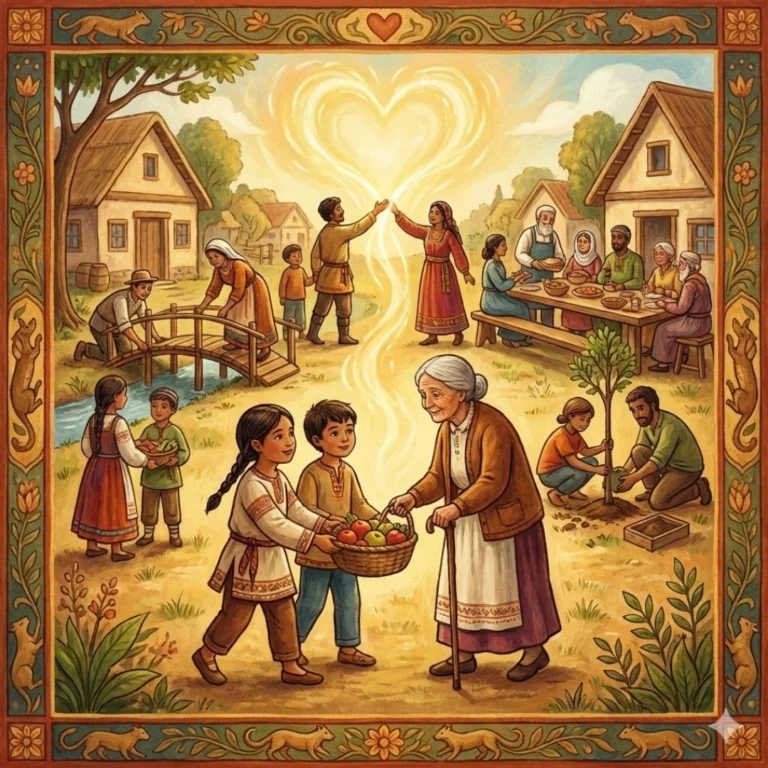
‘helping others brings joy’ is an educational moral story perfect for bedtime reading with children ages 6-12.
The summer sun blazed down on Athens like the forge of Hephaestus himself. The streets shimmered with heat, and even the lizards sought shade beneath the stones.
On this scorching afternoon, a boy named Theodoros was hurrying through the streets. His mother had sent him to fetch water from the public fountain, and he was eager to complete his task and escape the brutal heat.
As he rounded a corner near the agora, he nearly collided with an old man who was struggling under an enormous bundle of firewood. The bundle was so large that the old man could barely see over it, and he was weaving from side to side like a ship in a storm.
Theodoros stepped aside to let him pass. Most people were doing the same—glancing at the old man, then looking away, hurrying on with their own business.
But something made Theodoros pause.
The old man’s face was red with effort. His arms trembled under the weight. His breath came in short, painful gasps. And when his sandal caught on a stone and he stumbled, spilling half his firewood across the street, something in Theodoros’s chest twisted with sympathy.
“Here,” Theodoros said, setting down his water jug. “Let me help you.”
The old man looked at Theodoros with surprise. “You would help me? But you don’t even know me.”
“You need help,” Theodoros said simply. “That’s enough.”
Together, they gathered the scattered firewood and redistributed the load. Theodoros took half onto his own shoulders, grunting at the weight. It was heavier than he expected.
“Where are you taking this?” he asked.
“To the temple of Asklepios, on the hill,” the old man said. “The priests need fuel for their sacred fires, and I earn a few coins by supplying it.”
The temple of Asklepios was the healing temple, where the sick came to pray for recovery and where the god of medicine was honored with offerings. But it was a long walk, mostly uphill, in the hottest part of the day.
Theodoros thought of his mother waiting for the water. He thought of the cool shade of his home. He thought of a hundred reasons to set down the wood and continue on his way.
Instead, he said, “Let’s go, then.”
The walk to the temple was harder than Theodoros had imagined. The firewood seemed to grow heavier with every step. The sun beat down mercilessly. Sweat poured down his face and stung his eyes.
But the old man walked beside him, and as they walked, he talked.
“My name is Lysander,” he said. “I was a soldier once, many years ago. I fought in the wars and earned my share of glory. But now I am old, and my only glory is carrying firewood.”
He laughed, though there was sadness in it.
“I have no family left. My wife died many years ago. My sons were killed in battle. I live alone in a small room and do whatever work I can find to eat.”
Theodoros listened, feeling the weight of the wood on his shoulders and the weight of the old man’s story on his heart.
“Don’t you have friends?” he asked. “People who help you?”
Lysander shrugged. “People are busy with their own lives. They have their own problems. An old man is invisible, boy. You will learn this someday. When you are young and strong, everyone sees you. When you are old and weak, everyone looks away.”
Theodoros thought about this. He had nearly looked away himself.
At last, they reached the temple of Asklepios. The priests greeted Lysander warmly—he had been supplying their firewood for years. They did not know Theodoros, but they smiled at him too.
“Who is your young helper?” one priest asked.
“A stranger who became a friend,” Lysander said. “He found me struggling in the street and refused to pass by. He has carried half my burden all the way up this hill.”
The priest looked at Theodoros with interest. “That is no small thing. The god Asklepios teaches us that healing comes through compassion. You have shown great compassion today.”
Theodoros felt embarrassed by the praise. “I just helped carry some wood. It’s not that special.”
“Ah,” the priest said, “but that is where you are wrong. Every great deed begins with a small one. Every hero’s journey begins with a single step. You chose to help when you could have walked away. That choice—that small choice—is what makes the difference.”
After the firewood was delivered, Lysander pressed a few copper coins into Theodoros’s hand.
“No,” Theodoros said, trying to give them back. “I didn’t help you for money.”
“I know,” Lysander said. “That is why you deserve it. Keep it. You have earned it, and you have earned something more valuable too.”
“What is that?”
The old man smiled. “You’ll see.”
Theodoros hurried home with the coins in his pocket, arriving much later than expected. His mother was worried at first, then proud when she heard what had happened.
“You did the right thing,” she said. “The gods notice such kindness. It may not be rewarded today or tomorrow, but kindness is never wasted.”
Several weeks passed. Theodoros had almost forgotten about Lysander and the firewood when a visitor arrived at his family’s modest home.
The visitor was a prosperous-looking man in fine clothes, accompanied by servants. He asked to speak to the head of the household.
Theodoros’s father, the potter Nikolaos, came forward nervously. What could such a wealthy man want with a simple craftsman?
“I am looking for a boy named Theodoros,” the man said. “I was told he lives here.”
Theodoros stepped forward, his heart pounding. “I am Theodoros.”
The wealthy man studied him for a long moment. Then he smiled.
“I am Kallias, a merchant. A month ago, you helped an old man named Lysander carry firewood to the temple of Asklepios. Is this true?”
“Yes, sir.”
“Lysander is my father’s brother—my uncle. When he told me what you did, I was… surprised. Most people ignore him. Most people do not see an old man carrying burdens. But you saw him. You helped him. You even refused payment.”
Kallias paused, and his expression grew serious.
“I am looking for an honest and kind-hearted young man to work in my business. Someone who will deal fairly with customers and treat everyone—rich or poor, young or old—with respect. Lysander told me I would find such a person in you. Was he right?”
Theodoros could hardly believe what was happening. Kallias was offering him a position in his merchant business—an opportunity that could change his family’s entire future.
“But… I’m just a potter’s son,” he said. “I don’t know anything about being a merchant.”
“Skills can be learned,” Kallias said. “But character cannot be taught. Either you have it or you don’t. You showed me your character on that hot afternoon when you chose to help a struggling old man instead of walking away. That is worth more than all the book learning in Greece.”
Theodoros looked at his parents. His mother had tears in her eyes. His father was trying to maintain his dignity, but his hands were shaking.
“Say yes,” his father whispered. “This is the blessing of the gods.”
And so Theodoros said yes.
Years later, when Theodoros was a successful merchant himself, he would tell this story to young people who came to work for him.
“Many people think that kindness is a weakness,” he would say. “They think that helping others costs us something—our time, our energy, our resources. And it does cost these things.
“But what they don’t understand is that kindness pays back more than it costs. Not because we might receive rewards—though sometimes we do—but because of how it changes us inside.
“When I helped Lysander that day, I felt something that I had never felt before. It was a kind of warmth in my chest, a lightness in my step. The firewood was heavy, the sun was hot, but I felt stronger than I had ever felt. I felt alive.
“Later, I learned that there is a word for this feeling. The Greeks call it ‘eudaimonia’—it means flourishing, well-being, the good life. It is the deep satisfaction that comes from living according to your best self.
“Helping others brings joy because it aligns us with our true nature. Human beings are made to care for each other. When we act selfishly, we are working against our nature. When we act kindly, we are working with it.
“That old man Lysander—he taught me this lesson just by needing help. And I am grateful to him every day.”
This Greek-inspired tale teaches several important lessons about kindness.
*First, small acts of kindness can have large consequences. Theodoros simply helped carry some firewood, but this single act led to a friendship, a recommendation, and ultimately a career.
Second, kindness should not depend on reward. Theodoros helped Lysander without expecting anything in return. The fact that rewards came later was a bonus, not the motivation.
Third, everyone deserves respect and care. Lysander was old, poor, and invisible to most people. But he was a human being with a history, a story, and inherent dignity. Theodoros saw this when others did not.
Fourth, helping others brings genuine joy. The satisfaction that comes from kindness is not just pleasant—it is a deep, meaningful happiness that comes from living in alignment with our best selves.
Finally, character is noticed. Kallias was looking for someone honest and kind, and Theodoros’s single act of compassion revealed his character more clearly than any interview could have.
This story draws on authentic elements of ancient Greek culture:
The ancient Greeks believed strongly in the duty of hospitality, called xenia. This was not just being polite to guests—it was a sacred obligation. Zeus himself was the protector of guests and strangers, and violating xenia was considered a serious offense against the gods.
Asklepios was the Greek god of medicine and healing. His temples were healing centers where the sick would come to pray, sleep, and receive treatment. The association of healing with compassion in the story reflects authentic Greek beliefs.
The Greek word philanthropia means “love of humanity.” It was considered a virtue—the disposition to treat all human beings with kindness and care.
This concept, central to Greek philosophy, means something like “flourishing” or “living well.” Philosophers like Aristotle argued that eudaimonia comes from living virtuously—and kindness was considered a key virtue.
– Xenia: The Greek concept of hospitality, especially the duty to be kind to strangers and guests
– Philanthropia: Love of humanity; the virtue of treating all people with kindness
– Eudaimonia: Flourishing, well-being, or the good life that comes from living virtuously
– Asklepios: The Greek god of medicine and healing
– Agora: The marketplace and public gathering space in Greek cities
– Compassion: The feeling of concern for others’ suffering combined with the desire to help
1. Why do you think most people passed by Lysander without helping? Have you ever done this? (Social psychology, self-reflection)
2. Theodoros says helping others brought him joy even though it was hard work. Have you experienced this? (Personal experience, eudaimonia)
3. Kallias said character cannot be taught, only skills can. Do you agree? Can character be developed? (Ethics, education)
4. Lysander said old people become “invisible.” Why might this happen? What can we do about it? (Social awareness, respect for elders)
5. If Theodoros had never received any reward for his kindness, would it still have been worth doing? Why or why not? (Motivation, intrinsic vs. extrinsic rewards)
– Greek ethical philosophy (Aristotle’s “Nicomachean Ethics”)
– Greek concepts of xenia and philanthropia
– Historical information about Greek society, temples, and customs
This story, inspired by the values of ancient Greece, teaches that helping others is not a sacrifice but a source of deep and lasting joy—a joy that comes from living according to our best selves and treating every person, no matter how humble, with the dignity they deserve.*
Test Your Understanding
1What was Theodoros like as a person?
Frequently Asked Questions
What is the moral lesson of Helping others brings joy?
What age is this story appropriate for?
How long does it take to read Helping others brings joy?
What culture does this story come from?
Can I use this story for teaching?
Frequently Asked Questions
What age group is this helping others story suitable for?
This moral story about helping others is perfect for children ages 6-12. The content is age-appropriate for bedtime reading, featuring relatable characters and situations that teach valuable lessons about kindness and compassion without being too complex for young readers.
What lesson does this story teach about helping others?
The story demonstrates how helping others brings genuine joy and satisfaction. Through the character of Theodoros, children learn that small acts of kindness toward those in need create happiness for both the helper and the person being helped, making it a rewarding experience.
Where does this moral story take place?
The story is set in ancient Athens, Greece, during a scorching summer day. The setting includes familiar places like the agora and public fountains, giving children a glimpse into ancient Greek life while delivering timeless moral lessons.
📚 Recommended Books
Handpicked for readers like you
As an Amazon Associate, we earn from qualifying purchases. These recommendations are personalized based on this story's themes and your reading history.
Is this a good bedtime story for kids?
Yes, this is an excellent bedtime story for children ages 6-12. It combines educational content with moral lessons in an engaging narrative that’s perfect for nighttime reading, helping kids end their day with positive thoughts about kindness and helping others.
How long does it take to read this moral story?
This educational moral story is designed for comfortable bedtime reading, typically taking 10-15 minutes to read aloud. The length is perfect for maintaining children’s attention while delivering meaningful lessons about compassion and the joy that comes from helping others.