

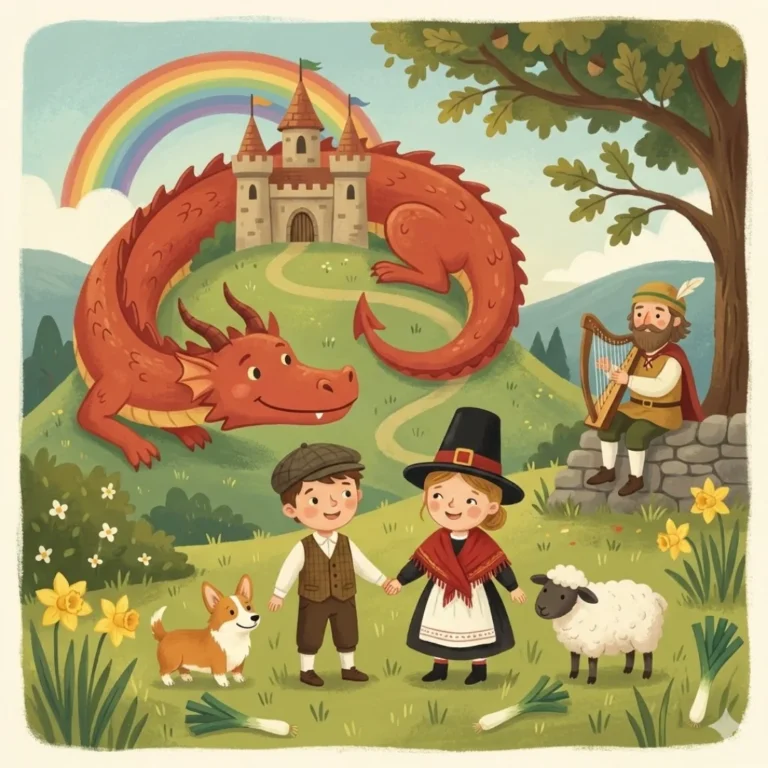
‘Wales’ is an educational moral story perfect for bedtime reading with children ages 6-12.
Chapter 1: The Book That Remembers
Long ago, before cities of glass and steel covered the land, before iron roads carried thundering carriages, even before the castles that now stand in ruins – there was magic in Wales. Real magic, the kind that lived in misty mountains and hidden valleys, in stone circles and sacred groves.
In those days, there were special people called bards. They were not merely musicians or poets, though they were those things too. Bards were the memory of the people. They remembered the old stories, the ancient laws, the names of heroes and the deeds of gods. Without written books, the bards carried entire libraries in their hearts.
In a small village nestled in the hills of Gwynedd, a young girl named Rhiannon was known for two things: her fiery red hair and her endless questions. While other children played in the meadows, Rhiannon sat at the feet of the village bard, an old man named Taliesin, listening to his tales with eyes as wide as moons.
“Tell me about the Mabinogion,” she would beg. “Tell me about Pwyll and Branwen and the children of Llyr!”
And Taliesin, whose voice was like wind through ancient oak trees, would smile and begin.
Chapter 2: The Prince Who Entered Another World
“Listen well,” Taliesin said one evening as autumn mists crept through the valley. “For this is the tale of Pwyll, prince of Dyfed, who stumbled into a world beyond our own.”
Rhiannon leaned forward, and the story unfolded like magic.
“Prince Pwyll was hunting in the forest of Glyn Cuch when he became separated from his companions. Following the sound of dogs, he came upon a strange sight – a magnificent white stag, brought down by a pack of hounds unlike any he had ever seen. Their coats shone bright as moonlight, and their ears were red as blood.
Before Pwyll could think, he drove these strange hounds away and set his own pack on the fallen stag. But then a horseman appeared, dressed in gray like morning fog, and his face held a cold anger.
‘Prince of Dyfed,’ the stranger said, ‘you have committed a discourtesy. Those were my hounds, and you have stolen their rightful prey.’
Pwyll, ashamed, asked how he might make amends.
‘I am Arawn, King of Annwn – the Otherworld that exists alongside your own, hidden from mortal eyes. There is one who challenges me, a rival king named Hafgan. Only a single blow can slay him, and if struck twice, he will rise stronger than before. Help me defeat him, and all will be forgiven.’
But here was the strange part: Arawn asked Pwyll to trade places with him for a year. Pwyll would rule Annwn in Arawn’s form, while Arawn would rule Dyfed in Pwyll’s form. At the year’s end, Pwyll would fight Hafgan.”
Chapter 3: The Test of Honor
Rhiannon interrupted: “But if Pwyll looked like King Arawn, wouldn’t Arawn’s wife think he was her husband?”
Taliesin’s eyes twinkled. “You ask the right questions, child. And this is where the tale teaches its first lesson.”
He continued: “For one full year, Pwyll lived in the palace of Annwn. He ate at Arawn’s table. He slept in Arawn’s chamber. He ruled Annwn’s people. And every night, the beautiful queen lay beside him, never knowing that her husband was far away.
But Pwyll never once touched her. Not once, in a whole year, though she was the most beautiful woman he had ever seen. He turned his face to the wall each night and kept faith with the trust Arawn had placed in him.
When the year ended, Pwyll met Hafgan in combat. He struck a single mighty blow, and Hafgan fell. ‘Finish me!’ Hafgan cried, for he hoped a second blow would heal him. But Pwyll, remembering Arawn’s warning, refused. ‘I will not strike you again. Let others finish what I have begun.’ And so Hafgan died, and Arawn’s kingdom was safe.
When Pwyll and Arawn met to exchange forms again, Arawn was amazed to learn that Pwyll had never been unfaithful with his wife. ‘You have shown honor beyond what any mortal has ever shown me,’ Arawn said. ‘From this day forward, you shall be called Pwyll Pen Annwn – Pwyll, Head of Annwn – and our worlds shall be friends forever.’”
“What happened to him next?” Rhiannon asked eagerly.
“That,” said Taliesin, “is a story for another night.”
Chapter 4: The Woman of the Mound
Days later, Rhiannon begged for more of Pwyll’s story. Taliesin obliged.
“After Pwyll returned from Annwn, he climbed the magical mound of Arberth. It was said that whoever sat upon this mound would either be wounded or witness something wondrous. Pwyll was curious, and so he sat.
He saw a woman riding toward him on a great white horse. She was dressed in golden silk, and she moved with the grace of flowing water. Pwyll sent his fastest runners to meet her, but no matter how fast they ran, she seemed to stay just ahead, her horse walking calmly while they sprinted.
The next day, Pwyll sent his fastest riders, but again the woman in gold remained just out of reach. Her horse never galloped, yet no one could catch her.
Finally, Pwyll himself gave chase. When he could not overtake her, he called out: ‘Lady, for the sake of the one you love best, please stop!’
And she did. She turned and smiled.
‘I would have stopped long ago if you had only asked,’ she said. ‘I am Rhiannon, princess of the Otherworld, and I have come because I love you and wish to be your bride. But you must win me fairly, for another has claimed me against my will.’”
Rhiannon – the girl, not the princess – gasped. “I’m named after her!”
“Indeed you are,” Taliesin said. “And the princess Rhiannon was clever and brave, just like you. She helped Pwyll overcome the rival who wanted to marry her, and together they ruled Dyfed in happiness for many years. The story teaches us that the things we desire cannot be captured by force or speed alone – sometimes we must simply ask, with humility and respect.”
Chapter 5: The Bard’s Promise
As the seasons turned, Rhiannon learned many tales from Taliesin – stories of Branwen, whose beauty sparked a terrible war between Britain and Ireland; of Manawydan, who used patience and cunning to defeat a cruel enchantment; of Math, the ancient king who could only live if his feet rested in the lap of a maiden.
But she also learned something else: how to tell the stories herself.
“Being a bard is not just about remembering words,” Taliesin explained. “It is about understanding why the stories matter. Every tale carries wisdom wrapped in wonder. When you tell a story, you must find the wisdom within it and give it to your listeners as a gift.”
One evening, a visitor came to the village – a man named Iolo, whose eyes burned with passion for the old ways. He was traveling from village to village, gathering the ancient tales before they could be lost forever.
“The world is changing,” Iolo told them, his voice urgent. “Fewer and fewer people remember the old stories. If we do not preserve them, they will vanish like mist in the morning sun.”
“But you cannot simply write them down,” Taliesin said. “The stories live in the telling. On paper, they are only shadows of themselves.”
Iolo nodded thoughtfully. “Then we must do both. Write them down to preserve the words, but continue telling them to preserve the spirit. This is the only way the Mabinogion will survive.”
Chapter 6: The Sacred Circle
That night, Iolo spoke of the ancient druids and bards who had served the people before the new religions came to Wales.
“The druids understood something important,” he said. “They called it the harmony of all things. The earth, the sky, the water – all are connected. Humans, animals, spirits – all are part of one great circle. To harm one is to harm all. To help one is to help all.”
“That sounds like the Otherworld in Pwyll’s story,” Rhiannon observed.
“Exactly,” Iolo smiled. “The Otherworld is not far away – it is right here, alongside our own world, just beyond our seeing. The old stories remind us that there is more to life than what our eyes can see. Magic is not something from long ago; it is something we have forgotten how to notice.”
He looked at young Rhiannon with knowing eyes. “You have the gift, child. I can see it. One day, you will be a bard yourself, carrying these tales forward.”
Taliesin placed a hand on Rhiannon’s shoulder. “She is already learning well. But she must understand that a bard carries a great responsibility. These stories are not entertainment – they are the soul of our people. To tell them carelessly is to diminish them. To tell them well is to keep Wales alive.”
Chapter 7: The New Keeper
Years passed. Rhiannon grew into a young woman, and old Taliesin’s voice grew weak. On his last evening, as snow fell softly outside the window, he called Rhiannon to his side.
“I have one more story for you,” he whispered. “The most important one of all.”
Rhiannon leaned close to hear.
“Once, there was a land where stories lived in every stone and stream, every mountain and meadow. The people loved these stories, and the stories loved the people. They grew together, like trees whose roots intertwine.
But time passed, and some people began to forget. They said stories were for children. They said the old ways were foolish. They turned away from magic and wonder.
The stories grew sad. Without voices to speak them, they began to fade. Without ears to hear them, they began to disappear.
But there were some who remembered. They passed the stories from parent to child, from teacher to student, keeping the flame alive through the darkest nights. And because of these keepers, the stories survived.
One day, the world will remember again. One day, people will hunger for magic and wonder, for wisdom wrapped in beautiful words. And on that day, the stories will be waiting, ready to bloom again.”
Taliesin’s eyes closed. “You are a keeper now, Rhiannon. Guard the stories well. Tell them with love. And pass them on before your voice, too, grows silent.”
Chapter 8: The Tales Continue
Many years later, an old woman with silver-streaked red hair sat by a fire in the hills of Gwynedd. Around her gathered children, grandchildren, and visitors from distant lands who had heard of the last keeper of the old tales.
“Tell us about Pwyll!” a young boy begged.
“Tell us about Branwen!” a girl chimed in.
Rhiannon smiled – the same smile that Taliesin had worn so long ago.
“I will tell you all these stories,” she said, “and many more. But first, you must understand why they matter.
These tales come from a time when magic was real, when the boundary between our world and the Otherworld was thin as morning mist. They teach us about honor, like Pwyll showed in the kingdom of Annwn. They teach us about courage, like Branwen showed in her sorrow. They teach us about patience, like Manawydan showed against the enchanter. They teach us about love, like the princess Rhiannon showed when she waited for a prince brave enough to simply ask.
The world has changed since those days. But humans have not. We still need honor. We still need courage. We still need patience and love. And we still need magic – the magic of stories that help us see the wonder hidden in ordinary life.”
She looked around at her listeners, seeing in their faces the same hunger for wonder that she had felt as a child.
“Now then,” she said, her voice strong and clear as it had ever been, “let me tell you about a prince named Pwyll, who stumbled into a world beyond our own…”
And as the fire crackled and the stars wheeled overhead, the ancient tales lived again, as they had for countless generations, as they would for countless more.
Moral Lessons
- The stories and wisdom of our ancestors are treasures that connect us to magic and wonder beyond what our eyes can see. When we honor these traditions by listening, learning, and passing them on, we keep our heritage alive and remember that the world holds more mystery and possibility than everyday life reveals.
Test Your Understanding
1Who was Iolo Morganwg?
Frequently Asked Questions
What is the moral lesson of Wales?
What age is this story appropriate for?
How long does it take to read Wales?
What culture does this story come from?
Can I use this story for teaching?
Frequently Asked Questions
What is the Wales bedtime story about?
Wales is an educational moral story about a curious young girl named Rhiannon who lives in ancient Gwynedd and learns from a village bard named Taliesin. The story explores Welsh mythology, the role of bards as memory-keepers, and the magic of storytelling. It’s designed for children ages 6-12 and carries meaningful moral lessons.
What age group is the Wales story suitable for?
The Wales story is perfect for children aged 6 to 12. Its engaging characters, rich imagery, and gentle moral themes make it ideal for bedtime reading. Parents can read it aloud to younger children, while older kids in the age range can enjoy it independently.
What were bards in ancient Wales?
In ancient Wales, bards were special people who served as the living memory of their communities. They weren’t just poets or musicians — they memorised entire libraries of stories, ancient laws, and the heroic deeds of gods and legends. Before written books existed, bards preserved culture and history entirely from memory.
📚 Recommended Books
Handpicked for readers like you
As an Amazon Associate, we earn from qualifying purchases. These recommendations are personalized based on this story's themes and your reading history.
What moral lessons does the Wales story teach children?
The Wales story teaches children the value of curiosity, knowledge, and preserving cultural heritage. Through Rhiannon’s love of listening and learning, kids discover that asking questions and seeking wisdom are powerful virtues. The story also highlights the importance of memory, storytelling, and honouring traditions passed down through generations.
Is the Wales story based on real Welsh mythology?
Yes, the Wales story draws on authentic Welsh mythology and history. It features real cultural elements like the bard tradition, the region of Gwynedd, and the legendary figure Taliesin — a famous bard from Welsh legend. These roots in genuine folklore make the story both entertaining and educational for young readers.
