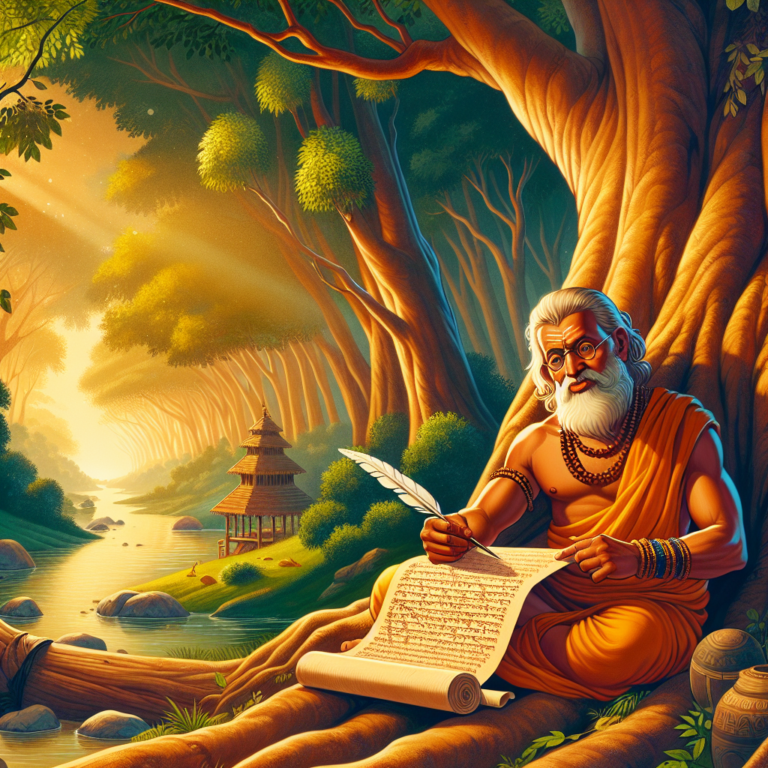
‘Manu’s Quest for the laws of harmony’ is an educational moral story perfect for bedtime reading with children ages 6-12.
Chapter 1: The First Morning
In the very beginning, when the world was new and fresh as morning dew, there lived a man unlike any other. His name was Manu, and he was the first – the very first human being to walk upon the earth.
Manu opened his eyes to a world of wonder. Mountains touched the clouds. Rivers sang as they danced to the sea. Animals roamed freely, each kind knowing its place in the great web of life. But Manu looked around and felt something he could not name – a kind of confusion, a wondering.
“The sun knows to rise in the east and set in the west,” he said to himself, watching the golden light paint the morning sky. “The birds know when to sing and when to rest. The seasons know when to come and go. But I… what am I supposed to do? How am I supposed to live?”
As if in answer to his question, a magnificent figure appeared before him – Lord Brahma, the Creator himself, seated upon a lotus flower that floated in the air like a dream made visible.
“Manu,” Brahma spoke, his voice like music and thunder combined, “you are right to ask. The animals follow their nature by instinct. But humans are different. You have been given the power to choose. And with that power comes responsibility.”
“How shall I choose wisely, Lord?” Manu asked, bowing deeply.
“You must discover the laws of harmony,” Brahma replied. “They are written in the fabric of the universe itself. Seek them. Learn them. Teach them. For if humans do not live in harmony – with nature, with each other, and with the divine – great suffering will follow.”
And with that, Brahma disappeared, leaving Manu alone with the greatest challenge any being had ever faced: to discover the laws of living well.
Chapter 2: The First Lessons
Manu traveled the length and breadth of the earth, observing and learning. He watched the ants, who worked together without quarreling, each one doing its part for the colony. He watched the bees, who created sweetness from flowers and organized their hive with perfect order. He watched the wolves, who cared for their young and their elderly, who hunted together and shared their food.
“The first law,” Manu wrote on a palm leaf with a sharpened stick, “is cooperation. No creature thrives alone. All life depends on other life.”
He continued his journey. He climbed the highest mountains and descended into the deepest valleys. He spoke with the rivers, asking why they flowed. “We flow because it is our nature to give,” the rivers answered. “Water that does not flow becomes stagnant and dies. Life must move, must give, must serve.”
“The second law,” Manu wrote, “is generosity. To hold tightly to what we have is to lose it. To give freely is to receive endlessly.”
In the forests, he met a great sage named Vasishtha, who had spent centuries in meditation, seeking truth.
“What have you learned?” Manu asked him.
“I have learned that truth is the foundation of everything,” Vasishtha replied. “A house built on lies will fall. A life built on deception will crumble. Only truth endures.”
“The third law,” Manu recorded, “is honesty. Speak truth. Live truth. Be truth.”
Chapter 3: The Test of Dharma
As years passed, other humans came into being. Manu’s children had children, who had children of their own. Villages formed. Communities grew. And with growth came conflict.
Two brothers came to Manu, their faces red with anger.
“Our father has died,” the elder said, “and left us his farm. I am the eldest, so the farm should be mine entirely.”
“That is not fair!” the younger protested. “I worked that farm just as much as you did. It should be divided equally!”
“What say you, Manu?” they both demanded.
Manu sat in thought for a long time. Both brothers had a point. Traditional custom often gave everything to the eldest son. But justice suggested that reward should match effort.
“Tell me,” Manu finally asked, “what would your father have wanted?”
The brothers looked at each other, their anger fading slightly.
“He… he always said he wanted us to remain close,” the elder admitted. “He worried that after he was gone, we would fight.”
“He told me the same thing,” the younger said quietly. “His greatest fear was that his death would divide us.”
“Then perhaps,” Manu suggested, “the question is not who deserves the farm, but how you can remain the brothers your father loved. A farm can be divided, but can brotherhood?”
The brothers spoke long into the night. By morning, they had decided to work the farm together, as they had when their father was alive.
Manu wrote: “The fourth law is that the spirit of the law matters more than the letter. Rules exist to create harmony, not to create winners and losers.”
Chapter 4: The Council of Sages
As Manu’s collection of laws grew, so did his reputation. Wise men from all over the land came to learn from him. Among them were three sages whose wisdom shone like stars: Apastamba, who understood duty; Gautama, who understood justice; and Baudhayana, who understood ritual and practice.
“Let us work together,” Manu proposed. “I have gathered many laws, but one man’s wisdom is limited. Help me complete this work.”
Each sage brought his own insights.
Apastamba taught about duty – how each person has responsibilities based on their role in life. “A parent has a duty to their children. A child has a duty to their parents. A teacher has a duty to students. A student has a duty to learn. When everyone fulfills their duty, society functions like a healthy body.”
Gautama taught about consequences. “Every action creates ripples, like a stone thrown into a pond. A kind action creates kind ripples. A harmful action creates harmful ripples. This is the law of karma, and no one escapes it.”
Baudhayana taught about discipline. “The mind is like a wild horse. Without training, it runs wherever it wishes, often toward destruction. Through discipline – in eating, in sleeping, in speaking, in acting – we gain control of ourselves.”
Manu wrote all of this down, weaving together the wisdom of many teachers into a tapestry of guidance for human life.
Chapter 5: The Young Student’s Challenge
One day, a young student named Kavi came to Manu with a troubled heart.
“Great lawgiver,” Kavi said, “I have studied your teachings. I know the laws. But I do not understand them.”
“What do you mean?” Manu asked.
“You say we should be honest, but sometimes honesty hurts people. You say we should be generous, but some people take advantage of generosity. You say we should do our duty, but sometimes duties conflict. How can anyone follow these laws when life is so complicated?”
Manu smiled, recognizing in this young man the same confusion he had felt on his first morning in the world.
“Come walk with me,” he said.
They walked to a great tree, its branches spreading wide and its roots plunging deep into the earth.
“Do you see this tree?” Manu asked. “It has thousands of branches. Some grow toward the sun. Some grow toward the shade. Some twist one way, some another. They seem to have no order at all.”
“But look at the trunk,” Manu continued. “And look at the roots. No matter how differently the branches grow, they all connect to the same center. They all draw from the same source.”
“The laws I have written are like the branches,” Manu explained. “They can seem to conflict. They can seem to pull in different directions. But they all grow from one root – one central truth.”
“What is that truth?” Kavi asked eagerly.
“Dharma,” Manu replied. “Harmony. Balance. The way things ought to be. Every law I have written is an attempt to describe one aspect of dharma. When laws seem to conflict, look for the dharmic solution – the choice that creates the most harmony, that brings people closer to balance.”
Chapter 6: The Flood and the Fish
Years continued to pass. Manu grew old and wise, his collection of laws filling many palm leaves, his students carrying his teachings to distant lands. But the world was changing. People had become careless with nature. They had forgotten the first law about cooperation. They took from the earth without giving back.
The gods grew concerned. Lord Vishnu appeared to Manu one day in an unusual form – that of a tiny fish.
“Manu,” the fish spoke, “a great flood is coming. The world will be cleansed and begun anew. You must build a boat and save the seeds of all living things, along with your books of law. Human wisdom must not be lost.”
Manu was shocked. “Lord, must it truly come to this?”
“When the laws of harmony are forgotten,” Vishnu replied, “nature itself falls out of balance. This flood is not punishment – it is correction. But it need not happen again. Teach well, Manu. Help humanity remember.”
Manu did as he was told. He built a great boat, gathered the seeds of every plant, rescued pairs of every animal, and secured his precious palm leaves containing the laws. When the floods came, his boat floated safely while the world was washed clean.
After the waters receded, Manu and those with him began again. And the first thing he did was gather his family and teach them the laws once more.
“We have been given a second chance,” he told them. “Let us not waste it. Let us remember that we are part of this world, not masters of it. Let us live in harmony with nature, with each other, and with the divine.”
Chapter 7: The Living Laws
In his final years, Manu was often asked which of his many laws was the most important.
His answer was always the same: “The laws are not things to be counted and compared. They are like the parts of a body. Is the heart more important than the lungs? Is the brain more important than the blood? Each is essential. Each supports the others. Remove any one, and the whole suffers.”
But if pressed, he would say this: “If you remember nothing else, remember this – treat others as you would wish to be treated. Act always in ways that create harmony rather than discord. And when you make mistakes, as you surely will, learn from them and try again.”
On his last morning, surrounded by children and grandchildren who stretched across generations, Manu looked at the world he had helped shape. It was not perfect. People still fought. People still made mistakes. But they had guidance now. They had laws that could bring them back to harmony when they strayed.
“I was so confused on my first morning,” Manu said softly, remembering that distant day when he had first opened his eyes to wonder. “I did not know how to live. Now I understand that the question is never fully answered. Each day, we must ask again – how shall I live today? The laws are not the answer. They are the map. The journey is still ours to make.”
And so Manu closed his eyes for the last time, but his laws lived on – taught by his students to their students, copied from palm leaves to paper to books, spreading across continents and centuries, still guiding those who seek to live in harmony with the world around them.
Moral Lessons
- Living well requires understanding the laws of harmony – cooperation, generosity, honesty, and duty – that govern all existence. When these principles seem to conflict, we must look to the deeper truth of dharma, seeking the path that creates the greatest balance and brings people together rather than driving them apart.
Test Your Understanding
1Who was Manu in the story?
Frequently Asked Questions
What is the moral lesson of Manu’s Quest for the Laws of Harmony?
What age is this story appropriate for?
How long does it take to read Manu’s Quest for the Laws of Harmony?
What culture does this story come from?
Can I use this story for teaching?
Frequently Asked Questions
What is Manu’s Quest for the Laws of Harmony about?
It’s an educational moral story about Manu, the first human being, who seeks guidance from Lord Brahma on how to live rightly. Unlike animals guided by instinct, Manu must discover the laws of harmony to understand his purpose on earth. It’s written for children ages 6-12 and is perfect for bedtime reading.
What age group is this laws of harmony story suitable for?
Manu’s Quest for the Laws of Harmony is ideal for children between 6 and 12 years old. Its gentle storytelling, rich imagery, and moral lessons make it a wonderful bedtime story that parents and kids can enjoy together, sparking meaningful conversations about purpose, nature, and living wisely.
Who is Manu in this story?
Manu is portrayed as the very first human being to walk the earth. Unlike animals who follow their instincts naturally, Manu feels confused about how he is supposed to live. His honest questioning leads him to seek guidance from Lord Brahma, the Creator, setting him on a quest to discover life’s deeper purpose.
📚 Recommended Books
Handpicked for readers like you
As an Amazon Associate, we earn from qualifying purchases. These recommendations are personalized based on this story's themes and your reading history.
What moral lesson does this story teach children?
The story encourages children to ask big questions about life, purpose, and how to treat others and the world around them. It teaches that humans, unlike animals, must consciously choose to live in harmony — and that seeking wisdom and guidance is a sign of strength, not weakness.
Is this story based on any traditional or cultural teachings?
Yes, the story draws inspiration from ancient Hindu traditions, featuring figures like Lord Brahma, the Creator. Manu is a revered figure in Hindu mythology associated with the origins of humanity and moral law. The narrative blends these spiritual roots with accessible, child-friendly language to make timeless wisdom engaging for young readers.