

In the northern city of Chiang Mai, where the mountains breathe mist every morning and the temples wear their golden roofs like crowns, there was once a golden bowl that no one could empty.
Or so the monks said. The truth was more complicated and more beautiful than magic.
The bowl belonged to Wat Doi Phra, a temple on the hillside above the city, and it sat in the entrance courtyard where worshippers came to make offerings. It was indeed golden – not solid gold, but lacquered wood shining gold with age and with the hands of many years – and it was always full. Always brimming with fruit and flowers and rice and, occasionally, things that surprised even the head monk: a small carved elephant left by a child, a handwritten poem folded into a lotus shape, a key to something no longer remembered.
A girl named Nong Prae, who was eight years old and lived down the hill from the temple, had noticed the bowl all her life. She passed it on the way to school and on the way back. She had watched people place things in it, and she had wondered, with the particular wondering of someone who is not yet old enough to assume things are ordinary: where do the offerings go? The bowl never overflows, but it is always full.
She asked the old monk who swept the courtyard, whose name was Luang Ta Surin and whose broom had been with him so long it was nearly a friend.
“The bowl is fed by everyone who passes,” said Luang Ta Surin, sweeping. “It is emptied every evening and its contents given to those who need them. And by morning it is full again.”
“But why is it always full?”
The monk smiled at his broom as though it had said something. “Because people always come. The fullness is not in the bowl. The fullness is in the coming.”
Nong Prae thought about this for a long time.
She thought about it especially the day she walked past the bowl and saw a young woman sitting against the temple wall with a small baby, her face turned away from the street in the particular way of someone who does not want to be seen needing something. Nong Prae had in her pocket exactly one thing: the tangerine she had been saving since breakfast, which was supposed to be her afternoon snack.
She had been saving it carefully. She was hungry.
She also knew, looking at the young woman with her baby, what hunger looked like in a different way.
She put the tangerine in the bowl. Then, after a moment’s consideration, she took it back out and brought it directly to the young woman.
“For your child,” she said. “And for you.”
The young woman looked at her for a moment. Then she accepted it with a wai – hands pressed together, a slight bow – that held more inside it than Nong Prae could quite measure.
Nong Prae went home hungry. This was, she discovered, not as terrible as it sounded. Hunger felt different when you had given something away.
The next morning, she came past the temple and there was a small brown paper bag on the wall where the young woman had been sitting. Inside: two tangerines and a piece of sticky rice wrapped in banana leaf.
Nong Prae looked at it for a long time. She did not know who had left it. She did not know if the young woman had left it or some other person who had seen and understood. She ate the sticky rice at the temple gate, sitting in the morning light.
Over the following weeks, Nong Prae began to pay attention differently.
She noticed the flower seller on the corner who gave her last unsold garland every evening to the monk collecting for the temple, even when the garland was what she had hoped would cover her supper. She noticed the noodle shop owner who sent a bowl of soup each day to the old man who sat outside the shop but could not pay – sent it without announcement, just placed it in front of him and went back inside. She noticed the schoolboys who pooled their coins each Tuesday to buy fruit for the spirit house at the crossroads, arguing cheerfully the whole time about which fruit was most appropriate.
All of it going in, going out, going on.
Luang Ta Surin was right. The fullness was not in the bowl. The fullness was in the coming.
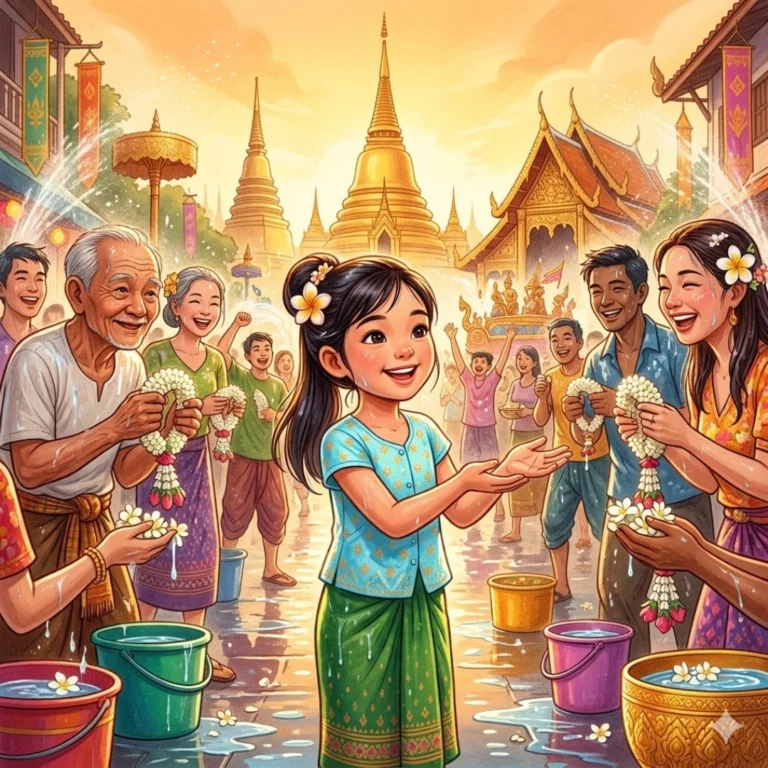
At New Year, when the Songkran water festival filled the streets with laughter and soaking and the smell of jasmine and mango blossom, Nong Prae saved her festival money. Not to keep – she had a plan.
She went to the flower market at dawn, when the stalls were being set out and the air was still cool, and she bought as many white jasmine garlands as her money could buy: twelve, small ones, strung tight on bamboo skewers.
Then she walked up and down the streets of Chiang Mai and gave them away. To the old woman who swept the intersection each morning. To the motorbike taxi drivers waiting at the corner. To the fruit seller, the postal worker, a small girl she didn’t know who was watching the festival from a doorway with an expression of wanting-to-join-but-not-being-quite-sure-she-was-invited.
By the time she reached the temple, her hands were empty.
But they felt, she thought, very full.
At the temple, the golden bowl was heaped high with festival offerings – jasmine and marigold, sticky sweets wrapped in banana leaf, candles and lotus buds. Nong Prae stood before it and folded her hands in a wai.
Luang Ta Surin appeared beside her, broom in hand, as he always was.
“Your hands are empty,” he observed.
“I gave everything away.”
The monk looked at the bowl, then at her. “And?”
Nong Prae looked at her hands – small, empty, jasmine-scented from handling the garlands all morning.
“They don’t feel empty,” she admitted.
“No,” said Luang Ta Surin. “They never do. That is the secret the bowl has been trying to tell everyone for three hundred years.”
He went back to his sweeping. The morning sun found the golden bowl and set it glowing, full to the brim as always, in the way of something that cannot be exhausted because it is always being replenished by hands just like hers.
The Moral of This Story
The hand that gives freely always finds itself full again
About This Story’s Culture
This story is set in Chiang Mai, the cultural capital of northern Thailand and home to over 300 Buddhist temples (wats). The Luang Ta honorific is an authentic respectful title for senior monks (luang = venerable, ta = grandfather). Songkran is the Thai New Year water festival, celebrated in April, one of the most important cultural celebrations in Thailand. Jasmine garlands (phuang malai) are central to Thai Buddhist offerings and are sold at markets throughout Thailand. The practice of making merit (tam bun) through giving to temples, monks, and those in need is a fundamental expression of Theravada Buddhism as practiced in Thailand, Laos, and Cambodia. Wat Doi refers to temple-on-the-hill, a common feature of Chiang Mai geography.
Key Story Elements
- Nong Prae – an eight-year-old Thai girl who puzzles over the bowl that is always full
- The golden lacquered bowl at Wat Doi Phra – fed by offerings, emptied to give, always full again
- Luang Ta Surin the sweeping monk – his wisdom: the fullness is in the coming, not the bowl
- The tangerine given to the young mother – Nong Prae’s first act of direct giving
- Andersen’s pattern: small quiet observations of ordinary human generosity forming a larger truth
- Songkran festival as the backdrop for the climactic giving of twelve jasmine garlands
- The empty hands that feel full – the paradox at the heart of generosity
Frequently Asked Questions
What is The Golden Bowl of Chiang Mai story about?
The Golden Bowl of Chiang Mai is a Thai moral story for kids aged 6 to 12 about a magical-seeming bowl at a hilltop temple that is always full. It follows an eight-year-old girl named Nong Prae who discovers the beautiful truth behind the bowl, exploring themes of generosity and community.
What age group is The Golden Bowl of Chiang Mai suitable for?
This story is written for children aged 6 to 12 and takes around 8 to 10 minutes to read aloud. It works well as a bedtime story or classroom read, and parents can use it to start conversations about kindness and giving with younger children.
What moral lesson does this Chiang Mai story teach children?
The story teaches children that generosity creates something that feels like magic. When many people give a little, the result is always abundance. It shows kids that acts of kindness, even small ones like a child leaving a carved elephant, contribute to something much bigger than themselves.
📚 Recommended Books
Handpicked for readers like you
As an Amazon Associate, we earn from qualifying purchases. These recommendations are personalized based on this story's themes and your reading history.
Is this story based on real Thai traditions or culture?
Yes, the story draws on real Thai Buddhist traditions, including temple offerings and the culture of giving in northern Thailand around Chiang Mai. While the tale itself is fictional, the setting, customs, and spiritual atmosphere reflect genuine Thai heritage, making it educational as well as entertaining.
Where is the golden bowl located in the story?
In the story, the golden bowl sits in the entrance courtyard of Wat Doi Phra, a fictional temple on a hillside above Chiang Mai. The bowl is described as lacquered wood shining gold with age, always brimming with fruit, flowers, rice, and heartfelt offerings left by worshippers over many years.
