Share this engaging bedtime story with kids ages 6-12 to teach valuable life lessons.
Chapter 1: The Journey to the Monastery
The morning mist clung to the peaks like cotton wrapped around giants’ shoulders as Maya, her brother Liam, and their cousin Sophie made their way up the winding mountain path. Their guide, a cheerful Sherpa named Tenzin, pointed toward a cluster of red and gold buildings nestled against the mountainside.
“There,” Tenzin said, his breath forming small clouds in the cold air. “Pema Choling Monastery. Very old, very wise place.”
Maya pulled her jacket tighter. At twelve years old, she had traveled from Sydney to the Himalayas with her family for what her parents called “an adventure of a lifetime.” But trudging up this steep path at dawn, her legs aching and lungs burning from the thin air, she wondered if the adventure might be a bit too much.
“How much further?” Liam groaned. At ten, he was the youngest of the three, and his enthusiasm from the day before had faded considerably.
“Not far now,” Tenzin smiled. “Besides, the Rinpoche is expecting you. He does not often invite visitors to hear his stories.”
Sophie, fourteen and trying to act unimpressed, perked up at this. “What kind of stories?”
“Ah,” Tenzin’s eyes sparkled. “Stories that have traveled through time itself. Stories that teach without lecturing, that make you laugh while making you think. You will see.”
Chapter 2: Meeting the Lama
The monastery courtyard was alive with morning activity. Young monks in crimson robes swept the stone pathways while others carried steaming pots from the kitchen. Prayer flags in five colors – blue, white, red, green, and yellow – fluttered in the breeze, each flutter sending prayers into the wind.
An elderly monk approached them, his face a map of wrinkles that deepened when he smiled. His eyes held a warmth that made Maya feel instantly at ease.
“Welcome, young travelers from the land of the southern stars,” he said, his English carrying a melodic accent. “I am Lama Dorje. I have been waiting for you.”
“How did you know we were coming?” Liam blurted out, then looked embarrassed.
Lama Dorje chuckled, a sound like stones rolling in a stream. “The mountains whisper, young one. And sometimes, they whisper about curious children who come seeking wisdom/” title=”More stories about wisdom”>wisdom.” He winked. “Also, your guide sent a message yesterday.”
The children laughed, and the ice was broken.
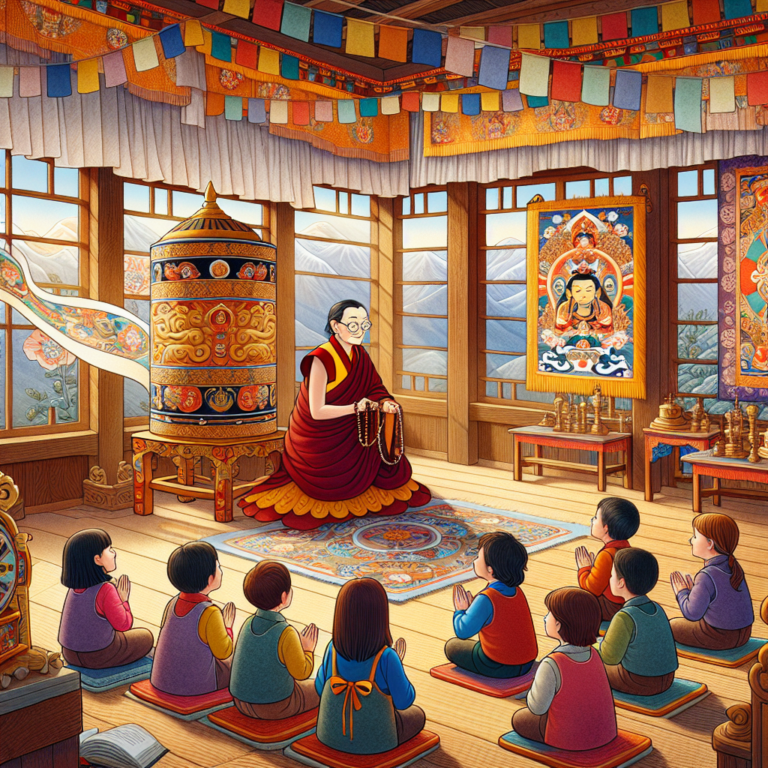
They followed the Lama through corridors decorated with intricate paintings of enlightened beings, fierce protectors, and peaceful landscapes. Finally, they entered a warm room where cushions were arranged in a circle around a small fire. The smell of juniper incense filled the air.
“Sit, sit,” Lama Dorje gestured. “Make yourselves comfortable. I shall tell you three tales today, and each one holds a teaching. But the teaching is not for me to explain – it is for you to discover.”
Chapter 3: The Tale of Dorje the Yak
“Many years ago,” the Lama began, settling onto his cushion with surprising grace for his age, “in a village not far from here, there lived a young boy named Karma and his pet yak named Dorje.”
“What’s a yak?” Liam whispered to Maya.
“a big, hairy cow that lives in the mountains,” she whispered back.
Lama Dorje’s eyes twinkled. “Indeed. Picture a cow the size of a small truck, covered in shaggy black fur, with horns like curved swords. Now, Dorje was not an ordinary yak. He was, as the villagers said, ‘blessed with opinions.’”
The children giggled.
“Karma loved Dorje dearly, but the yak was stubborn as… well, as a yak. One winter, a terrible blizzard struck the village. The snow piled higher than the houses, and the villagers ran out of food.”
“The village elder called a meeting. ‘We must send someone to the next village for supplies,’ he said. ‘But who can travel through such snow?’
“Karma stood up. ‘Dorje and I will go,’ he said. Everyone gasped. The journey was dangerous, and Karma was only twelve years old.
“His mother grabbed his arm. ‘Please, my son, let someone else go. The mountain spirits are angry. The snow will swallow you!’
“But Karma looked into Dorje’s eyes and saw something there – understanding, determination. ‘Dorje wants to help,’ he said simply.
“They set off into the white wilderness. The wind howled like hungry wolves. The snow stung their faces. Several times, Karma wanted to turn back, but each time, Dorje would grunt and push forward, breaking a path through the drifts with his massive body.”
Lama Dorje paused, pouring tea into small cups. “What do you think happened next?”
“They made it?” Sophie guessed.
“Ah, but not so easily. Halfway through the journey, they came to a frozen river. Karma knew they must cross it, but the ice groaned ominously beneath their feet. Suddenly, CRACK! The ice began to split.
“Karma froze in terror. But Dorje did something unexpected. He pushed Karma with his great head, sending the boy sliding to safety on the other bank. Then, carefully, deliberately, the yak spread his legs wide and lowered his body, distributing his weight across the cracking ice.
“Step by step, inch by inch, Dorje made his way across. When he finally reached the other side, Karma threw his arms around the yak’s shaggy neck and wept.
“‘You saved my life,’ he cried.
“Dorje simply huffed, as if to say, ‘Of course I did. Now stop crying and let us continue. We have supplies to fetch.’”
The children laughed again.
“They completed their journey, brought back food and medicine, and saved the village. From that day forward, no one ever called Dorje ‘just a stubborn yak’ again.”
Lama Dorje smiled. “The first lesson is in this tale, if you can find it.”
Maya thought carefully. “Is it about… doing brave things even when you’re scared?”
“That is one layer,” the Lama nodded. “But think also about Dorje. He was called stubborn, difficult, a problem. Yet when the moment came, his stubbornness became determination. His difficulty became strength. Sometimes what we see as faults in ourselves or others are actually gifts waiting for the right moment to shine.”
Chapter 4: The Bishop Who Laughed
“Now for a very different tale,” Lama Dorje continued. “This story comes from far to the west, from a land called Syria, about a bishop named Bar-Hebraeus who lived many centuries ago.”
“Why would a Buddhist lama tell a story about a Christian bishop?” Sophie asked, curious.
Lama Dorje spread his hands. “Wisdom has no borders, young one. Truth wears many clothes but is always the same underneath. Now listen.
“Bar-Hebraeus was a very important man – a scholar, a leader, a person others came to for advice on serious matters. But he had a secret: he loved to laugh.
“In his time, many people believed that religious leaders should always be solemn and serious. ‘A holy man does not joke,’ they said. ‘Laughter is for fools.’
“But Bar-Hebraeus disagreed. He collected funny stories from everywhere he traveled – jokes from Jewish merchants, humorous tales from Muslim scholars, silly stories from village children. He wrote them all down in a book.
“One day, a group of stern monks visited him. ‘We have heard,’ their leader said, nose in the air, ‘that you spend your time with jokes and foolishness. Is this true?’
“Bar-Hebraeus smiled. ‘It is true that I collect stories that make people smile.’
“‘But why?’ the monk demanded. ‘You are a bishop! You should be thinking only of heaven!’
“Bar-Hebraeus stood and walked to the window. ‘Tell me,’ he said, ‘do you see that bow over there?’ He pointed to a hunting bow hanging on the wall. ‘If I kept that bow strung tight all the time, what would happen?’
“The monk frowned. ‘It would break.’
“‘Exactly!’ Bar-Hebraeus clapped his hands. ‘The human heart is the same. If we keep it tight and serious all the time, it will break. Laughter is how we unstring the bow. Joy is how we rest so we can be strong again.’
“The monks left, still grumbling. But years later, when Bar-Hebraeus’s books spread throughout the land, his jokes and funny stories touched more hearts than all his serious writings combined. People remembered his wisdom because they first remembered his laughter.”
Liam was grinning. “I like that guy.”
“Many do,” Lama Dorje agreed. “He understood something important: that joy is not the opposite of wisdom – it is wisdom’s companion.”
Chapter 5: The Girl Who Faced the Mountain Spirit
“Our final tale,” Lama Dorje said, and his voice grew softer, more serious, “is about courage of a different kind.
“In the highest mountains, where the air is so thin that ordinary people cannot breathe, there lives – the old stories say – a spirit called the Yeti. Some call it a monster. Others say it is a guardian. The truth… well, the truth depends on who you are.
“Once, a young girl named Pema lived in a village plagued by fear. Livestock disappeared. Strange howls echoed at night. Footprints the size of dinner plates appeared in the snow each morning. ‘It is the Yeti!’ the villagers cried. ‘It will kill us all!’
“The men organized hunting parties, but they always returned empty-handed and more frightened than before. ‘We must abandon our homes,’ the elder declared.
“Pema, who was thirteen and known for her quiet thoughtfulness, spoke up. ‘Has the Yeti actually hurt anyone?’
“The villagers went silent. Now that they thought about it… no. The creature had taken some goats, yes. But it had never harmed a person.
“‘I will go and speak to it,’ Pema said.
“The villagers were horrified. Her father forbade it. Her mother wept. But that night, Pema slipped out of her house with a bundle of food and climbed toward the cave where the footprints originated.
“She was terrified. Her heart pounded so loudly she was sure it would give her away. The cold bit through her clothes. But she kept walking.
“At the mouth of the cave, she stopped. In the darkness, she could see two eyes glowing faintly.
“‘I have brought you food,’ Pema called out, her voice trembling. ‘I mean you no harm. I only want to talk.’
“For a long moment, nothing happened. Then, slowly, a massive shape emerged from the shadows. The Yeti was enormous, covered in white fur, with arms that could crush a tree. Its face was somewhere between a bear and something almost human.
“Pema did not run. Instead, she placed the food on the ground and sat down.
“‘Why do you take our goats?’ she asked.
“To her amazement, the creature’s mouth opened, and it spoke – not in words exactly, but in thoughts that appeared in Pema’s mind. ‘The winter has been long. My cave collapsed. I cannot reach my hunting grounds. I take only what I need to survive.’
“‘Why don’t you ask for help?’ Pema wondered.
“‘Look at me,’ the thought came, tinged with sadness. ‘When your people see me, they scream. They throw stones. They want to kill me. How can I ask for help?’
“Pema thought for a while. Then she said, ‘What if I bring you food? And in return, you help protect the village from avalanches? I’ve heard that your kind can sense when the snow is about to fall.’
“The Yeti was silent. Then, slowly, it nodded.
“Pema returned to the village and told them everything. At first, no one believed her. But winter after winter, the mysterious warnings came – a particular howl that meant ‘move the animals’ or strange marks in the snow pointing away from dangerous slopes. And the livestock disappearances stopped.
“Pema grew up to become the village leader, known throughout the region as ‘She Who Speaks to Mountains.’ But she always said her greatest achievement was not bravery – it was curiosity. ‘I was not brave enough to face a monster,’ she would say. ‘I was simply curious enough to wonder if it was a monster at all.’”
Chapter 6: The Lesson
The fire had burned low, and afternoon light streamed through the monastery windows. The children sat in thoughtful silence.
“Three stories,” Lama Dorje said softly. “A stubborn yak who became a hero. A bishop who understood that joy and wisdom walk hand in hand. A girl who turned an enemy into a friend through courage and curiosity.”
Maya found herself speaking. “They’re all about… seeing things differently. About looking past what something seems to be on the surface.”
“And not being afraid,” Liam added. “Or, being afraid but doing the right thing anyway.”
Sophie nodded slowly. “And about connection. None of the heroes in those stories could have succeeded alone. Karma needed Dorje. Bar-Hebraeus needed the people who shared stories with him. Pema needed to actually listen to the Yeti instead of just fearing it.”
Lama Dorje’s smile was like sunrise. “You see? I did not need to explain the lessons at all. You found them yourselves.”
He rose and handed each child a small stone, smooth and warm. “These are from the highest peak above our monastery. When you hold them, remember: wisdom is not something given to you. It is something you discover. And it is found not in separation from others, but in connection with them – even the most unlikely others.”
As they left the monastery that evening, the children looked back to see Lama Dorje standing at the gate, his crimson robes bright against the darkening sky. He raised his hand in blessing.
And somehow, though the mountain air was cold, they all felt warm inside.
Moral Lessons
- True wisdom comes from seeing beyond appearances, embracing joy alongside seriousness, and finding courage through curiosity and connection with all beings.
Test Your Understanding
1Who was the first character introduced in the story?
Frequently Asked Questions
What is the moral lesson of The Lama’s Tale: A Himalayan Adventure of compassion and Bravery?
What age is this story appropriate for?
How long does it take to read The Lama’s Tale: A Himalayan Adventure of Compassion and Bravery?
What culture does this story come from?
Can I use this story for teaching?
Frequently Asked Questions
What age group is The Lama’s Tale Himalayan adventure story suitable for?
The Lama’s Tale is designed for children ages 6 to 12. It works wonderfully as a bedtime story that parents can share with kids, combining an exciting Himalayan adventure with meaningful life lessons about compassion and bravery that children in this age range can understand and relate to.
What life lessons does The Lama’s Tale teach children?
The story focuses on two core values: compassion and bravery. Set against a Himalayan backdrop, children follow young characters on a journey to a mountain monastery where they encounter wisdom passed down through generations. The tale encourages empathy, courage in difficult situations, and the importance of listening to those wiser than ourselves.
Is The Lama’s Tale a good bedtime story for kids?
Yes, it’s crafted specifically as a bedtime story. The gentle pacing, vivid Himalayan scenery, and relatable child characters named Maya, Liam, and Sophie make it easy for kids to follow along while winding down. Its chapter format also makes it ideal for reading in short nightly sessions.
📚 Recommended Books
Handpicked for readers like you
As an Amazon Associate, we earn from qualifying purchases. These recommendations are personalized based on this story's themes and your reading history.
Where is The Lama’s Tale Himalayan adventure set?
The story is set in the Himalayan mountains, where three children travel to visit Pema Choling Monastery, guided by a cheerful Sherpa named Tenzin. The rich setting introduces kids to Himalayan culture, Buddhist monastery life, and breathtaking mountain landscapes in an accessible and imaginative way.
Who are the main characters in The Lama’s Tale?
The main characters are three young cousins: Maya, a twelve-year-old from Sydney; her ten-year-old brother Liam; and their fourteen-year-old cousin Sophie. Together they journey to a Himalayan monastery guided by Tenzin, a Sherpa, where they’re invited by a Rinpoche to hear ancient, wisdom-filled stories.