This moral story for children ages 6-12 combines entertainment with important values.
Chapter 1: The Temple Where Stories Live
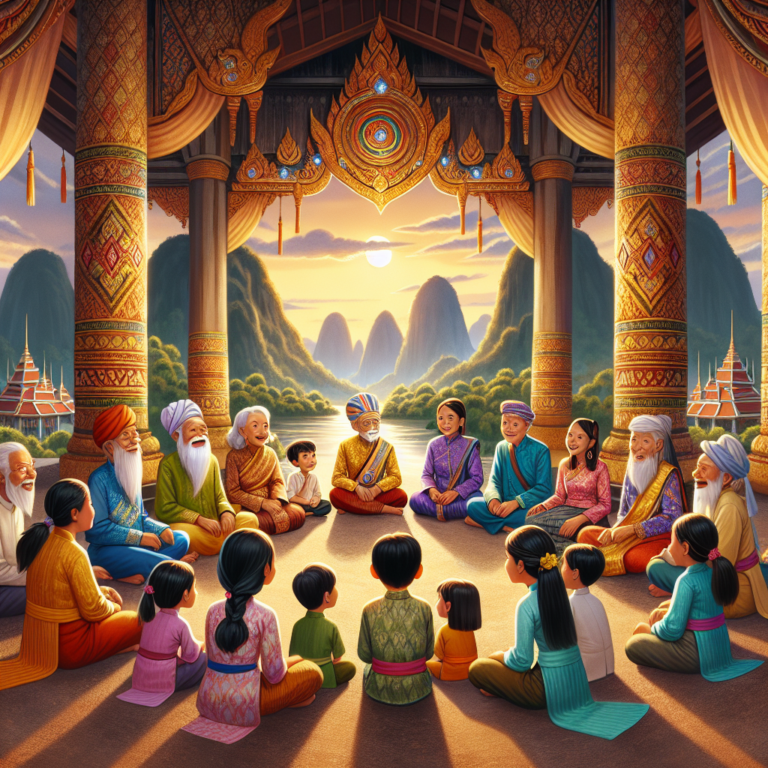
In the ancient city of Mosul, where the Tigris River flows like a ribbon of silver through golden hills, there once stood a remarkable building. It was not quite a mosque, not quite a church, not quite a synagogue. The people called it the House of Stories, though some named it the Temple of Laughter.
Four towers rose from its corners, each decorated in a different style – one with crosses, one with crescents, one with stars, and one with the sacred peacock of the Yezidis. Within its walls, storytellers from every faith and nation gathered to share their tales.
Our story begins with three children: Miriam, a Jewish girl whose father traded spices; Hassan, a Muslim boy whose mother wove the finest carpets in the city; and Shirin, a Yezidi girl whose grandmother was known as the greatest storyteller in seven villages.
These three were unlikely friends in a world that often kept people apart. They had met by accident, each hiding from afternoon chores in the cool shade of the Temple’s courtyard. And they had kept meeting, drawn by the magical stories that seemed to seep from the very stones of the building.
“I heard,” Hassan whispered one autumn afternoon, “that the Great Teller is coming tonight.”
Miriam’s eyes widened. “Bar-Hebraeus? The bishop who collects funny stories?”
“The very same,” Shirin confirmed. “My grandmother says he has gathered tales from a hundred lands. And tonight, he will share the best of them.”
Chapter 2: The Bishop’s Entrance
As the sun set and painted the sky in shades of orange and purple, the children crept into the Temple’s great hall. They found a hiding spot behind a marble pillar, just as the crowd began to gather.
Merchants sat beside mystics. Scholars debated quietly with farmers. Women in colorful headscarves settled next to men in prayer caps and turbans. The Temple of Laughter was the one place where differences seemed to dissolve like sugar in tea.
Then the door opened, and a hush fell over the assembly.
Bar-Hebraeus was not what the children expected. They had imagined someone grave and imposing, with a long beard and stern eyes. Instead, in walked a plump man with twinkling eyes and a smile that seemed permanently etched on his round face. His bishop’s robes were slightly rumpled, as if he had been too busy laughing to worry about appearances.
“Friends!” he announced, spreading his arms wide. “I have traveled from Antioch to Baghdad, from Damascus to the mountains of Anatolia. And everywhere I went, I asked people one question: ‘What makes you laugh?’”
He settled onto a cushion, accepting a cup of tea from an attendant. “Do you know what I discovered? That laughter is the one language every human speaks. A joke in Persian sounds just as funny in Arabic. A silly story makes a Yezidi grandmother giggle the same as a Jewish rabbi.”
“Tonight,” he continued, “I will share some of the tales I have gathered. But I warn you – some are wise, some are foolish, and some are both at the same time. Listen with your ears, but also with your hearts. For in every joke hides a truth, if you know how to find it.”
Chapter 3: The Clever Judge
“In Baghdad,” Bar-Hebraeus began, “there lived a judge famous for his wisdom. One day, two men came before him, both claiming to own the same donkey.
“The first man said, ‘This is my donkey, Abu! I raised him from a foal!’
“The second man insisted, ‘No, this is my donkey, Suleiman! I bought him at the market last month!’
“The judge stroked his beard. ‘Bring the donkey before me,’ he commanded.
“When the donkey was brought in, the judge studied it carefully. Then he said, ‘I will now blindfold the donkey and cover its ears. Then I will ask each of you a question.’
“He wrapped cloth around the donkey’s head. Then he turned to the first man. ‘Tell me – is your donkey blind in the left eye or the right eye?’
“The first man hesitated. ‘The… the left eye?’
“The judge turned to the second man. ‘And you?’
“The second man thought frantically. ‘The right eye!’
“The judge removed the blindfold, revealing two perfectly good eyes. ‘Interesting. And tell me – is the donkey’s tail cut short or does it have a full tail?’
“‘Short!’ said the first man.
“‘Full!’ said the second.
“The judge revealed a perfectly normal tail.
“‘And finally – is the donkey black or brown?’
“‘Black!’ shouted one.
“‘Brown!’ shouted the other.
“The judge shook his head sadly, looking at the obviously gray donkey. ‘I have never seen two men who know so little about a donkey they claim to own. Guards, take them away for wasting my time. The donkey will remain here until its true owner appears.’
“And wouldn’t you know it – within an hour, a woman came looking for her missing gray donkey, and was happily reunited with it.”
The crowd laughed heartily. Behind their pillar, the children giggled.
“You see,” Bar-Hebraeus smiled, “liars often trap themselves. The truth needs no memory – it simply is. But lies require more lies to support them, and eventually, they collapse.”
Chapter 4: The Turkish Fairy Tale
“Now,” the bishop continued, “let me share a tale from the Turkish lands, collected by a scholar who wandered through Anatolia’s villages.”
He cleared his throat and began in a singsong voice:
“Once, there was and once there wasn’t – in the old days when camels were town criers and fleas were barbers – a clever girl named Aysha who was as poor as a mouse in an empty granary.
“Aysha had nothing but a broken comb, a three-legged stool, and a grandmother who gave terrible advice. ‘Aysha!’ the grandmother would say. ‘Go marry the sultan’s son!’
“‘But grandmother, how would the sultan’s son even notice me?’
“‘That’s your problem, not mine.’
“So Aysha, who was clever, decided to think of a plan.
“She discovered that the sultan’s son loved riddles more than anything in the world. He had announced that he would marry whoever could ask him a riddle he could not solve.
“Thousands of people had tried. All had failed.
“Aysha walked up to the palace gates with nothing but her broken comb.
“‘I have a riddle,’ she told the guards.
“They laughed but let her in, expecting entertainment.
“Before the prince, Aysha bowed low. ‘Your highness, here is my riddle: I am holding something in my hand. It is broken, yet it is whole. It belongs to me, yet it has been owned by a thousand heads. It serves the rich and the poor alike. What is it?’
“The prince thought and thought. A broken thing that is whole? Owned by thousands yet belonging to one? Used by rich and poor?
“After three days, he admitted defeat.
“Aysha revealed the broken comb. ‘A comb is “broken” by design – its teeth are separate. Yet together, they form a whole tool. My comb has touched many heads before it came to me. And whether prince or pauper, all must comb their hair.’
“The prince was so delighted by her cleverness that he married her on the spot.
“And they lived happily, though the grandmother claimed credit forever after.”
Chapter 5: The Yezidi Wisdom
Bar-Hebraeus leaned forward. “Now I share a story that was told to me by a Yezidi elder in the mountains. It is perhaps not funny, but it made me smile with its wisdom.”
Shirin squeezed her friends’ hands. This was her people’s story.
“The Yezidis believe,” Bar-Hebraeus explained respectfully, “in Melek Taus, the Peacock Angel, who teaches that one’s actions in this life determine the soul’s journey.
“An old Yezidi teacher was asked by his student: ‘Master, why do people fear us? Why do they spread lies about our beliefs?’
“The teacher smiled gently. ‘Let me tell you about the river and the stones.’
“‘A river flows endlessly,’ he said. ‘It does not stop to argue with every stone in its path. If it did, it would never reach the sea.
“‘When people speak badly of us, they are like stones. If we stop to fight with every stone, we will never complete our journey. Instead, we must flow around them, wear them smooth with our patience, and continue toward the sea of understanding.’
“‘But master,’ the student pressed, ‘what if they block our path entirely?’
“‘Then we become like water,’ the teacher answered. ‘We seep into the earth and flow beneath them. We rise as rain on the other side. Nothing can truly stop water that is determined to reach its destination.’
“‘And what is our destination?’
“‘To live good lives. To help others. To return our souls to the divine a little brighter than when we received them. This is the journey. Everything else is just stones.’”
Chapter 6: The True Story of the Temple
By now, the moon had risen, sending silver light through the Temple’s windows. Bar-Hebraeus stood and stretched.
“One more story,” he said, “and this one is true.
“Years ago, this Temple was just a ruined building, used by no one. A Jewish merchant, a Muslim scholar, a Christian priest, and a Yezidi elder all happened to seek shelter here on the same stormy night.
“They sat in the darkness, each suspicious of the others.
“Then the Jewish merchant began to laugh. ‘You know,’ he said, ‘this reminds me of a joke my grandfather told me.’
“‘A joke?’ the Muslim scholar asked warily.
“‘Yes. Stop me if you’ve heard it. A merchant, a scholar, a priest, and an elder all walk into a ruined building…’
“The others couldn’t help but smile at the absurdity.
“The merchant continued with his joke, which was quite silly, about the four men trying to cook dinner with only one pot and many opinions. By the end, they were all laughing.
“Then the Muslim scholar shared a funny story. Then the priest. Then the elder.
“By morning, the storm had passed, and the four men emerged as friends. They decided that this place – where four strangers became friends through laughter – should remain a place of stories forever.
“They each contributed what they could. The merchant donated money. The scholar brought books. The priest gave beautiful decorations. The elder blessed the building with prayers.
“And that,” Bar-Hebraeus concluded, “is how the Temple of Laughter was born. Not through grand plans or powerful decrees, but through four people who discovered that a shared laugh is stronger than any wall that divides us.”
Chapter 7: The Children’s Discovery
As the crowd dispersed, chattering happily, the three children remained behind their pillar. Bar-Hebraeus was gathering his things when he suddenly turned and looked directly at their hiding spot.
“You three can come out now,” he said, his eyes twinkling. “I noticed you hours ago. You are terrible at hiding but excellent at listening.”
Red-faced, Miriam, Hassan, and Shirin emerged.
“We’re sorry,” Hassan mumbled. “We weren’t supposed to be here.”
“Nonsense,” Bar-Hebraeus waved his hand. “Children belong wherever stories are told. Tell me – what did you learn tonight?”
The three looked at each other.
“That funny stories can teach serious things?” Miriam offered.
“That people from different places tell similar tales?” Hassan added.
Shirin thought carefully. “That… that we’re more alike than we think. And that when we share stories, the things that divide us seem smaller.”
Bar-Hebraeus beamed. “You have learned in one night what some people never learn in a lifetime. Stories are bridges, my young friends. They help us cross from our world into someone else’s. And once you have stood in someone else’s world, even for a moment, you can never quite see them as a stranger again.”
He reached into his bag and pulled out three small scrolls. “Here. Each of these contains a story from a different tradition. Trade them among yourselves. Tell them to others. Keep building bridges.”
As the children left the Temple that night, scrolls tucked safely in their clothes, they made a promise to each other. They would meet every week to share stories – from their own traditions and from others. They would become collectors of tales, just like Bar-Hebraeus.
And years later, when Miriam became a merchant like her father, when Hassan became a scholar like his heroes, and when Shirin became a storyteller like her grandmother, they remembered that promise. They kept building bridges.
One story at a time.
Moral Lessons
- Laughter and stories are bridges that connect people across differences; when we share tales from our hearts, we discover our common humanity.
Test Your Understanding
1Who was Bar-Hebraeus?
Frequently Asked Questions
What is the moral lesson of Bar-Hebraeus and the Temple of Laughter?
What age is this story appropriate for?
How long does it take to read Bar-Hebraeus and the Temple of Laughter?
What culture does this story come from?
Can I use this story for teaching?
Frequently Asked Questions
Who is Bar-Hebraeus and why is he important in this story?
Bar-Hebraeus was a real 13th-century bishop and scholar known for collecting wisdom, humor, and stories from many cultures. In ‘Bar-Hebraeus and the Temple of Laughter,’ he appears as the legendary Great Teller whose tales bring together children of different faiths, making him the heart of the story’s message about shared humanity.
What age group is Bar-Hebraeus and the Temple of Laughter written for?
This moral story is written for children ages 6 to 12. It combines entertaining adventure with important values like friendship, tolerance, and respect across different cultures and religions, making it suitable for both independent readers and read-aloud sessions with younger children.
What values does the Temple of Laughter story teach kids?
The story teaches children about interfaith respect, the power of friendship across differences, and the importance of storytelling as a shared human experience. Through Miriam, Hassan, and Shirin — a Jewish, Muslim, and Yezidi child — kids learn that people from very different backgrounds can find common ground.
📚 Recommended Books
Handpicked for readers like you
As an Amazon Associate, we earn from qualifying purchases. These recommendations are personalized based on this story's themes and your reading history.
Where is the Temple of Laughter set in the story?
The story is set in the ancient city of Mosul, in present-day Iraq, where the Tigris River runs nearby. The Temple of Laughter, also called the House of Stories, is a fictional building decorated with symbols from multiple faiths, reflecting the region’s rich history of cultural and religious diversity.
Is Bar-Hebraeus and the Temple of Laughter based on real history?
The story blends real history with fiction. Bar-Hebraeus was a genuine historical figure — a 13th-century Syriac bishop and polymath who wrote books of wisdom and humor. The Temple of Laughter itself is fictional, but it is inspired by the real multicultural heritage of Mosul and the broader medieval Middle East.