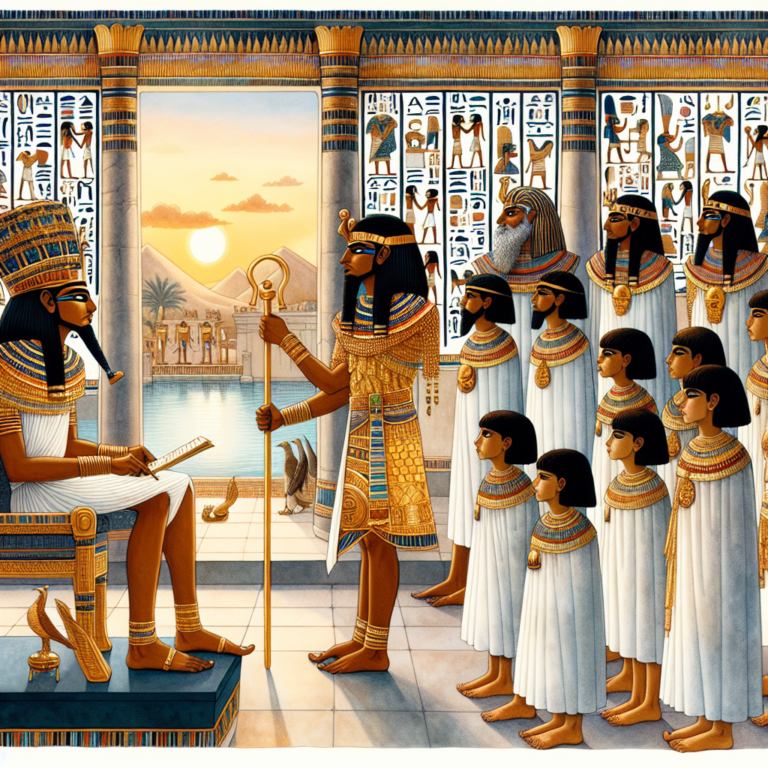
Share this engaging bedtime story with kids ages 6-12 to teach valuable life lessons.
Chapter One: The Young Pharaoh’s Question
In the land of Egypt, where the great Nile River spread its life-giving waters across the desert like a green ribbon laid upon golden sand, there ruled a young Pharaoh named Amenhotep. He had come to the throne at only fourteen years of age, after his father joined Osiris in the afterlife, and though his advisors helped him rule, Amenhotep often felt lost among the responsibilities that pressed upon his young shoulders.
One night, unable to sleep, Amenhotep climbed to the roof of his palace and gazed at the vast river of stars stretching across the sky. The Egyptians called it the celestial Nile, believing it mirrored the river below. Somewhere up there, he had been told, his father sailed with Ra in the sun boat, battling the serpent Apophis through the underworld each night so the sun could rise again each morning.
“Father,” Amenhotep whispered to the stars, “how can I be a good pharaoh when I understand so little about our gods and our people?”
The next morning, Amenhotep summoned his wisest advisor, the High Priest Khaemwaset, to the throne room. The throne room was magnificent, its walls painted with images of gods and pharaohs past, its columns carved to look like papyrus plants, and its ceiling decorated with golden stars against blue lapis lazuli.
“Khaemwaset,” the young pharaoh said, “I wish to learn the stories of our gods. Not the simple versions we sing at festivals, but the deep truths. I want to understand why the Nile floods, why the sun rises, why we live and die. Only then can I truly rule as a pharaoh should.”
The High Priest bowed low, a smile hidden in his beard. “Your father would be proud, Great One. Let us begin with Ra, the father of all.”
Chapter Two: Ra and the First Light
Khaemwaset led Amenhotep to a small chapel within the temple complex, where a single shaft of sunlight illuminated a golden disc mounted on the wall.
“In the beginning,” Khaemwaset intoned, his voice taking on the rhythm of ancient recitation, “there was only Nun, the dark waters of chaos. Nothing existed, no light, no land, no life. But within Nun, there stirred a thought, a potential, a single spark of awareness.”
“Where did the spark come from?” Amenhotep asked.
“That, Great One, is the mystery even our wisest priests cannot answer. Some say Ra created himself through the power of his own will. Others say he emerged from a cosmic lotus that bloomed upon the waters. Still others say he was formed by the thought of an even greater, unknowable force.”
Amenhotep considered this. “So even the gods have mysteries beyond their understanding?”
“Indeed. And perhaps that is the first lesson: true wisdom begins with accepting that some things are beyond even the wisest minds.”
Khaemwaset continued the story. Ra rose from the waters and, finding himself alone, created the first gods: Shu, god of air, and Tefnut, goddess of moisture. From Shu and Tefnut came Geb, the earth, and Nut, the sky. Ra separated them, placing Shu between them so that the sky arched above the earth.
“And so the world took shape,” Khaemwaset concluded. “Ra sailed his boat across the belly of Nut each day, bringing light and warmth. But even Ra grew old in time, and that led to new troubles.”
Chapter Three: The Tragedy of Osiris
Over the following days, Khaemwaset shared more stories with the young pharaoh. They walked through temple corridors covered in hieroglyphics, each panel telling a part of the sacred narratives.
“Now I must tell you of Osiris,” Khaemwaset said as they stopped before a particularly elaborate painting. “This story is perhaps the most important of all, for it explains death, rebirth, and the duty of children to their parents.”
Amenhotep studied the painting, which showed a green-skinned god wearing the white crown of Upper Egypt. “Osiris looks different from the other gods.”
“His green skin represents vegetation and rebirth. Osiris was the first pharaoh of Egypt, the son of Geb and Nut. He was wise and good, teaching the people to grow wheat and barley, to make wine and beer, to build cities and live in harmony.”
“But something went wrong,” Amenhotep guessed, seeing the dark figure in the painting’s corner.
“His brother Set grew jealous. Set was the god of chaos, of storms and the desert. He could not bear that Osiris was so beloved. So he devised a wicked plan.”
Khaemwaset described how Set built a beautiful chest and announced at a feast that whoever fit inside perfectly could keep it. When Osiris lay down in the chest, Set and his conspirators slammed the lid and sealed it with lead, throwing it into the Nile.
“Osiris drowned?” Amenhotep asked, horrified.
“Yes. But the story does not end there. Isis, Osiris’s wife and sister, was the goddess of magic and fierce devotion. She searched all of Egypt for her husband’s body, eventually finding it in a distant land where it had washed ashore.”
Chapter Four: The Power of Love and Loyalty
The High Priest continued the tale as they walked through a garden where lotus flowers bloomed in reflecting pools.
“Isis brought Osiris’s body back to Egypt to bury him properly. But Set discovered this and flew into a rage. He found the body, tore it into fourteen pieces, and scattered them throughout the land.”
Amenhotep gasped. “That’s terrible! What did Isis do?”
“She searched again, Great One. For years, she traveled the length of Egypt, gathering every piece with the help of her sister Nephthys and the jackal-god Anubis. When she had found them all, she used her magic to bind Osiris back together, wrapped in linen bandages.”
“The first mummy,” Amenhotep realized.
“Exactly so. Though Osiris could not return to the land of the living, through Isis’s love and magic, he was able to father a son: Horus, the falcon god. And Osiris became the lord of the underworld, the judge of souls, proving that death was not an ending but a transformation.”
Amenhotep sat by the pool, watching the lotus flowers float on the still water. “So Isis’s love was stronger than Set’s hatred. Stronger even than death.”
“Yes, Great One. And there is more. Young Horus grew up hidden in the marshes, protected by his mother. When he came of age, he challenged Set for the throne that rightfully belonged to his father.”
“Who won?”
“The battle lasted for eighty years. Horus lost an eye; Set lost other things equally precious. Finally, the gods held a tribunal, and Horus was declared the rightful king. This is why every pharaoh is considered the living Horus, Great One. You sit upon the throne that Horus won through courage, persistence, and righteous claim.”
Chapter Five: The Wisdom of Ma’at
Days turned to weeks as Amenhotep absorbed more stories. He learned about Thoth, the ibis-headed god of wisdom who invented writing and served as scribe to the gods. He heard tales of Hathor, the cow goddess of joy, music, and motherhood, who could transform into the fierce lioness Sekhmet when provoked. He studied the story of Anubis, guide of souls, who weighed hearts against the feather of Ma’at.
“Ma’at,” Amenhotep said one evening, as he and Khaemwaset watched the sun set over the Nile. “Her name appears in every story. Who is she truly?”
“Ma’at is more than a goddess, Great One. She is a concept, a force, a truth. She represents order, justice, harmony, and balance. Her feather is the measure against which every soul is judged. If your heart is lighter than her feather, you have lived a good life and may join Osiris in the blessed afterlife. If it is heavier, weighted with lies and cruelty, the demon Ammit will devour it.”
“That’s why pharaohs must uphold Ma’at,” Amenhotep said, understanding dawning. “We are not just rulers. We are guardians of balance itself.”
“Now you see, Great One. The gods gave us these stories not merely for entertainment, but for guidance. Ra teaches us that light can emerge from darkness. Osiris teaches us that love transcends death. Horus teaches us that the just cause will prevail. And Ma’at teaches us that balance must be maintained in all things.”
Chapter Six: The Pharaoh’s Feast
Armed with his new understanding, Amenhotep organized a great feast at the palace. He invited not just nobles and priests, but craftsmen, farmers, and common citizens from along the Nile.
As the torches flickered and music played, Amenhotep stood before his people and began to speak.
“I have spent these past weeks learning the stories of our gods,” he announced. “I learned of Ra’s eternal journey, of Osiris’s sacrifice, of Isis’s undying love, of Horus’s righteous victory. But the greatest lesson I learned is this: these stories belong to all of us.”
He gestured to the crowd. “Every day, you who farm the fields participate in Osiris’s gift of agriculture. You who create beautiful things with your hands honor Ptah, the craftsman god. You who sing and dance please Hathor. And all of us, when we live justly and care for one another, uphold the sacred Ma’at.”
The people listened, many hearing their pharaoh speak so personally for the first time.
“I vow,” Amenhotep continued, “to rule as the stories teach. With Ra’s persistence in facing darkness. With Osiris’s wisdom in nurturing growth. With Isis’s devotion to those I protect. With Horus’s courage in defending what is right. And always, always, with Ma’at’s balance guiding every decision.”
The cheers that rose from the crowd could be heard across the Nile.
Chapter Seven: The Legacy of Stories
In the years that followed, Amenhotep became one of Egypt’s most beloved pharaohs. He built temples not only to the great gods but to the minor deities beloved by common people. He established schools where children could learn the sacred stories. He ensured that even the poorest Egyptian could receive a proper burial, so all might hope to stand before Osiris and pass the weighing of the heart.
When visiting rulers asked the secret of Egypt’s prosperity, Amenhotep would smile and answer: “We tell our children the stories of the gods. Not to make them worship blindly, but to teach them the truths hidden within. That light defeats darkness. That love conquers death. That justice ultimately prevails. And that balance must be maintained in all things.”
And when Amenhotep finally joined his father in the afterlife, his heart was weighed against Ma’at’s feather and found lighter than air. He sailed with Ra across the heavenly Nile, and the stories he had championed continued to be told, generation after generation, as eternal as the stars.
Moral Lessons
- True leadership requires understanding the wisdom passed down through stories. When we learn the values of our culture, love, justice, balance, and courage, we are better prepared to guide others and live meaningful lives.
Test Your Understanding
1Who was the most powerful god according to the high priest?
Frequently Asked Questions
What is the moral lesson of The Pharaoh’s Quest for Wisdom Amongst the Stars?
What age is this story appropriate for?
How long does it take to read The Pharaoh’s Quest for Wisdom Amongst the Stars?
What culture does this story come from?
Can I use this story for teaching?
Frequently Asked Questions
What is The Pharaoh’s Quest for Wisdom Amongst the Stars about?
It’s a bedtime story about a young Egyptian Pharaoh named Amenhotep who becomes ruler at just fourteen years old. Feeling unprepared, he seeks wisdom about his gods and his people. The story blends Egyptian mythology with valuable life lessons, making it perfect for kids ages 6 to 12.
What age group is this pharaoh wisdom story suitable for?
This story is ideal for children ages 6 to 12. It uses engaging storytelling set in ancient Egypt to teach meaningful life lessons in a way that’s easy for kids to understand and enjoy, making it a great choice for bedtime reading or classroom discussions.
What life lessons does The Pharaoh’s Quest for Wisdom teach kids?
The story encourages children to seek knowledge, ask for guidance, and understand that admitting you don’t know something is a sign of strength, not weakness. Through Amenhotep’s journey, kids learn that wisdom comes from curiosity, humility, and listening to those with experience.
📚 Recommended Books
Handpicked for readers like you
As an Amazon Associate, we earn from qualifying purchases. These recommendations are personalized based on this story's themes and your reading history.
Who are the main characters in this Egyptian bedtime story?
The main character is Amenhotep, a young Pharaoh who inherits the throne at fourteen. His key advisor is the High Priest Khaemwaset, a wise figure who helps guide him. The story also draws on Egyptian mythology, referencing gods like Ra and Osiris.
Why is ancient Egypt a good setting for a children’s wisdom story?
Ancient Egypt offers rich mythology, fascinating history, and timeless themes that captivate children’s imaginations. The setting naturally supports a story about seeking wisdom, as Egyptian culture deeply valued knowledge, the gods, and the afterlife, giving young readers an exciting backdrop for learning important life lessons.