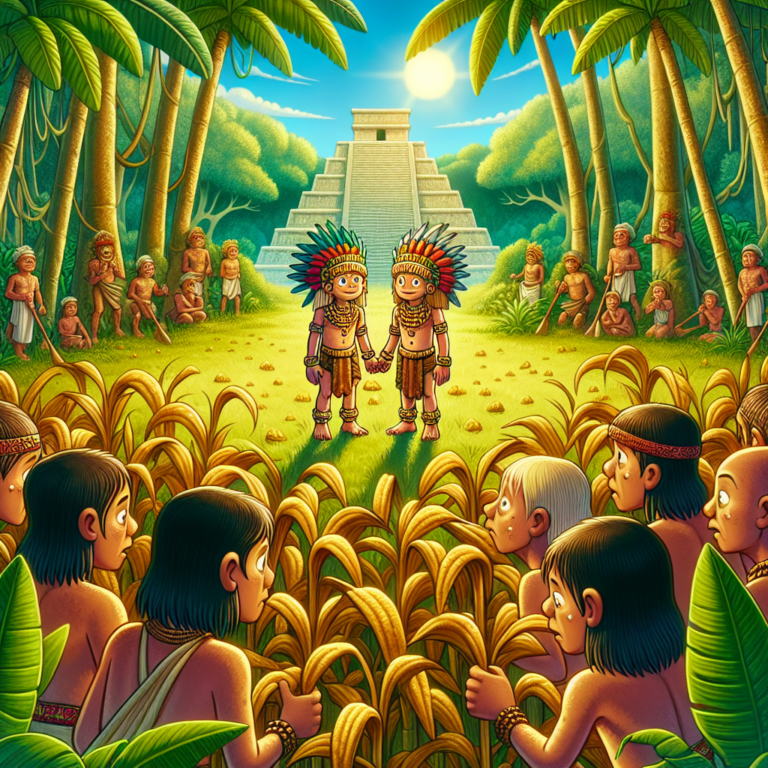
This bedtime story for kids, ‘The Brave Twins and the Mystery of the Wilting Maize’, teaches children ages 6-12 about important moral values.
Chapter 1: The Sacred Gift
In the time when gods still walked among humans and jaguars spoke prophecies in the moonlight, the Maya people lived in harmony with the world. Their villages dotted the forests like jewels, and at the heart of each village grew the sacred maize.
The maize was no ordinary crop. Long ago, the Feathered Serpent, Kukulcan, had descended from the heavens and shown the first Maya how to plant it. “This is my gift to you,” he had said, his scales shimmering with all the colors of the rainbow. “It will nourish your bodies and connect your spirits to the sky. Care for it well, and it will care for you.”
And for many generations, it did.
But one terrible morning, the Maya of the village of Xel-Ha woke to find something was wrong.
Ajaw, the village chief, was first to notice. He walked to the maize fields as the sun rose, as he did every morning, to offer thanks for the growing crops. But instead of tall, green stalks reaching toward the sky, he found leaves turning brown and curling at the edges.
“What is this?” he whispered, fear creeping into his heart.
By midday, the news had spread. The maize was dying – not just in Xel-Ha, but in every village that sent messengers. Something was draining the life from the sacred crop.
And without maize, the people would not survive.
Chapter 2: The Hero Twins
In a modest house at the edge of Xel-Ha lived two boys who were anything but modest in their gifts.
Hunahpu and Xbalanque were twins, though they looked nothing alike. Hunahpu was tall and quiet, with eyes that seemed to see things others missed. Xbalanque was shorter and quicker, with a smile that could charm birds from trees and words that flowed like water over stones.
They were known throughout the region for their cleverness. When the village was troubled by a giant bird that blocked the sun, the twins had tricked it into eating a stone covered in pitch, weighing it down until it could fly no more. When a pair of jealous giants terrorized travelers on the mountain road, the twins had challenged them to a contest, then outsmarted them so thoroughly that the giants were still trying to figure out what happened.
“If anyone can discover why the maize is dying,” Ajaw said, summoning the twins to the village center, “it is you.”
Hunahpu and Xbalanque looked at each other. A silent conversation passed between them – the kind only twins can have.
“We will need to consult the ceiba tree,” Hunahpu said. The ceiba was the world tree, its roots reaching to the underworld and its branches touching the heavens. If anything knew what was happening, it would.
“And we may need to journey far,” Xbalanque added. “Perhaps farther than anyone has gone before.”
Ajaw nodded gravely. “Then go with our blessing. The fate of our people rests with you.”
Chapter 3: The World Tree’s Warning
The great ceiba stood in a clearing sacred to the gods, its trunk wider than ten men standing arm to arm, its branches disappearing into the clouds above. The Maya believed that souls traveled up this tree to reach the heavens and down through its roots to visit the realm of the dead.
The twins approached with offerings: copal incense that sent sweet smoke spiraling upward, flowers the color of sunset, and a bowl of the freshest water from the sacred cenote.
“Great ceiba,” Hunahpu called out, “we come seeking wisdom. The maize is dying, and our people will starve. What force causes this?”
The tree was silent. Then, slowly, its bark began to shift, forming something like a face – ancient beyond imagining, patient beyond human understanding.
“The illness comes from below,” the ceiba spoke, its voice like wind through a thousand leaves. “The Lords of Xibalba have grown hungry. They reach up from the underworld to pull the life force down, down, down to feed their eternal darkness.”
Xbalanque stepped forward. “How do we stop them?”
“You cannot stop them. The Lords of Death are as eternal as death itself.” The tree paused. “But you can bargain with them. Journey to Xibalba. Find the source of their hunger. Perhaps… perhaps there is something they want more than the life of your maize.”
“How do we reach the underworld?” Hunahpu asked.
The ceiba’s bark-face creaked into something like a smile. “Through the cenote, of course. The sacred well is a doorway. But be warned: many have entered Xibalba. Few have returned.”
The brothers looked at each other again. No words were needed.
“We will go,” they said together.
Chapter 4: The Descent
The sacred cenote was a vast natural well, its waters dark and still, reflecting the sky like a mirror into another world. The Maya believed these pools were portals – places where the barrier between the living world and the underworld grew thin.
The twins stood at the cenote’s edge as dawn painted the sky pink.
“Brother,” Xbalanque said quietly, “if we don’t return…”
“We’ll return,” Hunahpu said firmly. “We always find a way.”
“Yes, but if we don’t – promise me you’ll tell the village that we went bravely.”
Hunahpu turned to his brother, surprised. Xbalanque was never serious. But in this moment, his eyes held no humor.
“We go together,” Hunahpu said, gripping his brother’s arm. “We return together. That is the only promise I will make.”
They took three deep breaths. Then they dove.
The water was cold – colder than anything they had felt above ground. They swam down and down through the darkness until their lungs burned and their eyes could see nothing. Just when Hunahpu was certain they would drown, the water ended and they tumbled onto dry stone.
They were in Xibalba.
Chapter 5: The Trials
The underworld was not what they expected. It was not fire and torment, but a strange kingdom of shadows and echoes. Bioluminescent fungi provided a ghostly blue light. Rivers of mist flowed between buildings that seemed carved from obsidian. And everywhere, there was silence – a silence so thick it felt like cloth wrapped around their ears.
“Welcome, little heroes.”
The voice came from everywhere and nowhere. Before them, two thrones materialized from the shadows, and upon them sat the Lords of Xibalba: One Death and Seven Death, rulers of this realm.
They looked almost human – almost. But their eyes were empty voids, and their smiles showed far too many teeth.
“We wondered when someone would come,” One Death said.
“We’ve been so hungry,” Seven Death added, his voice like bones scraping together. “The world above has forgotten us. No offerings. No remembrance. So we take what we need.”
“You’re draining the maize,” Hunahpu stated. “Our people’s sacred crop.”
“Sacred to you,” One Death shrugged. “To us, it is merely life force. And life force is what sustains us.”
Xbalanque stepped forward. “What would it take for you to stop?”
The two lords looked at each other. Something passed between them – amusement, perhaps.
“We will give you a chance,” Seven Death said. “Pass our trials, and we will release the maize. Fail, and you will remain here forever, your own life force added to our larder.”
“Three trials,” One Death added. “The House of Cold. The House of Jaguars. The House of Razors. Pass all three before the sun sets above – not that you can see it from here – and you win.”
“And if we pass,” Xbalanque said carefully, “you’ll leave our maize alone forever?”
“Forever is a long time,” One Death smiled his too-wide smile. “But yes. Win, and we will find our sustenance elsewhere. Do we have a bargain?”
The twins clasped hands. “We accept.”
Chapter 6: The Trials Within
The House of Cold was their first challenge – a chamber where ice covered every surface and wind howled with voices that promised warmth if only they would sleep, just rest for a moment…
But Hunahpu remembered what his grandmother had taught him about cold: “Movement is life. Stay still, and the cold wins. Keep moving, and you survive.”
They ran in place, did jumping exercises, told each other stories and jokes – anything to keep their blood flowing. When the first trial ended, their teeth chattered but their hearts still beat.
The House of Jaguars was worse. Great spotted cats prowled the darkness, their eyes gleaming with predatory intelligence. Every instinct screamed at the twins to run, but running from a jaguar was the surest way to become its prey.
“Brother,” Xbalanque whispered, “remember what Father taught us about jaguars?”
“Respect,” Hunahpu whispered back. “Show respect, and they may show mercy.”
They bowed low to the great cats, speaking soft words of admiration for the jaguar’s power and beauty. They offered the jaguars their respect as fellow hunters, as fellow creatures of the world, as beings worthy of honor.
And slowly, remarkably, the jaguars sat. They watched with curious eyes as the twins backed carefully out of the chamber, never turning away, never showing fear.
The House of Razors was the final trial. Obsidian blades filled the chamber like a forest of death, swaying and slicing through the air seemingly at random. There was no path through.
“We can’t fight them,” Hunahpu said, studying the blades. “And we can’t dodge them forever.”
“Then we think like heroes think,” Xbalanque replied. “What do the blades want?”
“Want?” Hunahpu frowned. “They’re blades. They don’t want anything.”
“Everything wants something. Even objects. What is a blade made to do?”
“Cut…”
“Cut what?”
Hunahpu’s eyes widened with understanding. “Offerings. These are sacred blades, made to cut offerings to the gods.”
Together, they pulled strands of hair from their own heads – an offering of themselves, freely given. They held up the strands and spoke words of respect to the blades, honoring their purpose, thanking them for their service.
The blades stopped. They withdrew to the walls, leaving a clear path to the door on the other side.
Chapter 7: The Bargain
One Death and Seven Death sat upon their thrones, no longer amused.
“You passed,” One Death admitted. “Clever children.”
“You remember the old ways,” Seven Death added grudgingly. “You understand that respect is the currency of all realms.”
Hunahpu stepped forward. “We won. Release the maize.”
“As promised,” One Death waved his hand. “The maize will recover. But remember this, little heroes: we released it because you won, but also because you reminded us of something we had forgotten.”
“The world above has changed,” Seven Death said. “People no longer send offerings. They no longer remember us. We grew hungry because we were forgotten, and in our hunger, we reached out the only way we knew.”
Xbalanque understood. “You weren’t trying to destroy our people. You were trying to be remembered.”
“All beings need to be remembered,” One Death said softly. “Even death.”
“Then we make you a new promise,” Hunahpu declared. “Return us safely, and we will tell our people to honor you again. Not in fear, but in respect. We will remember the dead at harvest time. We will speak the names of ancestors. We will acknowledge that Xibalba is as much a part of the world as the sky above.”
The Lords of Death were silent for a long moment. Then, for the first time, their smiles looked almost genuine.
“Go home, Hero Twins,” Seven Death said. “And keep your promise.”
Chapter 8: The Return
When Hunahpu and Xbalanque emerged from the cenote, three days had passed in the world above. Search parties had been sent. Funeral preparations had begun. Hope had nearly died.
But the twins returned.
And with them came news: the maize was already recovering. Green shoots were pushing through the soil where brown stalks had wilted. Within a month, the crop was healthier than ever.
“What did you do?” Ajaw asked in wonder.
“We made a bargain,” Xbalanque said simply. “And we remembered an important truth: everything in the world – above and below – is connected. When we forget part of the world, we harm the whole.”
From that time forward, the Maya held special ceremonies at harvest time to honor both the living and the dead. They remembered that the underworld was not simply a place of fear, but a necessary part of the great cycle. They kept their promise.
And the Hero Twins? They had many more adventures, each one teaching them and their people valuable lessons about courage, cleverness, and the power of respect.
But that is another story, for another time.
Moral Lessons
- Respect for all parts of existence – including death and the ancestors – maintains balance in the world; courage combined with cleverness can overcome any challenge.
Test Your Understanding
1Who were the Hero Twins?
Frequently Asked Questions
What is the moral lesson of The Brave Twins and the Mystery of the Wilting Maize?
What age is this story appropriate for?
How long does it take to read The Brave Twins and the Mystery of the Wilting Maize?
What culture does this story come from?
Can I use this story for teaching?
Frequently Asked Questions
What is ‘The Brave Twins and the Mystery of the Wilting Maize’ about?
It’s a bedtime story for kids aged 6-12 set in ancient Maya times. The story follows brave twins who must solve the mystery of why their village’s sacred maize is dying. It blends Mayan mythology with moral lessons about courage, responsibility, and caring for nature.
What age group is the Wilting Maize story suitable for?
The story is written for children aged 6 to 12. The adventurous plot and mythological elements keep older kids engaged, while the simple moral values and vivid storytelling make it accessible and enjoyable for younger children too, especially as a bedtime read-aloud.
What moral values does this kids’ story teach?
The story teaches children important values including bravery, community responsibility, and respect for nature. Through the twins’ journey to save the sacred maize, kids learn that courage means acting even when things are uncertain, and that caring for shared resources benefits everyone.
📚 Recommended Books
Handpicked for readers like you
As an Amazon Associate, we earn from qualifying purchases. These recommendations are personalized based on this story's themes and your reading history.
Is the Wilting Maize story based on real Mayan mythology?
Yes, the story draws on authentic Mayan mythology. It features Kukulcan, the Feathered Serpent deity, and centers on maize, which held deep sacred significance in Maya culture. These real mythological elements give the story cultural richness while making it educational alongside being entertaining.
Why is maize so important in this bedtime story for kids?
In the story, maize is a sacred gift from the god Kukulcan, meant to nourish both bodies and spirits. When it begins wilting, the entire village is threatened. This makes the maize a powerful symbol, helping children understand how communities depend on shared resources and why protecting them matters.