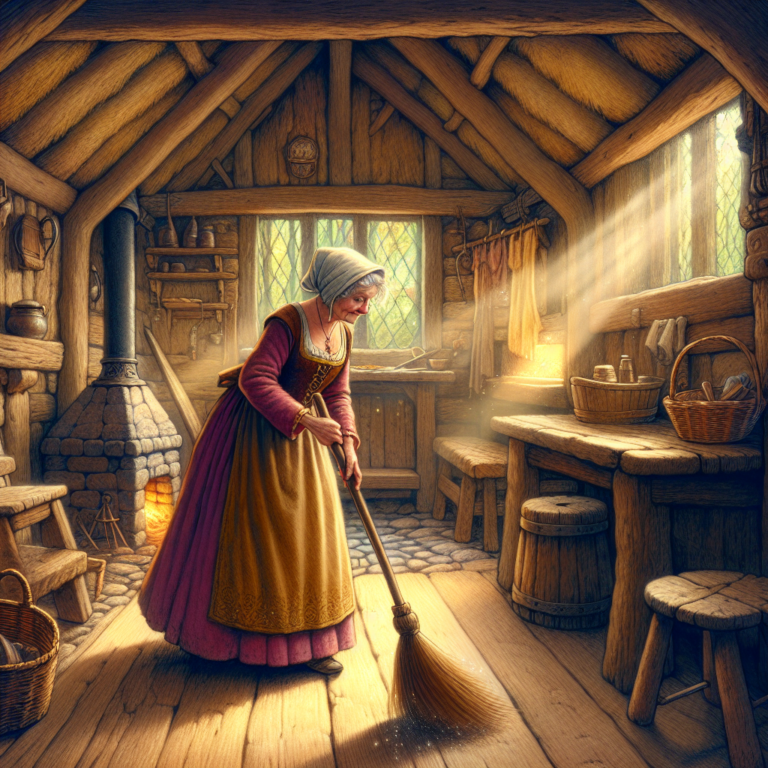
‘Gerald’s Magical Journey to the Book of Shadows’ is an educational moral story perfect for bedtime reading with children ages 6-12.
Chapter 1: The Curious Discovery
In the attic of Thornbury House, beneath dust cloths and cobwebs, twelve-year-old Emma Mitchell found a most unusual book.
It was not large – about the size of a school notebook – but its cover was strange. Leather, certainly, but embossed with symbols Emma had never seen before: a crescent moon, a five-pointed star, and what looked like a twisted tree.
“Gran!” Emma called down the attic stairs. “What’s this old book?”
Her grandmother, Margaret Mitchell, climbed up with the careful steps of someone who had navigated those stairs many times over eighty years. Her eyes widened when she saw what Emma held.
“Well, well,” Gran said softly, taking the book with gentle hands. “I thought this had been lost ages ago. This belonged to my grandmother, your great-great-grandmother. She was… something of a collector of unusual knowledge.”
“What kind of knowledge?” Emma asked, her curiosity growing.
Gran smiled mysteriously. “The kind of knowledge that asks questions other people have forgotten to ask. Questions about why we celebrate certain holidays, why we tell certain stories, why some places feel special and others don’t.” She handed the book back to Emma. “Would you like to learn?”
Chapter 2: The Keeper of Stories
That evening, Gran made tea in the old way, with loose leaves and a proper pot, and sat Emma down in the library.
“To understand this book,” Gran began, “you need to understand the people who created it. Let me tell you about three searchers who lived about seventy years ago.”
She opened the book to its first page, where a name was written in careful script: Gerald Gardner.
“Gerald was a man who spent most of his life in far-off places – Malaya, Cyprus, Palestine. He studied the customs of the people he met, and he noticed something interesting: people everywhere, in every culture, had similar ways of celebrating the seasons and honoring nature.”
“Like how lots of cultures have festivals in winter?” Emma asked.
“Exactly! Gerald wondered why this was. Were these just coincidences? Or were they echoes of something very old – ways of understanding the world that humans had practiced for thousands of years before anyone wrote them down?”
Gran turned to a page filled with handwritten notes about seasonal celebrations.
“Gerald became especially interested in British folk customs – the maypole dances, the harvest festivals, the midwinter celebrations. He believed these weren’t just quaint traditions but surviving pieces of an ancient way of seeing the world. A way that honored nature, celebrated the turning of the seasons, and saw the divine in the everyday world around us.”
Chapter 3: The Poet’s Quest
“The second searcher,” Gran continued, “was a poet named Robert Graves.”
She showed Emma a page with a drawing of a full moon reflected in still water.
“Robert was fascinated by poetry – not just how to write it, but where it came from. He noticed that the oldest poems, the myths and legends from ancient times, often spoke of a powerful feminine divine being. A goddess associated with the moon, with the cycles of nature, with birth and death and rebirth.”
“Like Diana? We learned about her in school – the Roman moon goddess.”
“Yes! And Luna, and Artemis, and Brigid, and so many others. Robert wondered: why did so many different cultures, who had never met each other, imagine such similar goddess figures? Was it just chance, or did it point to something deeper about how humans experience the world?”
Emma leaned forward, intrigued. “What did he decide?”
“He wrote a book called ‘The White Goddess,’ arguing that these goddess stories were memories of very ancient beliefs – beliefs that had been pushed aside as newer religions spread, but never quite forgotten. They survived in folk songs, in nursery rhymes, in the names of hills and rivers and sacred wells.”
Gran closed the old book for a moment and looked at Emma seriously. “Now, not everyone agreed with Robert’s ideas. Scholars argued about his theories for decades. But whether he was right about history or not, he made people ask important questions: What have we forgotten? What wisdom might be hiding in old stories? What can we learn from how our ancestors saw the world?”
Chapter 4: The Question Asker
“The third searcher,” Gran said, “was a woman named Margaret Murray.”
“Like your name!” Emma exclaimed.
“Yes, I was named after her, actually. My grandmother admired her greatly.” Gran smiled. “Margaret was an archaeologist and a scholar. She asked a dangerous question – dangerous because it made many people uncomfortable.”
“What question?”
“She asked: What if the people who were accused of witchcraft in the old days weren’t evil? What if they were simply practicing an older religion, one that the newer religions didn’t understand?”
Emma thought about this. In school, they had learned about the witch trials in history – the fear and persecution and injustice.
“Now,” Gran continued carefully, “Margaret’s theories about this weren’t entirely accurate. Later historians found that the reality was more complicated – that the witch trials were often about politics, land, power, and fear rather than any surviving ancient religion. But Margaret’s question was still valuable.”
“Why?”
“Because it made people think differently about the past. It reminded them that ‘witch’ was often just a word used against people who were different – healers, wise women, people who knew about herbs and nature, or simply people who were disliked by their neighbors. Asking ‘what really happened?’ and ‘who were these people really?’ – these are important questions, even if the answers aren’t always what we first imagine.”
Chapter 5: The Gathering
Emma turned the pages of the old book, finding drawings of flowers, notes about moon phases, recipes that looked like medicine, and songs written in a careful hand.
“So what is this book exactly?” she asked.
“It’s a Book of Shadows,” Gran said. “A personal journal where someone who followed this nature-based path would write down what they learned – poems, observations of nature, meaningful thoughts, traditions they wanted to remember.”
“Like a diary?”
“Something like that, but focused on wisdom rather than daily events. The idea was that each person would create their own book, adding to and changing it as they learned and grew. No two Books of Shadows were identical because no two people’s spiritual journeys are identical.”
Emma ran her fingers over the handwritten pages. “Why is it called Book of Shadows?”
“There are different explanations. Some say it’s because the knowledge within is like shadows – glimpses of something larger that we can’t fully see. Others say it’s because these traditions were often kept quiet, practiced in the shadows rather than openly.”
Gran leaned back in her chair. “Your great-great-grandmother was fascinated by nature and the old country ways. She wasn’t part of any formal group, but she kept this book as her way of remembering the wisdom she found valuable – folk traditions, seasonal celebrations, lessons from the natural world.”
Chapter 6: The Lesson
“Gran,” Emma said thoughtfully, “why are you telling me all this?”
Gran was quiet for a moment. “Because you’re old enough now to understand something important: there are many different ways people try to understand the world and find meaning in it. Some people find it through organized religions. Some through science. Some through art or music. And some – like Gerald and Robert and Margaret and your great-great-grandmother – find it by studying old traditions and the natural world.”
“Which way is right?”
“That’s a question every person has to answer for themselves. But here’s what I think is important: respect. Respect for different paths, even if they’re not your own. Respect for the seekers who came before us, even when their ideas turned out to be wrong. Respect for questions, even when we don’t have all the answers.”
She tapped the Book of Shadows. “This book doesn’t contain magical spells or hidden secrets. It contains one person’s attempt to understand the world – to notice the changing seasons, to appreciate the wisdom in old stories, to feel connected to nature and to history. That’s not magic. That’s being human.”
Chapter 7: The Continuation
The next morning, Emma asked Gran for a blank notebook.
“Starting your own Book of Shadows?” Gran asked with a knowing smile.
“I don’t know if that’s what I’d call it,” Emma said. “But I want to write down the things I learn. About nature, and stories, and… I don’t know. Things that seem important.”
“What will you start with?”
Emma thought about it. Through the window, she could see the garden, where autumn was just beginning to turn the leaves golden.
“I think I’ll write about the seasons. Why we celebrate harvest festivals. Where Halloween really comes from. That kind of thing.”
“A fine beginning,” Gran said.
“And Gran? Thank you for telling me about the searchers. Gerald and Robert and Margaret. Even if some of their ideas were wrong, it’s nice to know that people asked the questions.”
Gran hugged her. “That’s the real wisdom, you know. Not having all the answers, but being brave enough to ask the questions. And keeping a record for those who come after, so they can keep searching too.”
Emma wrote the first entry in her new notebook that afternoon, while sitting under the old oak tree in the garden. She wrote about autumn, and about questions, and about the idea that wisdom isn’t something you find in one place – it’s something you gather, bit by bit, over a lifetime.
Like leaves collected in a book. Like shadows dancing in the light.
Moral Lessons
- Wisdom comes from asking questions and respecting different paths to understanding; keeping records of what we learn helps future generations continue the search for meaning.
Test Your Understanding
1Who found the Gardnerian Book of Shadows?
Frequently Asked Questions
What is the moral lesson of Gerald’s Magical Journey to the Book of Shadows?
What age is this story appropriate for?
How long does it take to read Gerald’s Magical Journey to the Book of Shadows?
What culture does this story come from?
Can I use this story for teaching?
Frequently Asked Questions
What is Gerald’s Magical Journey to the Book of Shadows about?
It’s an educational moral story following young Emma Mitchell, who discovers a mysterious ancient book in her grandmother’s attic. The story explores themes of curiosity, family history, and hidden knowledge, making it perfect bedtime reading for children ages 6 to 12.
What age group is the Book of Shadows story suitable for?
Gerald’s Magical Journey to the Book of Shadows is written for children aged 6 to 12. It combines an engaging adventure storyline with moral lessons, making it ideal for parents and grandparents to read aloud together with younger children at bedtime.
Is this story appropriate for young children given it mentions a Book of Shadows?
Yes, it’s completely child-friendly. The Book of Shadows in the story is presented as a collection of unusual knowledge about holidays, traditions, and special places. It’s framed as an educational and magical discovery rather than anything scary or inappropriate for kids.
📚 Recommended Books
Handpicked for readers like you
As an Amazon Associate, we earn from qualifying purchases. These recommendations are personalized based on this story's themes and your reading history.
What moral lessons does this children’s story teach?
The story encourages curiosity, respect for family history, and asking thoughtful questions about the world around us. Through Emma’s discovery and her grandmother’s guidance, children learn the value of exploring knowledge passed down through generations and staying open to wonder.
Can I read Gerald’s Magical Journey to the Book of Shadows as a bedtime story?
Absolutely. It’s specifically designed as a bedtime story for children ages 6 to 12. The gentle pacing, relatable young characters, and imaginative setting make it easy to read in chapters, giving kids something to look forward to each night without being too stimulating before sleep.