

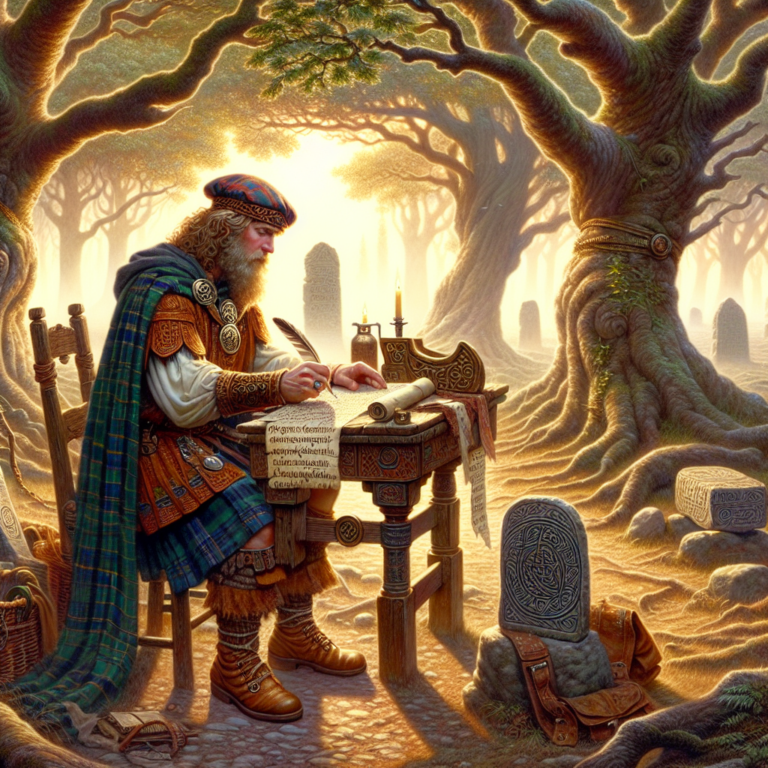
This moral story for children ages 6-12 combines entertainment with important values.
Chapter 1: The Dreamer’s Call
In the misty valleys of Gwynedd, where mountains wore crowns of cloud and rivers sang songs older than memory, there lived a young man named Llewelyn ap Cadwgan. He was fifteen summers old, trained in the ways of warriors as befitted his father’s son, but his heart pulled him toward something else entirely.
Llewelyn dreamed.
Not the ordinary dreams that come and go like wind through wheat. Llewelyn dreamed true dreams – visions that showed him glimpses of things that were, things that might be, and things that must not be forgotten.
“You have the sight,” his grandmother told him one winter evening, feeding peat to the fire in their stone cottage. “It runs in our family, skipping generations like a stone across water. My grandfather had it. I do not. But you…”
“What do I do with it, Mamgu?” Llewelyn asked, using the Welsh word for grandmother. “The dreams show me people I don’t know, places I’ve never been, words in a language I almost understand.”
“You must find a teacher,” his grandmother said. “Someone who can help you understand what you see. There is a Druid who lives in the sacred grove beyond the mountains – Iolo, they call him. Iolo of the Prophecies. He might be able to guide you.”
Llewelyn’s father, a practical man who valued swords over songs, scoffed at the idea. “Druids are relics of a dead past. There is no place for such things in the modern world.”
But that night, Llewelyn dreamed of an oak tree so vast its branches touched the stars, and beneath it sat an old man with eyes like deep wells, waiting.
At dawn, Llewelyn began his journey.
Chapter 2: The Path Through Memory
The road to the sacred grove wound through countryside that seemed to exist half in this world and half in another. Llewelyn passed standing stones that hummed with faint energy when he touched them. He crossed bridges over streams that whispered his name as he walked above. He rested in the shade of hawthorn trees that, according to old stories, marked the boundaries between the mortal realm and the Otherworld.
On the third day, he met a girl his own age sitting beside the road, weaving a crown of wildflowers.
“Going to see old Iolo, are you?” she asked without looking up.
Llewelyn stopped, startled. “How did you know?”
“You have the look of a seeker. Plus, you’re walking toward the sacred grove, and no one goes there unless they’re looking for the Druid.” She finally looked up, and Llewelyn saw that her eyes were the color of storm clouds. “I’m Rhiannon. Named after the queen of the Otherworld, though I’ve never been there myself. Yet.”
“I’m Llewelyn.”
“I know. I dreamed about you last night.”
Llewelyn felt a chill that had nothing to do with the mountain breeze. “You have the sight too?”
“Mamgu says I have just enough to be inconvenient,” Rhiannon grinned, standing and dusting off her skirt. “Mind if I walk with you? I’ve been waiting three days for you to show up, and I’d hate to miss whatever happens next.”
Chapter 3: The Druid’s Grove
The sacred grove was hidden in a valley that didn’t appear on any map. Rhiannon led the way, following paths that seemed to shift and change when Llewelyn wasn’t looking directly at them.
“The grove protects itself,” Rhiannon explained. “Only those who are meant to find it ever do.”
They emerged through a curtain of hanging willow branches into a clearing that took Llewelyn’s breath away.
Ancient oaks formed a perfect circle, their branches interweaving overhead to create a living cathedral. Moss covered everything in shades of green so deep they seemed to glow. In the center stood a single stone altar, and beside it sat an old man wrapped in a grey cloak.
He looked exactly as he had in Llewelyn’s dream.
“You came,” Iolo said, his voice surprisingly strong for someone who appeared so ancient. “Good. I was beginning to wonder if I’d have to send another dream. The first three didn’t seem to take.”
“I came as fast as I could,” Llewelyn said.
“And you brought a friend. Also good. Some journeys shouldn’t be made alone.” Iolo rose, using a staff carved with spiraling patterns. “Sit, both of you. You want to understand your dreams, young Llewelyn. But to do that, you must first understand where dreams come from.”
Chapter 4: The Three Worlds
“The ancients,” Iolo began, settling back onto his stone seat, “understood that the world is not one thing, but many things layered together like the pages of a book.”
He drew a vertical line in the earth with his staff. “There is the Upperworld – the realm of sky, of eagles, of stars and storms and the souls who have passed beyond this life. When we look up and feel small and awed, we touch the Upperworld.”
He drew a circle at the bottom of the line. “There is the Underworld – not a place of punishment, but a place of roots. Where the ancestors dwell. Where seeds sleep before they grow. Where the foundations of everything rest.”
Finally, he drew a circle in the middle. “And there is this world – the Middle World, where humans live and love and struggle and grow. Where the Upperworld and Underworld meet and mingle.”
“The dreams I have,” Llewelyn said slowly, “they come from all three, don’t they?”
“You see truly. The sight is the ability to perceive all three worlds at once. Most people see only the Middle World, and even that, not very clearly. But some – like you, like Rhiannon, like me – see the connections. We see how what happened in the Underworld of the past affects the Middle World of the present. We glimpse how the Upperworld of possibility touches what is yet to come.”
Rhiannon leaned forward. “And the Druids – the old Druids – they were the ones who could see most clearly?”
“The Druids were teachers, judges, healers, and keepers of memory. They held the stories of our people – not just tales for entertainment, but the deep memories that tell us who we are and where we came from.” Iolo’s eyes grew sad. “Much has been lost. The old Romans, then the Saxons, then time itself – all have eroded what was once known. But some of us keep trying to remember.”
Chapter 5: The Red Book
Iolo rose and walked to a hollow in one of the great oaks. From it, he withdrew a bundle wrapped in oiled cloth.
“This is a copy,” he said, unwrapping it to reveal an ancient book bound in faded red leather. “The original – the Red Book of Hergest – is kept at a college in Oxford. But the stories within it are older than any book. They were told around fires for a thousand years before anyone wrote them down.”
He opened the book carefully, and Llewelyn saw pages filled with flowing script in a language that seemed both familiar and strange.
“Here are the tales of the Mabinogi – the stories of Pwyll and Rhiannon, of Branwen and Bran the Blessed, of Manawydan and Math. Here are the first stories of Arthur, older than the versions the English tell. Here are our ancestors, preserved in words.”
Rhiannon gasped softly. “Is that why I was given her name? Rhiannon from the stories?”
“Perhaps your parents felt the connection without knowing why. Names have power. When we name our children after the old heroes, we invite those heroes to guide them.” Iolo handed the book to Llewelyn. “Read. Learn. Remember.”
Chapter 6: The Lesson of the Trees
Over the following weeks, Llewelyn and Rhiannon stayed in the grove, learning from Iolo. They learned to identify sacred trees and understand their meanings – oak for strength and wisdom, ash for connection between worlds, yew for eternal life and death’s doorway.
They learned the importance of the oral tradition – how stories told aloud create a bond between teller and listener that written words cannot match.
They learned about the great festivals that marked the turning of the year: Imbolc in early spring, Beltane when summer came, Lughnasadh at harvest, and Samhain when the veil between worlds grew thin.
But most importantly, they learned about their own gifts.
“Your dreams,” Iolo told Llewelyn one evening, “are messages from the ancestors. They show you what was so that you can understand what is. Never ignore them, but do not be enslaved by them either. The past informs the present – it does not control it.”
“And my sight?” Rhiannon asked. “What is its purpose?”
“Your gift is different,” Iolo said thoughtfully. “You see possibilities. The branching paths of what might be. This is perhaps the most difficult sight, because you will see many futures, and most will never come to pass. Your task is not to choose among them, but to understand them – to help others see the choices before them clearly.”
Chapter 7: The Return
When autumn painted the grove in gold and crimson, Llewelyn and Rhiannon knew it was time to return home.
“You have learned well,” Iolo said, standing beneath the great central oak. “But remember: what I have taught you is not for yourselves alone. It is meant to be shared.”
“How do we share it?” Llewelyn asked. “My father doesn’t believe in the old ways. Most people have forgotten.”
“You share it by living it,” Iolo replied. “By telling the stories at firesides. By marking the festivals with your families. By remembering the ancestors not as distant figures but as people who faced challenges just as you do, and whose wisdom still has value.”
He placed a gnarled hand on each of their shoulders. “The old ways are not about returning to the past. They are about carrying forward what was good, what was wise, what was true. Every generation must do this, or the thread breaks.”
“Will we see you again?” Rhiannon asked.
Iolo smiled mysteriously. “Perhaps in this world. Certainly in dreams. The connections between those who share the sight are never truly broken.”
Chapter 8: The Song Continues
Llewelyn returned to Gwynedd changed. His father still didn’t understand him, but his grandmother listened eagerly to everything he had learned, her old eyes bright with remembered stories.
“Your great-great-grandfather knew these tales,” she said. “I had forgotten so many. Thank you for bringing them home.”
On the first day of winter, Llewelyn gathered the children of his village and told them the story of Pwyll’s journey to the Otherworld – how a prince learned humility and honor through a year spent in another’s body, living another’s life.
At first, only a few children came. Then their parents. Then their grandparents. By midwinter, the entire village gathered to hear Llewelyn speak.
“You have a gift,” his father admitted one night, grudging respect in his voice. “I don’t understand it. But I can see that it matters to people.”
Rhiannon became a healer, combining practical medicine with the old wisdom of plants and seasonal rhythms. She and Llewelyn wrote to each other often, sharing dreams and visions and the continuing story of their learning.
And in the sacred grove, old Iolo continued his work, knowing that the thread had not broken – that new weavers were adding their patterns to the ancient tapestry.
The song of Wales continued.
Moral Lessons
- Our heritage and the wisdom of our ancestors are precious gifts that must be actively remembered and passed on; knowledge shared is knowledge that survives.
Test Your Understanding
1Who was Iolo Morganwg?
Frequently Asked Questions
What is the moral lesson of Llewelyn’s Quest in the Enchanted Land of Ancestral Whispers?
What age is this story appropriate for?
How long does it take to read Llewelyn’s Quest in the Enchanted Land of Ancestral Whispers?
What culture does this story come from?
Can I use this story for teaching?
Frequently Asked Questions
What is Llewelyn’s Quest in the Enchanted Land of Ancestral Whispers about?
Llewelyn’s Quest is a moral story for children ages 6 to 12 set in the misty valleys of ancient Wales. It follows fifteen-year-old Llewelyn, a young man with the gift of prophetic dreams, as he embarks on a journey to find a Druid teacher who can help him understand his mysterious visions and ancestral heritage.
What age group is Llewelyn’s Quest suitable for?
Llewelyn’s Quest is written for children between 6 and 12 years old. It blends exciting adventure storytelling with meaningful moral values, making it ideal for both independent readers and parents or teachers reading aloud to younger children in that age range.
What values and lessons does Llewelyn’s Quest teach children?
The story explores themes like self-discovery, embracing unique gifts, seeking wisdom from elders, and honouring cultural heritage. Through Llewelyn’s journey, children learn the importance of listening to ancestral wisdom, having courage to follow your calling, and understanding that being different can be a special strength.
📚 Recommended Books
Handpicked for readers like you
As an Amazon Associate, we earn from qualifying purchases. These recommendations are personalized based on this story's themes and your reading history.
Is Llewelyn’s Quest based on Welsh mythology or folklore?
Yes, Llewelyn’s Quest draws heavily from Welsh culture and folklore. It is set in Gwynedd, features a Druid character, references the Welsh gift of ‘the sight,’ and uses authentic Welsh words like ‘Mamgu’ for grandmother. The story weaves real Welsh traditions and mythology into its enchanting narrative.
What makes Llewelyn’s Quest a good bedtime or read-aloud story?
Llewelyn’s Quest features lyrical, descriptive language, a gentle pace, and a richly imagined world full of mountains, rivers, and ancestral magic. Its chapters are structured to hold children’s attention while delivering comforting moral messages, making it a perfect choice for bedtime reading or classroom storytelling sessions.
