

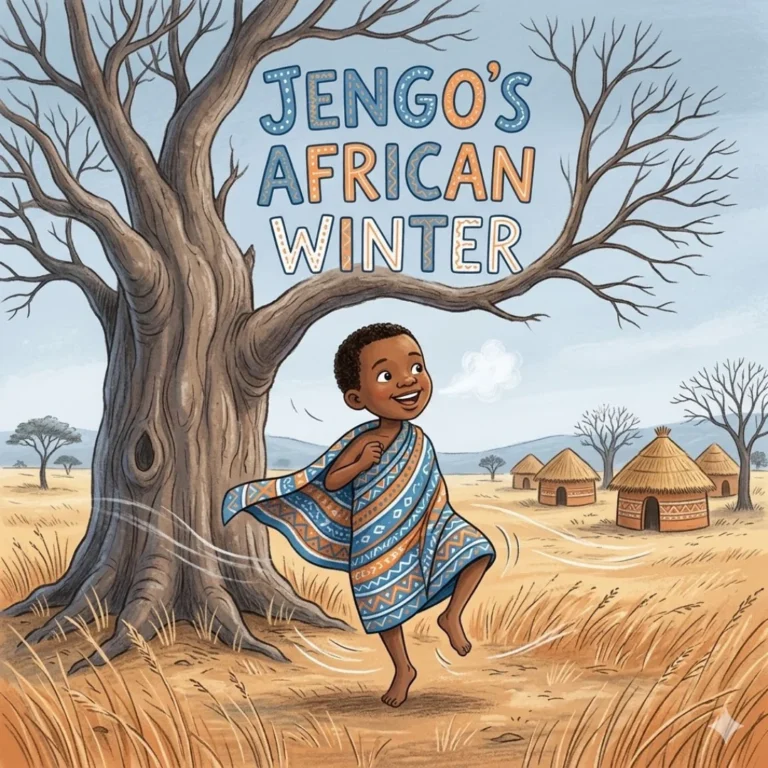
This bedtime story for kids, ‘Jengo’s Joyful Dance with the Winter Wind’, teaches children ages 6-12 about important moral values.
Elder Jengo’s weathered hands trembled as he tightened his worn blanket around his shoulders. The morning air bit at his skin, sharp and cold like tiny ice crystals dancing on the wind. But Jengo’s eyes sparkled with excitement as he gazed toward the eastern hills, where the sun was just beginning to paint the sky with streaks of gold and orange.
“Today,” he whispered to himself, a smile creeping across his wrinkled face. “Today the West Wind returns.”
From his small wooden stool outside his hut, Jengo could see the entire village still sleeping beneath a blanket of morning mist. Smoke curled lazily from a few early cooking fires, and somewhere in the distance, a rooster crowed its wake-up call. The old baobab tree in the village center stood silent and majestic, its massive trunk casting long shadows across the dusty ground.
Jengo closed his eyes and listened. There! A soft rustling in the acacia trees to the west. The sound grew stronger—a gentle whooshing that made the grass bend and sway like ocean waves. His heart quickened with joy.
“Old friend!” Jengo called out, rising to his feet with surprising speed for someone his age. “I’ve been waiting for you!”
The wind swept through the village, sending dust swirling in playful spirals. Leaves danced through the air, catching the golden morning light and sparkling like tiny bronze coins. And then, right before Jengo’s eyes, the wind seemed to take shape—a shimmering, translucent figure that moved like water flowing uphill.
“Jengo!” the West Wind’s voice was everywhere at once—in the rustling leaves, in the creaking branches, in the very air itself. “How could I visit our village without greeting you first? You’re the only one who still remembers the old ways, the old wisdom.”
Jengo’s smile grew wider. “Come, walk with me through the village. Let’s see what wonders you’ll bring today.”
Together they moved between the round mud huts with their thatched roofs. The West Wind swirled gently around Jengo, lifting his blanket and ruffling his gray hair. Chickens scattered in surprise, clucking indignantly. A goat bleated as its ears flapped in the sudden breeze.
“The children have forgotten about me,” the West Wind said, and Jengo could hear sadness in its voice. “They no longer look up when I pass. They no longer dance when I bring fresh air from distant lands.”
“Ah,” Jengo nodded thoughtfully. “But that’s because they’ve forgotten to really SEE, my friend. Come, let’s remind them.”
As if on cue, a small girl emerged from one of the huts, rubbing sleep from her eyes. Little Nia yawned widely, her braids still messy from sleep. She stopped short when she saw Elder Jengo standing in the village center, his arms spread wide, his eyes closed in concentration.
“Elder Jengo?” Nia called out, curious. “What are you doing?”
Jengo opened one eye and winked at her. “I’m listening to an old friend tell stories. Come closer, child. Be very still and listen.”
Nia tiptoed closer, her bare feet silent on the cool earth. Other children began to emerge from their homes, drawn by the strange sight of their village elder standing like a statue in the dawn light.
“I don’t hear anything,” whispered Nia’s friend Kofi, scratching his head.
“Shh!” Nia pressed a finger to her lips. “Listen harder.”
The children formed a circle around Jengo, their faces scrunched in concentration. And then—they felt it. The West Wind wrapped around them like a gentle hug, warm despite the winter cold. It whispered in their ears, tickled their noses, made their clothes flutter and dance.
“It’s alive!” gasped Nia, her eyes going wide with wonder. “The wind is ALIVE!”
“Of course I am,” the West Wind seemed to laugh, and suddenly all the children could hear it. “I’ve been bringing messages from far-off lands, carrying seeds to grow new plants, pushing storm clouds away to give you sunshine. But you never noticed.”
Kofi’s mouth dropped open. “You… you can talk?”
“Everything speaks, young one,” Jengo said softly, his voice warm as honey. “The wind, the trees, the very earth beneath your feet. You just have to learn their language. And their language is connection—Ubuntu. We are all part of one great story, and when one part changes, everything else changes too.”
The West Wind began to swirl faster, lifting dried leaves in a spiral that climbed higher and higher into the sky. The children laughed and spun with it, their arms outstretched, their faces tilted toward the sun.
“When I sweep away the old, cold air,” the West Wind explained, “I make room for something new and fresh. When you help each other, you do the same thing—you clear away sadness and make room for joy. Every kind word, every helping hand, every smile changes the air around you.”
Nia suddenly understood. She grabbed Kofi’s hand and then reached for another child’s hand. Soon all the children were holding hands in a circle, spinning together as the West Wind danced around them.
“We’re like the wind!” Nia shouted, laughing. “When we work together, we can change things! We can make our village brighter!”
Elder Jengo watched with tears of joy streaming down his weathered cheeks. The sun had fully risen now, bathing everything in warm golden light. The West Wind began to calm, settling gently into a soft breeze that made the grass whisper secrets.
“I must continue my journey,” the West Wind said, its voice growing fainter. “But I’ll return again, as I always do. Remember, children—you carry the wind inside you. Use it to sweep away darkness and bring light wherever you go.”
As the West Wind departed, the children stood breathless and amazed. They looked at each other with new eyes, suddenly aware that they were connected—to each other, to their village, to the very air they breathed.
That evening, as the sky painted itself in shades of pink and orange, the village was transformed. Children who usually fought were sharing their toys. Older siblings were helping younger ones carry water. Even the adults noticed something different—a sense of freshness in the air, a lightness in their hearts.
Elder Jengo sat on his stool, watching the sunset and smiling his knowing smile. Change and fresh starts didn’t have to wait for the West Wind to arrive. They could happen any time someone chose kindness over selfishness, unity over division, harmony over discord.
The West Wind had taught them well. And tomorrow, the children would wake up and remember that they too could be a force for change—gentle as a breeze or powerful as a gale, but always moving toward something better.
Test Your Understanding
1. What special visitor was Elder Jengo waiting for at the beginning of the story?
Frequently Asked Questions
What is the moral lesson of Jengo’s Joyful Dance with the Winter Wind?
What age is this story appropriate for?
How long does it take to read Jengo’s Joyful Dance with the Winter Wind?
What culture does this story come from?
Can I use this story for teaching?
Frequently Asked Questions
What is Jengo’s Joyful Dance with the Winter Wind about?
Jengo’s Joyful Dance with the Winter Wind is a bedtime story about Elder Jengo, an old man who eagerly awaits the return of the West Wind in his village. The story is set in an African village and explores themes of joy, appreciation for nature, and important moral values suitable for children ages 6 to 12.
What age group is this bedtime story best suited for?
This bedtime story is ideal for children between the ages of 6 and 12. The gentle, descriptive language and meaningful moral lessons make it a great choice for parents and caregivers looking for a calming, values-based story to read aloud at bedtime.
What moral values does Jengo’s Joyful Dance with the Winter Wind teach kids?
The story teaches children important moral values such as gratitude, finding joy in simple things, and living in harmony with nature. Through Elder Jengo’s cheerful anticipation of the West Wind, young readers learn to appreciate the world around them and embrace life with a positive spirit.
📚 Recommended Books
Handpicked for readers like you
As an Amazon Associate, we earn from qualifying purchases. These recommendations are personalized based on this story's themes and your reading history.
Where is the story of Jengo set?
The story is set in a traditional African village, complete with baobab trees, acacia trees, cooking fires, and morning mist. The vivid setting gives the story a warm, culturally rich atmosphere that introduces children to African village life in an engaging and imaginative way.
Is Jengo’s Joyful Dance with the Winter Wind a good bedtime story for young children?
Yes, it’s an excellent bedtime story for young children. The calm, peaceful morning setting and gentle descriptions of wind and nature create a soothing mood perfect for winding down. Combined with its positive moral message, it offers both a relaxing experience and a meaningful lesson for kids to carry with them.
