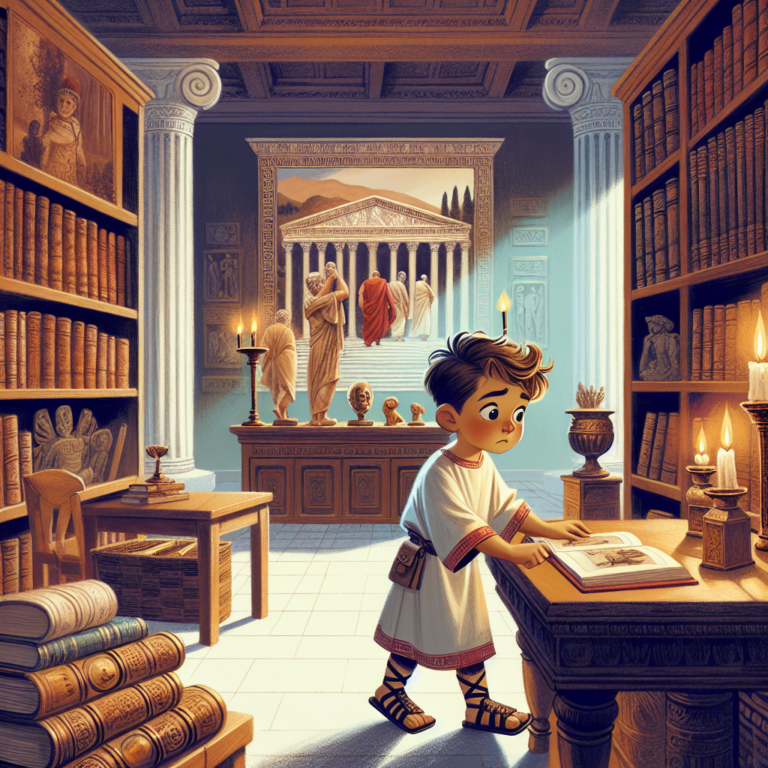
This bedtime story for kids, ‘Marcus and the Whispering Tales of Fallen Gods’, teaches children ages 6-12 about important moral values.
Chapter One: The Library of Wonders
In the ancient city of Rome, during the reign of Emperor Hadrian, there lived a boy named Marcus who was twelve years old and curious about everything. His grandfather, Gaius Aurelius, had been a scholar and collector, and his villa on the Aventine Hill contained the most remarkable library Marcus had ever seen.
The library’s walls were lined with wooden shelves holding hundreds of scrolls, each one a gateway to another world. There were texts in Latin and Greek, treatises on philosophy and astronomy, histories of distant lands, and most fascinating of all, the collected myths and legends of Rome and Greece.
On rainy afternoons, when the streets of Rome became rivers of mud and the sky turned the color of aged lead, Marcus would curl up among the scrolls and read until his grandfather’s oil lamps burned low.
“You spend more time with dead poets than with living friends,” his mother often scolded.
But Grandfather Gaius understood. “Leave the boy be, daughter. The stories he reads now will shape the man he becomes. There is wisdom in these old tales that no teacher can provide.”
One particular autumn day, Marcus discovered a scroll he had never noticed before, tucked behind a collection of agricultural treatises. Its wooden roller was darker than the others, and when he unrolled it, the Latin script was in an archaic style that made him squint.
“The Secret Histories of the Gods,” the title read. “Compiled from sources ancient and modern, for those who seek the truth behind the myths.”
Chapter Two: The Rise of Jupiter
Marcus settled into his favorite reading spot, a cushioned bench near the window where gray afternoon light provided enough illumination to read, and began to explore the scroll.
The text began with Jupiter, king of the gods, whom the Greeks called Zeus.
“Long before Rome existed,” the scroll read, “the world was ruled by the Titans, ancient beings of immense power. Cronus, their king, had overthrown his own father, Uranus, and feared that his children would do the same to him. So each time his wife Rhea gave birth, Cronus would swallow the baby whole.”
Marcus shuddered at this image but read on.
“When Jupiter was born, Rhea hid him and gave Cronus a stone wrapped in blankets instead. The Titan swallowed it, never knowing his youngest son still lived. Jupiter grew strong in a cave on the island of Crete, raised by nymphs and fed on the milk of the divine goat Amalthea.”
“Grandfather!” Marcus called out. “It says Jupiter was raised by a goat!”
Gaius appeared in the doorway, smiling. “Not raised by, dear boy, but fed by. There is a difference. And that goat was no ordinary animal. When Amalthea died, Jupiter honored her by placing her image in the stars. We call that constellation Capricorn.”
“So the stories explain the stars too?”
“Stories explain everything, Marcus. The Romans believed the world was full of divine presence. Every spring, every forest, every aspect of daily life had its deity. Understanding the gods meant understanding the world.”
Chapter Three: Mars and the Founding of Rome
The next section of the scroll concerned Marcus’s favorite god: Mars, the god of war, from whom he believed his own name derived.
“Mars was second only to Jupiter in the devotion of Roman hearts,” the scroll explained. “While the Greeks saw their war god Ares as brutal and chaotic, we Romans recognized Mars as a protector, a guardian of our city and our people. For it was through Mars that Rome itself was born.”
The story unfolded like an epic poem. Mars fell in love with a Vestal Virgin named Rhea Silvia, and from their union came twin boys: Romulus and Remus. But Rhea Silvia’s uncle, the usurper king Amulius, feared the prophecy that the twins would overthrow him. He ordered the babies thrown into the Tiber River to drown.
“But the gods protect their own,” the scroll continued. “The river carried the twins safely to the foot of the Palatine Hill, where a she-wolf discovered them. Instead of devouring the helpless infants, she nursed them as her own cubs.”
Marcus had seen statues of the wolf with the twins throughout Rome. Now the image seemed to glow with new significance. His city, the center of the world, had been founded by the sons of a god.
“Romulus and Remus were raised by a shepherd named Faustulus,” the scroll went on. “When they learned their true heritage, they overthrew Amulius and restored their grandfather to his throne. Then they set out to build their own city.”
“But only Romulus’s name is remembered,” Marcus murmured, knowing the tragic ending.
Indeed, the scroll confirmed it. The twins quarreled over who would rule the new city. Romulus marked out the city’s boundaries with a plow, and when Remus mockingly jumped over the furrow, Romulus killed him in rage.
“Thus was Rome born in blood,” the scroll concluded, “and thus does Rome’s history remind us that even the children of gods are capable of terrible deeds. Power without wisdom leads to tragedy.”
Chapter Four: The Goddess of Wisdom
Troubled by the dark turn of the story, Marcus rolled to a different section and found a gentler tale: the birth of Minerva.
“Unlike other gods, Minerva had no mother. Jupiter suffered terrible headaches, pains so severe that even the king of gods could not bear them. He commanded Vulcan, the smith god, to split his skull with an axe. When Vulcan obeyed, Minerva sprang fully grown from Jupiter’s head, wearing armor and carrying a spear.”
“That’s strange,” Marcus said aloud.
“Is it?” Grandfather Gaius had returned with two cups of warm spiced wine. “Think of what it means. Wisdom, which Minerva represents, comes from the mind. She emerged from Jupiter’s thoughts, already complete. The story tells us that wisdom does not need to grow slowly; it can arrive in a single flash of understanding.”
Marcus sipped his wine and considered this. “So the myths are like puzzles. The story on the surface hides a deeper meaning underneath.”
“Now you’re thinking like a philosopher, boy. The Greeks called these hidden meanings ‘allegories.’ Every educated Roman learns to read myths on multiple levels.”
Chapter Five: The Fall of Pride
As the afternoon darkened toward evening, Marcus found a section of the scroll that made him sit up straighter. It was titled “The Fall of Rome’s Virtue.”
“Rome was not always the greatest empire,” the scroll explained. “In the early days, our ancestors lived simply. They farmed their own land, made their own clothes, and asked the gods only for what they needed. The heroes of those times, Cincinnatus, Fabricius, Cato, lived humbly despite their great deeds.”
Marcus knew these names. Cincinnatus had been called from his plow to save Rome from invasion, served as dictator for sixteen days, defeated the enemy, and then returned to his farm, refusing power he did not need. Fabricius had been offered a fortune to betray Rome and laughed at the bribe. These were the heroes held up to Roman boys as examples.
“But as Rome grew powerful,” the scroll continued, “Romans grew proud. They forgot that the gods had blessed them for their virtue, not their strength. They began to believe they deserved their empire, rather than being grateful for it. They filled their homes with foreign treasures and forgot the simple ways of their ancestors.”
“Is that why empires fall, Grandfather?” Marcus asked quietly.
Gaius sat heavily on a nearby chair, his old joints creaking. “That is what some believe, yes. When people forget humility, when they mistake luck for merit and privilege for right, they sow the seeds of their own destruction. The gods gave our ancestors a gift, Marcus. Our task is to prove worthy of it.”
Chapter Six: The Eternal Lesson
Night had fully fallen by the time Marcus finished the scroll. His eyes were tired, but his mind was racing.
“Grandfather, why did you hide this scroll behind the agricultural texts?”
Gaius chuckled. “I didn’t hide it. I placed it there because that’s exactly where it belongs. You see, Marcus, the Romans wrote many books about farming because they understood that civilization depends on the land. The myths and the practical wisdom belong together. Stories about gods teach us how to live; knowledge of farming keeps us alive to live it.”
Marcus looked around the library with new eyes. Every scroll, he now realized, was connected to every other. The poetry described the same world the histories recorded. The philosophy explained the truths the myths dramatized. It was all one great tapestry of human thought.
“The old gods may be fading,” Gaius said softly. “New religions speak of one god instead of many. But the lessons of the old stories remain true. Be brave like Mars, but never cruel like Romulus in his worst moment. Be wise like Minerva, seeking understanding rather than just victory. Be humble like Cincinnatus, using power only when needed and laying it down when the task is done.”
Marcus carefully rolled up the scroll and returned it to its hiding place behind the farming texts. But he knew he would find it again, many times, throughout his life.
“Thank you, Grandfather,” he said. “For the stories, and for showing me how to read them.”
Gaius embraced his grandson. “The stories will thank you, boy, when you pass them on to your own children someday. That is how wisdom survives: not in scrolls alone, but in the hearts of those who understand their meaning.”
And so Marcus grew to be a man who valued humility over pride, wisdom over mere knowledge, and the lessons of the past over the empty promises of the present. He never forgot the whispering tales of the fallen gods, and he never stopped learning from them.
Moral Lessons
- History and mythology teach us that pride comes before a fall. True greatness lies not in power or wealth, but in humility, wisdom, and virtue. We must learn from the past to build a better future.
Test Your Understanding
1Who was Marcus exploring the library with?
Frequently Asked Questions
What is the moral lesson of Marcus and the Whispering Tales of Fallen Gods?
What age is this story appropriate for?
How long does it take to read Marcus and the Whispering Tales of Fallen Gods?
What culture does this story come from?
Can I use this story for teaching?
Frequently Asked Questions
What is Marcus and the Whispering Tales of Fallen Gods about?
Marcus and the Whispering Tales of Fallen Gods is a bedtime story for kids set in ancient Rome during Emperor Hadrian’s reign. It follows a curious twelve-year-old boy named Marcus who discovers myths and legends through his grandfather’s extraordinary library. The story teaches children ages 6-12 important moral values through adventure and mythology.
What age group is this bedtime story suitable for?
This story is designed for children ages 6 to 12. The rich historical setting, mythology, and moral lessons make it engaging for both younger children listening at bedtime and older kids reading independently. Parents and grandparents will also enjoy sharing it as a read-aloud experience.
What moral values does Marcus and the Whispering Tales of Fallen Gods teach kids?
The story weaves important moral values throughout its narrative, drawing on Roman and Greek mythology. Themes include the love of learning, wisdom passed between generations, curiosity, and how the stories we absorb shape our character. As Grandfather Gaius says, the stories a child reads will shape the adult they become.
📚 Recommended Books
Handpicked for readers like you
As an Amazon Associate, we earn from qualifying purchases. These recommendations are personalized based on this story's themes and your reading history.
Is this story based on real Roman mythology and history?
Yes, the story is grounded in authentic historical and mythological detail. It is set during the real reign of Emperor Hadrian in ancient Rome and draws on genuine Roman and Greek myths and legends. This blend of history and mythology makes it both entertaining and educational for young readers.
How long is this bedtime story and how many chapters does it have?
The story is divided into multiple chapters, beginning with Chapter One: The Library of Wonders. It is crafted as a longer narrative suitable for reading over several bedtimes or in one sitting for older children. The chapter format makes it easy to pause at natural stopping points during a bedtime routine.