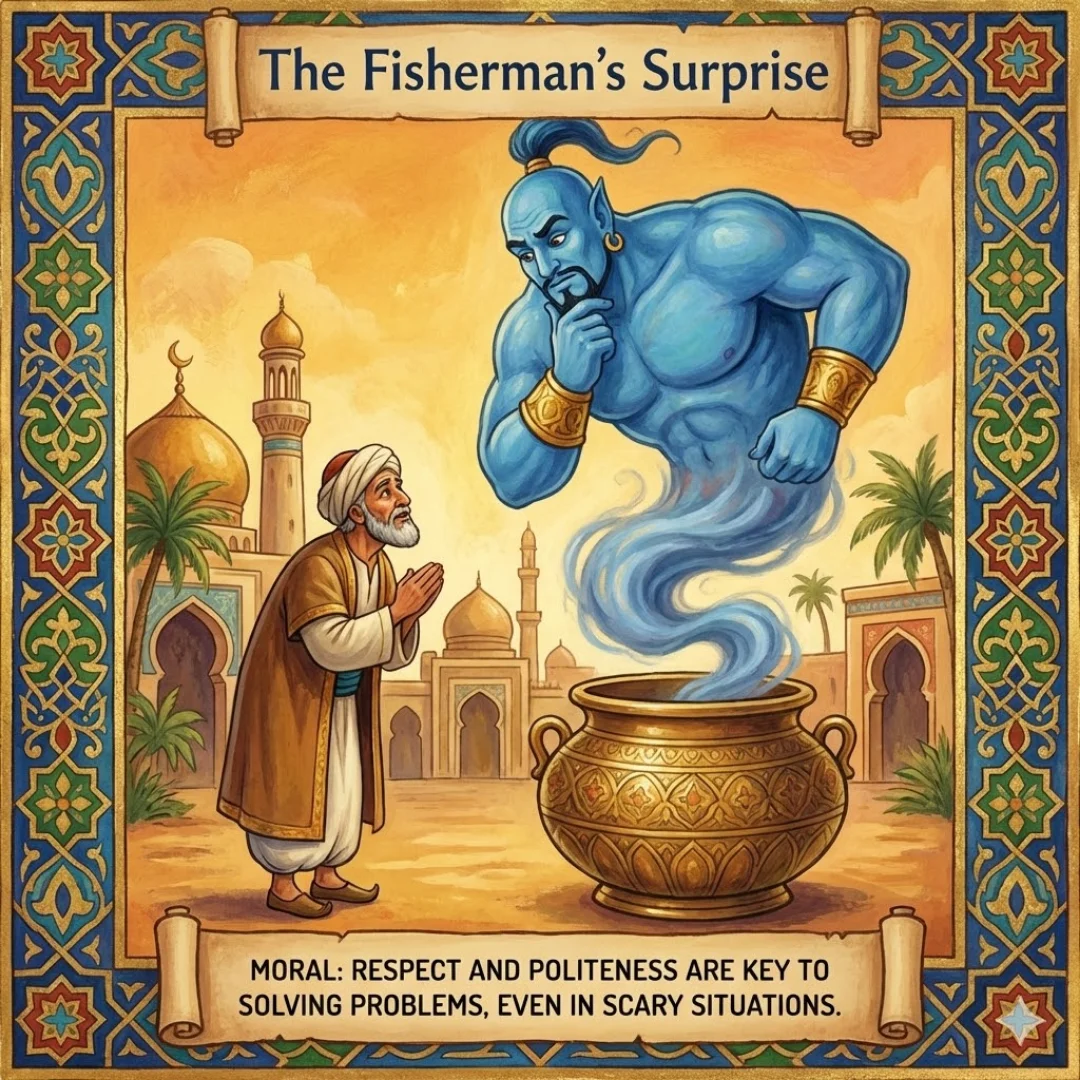
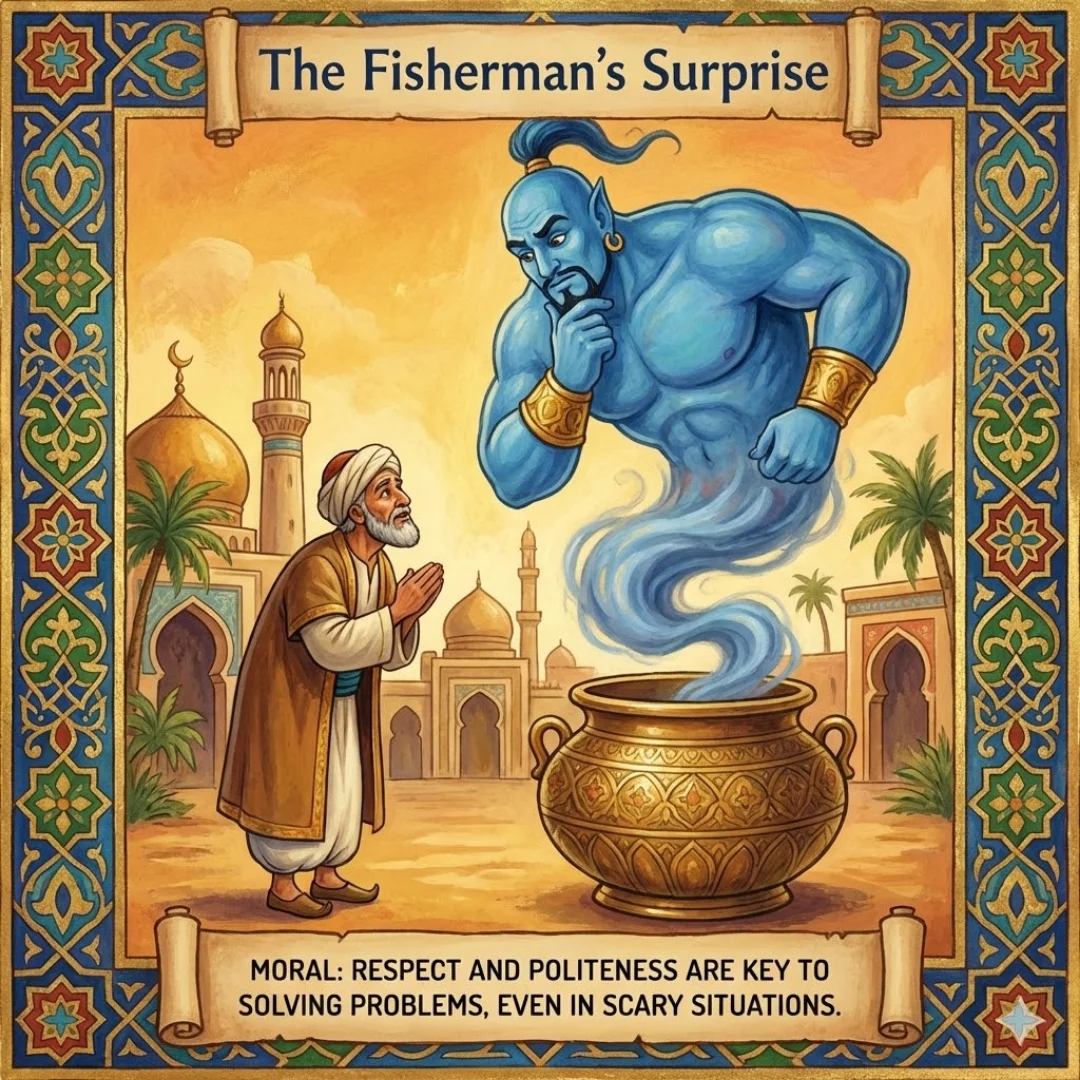
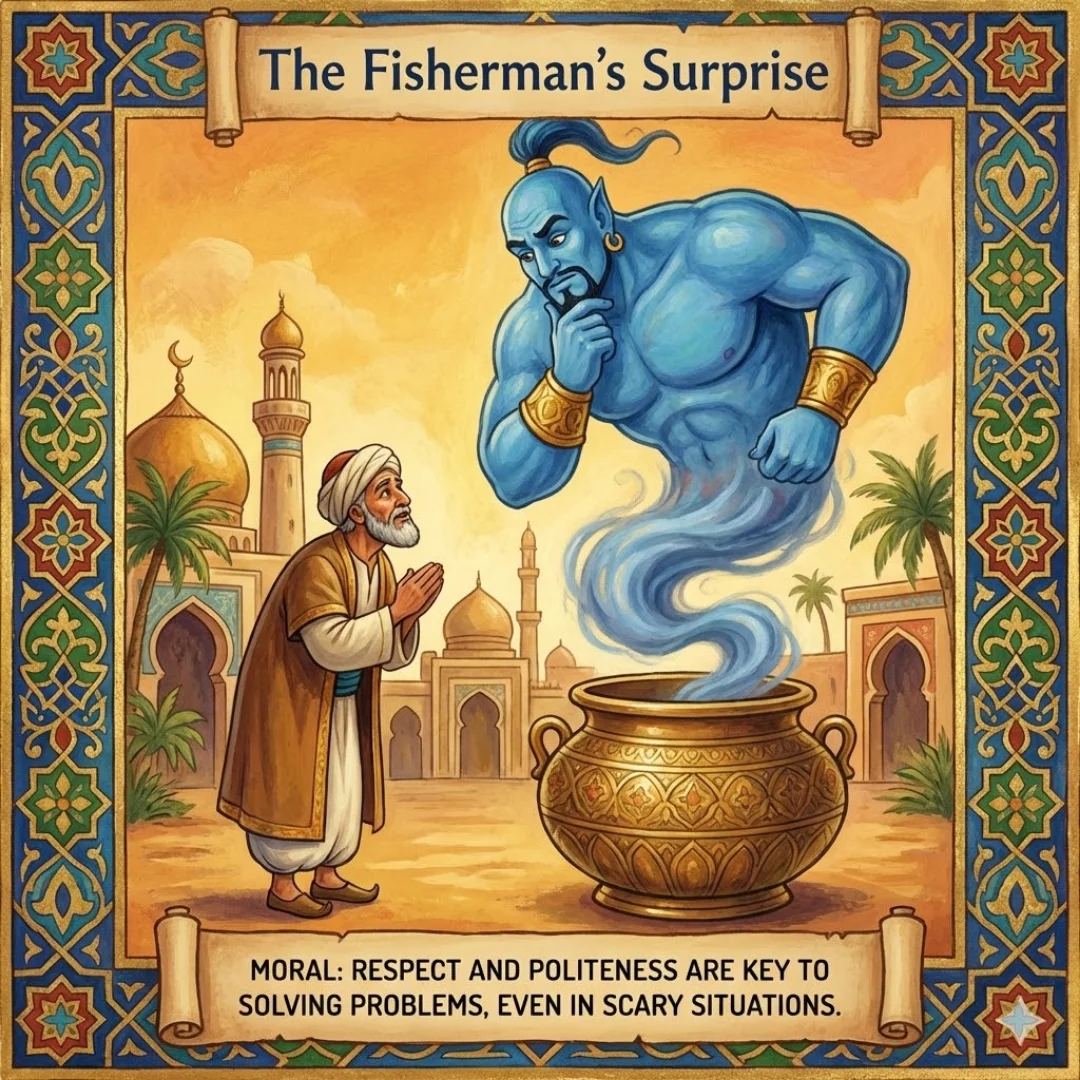
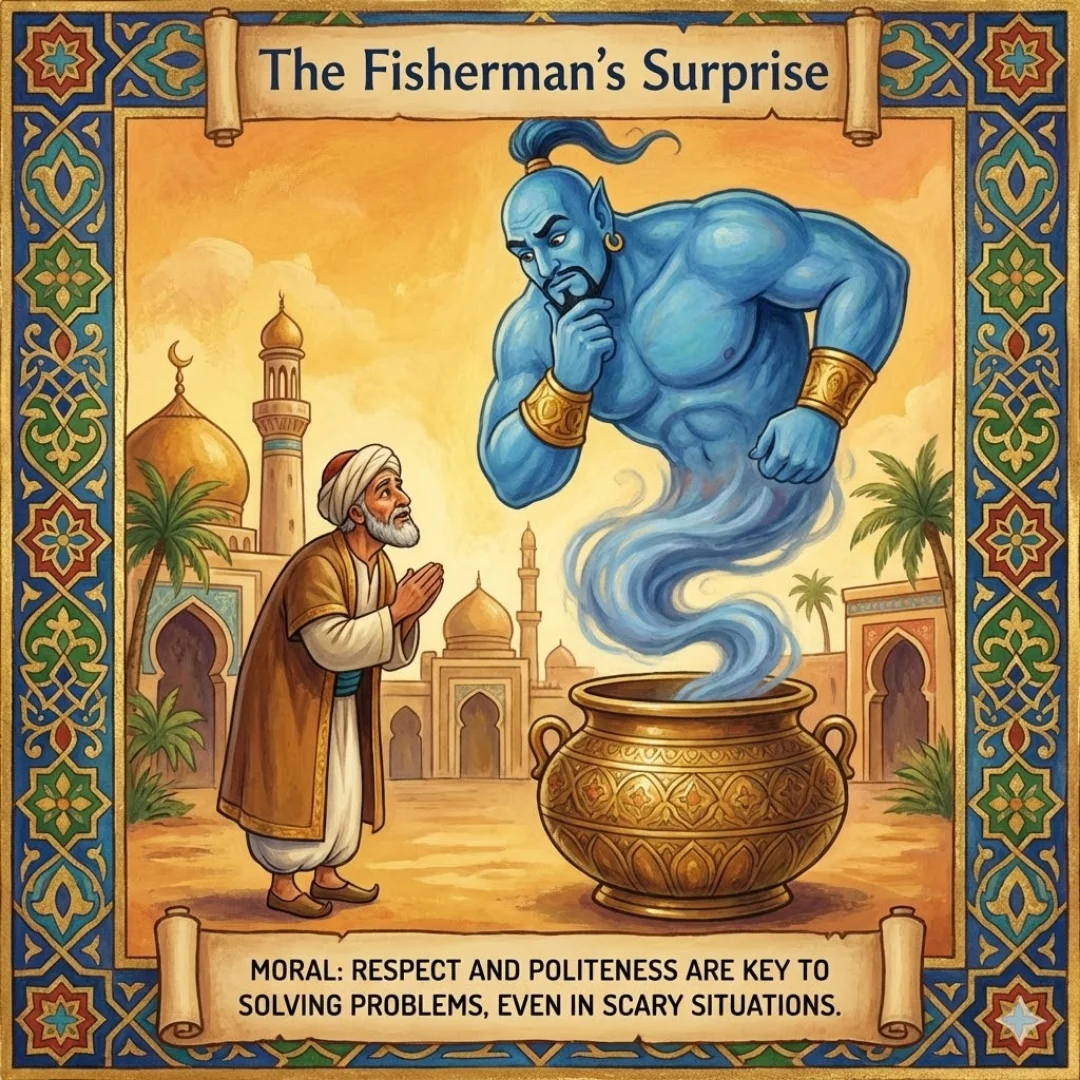
This bedtime story for kids, ‘The Fisherman’s Surprise’, teaches children ages 6-12 about important moral values.
The Tale of the Fisherman and the Jinni
From the Thousand and One Nights
Part One: The Unlucky Fisherman
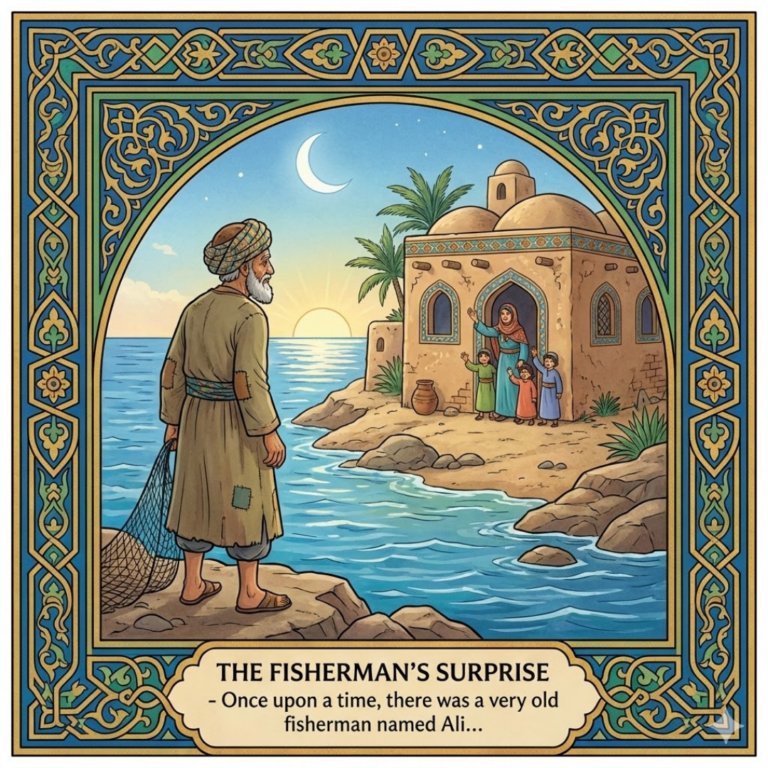
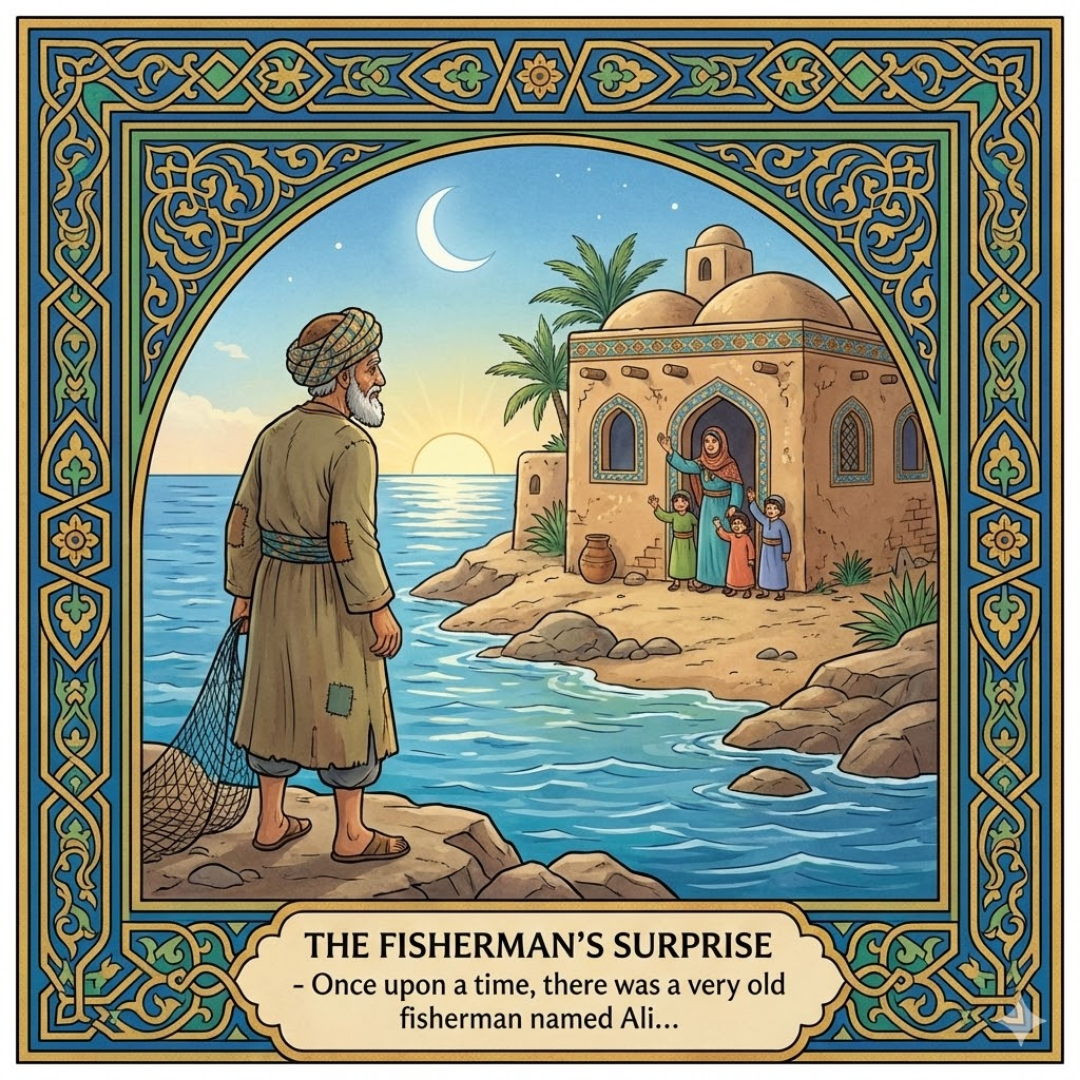
In a city long ago, when the great caliphs still ruled the lands of Persia and Arabia, there lived an old fisherman named Ali. He had a wife who loved him dearly and three children who depended on him for their daily bread. Though he worked hard every day, casting his nets into the sea, fortune had not smiled upon his family for many years.
Ali had made a solemn rule for himself: he would cast his nets exactly four times each day, no more and no less. “This is the way my father fished,” he would say, “and his father before him. Four is a number blessed by heaven.”
One morning, when the stars were still fading and the moon hung low over the water, Ali walked down to the shore with his nets over his shoulder. His bones ached from years of labor, and his heart was heavy with worry, for there was very little food left in his home.
“In the name of God, the Most Merciful,” he prayed as he waded into the cool water. “Grant me a good catch today, for my family is hungry.”
He cast his net with practiced skill, watching it spread like a great spider’s web over the surface of the sea. Then he waited, as every fisherman must wait, his hands gripping the rope that connected him to his hopes.
When he began to pull the net back, his heart leaped with excitement. The net was heavy, heavier than it had been in years! Surely this was a great catch, a bounty of fish that would feed his family for days!
But when Ali hauled the net onto the shore, he found only a dead donkey, its body swollen and foul.
“What terrible luck!” Ali cried, disgusted. He dragged the donkey away and cleaned his net, his spirits now lower than before.
Part Two: Three More Attempts
Ali said another prayer and cast his net a second time. Again, the net grew heavy. Again, his hopes rose like the morning sun.
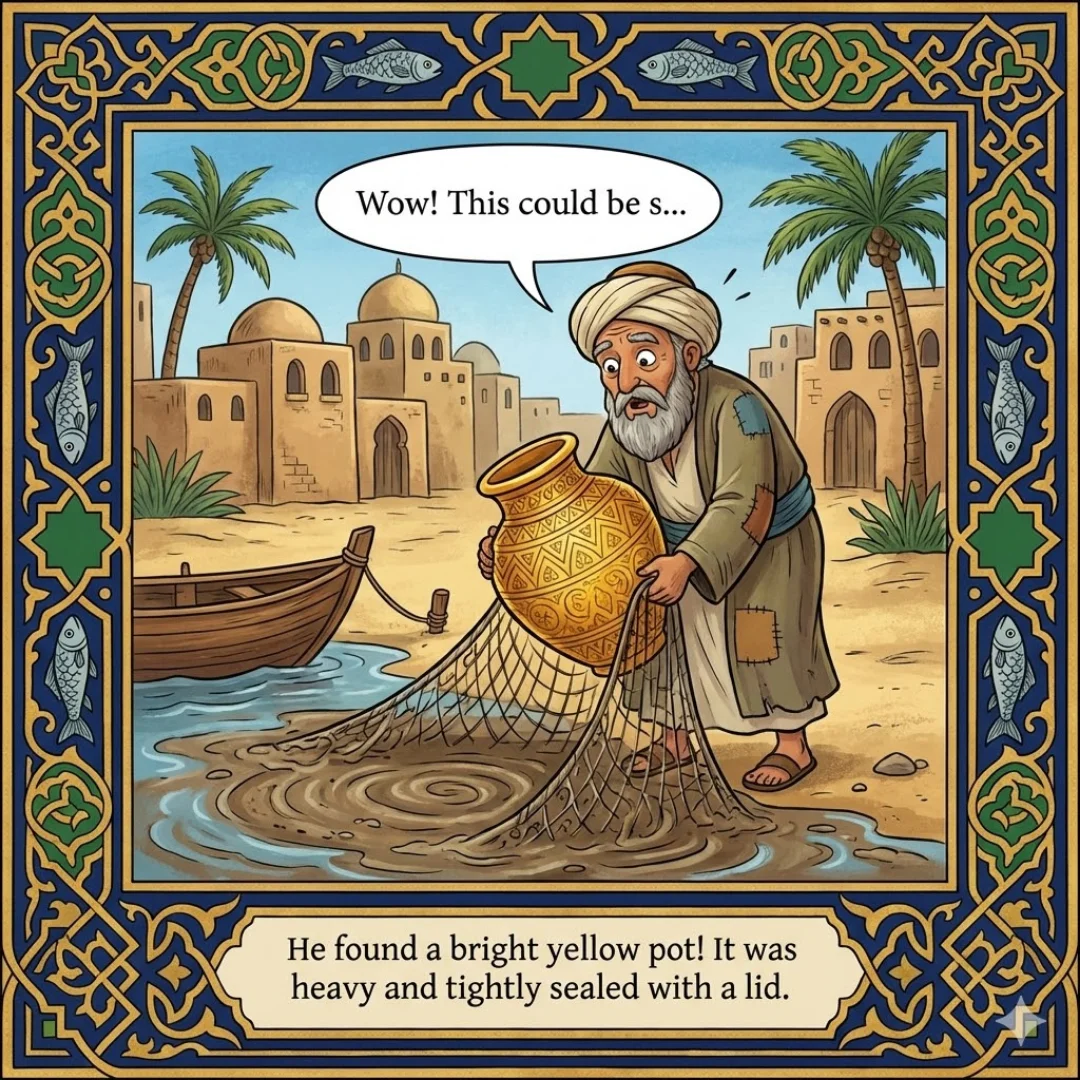
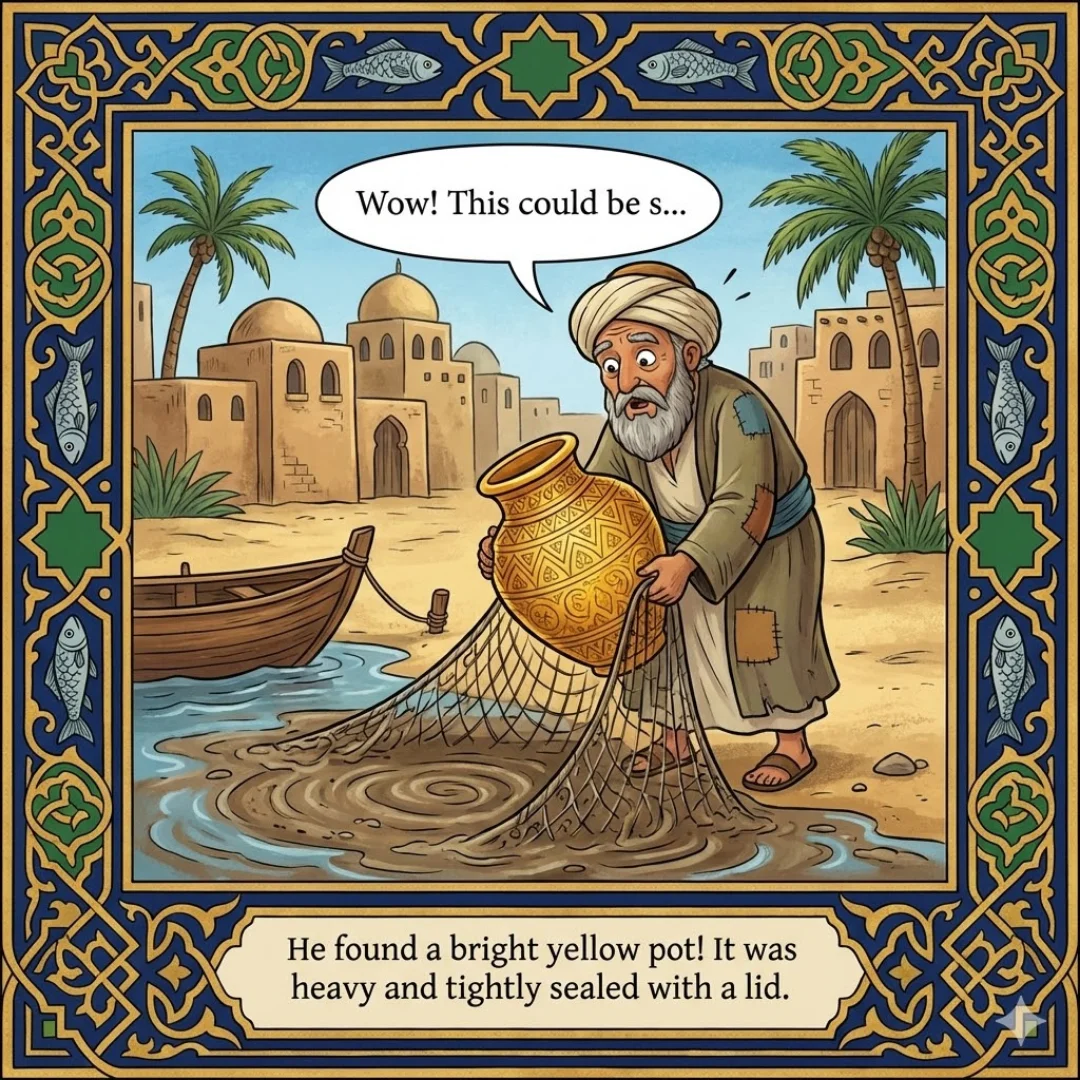
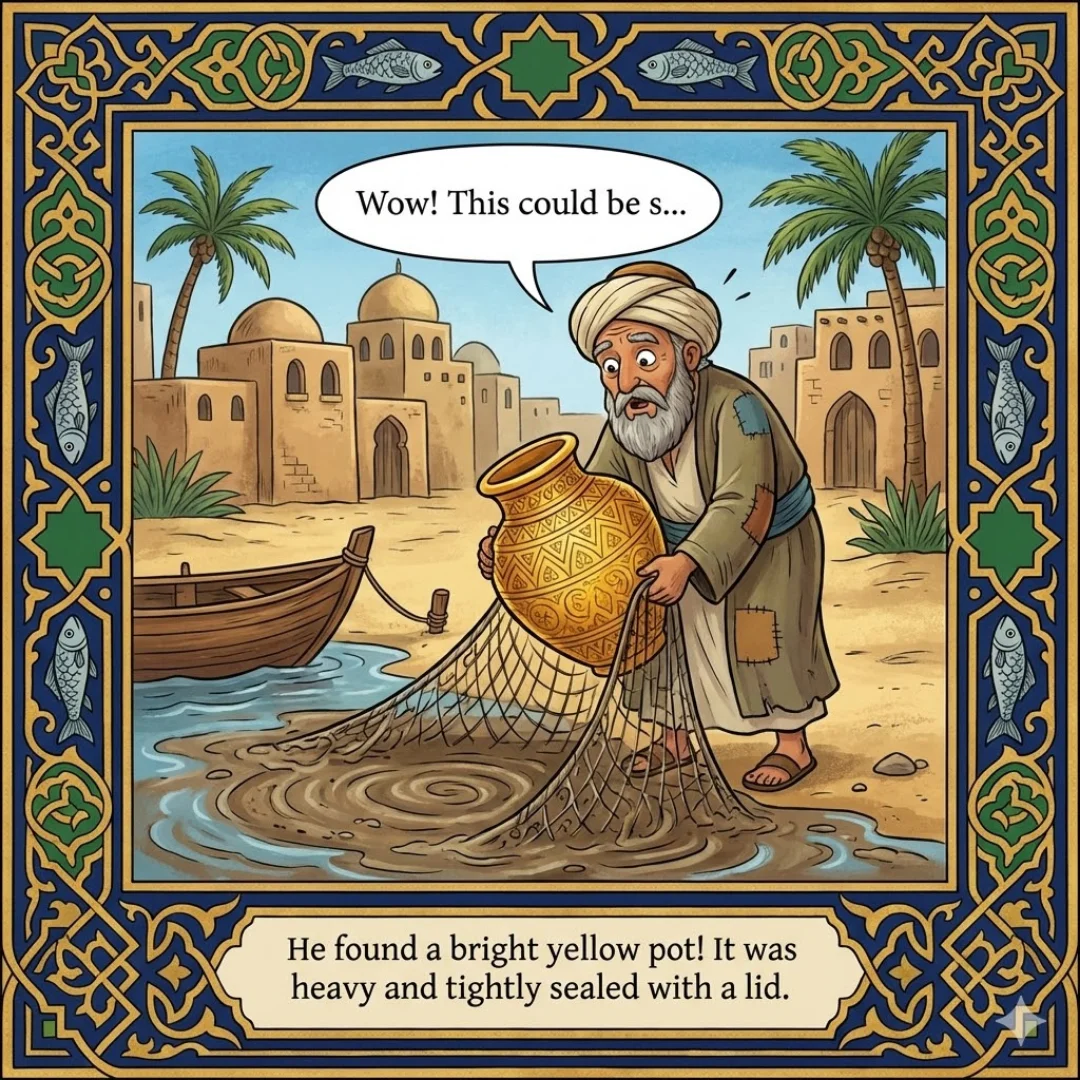
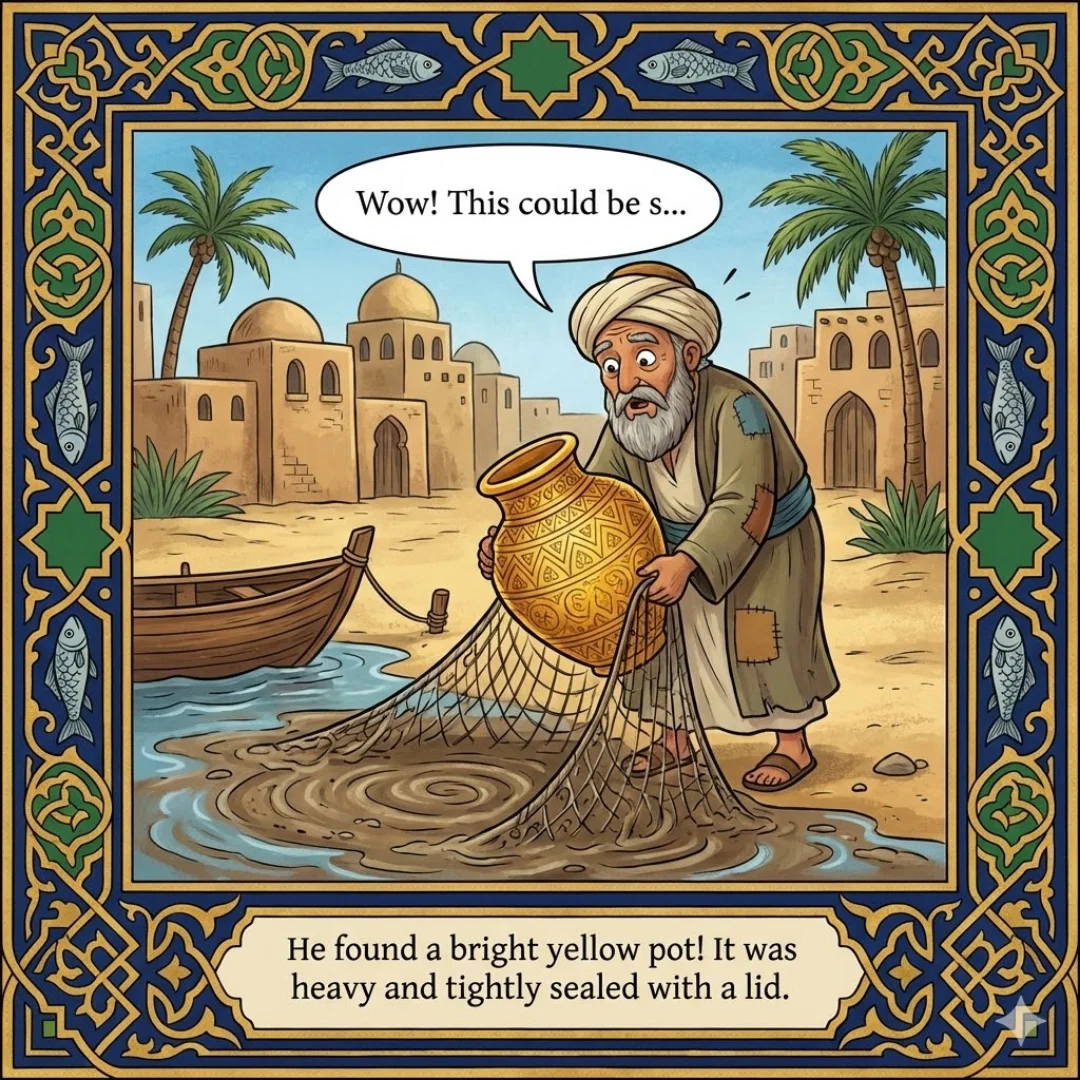
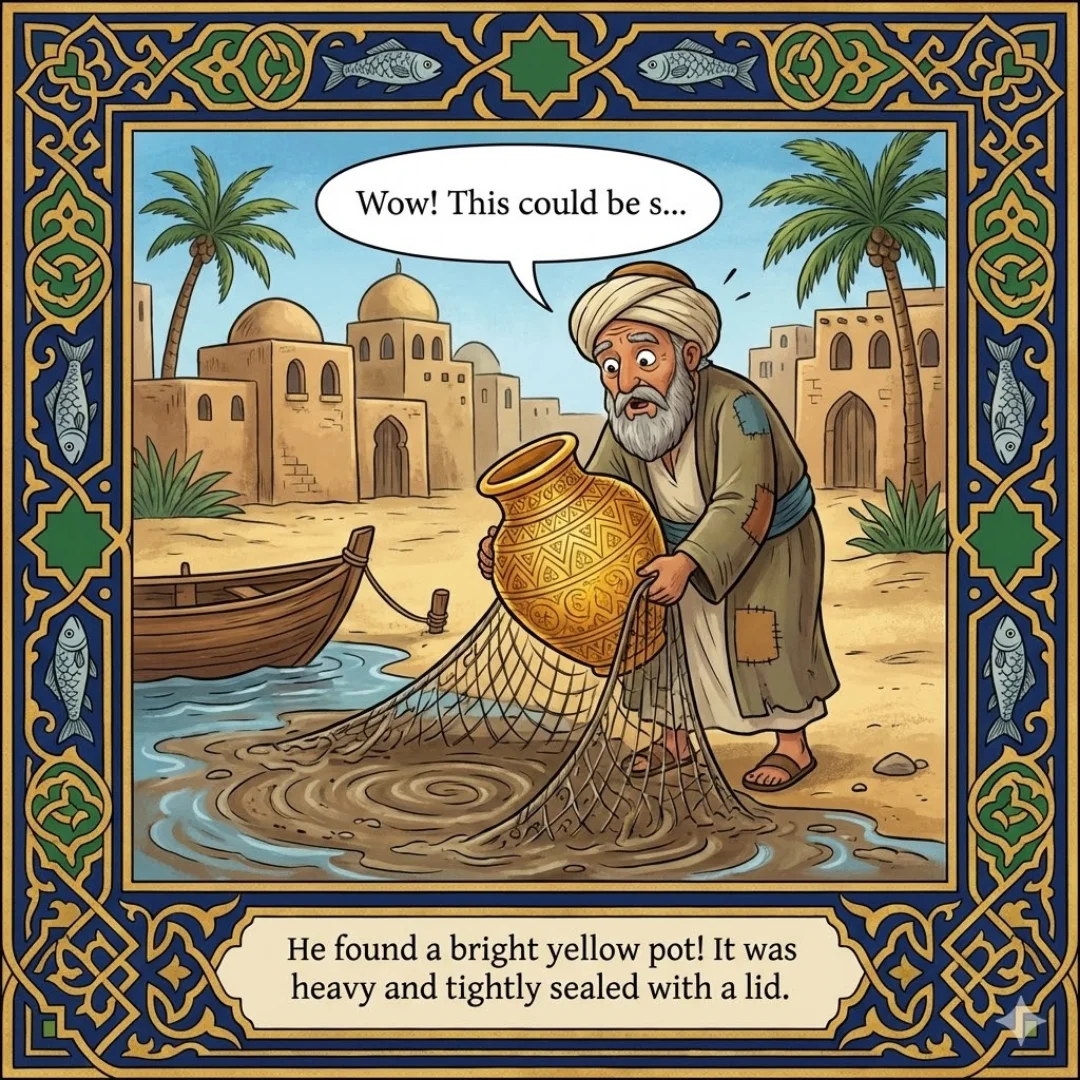
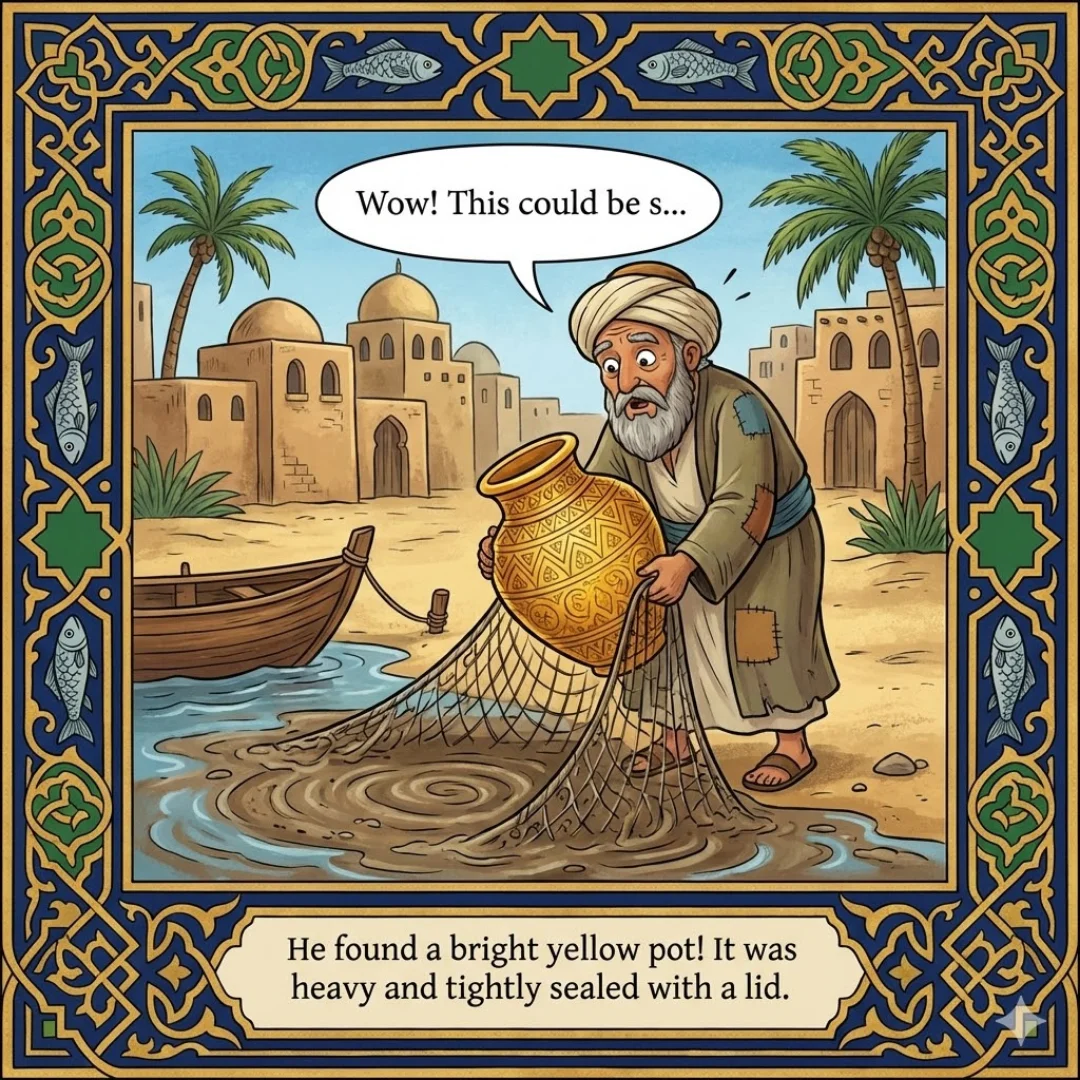
And again, he was disappointed. This time, the net contained only a large pitcher filled with mud and sand.
“What use is this?” Ali groaned. But he was a persistent man. He cleaned his net once more and cast it a third time.
The third catch was even worse: broken pottery, old glass, and the shells of long-dead creatures. Nothing of any value, nothing that could feed his family.
“One more cast,” Ali told himself, though his arms were tired and his heart was weary. “I have always cast my net four times, and I will not break my rule now.”
He prayed more fervently than before. “O Lord, you know my situation. You know that I have no other way to provide for my family. Please, in your infinite mercy, grant me something good with this final cast.”
Part Three: The Copper Jar
Ali threw his net one last time, and when he pulled it back, he found something strange: a copper jar, sealed at the top with a lead cap. The cap was stamped with a design that Ali recognized from the stories his grandmother used to tell, the seal of the great King Solomon, peace be upon him, who had power over the jinn.
“This is very old,” Ali murmured, turning the jar in his hands. “Perhaps there is treasure inside! Even if the jar is empty, I can sell the copper in the market.”
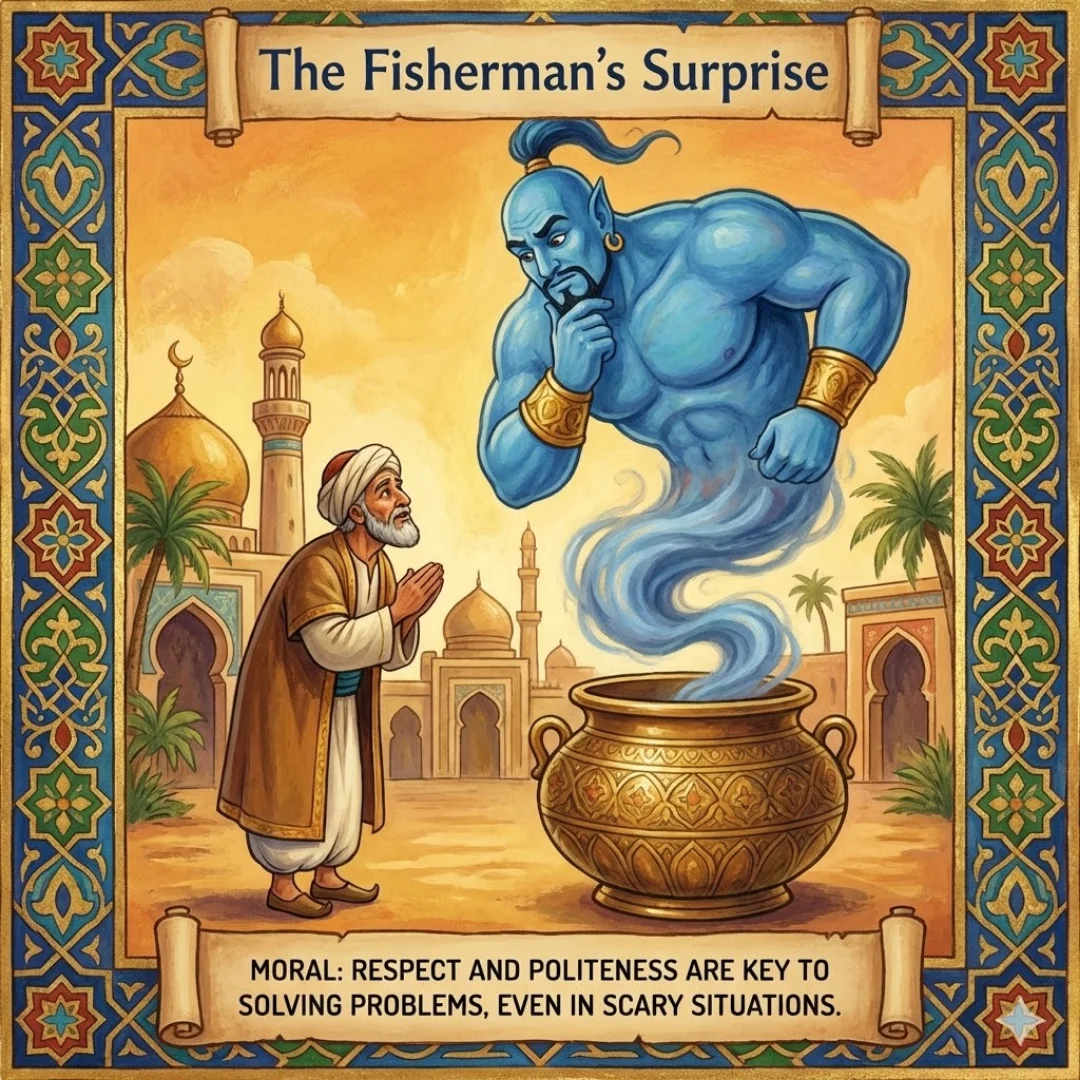
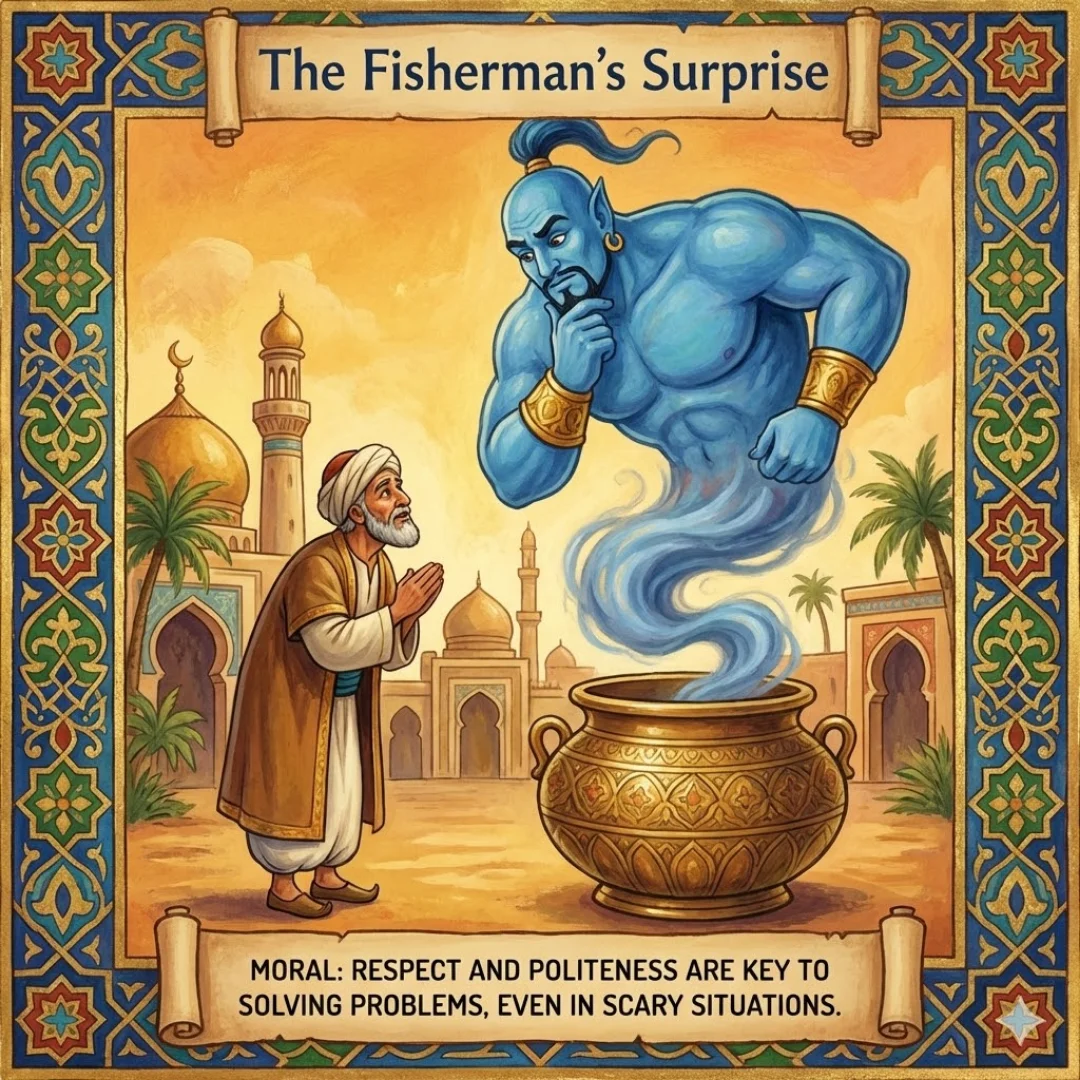
He used his fishing knife to pry off the lead cap. At first, nothing happened. Then a thin wisp of smoke began to rise from the jar, growing thicker and thicker until it formed a great pillar that stretched up toward the sky.
Ali fell backward in the sand, watching in terror as the smoke began to take shape. It formed into a figure so enormous that its head seemed to touch the clouds, a being with skin like burnished bronze, eyes like flames, and hands that could crush mountains.
It was a jinni, a spirit of fire, and the most fearsome one Ali had ever imagined.
Part Four: The Jinni’s Terrible Vow
The great jinni looked down at the tiny fisherman with eyes full of ancient fury.
“Prepare to die, human,” the jinni boomed, his voice shaking the very ground. “Choose how you wish to be killed, and I will grant you that mercy at least.”
Ali trembled but forced himself to speak. “O great spirit, why would you kill me? I have just freed you from your prison! Surely that deserves gratitude, not death!”
The jinni laughed, a sound like rocks grinding together.
“Gratitude? Let me tell you my story, little fisherman, and then you will understand.
“I am one of the jinn who rebelled against King Solomon long ago. As punishment, Solomon imprisoned me in that copper jar and cast it into the sea. For the first hundred years of my imprisonment, I made a vow: ‘Whoever frees me, I will make them rich beyond their wildest dreams.’ But no one came.
“For the second hundred years, I vowed: ‘Whoever frees me, I will reveal to them all the treasures of the earth.’ But still, no one came.
“For the third hundred years, I vowed: ‘Whoever frees me, I will grant them three wishes, any three wishes they desire.’ But the years passed in endless darkness, and no one came.
“After four hundred years alone in that jar, my hope turned to rage. I made a final vow: ‘Whoever frees me now, I will kill them, and I will only allow them to choose the manner of their death.’ And now, fisherman, you are that person. So choose, and choose quickly, for my patience is at an end.”
Part Five: The Fisherman’s Clever Plan
Ali’s heart pounded in his chest, but he was not a man who gave up easily. His years of fishing had taught him patience, and his grandmother’s stories had taught him that the jinn, for all their power, were often too proud for their own good.
“O mighty jinni,” Ali said slowly, his mind working furiously, “I accept my fate. But first, I have one small question. Will you not satisfy the curiosity of a dying man?”
“Ask,” the jinni growled.
“I believe that you were truly in that jar,” Ali said, “but I don’t understand how. You are enormous! Your head touches the clouds! That jar could barely hold a handful of dates. How did a being as vast as yourself fit inside something so small?”
The jinni’s eyes narrowed. “You doubt me? You dare to suggest I am lying?”
“I would never suggest that,” Ali said quickly. “I am simply too simple to understand. It is beyond my imagination. Perhaps if you showed me, I would understand and could die with a clear mind.”
The jinni’s pride was stung. “Very well, foolish human. I will show you, and then you will die knowing the truth.”
The great spirit began to shrink, his massive form collapsing in on itself. He turned back into smoke, and the smoke funneled down into the copper jar like water draining into a well.
The moment the last wisp of smoke disappeared, Ali seized the lead cap and slammed it back onto the jar.
“No!” came the jinni’s muffled roar from within. “Let me out! I promise I will not harm you!”
Part Six: A Lesson in Mercy
“Do you think I am a fool?” Ali replied, holding the jar firmly. “You just told me you spent four hundred years planning to kill whoever freed you. Why should I believe you have changed your mind in the space of a single breath?”
“Please!” the jinni begged, his voice now small and desperate. “I swear by the One who created heaven and earth, if you free me now, I will never harm you. I will reward you beyond your wildest dreams!”
Ali shook his head sadly. “I cannot trust you. I will throw this jar back into the deepest part of the sea, and I will tell everyone in the city your story. I will make sure that anyone who finds you knows to throw you back. You will stay in that prison for another thousand years, or perhaps forever.”
“Wait!” the jinni cried. “Listen to me! Please, listen! I know I was wrong. Four hundred years of anger made me mad. But being back in this jar, even for these few moments, has reminded me of my suffering. I do not want to return to that darkness. Please, show me the mercy I was not willing to show you.”
Ali considered the jinni’s words. He thought about his own life, about the times when he had been bitter and angry because of his bad luck. He thought about how easy it was to let frustration turn into cruelty.
“If I free you,” Ali said carefully, “and you break your promise, you will have to answer to God for your lies. Are you willing to stake your soul on your word?”
“I swear,” the jinni said solemnly, “by the Most High, by the angels, by all that is holy, I will not harm you. I will help you instead.”
Ali closed his eyes and made his own prayer. Then, trusting in God’s protection, he opened the jar once more.
Part Seven: The Jinni’s Gratitude
The smoke poured out and reformed into the great jinni, but this time his face was not twisted with rage. Instead, there was something like shame in his burning eyes.
“You are the first person in over a thousand years to show me kindness,” the jinni said. “I do not deserve it, but I am grateful.”
“Perhaps this is a lesson for both of us,” Ali replied gently. “You learned that mercy can come from unexpected places. And I learned that even the most frightening things can change when treated with wisdom instead of violence.”
The jinni nodded slowly. “I made a promise, and I will keep it. Come, follow me, and I will change your fortune forever.”
The jinni led Ali to a place beyond the hills, where a lake of clear water lay hidden from the world. In the water swam fish of four colors: white, red, blue, and yellow.
“Catch four of these fish, one of each color,” the jinni instructed. “Take them to the Sultan. These are magical fish, and they will bring you great wealth. But remember this: cast your nets in this lake only once per day, and never more. If you become greedy, you will lose everything.”
Ali caught the four fish and thanked the jinni. Then, as quickly as he had appeared, the great spirit vanished in a swirl of smoke, returning to wherever the jinn dwell when they are not in the world of humans.
Part Eight: The Sultan’s Palace
Ali brought the four magical fish to the Sultan’s palace, where they caused a great sensation. The royal cook prepared to fry them in the royal kitchen, but as soon as the fish touched the hot oil, something extraordinary happened.
A wall of the kitchen seemed to open, and a beautiful woman appeared, dressed in robes of pure white. She carried a staff of myrtle wood and spoke to the fish in a language no one could understand.
“Fish, fish, are you faithful to your covenant?” she asked.
And the four fish lifted their heads from the oil and replied: “Yes, yes! If you return, we return. If you keep your promise, we keep ours. If you flee, we are even.”
Then the woman struck the pan with her staff, and the fish turned to charcoal. She disappeared as mysteriously as she had arrived.
The cook fainted from shock. When he told the Sultan what had happened, the Sultan demanded to meet the fisherman who had caught these mysterious fish.
Part Nine: The Mystery Deepens
Ali was brought before the Sultan, who was kind but curious. “Old man,” the Sultan said, “where did you catch these remarkable fish?”
Ali told the truth: about the jinni, about the hidden lake, about everything that had happened. The Sultan was amazed.
“I must see this lake myself,” the Sultan declared. “You will guide me there tomorrow.”
The next day, Ali led the Sultan and his guards to the lake beyond the hills. It was exactly as Ali had described, with fish of four colors swimming in the crystal waters.
But beyond the lake, the Sultan discovered something even more amazing: a beautiful palace made of marble, surrounded by gardens of incredible flowers and trees. Yet despite its beauty, the palace seemed abandoned.
Inside, the Sultan found a young man sitting alone on a throne. From the waist up, he was a handsome prince. But from the waist down, his body had been turned to black stone.
“Who did this to you?” the Sultan asked in horror.
“It is a long story,” the young man said sadly. “One of betrayal, magic, and terrible punishment. But it is also a story of hope, for a prophecy has said that one day, a king from a distant land would come and set me free.”
And so the young man told his tale, and the Sultan listened, and eventually, through courage and wisdom, the Sultan was able to break the curse and restore the young man to his full humanity.
Part Ten: Blessings for the Faithful
As for Ali the fisherman, his life was transformed. The Sultan rewarded him richly for leading him to the magical lake and helping to uncover its mysteries. Ali’s days of poverty were over. He built a comfortable home for his wife and children, and he lived out his years in peace and contentment.
But Ali never forgot the lessons he had learned.
He never forgot that patience, even when everything seems to go wrong, can lead to unexpected blessings. He never forgot that cleverness and calm thinking can overcome even the most terrifying challenges. And he never forgot that showing mercy to others, even to those who seem to deserve punishment, can transform enemies into friends.
Every evening, when his grandchildren gathered around him to hear stories, Ali would tell them the tale of how he met the jinni in the copper jar.
“Remember,” he would say at the end, “the jinni spent four hundred years in darkness because he let his anger control him. When you feel angry or bitter, think of that poor spirit trapped in that tiny jar. Anger is its own prison. But wisdom and mercy, those are the keys that set us free.”
And his grandchildren would listen, and learn, and carry those lessons with them for the rest of their lives.
Frequently Asked Questions
What is the moral lesson of The Fisherman’s Surprise?
What age is this story appropriate for?
How long does it take to read The Fisherman’s Surprise?
What culture does this story come from?
Can I use this story for teaching?
The End
Epilogue: A Thousand and One Lessons
This is only one of the many tales from the Thousand and One Nights. In the original story, this tale is told by the wise Queen Scheherazade to her husband, King Shahryar, as part of her strategy to save her own life and teach the king the value of mercy and wisdom.
Scheherazade understood that the power of a good story lies not just in entertainment, but in the lessons it carries. Through her tales of fishermen and jinns, of princes and paupers, she taught a cruel king to become kind, and saved not only herself but countless others who would have suffered from his cruelty.
And so the stories of the Arabian Nights remind us that words and wisdom can be more powerful than swords and strength, that patience and cleverness can overcome any obstacle, and that the darkest night will always end in dawn.
Moral Lessons
- Wisdom and cleverness can overcome even the most powerful opponents. Patience in the face of bad luck, clear thinking in moments of danger, and showing mercy even to those who threaten us, these qualities can transform our lives and the lives of others.
Test Your Understanding
1. What rule did Ali the fisherman follow every day?
Frequently Asked Questions
What is The Fisherman’s Surprise story about?
The Fisherman’s Surprise tells the tale of Ali, an old fisherman who follows his family tradition of casting nets exactly four times each day. From the classic Thousand and One Nights collection, this story follows Ali’s encounter with a magical jinni and teaches important lessons about perseverance, faith, and following traditions even during difficult times.
What age group is this bedtime story for kids designed for?
This bedtime story for kids is specifically designed for children ages 6-12. The language and themes are age-appropriate for elementary school children, making it perfect for bedtime reading while teaching valuable moral lessons about patience, hard work, and trusting in divine providence during challenging times.
What moral values does The Fisherman’s Surprise teach children?
This moral story for children teaches several important values including perseverance during hardship, the importance of following family traditions, having faith during difficult times, and trusting that hard work will eventually be rewarded. It shows kids how staying committed to principles can lead to unexpected blessings.
📚 Recommended Books
Handpicked for readers like you
As an Amazon Associate, we earn from qualifying purchases. These recommendations are personalized based on this story's themes and your reading history.
Is this story originally from Arabian Nights?
Yes, The Fisherman’s Surprise is adapted from ‘The Tale of the Fisherman and the Jinni’ in the famous Thousand and One Nights collection (also known as Arabian Nights). This classic Middle Eastern story has been retold for children while preserving its original moral teachings and cultural wisdom.
How long does this educational story for kids take to read?
This educational story for kids is designed as a complete bedtime story that takes approximately 10-15 minutes to read aloud. It’s the perfect length for bedtime reading, long enough to engage children with an exciting plot involving a fisherman and a magical jinni, but not too long to keep them awake.