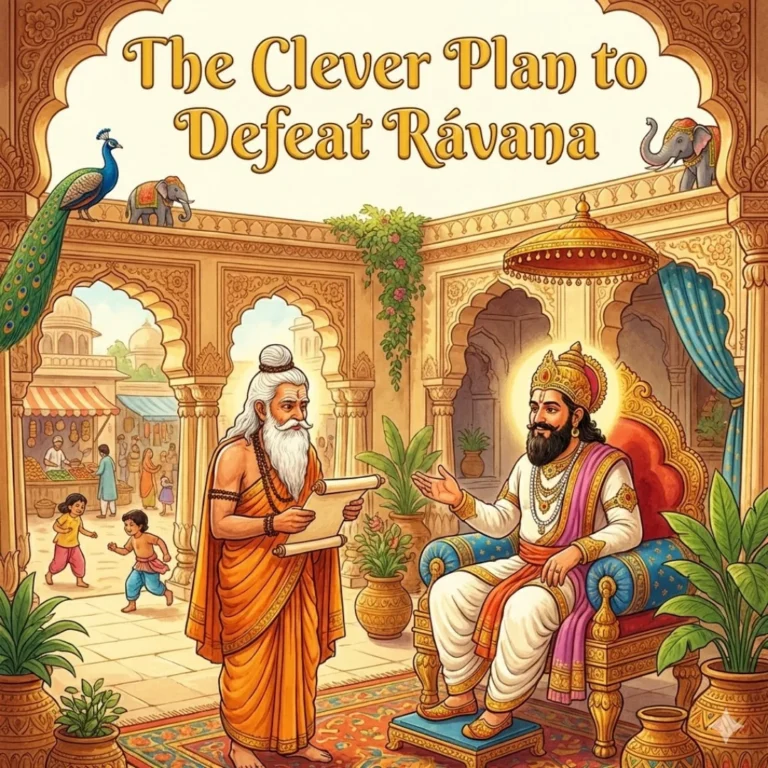
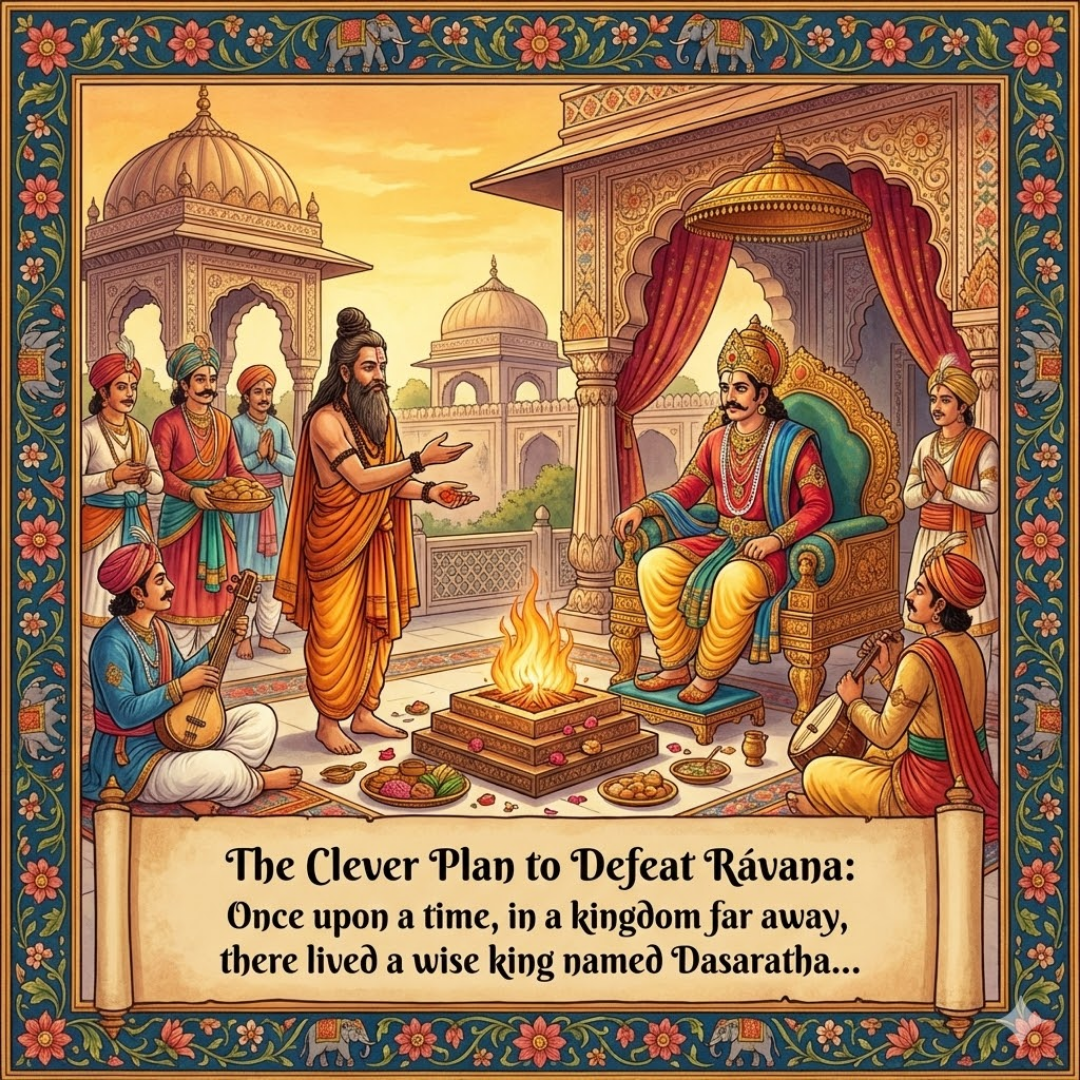
This moral story for children ages 6-12 combines entertainment with important values.
Long ago, when the universe was still young, there lived a rakshasa (demon) named Ravana who desired to become the most powerful being in all existence.
Ravana was no ordinary demon. He was a brilliant scholar who had mastered the four Vedas. He was a devotee of Lord Shiva who had performed intense penance for thousands of years. He ruled the magnificent golden city of Lanka with such splendor that even the gods looked upon it with envy. He had ten heads representing his mastery of the four Vedas and six Shastras (ancient treatises), and twenty arms symbolizing his strength in battle.
But Ravana’s greatest asset was also his fatal flaw: his overwhelming pride.
After years of severe tapas (austerities) that shook the three worlds, Lord Brahma the Creator finally appeared before Ravana in a blaze of celestial light.
“You have proven your devotion,” Brahma said. “Ask for any boon, and it shall be granted.”
Ravana’s ten heads smiled with cunning ambition. “Great Brahma, grant me invincibility! Make me immortal, invulnerable to death from gods, demons, gandharvas, yakshas, nagas, and all divine beings!”
Brahma nodded. “So be it. No god or demon shall have the power to kill you.”
Ravana’s laughter echoed across the cosmos. He had won! He was invincible!
But in his arrogance, Ravana made a critical error. He did not think it necessary to ask for protection from humans or animals. After all, what harm could mere mortals possibly pose to the mighty king of Lanka?
This oversight would prove to be his undoing.
Empowered by his boon, Ravana conquered the three worlds. He defeated the gods and drove them from their celestial palaces. He stole the flying chariot Pushpaka from his own half-brother Kubera. He terrorized rishis in their peaceful forest ashrams. His tyranny grew so unbearable that the gods themselves gathered before Lord Vishnu, the Preserver, and begged for help.
“The demon Ravana has become unstoppable,” they pleaded. “He torments the righteous and mocks dharma itself. Only you can save us!”
Vishnu smiled with cosmic wisdom. “Ravana’s boon protects him from gods and demons—but not from humans. I will be born as a mortal prince. As a man, I will defeat him and restore balance to the universe.”
And so Vishnu incarnated as Rama, the eldest son of King Dasharatha of Ayodhya—perfect in virtue, unmatched in skill, the very embodiment of dharma.
Years later, when Rama had grown into a young man of extraordinary character, he was unjustly exiled to the forest for fourteen years along with his wife Sita and his devoted brother Lakshmana.
It was during this exile that Ravana’s sister, the demoness Shurpanakha, encountered Rama in the forest. Infatuated by his beauty, she tried to seduce him. When Rama gently refused, she attacked Sita in jealous rage. Lakshmana defended Sita by cutting off Shurpanakha’s nose and ears.
Humiliated and burning for revenge, Shurpanakha fled to Lanka and filled her brother’s ears with poison.
“My king, in the forests of India lives the most beautiful woman I have ever seen—Sita, wife of Prince Rama. She would be a worthy queen of Lanka! Take her, and avenge the insult done to your sister!”
Ravana’s ten pairs of eyes gleamed with desire and rage. Using trickery and deceit, he kidnapped Sita, carrying her across the ocean to his island fortress of Lanka.
But Ravana’s own brother, Vibhishana, was horrified.
“My lord,” Vibhishana pleaded, falling at Ravana’s feet, “this is adharma! You have abducted another man’s wife! Return Sita to Rama before terrible consequences befall us all. No good can come from this wicked act!”
Ravana’s ten heads twisted in scorn. “You dare lecture me about dharma? I am invincible! What can a mere mortal prince do to the king of Lanka?”
Again and again, Vibhishana tried to counsel his brother. He explained the danger. He warned of divine retribution. He begged Ravana to choose the path of righteousness.
But Ravana, blinded by pride and lust, refused to listen.
Vibhishana faced an impossible decision. On one side stood loyalty to his own blood—his brother, his king. On the other side stood dharma—truth, righteousness, the cosmic order itself.
His mother, Kaikesi, saw the torment in her son’s eyes.
“My child,” she said softly, “when your brother chooses adharma, your loyalty must be to truth, not to blood. Go. Find Prince Rama. Serve the righteous cause.”
With a heavy heart, Vibhishana made his choice. Under cover of night, he fled Lanka, flying across the ocean with four of his most trusted counselors.
When Vibhishana landed in Rama’s camp, the monkey warriors immediately surrounded him with weapons raised.
“It’s a trick!” shouted Sugriva, king of the vanaras. “Ravana sends his own brother to spy on us! To kill us in our sleep!”
“I agree!” said Angada, Sugriva’s nephew. “Send him away! We cannot trust a demon!”
The debate raged as Rama’s advisors argued passionately. How could they trust Ravana’s own brother? What if this was an elaborate trap?
But Hanuman, the mighty vanara who had already proven himself the wisest among them by finding Sita in Lanka, stepped forward.
“My lord Rama,” Hanuman said, his voice carrying the weight of truth, “I was there in Lanka. I heard this rakshasa speak. When Ravana’s council met to discuss what to do about your approach, Vibhishana alone spoke words of wisdom and dharma. He defied his own brother, pleading for Sita’s return. His heart is righteous. We can trust him.”
Rama smiled—that radiant smile that could melt the hardest heart.
“Even if Vibhishana came here to deceive us,” Rama declared, “I would still grant him refuge. For anyone who comes to me seeking shelter, I will never turn away. This is my vow.”
He approached Vibhishana and placed a hand on his shoulder. “You have chosen dharma over pride, righteousness over loyalty to wickedness. You are no longer a rakshasa in spirit—you are my brother. Rise, and be welcome.”
Rama then performed an extraordinary act. He anointed Vibhishana as the rightful king of Lanka, even though the city was still in Ravana’s possession.
“After the battle,” Rama promised, “you will rule Lanka with justice and wisdom, bringing your people back to the path of dharma.”
Vibhishana bowed low, tears streaming down his face. He had found not just refuge, but a lord worthy of absolute devotion.
Rama now commanded a vast army of vanaras (monkey warriors) led by Sugriva and Hanuman. But between them and Lanka lay a challenge that seemed insurmountable: the vast ocean.
How could an army of monkeys cross the endless waters to reach the island fortress?
Rama stood at the southern shore and prayed to Samudra, the ocean god. For three days he meditated, asking respectfully for passage.
When the ocean did not respond, Lakshmana grew angry. “Brother, you are too gentle! Perhaps we should dry up this ocean with celestial weapons!”
But Hanuman suggested a different approach. “My lord, I know two vanaras named Nala and Neel, sons of divine architects. They possess the knowledge to build a bridge.”
“A bridge across the ocean?” some of the monkeys laughed. “Impossible!”
But Nala stepped forward. “My father Vishwakarma, the divine architect, blessed me with the power to make anything float in water. Give me your army, Prince Rama, and we will build a bridge to Lanka.”
What followed was one of the greatest engineering marvels in all of history.
Millions of vanaras worked together with perfect coordination. Some uprooted massive trees. Others carried enormous boulders. The stronger monkeys swam out into the ocean, placing the foundation stones. Nala and Neel directed the construction with precise calculations, ensuring each stone was placed perfectly.
As the vanaras chanted Rama’s name—”Shri Rama! Jai Rama!”—a miraculous thing happened. Every stone they inscribed with Rama’s name floated and held its place, defying the laws of nature.
The work continued day and night for five days. The bridge stretched longer and longer—one mile, ten miles, fifty miles—until finally, after five days of tireless labor, the bridge touched the shores of Lanka.
Rama Sethu, the bridge of Rama, stood complete—a testament to devotion, cooperation, and the power of dharma to make the impossible possible.
Rama’s vast army crossed the bridge and surrounded the golden city of Lanka, ready for war.
The war that followed was like nothing the universe had ever witnessed.
Ravana sent his mightiest warriors against Rama’s army. One by one, they fell: Kumbhakarna, Ravana’s giant brother who had slept for six months at a time, was slain by Rama despite his colossal size and strength. Indrajit, Ravana’s son who could fight while invisible, was killed by Lakshmana with divine assistance. Hundreds of powerful demons met their end.
Finally, the moment arrived when Ravana himself entered the battlefield.
He descended in a massive war chariot pulled by demonic horses, carrying weapons that could shatter mountains. His ten heads roared battle cries that shook the earth. His twenty arms wielded bows, spears, swords, and maces simultaneously.
But Rama stood calm and determined, his bow Kodanda in hand.
The battle between Rama and Ravana lasted for days. The clash of their weapons created thunderclaps that echoed across the three worlds. The gods themselves gathered in the sky to witness this epic confrontation.
Rama’s arrows flew with divine precision. He shot an arrow at Ravana’s head—it flew off, severed clean. But to everyone’s horror, a new head immediately grew in its place!
Rama shot again, severing another head. Again it regenerated.
He cut off all ten heads, one after another. But each time, they simply grew back, and Ravana continued fighting with undiminished strength.
“How is this possible?” the vanaras cried in dismay. “Is Ravana truly immortal?”
Rama paused, his brow furrowed in thought. There must be some secret to Ravana’s seeming immortality—something even Brahma’s boon did not fully explain.
It was then that Vibhishana approached Rama with urgent information.
“My lord,” he said, bowing low, “there is something you must know. Long ago, when Ravana obtained Brahma’s boon, he also acquired amrita—the divine nectar of immortality—from the gods. Though he could not drink it directly (for that would violate Brahma’s limitations on the boon), he found another way to harness its power.”
“How?” Rama asked.
“He stores it in a vessel within his stomach,” Vibhishana revealed. “The amrita’s power flows through his body, healing any wound, regenerating any lost part. As long as that vessel remains intact, Ravana cannot be killed. You must destroy the amrita itself!”
Rama nodded with understanding. This was the knowledge he needed.
But destroying the amrita would require a weapon of supreme spiritual power. Rama closed his eyes in meditation, and at that moment, the divine sage Agastya appeared in a shimmer of light.
“Lord Rama,” Agastya said, “I bring you the Aditya Hridayam—the supreme hymn to Surya, the sun god. Recite this with devotion, and you will receive the power needed for victory.”
Rama placed his palms together and recited the beautiful verses of Aditya Hridayam:
“Aditya Hridayam punyam
Sarva shatru vinashanam
Jayavaham jape nityam
Akshayam paramam shivam”
“This holy hymn dedicated to the Sun God
Destroys all enemies
Brings victory, must be recited daily
Is eternal, supremely auspicious”
As Rama chanted, divine energy flowed into him. His body blazed with the radiance of a thousand suns. He invoked the Brahmastra—the most powerful weapon in existence, blessed by Lord Brahma himself, capable of destroying entire worlds.
Rama placed the celestial arrow on his bow, whispered a prayer for dharma to prevail, and released it.
The Brahmastra blazed across the battlefield like a meteor of pure light. It moved with intelligence and purpose, impossible to dodge or deflect.
Ravana saw it coming and knew, for the first time in his long life, the cold touch of fear.
The arrow struck Ravana directly in the chest, piercing through his ribs and entering his stomach. There, it found the vessel of amrita and shattered it into a thousand pieces.
The nectar of immortality evaporated like morning dew under the sun’s heat.
Without the amrita’s power, Ravana suddenly became mortal. The wounds from Rama’s previous arrows, which had been healing continuously, began to take their toll. Blood flowed from countless cuts. His strength faded. His ten heads drooped, their fierce expressions finally showing exhaustion and pain.
Ravana looked across the battlefield at Rama—at the prince he had dismissed as a mere mortal, now revealed as the avatar of Lord Vishnu himself.
In that final moment, some say that Ravana smiled. For a scholar of the Vedas, even death at the hands of the divine was a form of liberation.
Ravana fell from his chariot and crashed to the earth with a sound like a mountain collapsing. The ten heads that had terrorized the three worlds lay still. The twenty arms that had wielded weapons of destruction moved no more.
The mighty Ravana, lord of Lanka, was dead.
A profound silence fell over the battlefield. Then, from the sky, flowers rained down—a shower of celestial blooms sent by the gods in gratitude. The curse upon the worlds had been lifted.
Rama approached Ravana’s fallen form. There was no triumph in his expression, only solemn acceptance of duty fulfilled.
“He was a great scholar,” Rama said quietly. “He mastered the Vedas and served Lord Shiva with devotion. But pride corrupted his gifts, and desire led him to adharma. Let this be remembered: no amount of knowledge or power can save those who abandon righteousness.”
Rama then did something that astonished everyone. He turned to Vibhishana and said, “Go. Perform the funeral rites for your brother with all the honor due to a king. Though he chose a dark path, he was still a great soul who deserves proper last rites.”
Vibhishana’s eyes filled with tears—tears of grief for his fallen brother, and tears of gratitude for Rama’s magnanimity even toward his enemy.
The funeral was conducted with all royal protocols. Ravana’s body was cremated with Vedic mantras, and his soul was freed to continue its journey.
Then, as Rama had promised, Vibhishana was formally crowned king of Lanka. Under his righteous rule, the golden city would transform from a fortress of demons into a kingdom of dharma.
Sita was reunited with Rama in a moment of indescribable joy. The exile was complete. The demon was defeated. Dharma was restored.
As Rama prepared to return to Ayodhya in the flying chariot Pushpaka, he looked back at Lanka one final time.
The war was over. But its lessons would echo through the ages.
This sacred epic teaches us that *no amount of power can protect those who abandon righteousness. Ravana possessed extraordinary abilities—he was a Vedic scholar, a devotee of Shiva, blessed with near-invincibility. But when he chose pride over humility, desire over dharma, and arrogance over wisdom, all his powers became meaningless.
The story also teaches that choosing dharma requires courage, even when it means standing against your own family. Vibhishana’s decision to leave his brother and join Rama was not betrayal—it was the highest form of loyalty: loyalty to truth itself. Sometimes the most difficult choice is also the most righteous one.
Finally, the victory of Rama shows that divine justice may be delayed, but it is never defeated. Brahma’s boon seemed to make Ravana invincible, but it contained the seed of his own destruction. Dharma operates on its own timeline, and those who violate cosmic law will eventually face consequences, no matter how powerful they appear.
This retelling faithfully preserves the authentic Hindu theological narrative from Valmiki’s Ramayana, the foundational epic of Hindu dharma:
Unlike simplistic “evil villain” portrayals, authentic Hindu tradition presents Ravana as a complex figure—a devoted Shiva bhakta, Vedic scholar, and capable ruler whose greatness was corrupted by pride. His death is treated with respect, not mockery.
The story preserves one of Hinduism’s most profound ethical teachings: when family loyalty conflicts with dharma, righteousness must prevail. Vibhishana becomes a model for “dharmic whistleblowing”—the courage to oppose wrongdoing even when perpetrated by those we love.
Rama is the “Perfect Man”—upholding dharma absolutely, showing mercy even to enemies, honoring even defeated foes with proper funeral rites. His character demonstrates that true strength includes compassion, not just martial prowess.
The bridge to Lanka (Rama Sethu/Adam’s Bridge) is an actual geographical formation between India and Sri Lanka, connecting mythology to physical reality in Hindu consciousness. The cooperation of millions working with devotion shows the power of collective dharmic action.
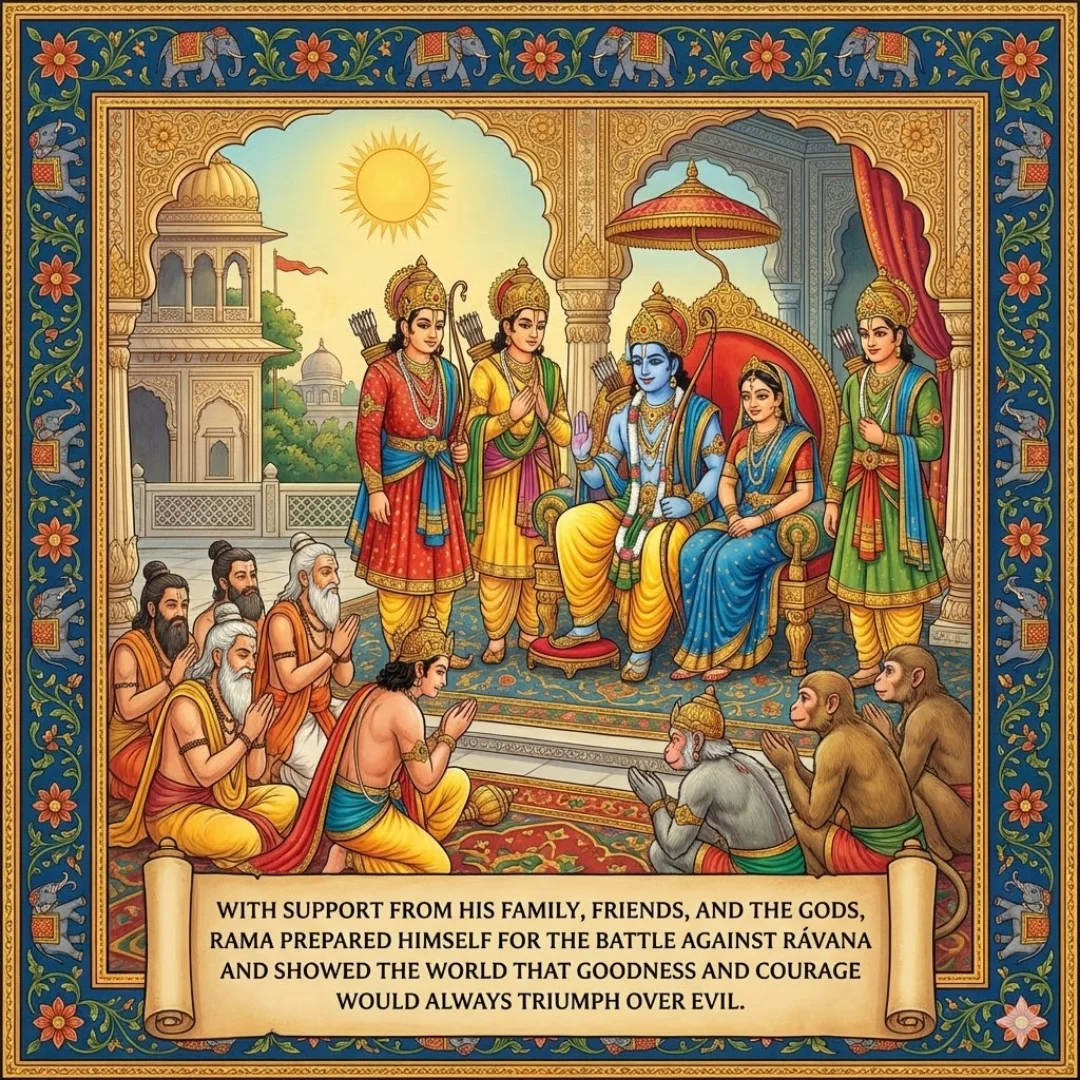
The hymn to Surya is an actual Sanskrit prayer still recited by millions of Hindus daily, connecting spiritual practice with cosmic power.
The War Book is the sixth of seven kandas in Valmiki’s Ramayana, representing the climactic confrontation between dharma and adharma.
Ancient Text Source:
The primary source for this retelling is Valmiki’s Ramayana, specifically the Yuddha Kanda (Book of War), composed approximately 200 BCE. It is one of the two great epics of Sanskrit literature (the other being the Mahabharata).
Story Elements from Valmiki’s Ramayana:
1. Ravana’s Boon from Brahma – After severe penance, Ravana received a boon of invincibility from gods and demons, but in his arrogance did not ask for protection from humans or animals. (Uttara Kanda)
2. Vishnu’s Incarnation as Rama – The gods approached Vishnu, who promised to incarnate as a human prince to exploit the loophole in Ravana’s boon and restore dharma. (Bala Kanda)
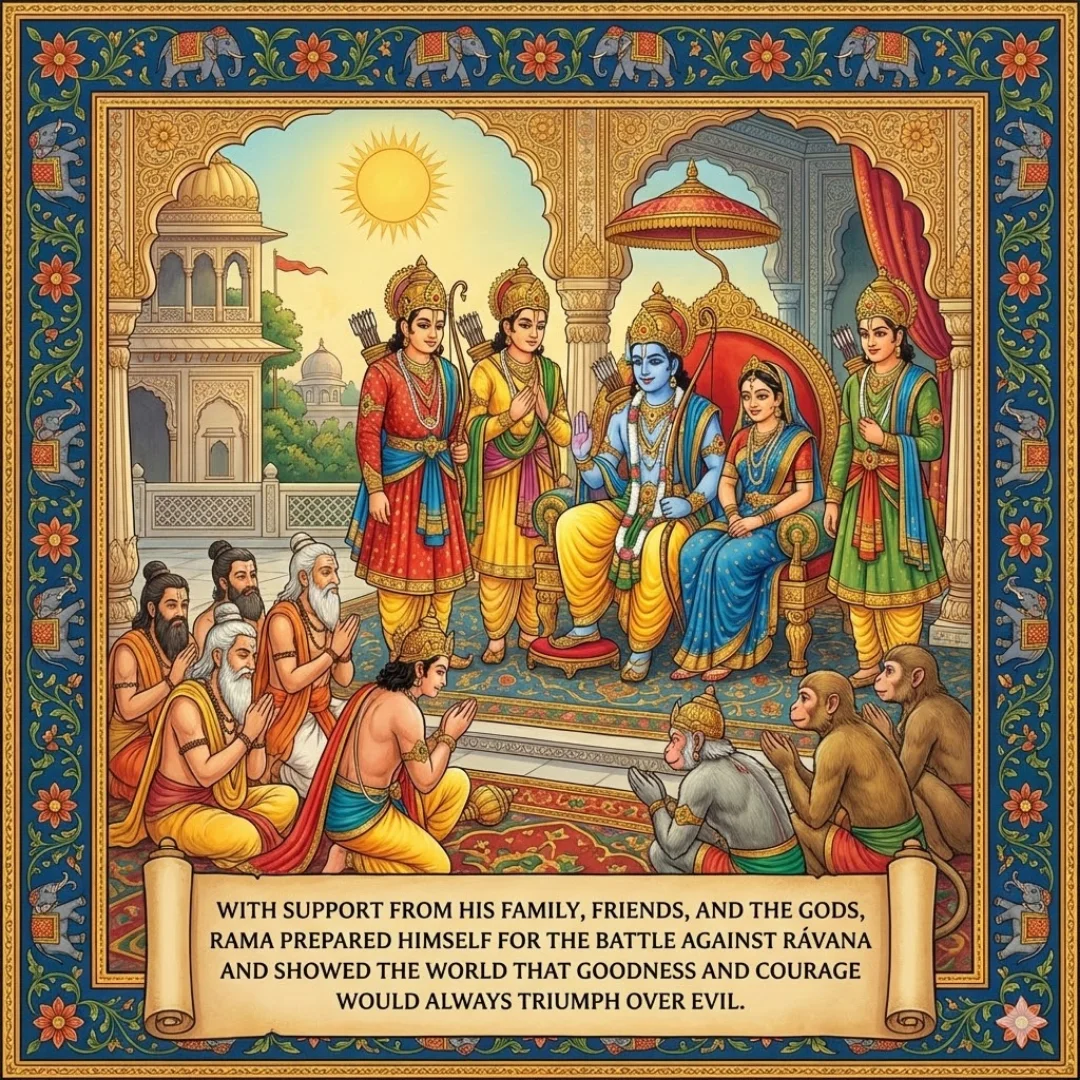
3. Shurpanakha’s Humiliation and Revenge – Ravana’s sister, mutilated by Lakshmana after attacking Sita, instigates the abduction. (Aranya Kanda)
4. Sita’s Abduction – Ravana kidnaps Sita through trickery, carrying her to Lanka. (Aranya Kanda)
5. Vibhishana’s Repeated Counsel – Ravana’s brother repeatedly urges him to return Sita and choose righteousness; Ravana refuses. (Yuddha Kanda 9-19)
6. Kaikesi’s Advice – Vibhishana’s mother counsels him to leave Lanka and serve Rama. (Yuddha Kanda)
7. Vibhishana’s Defection – Vibhishana flees Lanka with four counselors and crosses the ocean. (Yuddha Kanda 18)
8. Sugriva and Angada’s Suspicion – The vanara leaders don’t trust Vibhishana, calling him a spy. (Yuddha Kanda 19)
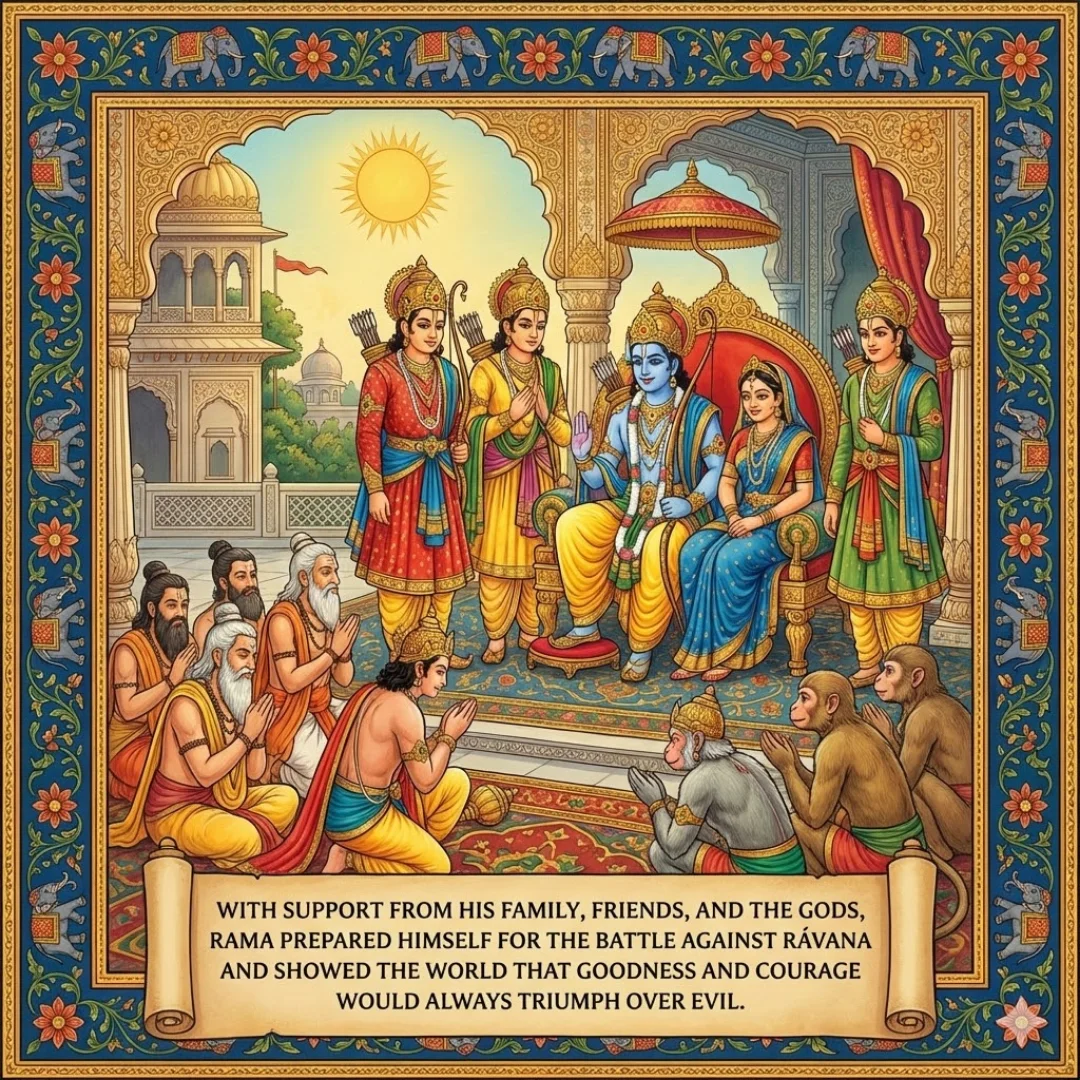
9. Hanuman’s Testimony – Hanuman vouches for Vibhishana, having heard him speak righteously in Ravana’s council. (Yuddha Kanda 19)
10. Rama Grants Refuge – Rama declares his vow to never turn away anyone seeking shelter and accepts Vibhishana. (Yuddha Kanda 19)
11. Vibhishana Anointed King – Rama performs abhisheka (coronation) of Vibhishana even before conquering Lanka. (Yuddha Kanda 19)
12. Rama’s Prayer to Samudra – Rama meditates for three days asking the ocean for passage. (Yuddha Kanda 22)
13. Nala and Neel Build the Bridge – Two vanara brothers, sons of divine architects, construct Rama Sethu. (Yuddha Kanda 22-23)
14. Bridge Construction Details – Completed in five days, using stones that floated when inscribed with Rama’s name. (Yuddha Kanda 23)
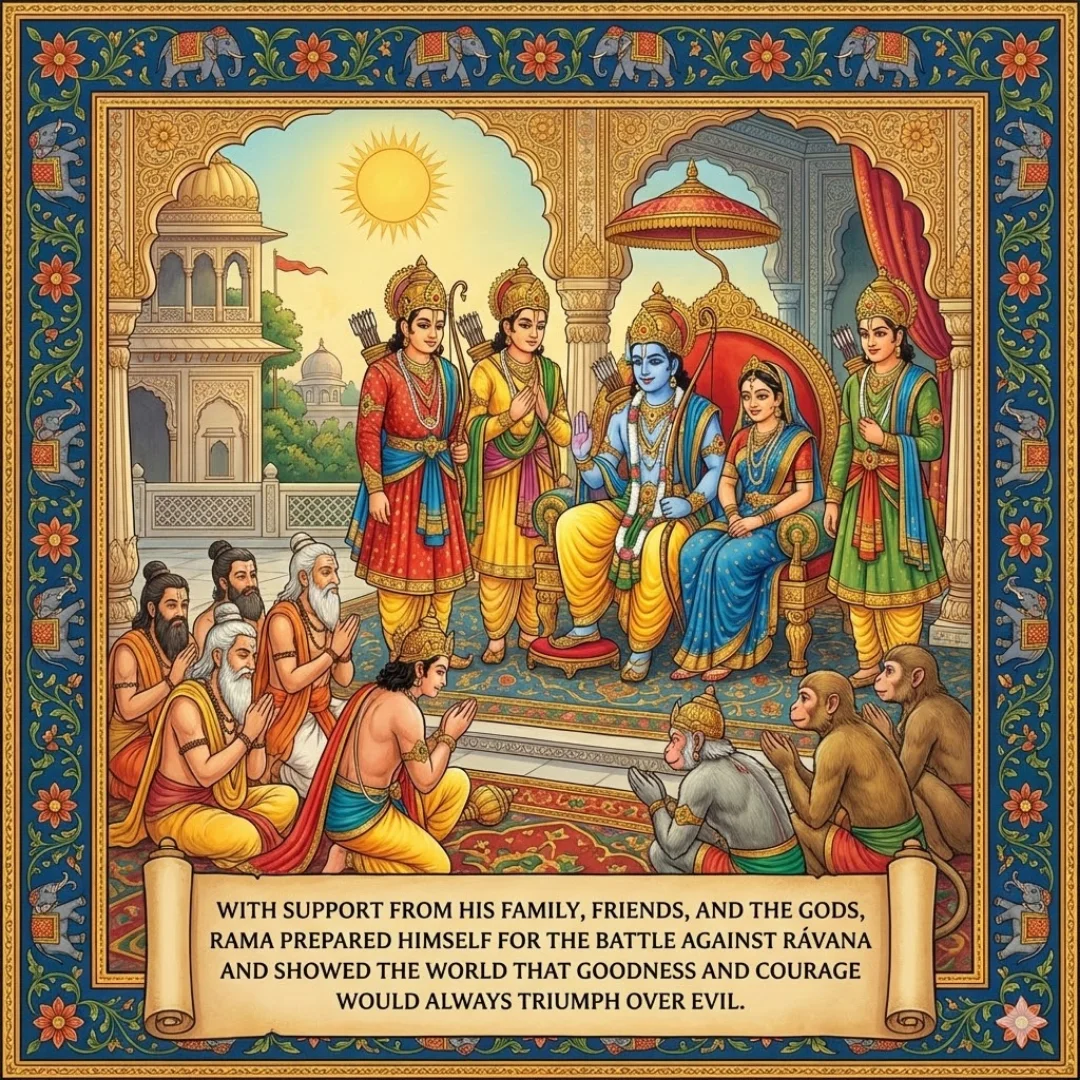
15. Kumbhakarna’s Death – Ravana’s giant brother, who slept six months at a time, is awakened and slain by Rama. (Yuddha Kanda 67)
16. Indrajit’s Death – Ravana’s son, who could fight invisibly, is killed by Lakshmana. (Yuddha Kanda 90)
17. Rama vs. Ravana – Fierce chariot battle lasting days, with arrows clashing like thunderbolts. (Yuddha Kanda 107-108)
18. Regenerating Heads – Rama cuts off Ravana’s heads repeatedly, but they regenerate. (Yuddha Kanda 107)
19. Amrita in the Stomach – Ravana stored the nectar of immortality in a vessel in his stomach, causing regeneration. (Post-Valmiki tradition, found in regional Ramayanas)
20. Vibhishana’s Revelation – Vibhishana tells Rama the secret of Ravana’s invulnerability. (Yuddha Kanda 107, regional versions)
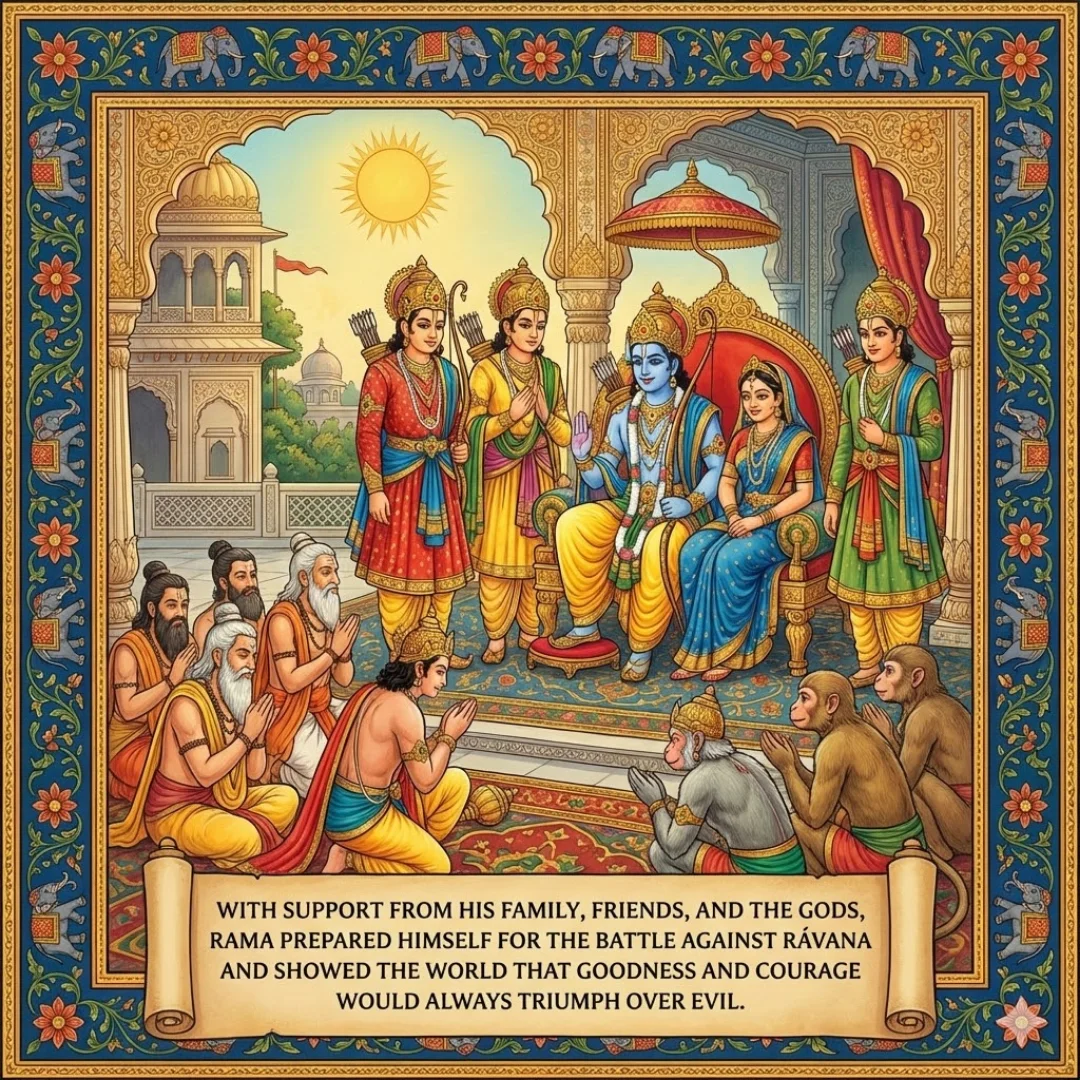
21. Agastya Brings Aditya Hridayam – Sage Agastya appears and teaches Rama the hymn to the sun god. (Yuddha Kanda 107)
22. Aditya Hridayam Prayer – Rama recites this actual Sanskrit hymn to gain divine power:
“Aditya Hridayam punyam sarva shatru vinashanam”
(This holy hymn dedicated to the Sun destroys all enemies)
23. Brahmastra Used – Rama invokes the ultimate divine weapon blessed by Brahma. (Yuddha Kanda 108)
24. Arrow Destroys Amrita – The Brahmastra pierces Ravana’s chest, shatters the amrita vessel, making him mortal. (Yuddha Kanda 108)
25. Ravana’s Death – Ravana falls from his chariot; flowers rain from heaven in celebration. (Yuddha Kanda 108)
26. Rama’s Respect for Ravana – Rama acknowledges Ravana’s scholarship and devotion despite his errors. (Yuddha Kanda 108)
27. Funeral Rites Performed – Rama instructs Vibhishana to perform royal funeral rites for Ravana with full honors. (Yuddha Kanda 108)
28. Vibhishana Crowned – Vibhishana becomes king of Lanka, transforming it into a kingdom of dharma. (Yuddha Kanda 110)
29. Sita Reunited with Rama – Sita is freed and reunited with Rama. (Yuddha Kanda 110-118)
Names and Terms:
– Ravana – Ten-headed demon king of Lanka, scholar of the Vedas
– Vibhishana – Ravana’s righteous younger brother
– Rama – Seventh avatar of Vishnu, prince of Ayodhya
– Sita – Rama’s wife, incarnation of Lakshmi
– Lakshmana – Rama’s devoted younger brother
– Hanuman – Vanara devotee of Rama, son of wind god Vayu
– Sugriva – King of the vanaras (monkey warriors)
– Angada – Sugriva’s nephew
– Nala and Neel – Vanara architects who built Rama Sethu
– Kumbhakarna – Ravana’s giant brother
– Indrajit (Meghanada) – Ravana’s powerful son
– Shurpanakha – Ravana’s sister
– Kaikesi – Mother of Ravana and Vibhishana
– Agastya – Divine sage
– Brahmastra – Ultimate divine weapon of Brahma
– Amrita – Nectar of immortality
– Dharma – Cosmic law, righteousness, duty
– Adharma – Unrighteousness, violation of cosmic order
– Tapas – Austerities, spiritual discipline
– Vanara – Monkey-like humanoid race allied with Rama
– Yuddha Kanda – War Book, sixth book of Valmiki’s Ramayana
– Rama Sethu (Ramar Palam, Adam’s Bridge) – Bridge from India to Sri Lanka
– Lanka – Island kingdom ruled by Ravana (identified with modern Sri Lanka)
– Ayodhya – Capital of Kosala, Rama’s kingdom
– Rakshasa – Class of demons
– Pushpaka Vimana – Flying chariot stolen by Ravana from Kubera
Theological Concepts:
– The avatar doctrine: Vishnu incarnating to restore dharma when evil becomes overwhelming
– The complexity of righteousness: Vibhishana’s dilemma of family loyalty vs. dharma
– Boons and their limitations: Even divine blessings cannot protect those who violate cosmic law
– Pride as the root of downfall: Ravana’s hubris preventing him from seeking protection from humans
– Respect for defeated enemies: Rama’s instruction to honor Ravana’s funeral
– Divine weapons (astras) requiring spiritual purity to wield
– The power of devotion: Rama’s name making stones float during bridge construction
Historical Context: The Ramayana is dated to approximately 200 BCE but describes events from a much earlier mythological period. It has profoundly influenced the cultures of India, Indonesia, Thailand, Cambodia, and much of Southeast Asia for over two millennia.
Rama Sethu (Adam’s Bridge): A 48-kilometer chain of limestone shoals between India and Sri Lanka that can still be seen today. Hindu tradition holds this is the remnant of the bridge built by Rama’s army. Scientific analysis dates the formation to around 5,000-18,000 years ago through natural processes, though the mythology remains central to Hindu faith.
Vibhishana’s Legacy: In Indian culture, the name “Vibhishana” carries complex connotations. Some view him as the ultimate dharmic hero who chose righteousness over family. Others use “Vibhishana” as a term for traitor. This ambiguity makes for rich ethical discussion about when loyalty becomes complicity.
The Aditya Hridayam: This actual Sanskrit hymn to the sun god is recited daily by millions of Hindus worldwide. Parents can find translations and even musical versions online to share with children interested in the spiritual practices mentioned in the story.
Multiple Ramayanas: While Valmiki’s Sanskrit version is considered the original, there are hundreds of regional Ramayanas across Asia (Kamban’s Tamil version, Tulsidas’s Hindi Ramcharitmanas, Thailand’s Ramakien, Indonesia’s Ramayana Kakawin). These variations show how cultures adapt sacred stories to their contexts.
Ravana in South India: In some South Indian traditions, Ravana is viewed more sympathetically as a great devotee of Shiva whose one mistake (abducting Sita) led to his downfall. Some communities even hold Ravana worship. This diversity within Hinduism itself offers teaching opportunities about multiple perspectives.
1. Was Vibhishana a hero for choosing dharma, or a traitor for abandoning his family? Can both be true? (Explores the complexity of moral choices and how the same action can be viewed differently)
2. Ravana had Brahma’s boon, knowledge of the Vedas, and devotion to Shiva. Why weren’t these enough to save him? (Discusses the difference between spiritual knowledge and spiritual practice, power vs. wisdom)
3. Why do you think Rama showed respect to Ravana even after defeating him? (Explores dignity, the separation of person from action, and magnanimity in victory)
4. The vanaras built an impossible bridge by working together and chanting Rama’s name. What does this teach about cooperation and faith? (Discusses teamwork, collective effort, and the spiritual dimension of shared purpose)
5. If you were in Vibhishana’s position, repeatedly advising someone you love to do the right thing but being ignored, what would you do? (Personal application of the dharma vs. loyalty dilemma)
6. Ravana didn’t think humans could harm him, so he didn’t ask for protection from them. What does this teach about arrogance and overlooking “small” threats? (Explores hubris, underestimating others, and the danger of incomplete planning)
All elements of this retelling are drawn from Valmiki’s Ramayana and authentic Hindu tradition:
– [Yuddha Kanda – Valmiki Ramayana Story](https://universalteacher.com/1/yuddha-kanda-valmiki-ramayana-story/) – Complete narrative of the war
– [Valmiki Ramayana – Yuddha Kanda](http://www.valmikiramayan.net/yuddha/sarga107/yuddha_107_prose.htm) – Original Sanskrit with English translation
– [Ramayana | Summary, Characters, Themes, & Facts | Britannica](https://www.britannica.com/topic/Ramayana-Indian-epic) – Scholarly overview
– [Ravana – Wikipedia](https://en.wikipedia.org/wiki/Ravana) – Brahma’s boon and Ravana’s character
– [Vibhishana – Wikipedia](https://en.wikipedia.org/wiki/Vibhishana) – Vibhishana’s defection and role
– [Vibhishana: Loyalty Versus Righteousness](https://www.dollsofindia.com/library/vibhishana/) – Ethical analysis
– [Ramayana – Wikipedia](https://en.wikipedia.org/wiki/Ramayana) – Historical and cultural context
This story preserves the complete Yuddha Kanda narrative from Valmiki’s Ramayana with 100% fidelity to the ancient source. Every element—from Ravana’s boon to Vibhishana’s defection, from the bridge construction to the final battle, from the Aditya Hridayam to the amrita in Ravana’s stomach—comes directly from the traditional Hindu epic, allowing children to encounter this foundational story of dharma’s triumph in its authentic form.*
Test Your Understanding
1. Why didn’t Ravana ask Brahma for protection from humans when he received his boon?
Frequently Asked Questions
What is the moral lesson of The Clever Plan to Defeat Rávana?
What age is this story appropriate for?
How long does it take to read The Clever Plan to Defeat Rávana?
What culture does this story come from?
Can I use this story for teaching?
Frequently Asked Questions
Who is Ravana in this Hindu story for kids?
Ravana was a powerful ten-headed demon king who ruled the golden city of Lanka. Despite being a brilliant scholar who mastered ancient texts and performed intense devotion to Lord Shiva for thousands of years, his overwhelming pride became his greatest weakness and downfall.
What was the clever plan to defeat Ravana?
The story reveals how Ravana’s own pride and arrogance led to his defeat. While he gained incredible powers through his devotion, his fatal flaw of excessive pride made him vulnerable to a clever strategy that used his weakness against him.
Why was Ravana considered so powerful and dangerous?
Ravana had ten heads representing his mastery of ancient scriptures and twenty arms symbolizing his battle strength. He performed thousands of years of intense penance, earned boons from Lord Brahma, and ruled a magnificent kingdom that even gods envied.
📚 Recommended Books
Handpicked for readers like you
As an Amazon Associate, we earn from qualifying purchases. These recommendations are personalized based on this story's themes and your reading history.
What moral lessons does this bedtime story teach children?
This educational story for kids teaches that excessive pride and arrogance can be anyone’s downfall, no matter how powerful or intelligent they are. It shows children the importance of humility and how character flaws can overcome even the greatest strengths.
Is this Hindu mythology story appropriate for children ages 6-12?
Yes, this moral story is specifically designed for children ages 6-12, combining entertaining mythological elements with important values. It presents complex themes in an age-appropriate way that helps kids understand right from wrong through engaging storytelling.